
August 6, 2026
Escalating Maritime Threats in Critical Shipping Lanes
Recent security incidents have highlighted the vulnerability of global maritime infrastructure to asymmetric warfare tactics. The drone attacks on Omani ports in March 2026 represent a significant escalation in regional conflict dynamics, demonstrating how neutral commercial facilities have become strategic targets. Furthermore, these developments underscore broader patterns where tariffs impact markets and geopolitical tensions reshape global trade flows.
The complex interplay between port security regulations, international shipping networks, and geopolitical tensions creates cascading risks that extend far beyond regional boundaries. Understanding these dynamics requires examining the legal frameworks, technological capabilities, and economic dependencies that shape modern maritime commerce. In addition, US‑China trade tensions continue to influence maritime security priorities across critical shipping lanes.
When big ASX news breaks, our subscribers know first
International Maritime Law and Port Security Obligations
Legal Framework Governing Port Protection Under ISPS Code
The International Ship and Port Facility Security (ISPS) Code represents the cornerstone of global maritime security regulation. Adopted by the International Maritime Organization following the September 11, 2001 attacks, this framework entered force on July 1, 2004, establishing mandatory security requirements for approximately 5,000 ports worldwide engaged in international commerce.
The ISPS Code operates through a three-tier security level system designed to scale protective measures based on threat assessments:
- Level 1: Baseline security protocols maintained during normal operations
- Level 2: Enhanced protective measures activated during elevated threat periods
- Level 3: Maximum security implementation for specific, immediate threats
Each port facility must designate a Port Facility Security Officer (PFSO) responsible for conducting security assessments, developing comprehensive security plans, and implementing access control measures. Under SOLAS Convention Regulation I/2 and Chapter XI-2, these officers coordinate with vessel security personnel and national authorities to maintain continuous monitoring capabilities.
However, the ISPS Code faces significant regulatory gaps in addressing modern aerial threats. Originally drafted in 2003, the framework lacks specific mandates for drone detection systems or counter-unmanned vehicle technologies. This represents a critical vulnerability as asymmetric warfare tactics increasingly target maritime infrastructure through airborne platforms.
Regional Security Architecture in the Arabian Peninsula
The Gulf Cooperation Council, established in 1981, provides the primary multilateral security framework for six member states: Saudi Arabia, UAE, Kuwait, Qatar, Bahrain, and Oman. The organisation's Unified Economic Agreement includes provisions for security cooperation, though maritime protection coordination has remained limited compared to other regional defence arrangements.
GCC Maritime Security Mechanisms
| Component | Function | Coverage |
|---|---|---|
| Ministerial Council | Policy coordination | All member states |
| Supreme Council | Strategic decisions | Heads of state |
| Bilateral channels | Intelligence sharing | Variable by nation |
| IORA coordination | Regional awareness | Indian Ocean Rim |
Oman maintains a distinctive position within this architecture through its traditional policy of strategic neutrality. This approach, evident during the Iran-Iraq War (1980-1988), enables diplomatic engagement with multiple parties whilst complicating collective defence arrangements. The nation's geographic position controlling access to the Strait of Hormuz amplifies the strategic significance of this neutrality stance.
Cross-border intelligence sharing operates through formal mechanisms including ministerial councils, bilateral hotlines, and military coordination channels. The International Maritime Organization's Indian Ocean Rim Association provides additional regional maritime awareness initiatives, though effectiveness varies significantly by geopolitical period and national priorities.
Economic Impact Assessment on Global Supply Chains
Critical Infrastructure Vulnerability Analysis
Omani ports serve as crucial nodes connecting Asian manufacturing centres with European and American markets. The strategic positioning of these facilities within established shipping routes creates single-point-of-failure risks for multiple supply chains simultaneously. Consequently, the drone attacks on Omani ports have demonstrated how regional conflicts can disrupt global commerce networks.
Omani Port Capacity and Strategic Importance
| Port | Annual Capacity | Primary Commodities | Regional Significance |
|---|---|---|---|
| Salalah | 5.9M TEU | Transshipment, Oil | Maersk regional hub |
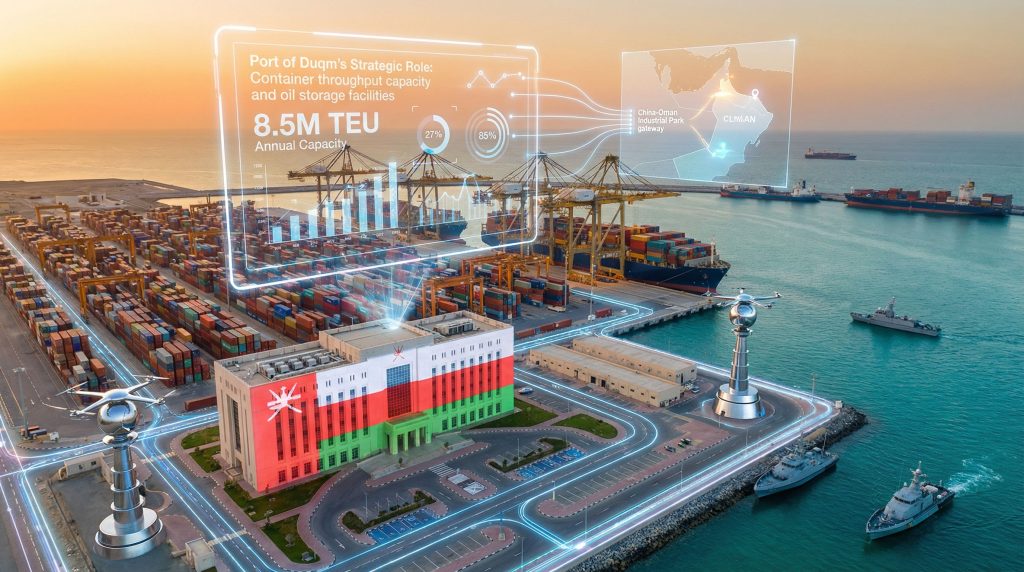
| Duqm | 8.5M TEU | Oil, Gas, Containers | China-Oman Industrial Park gateway |
| Sohar | 5.4M TEU | Industrial cargo | Aluminium, steel exports |
The targeting of fuel storage infrastructure at Duqm demonstrates the vulnerability of integrated port-industrial complexes. Storage facilities struck by drone attacks contained petroleum products destined for regional distribution networks, creating ripple effects throughout downstream supply chains. Similar patterns emerged across the broader Gulf region during the March 2026 escalation.
Insurance Market Responses and Risk Premium Adjustments
War risk coverage cancellations by shipping insurers created immediate disruptions to commercial maritime operations. Major underwriters suspended coverage for vessels transiting the Strait of Hormuz, with some extending restrictions to the entire Gulf of Oman region. These decisions reflected fundamental reassessments of acceptable risk levels in maritime insurance models.
The economic implications became apparent through crude oil pricing mechanisms. UAE Murban crude, typically priced at modest premiums to benchmark Dubai assessments, experienced dramatic value escalation due to delivery uncertainty. May-loading Murban reached $6.70 per barrel premium to Dubai, with delivered values exceeding $18 per barrel premium when including freight rate adjustments.
Alternative Supply Chain Routing Scenarios
Insurance restrictions forced refiners to evaluate substitute crude sources and alternative transportation routes. Japanese refiners, traditionally relying on Middle Eastern supplies, purchased US WTI crude at approximately 45% discount to Murban on a delivered basis. This shift demonstrated the flexibility of global oil markets whilst highlighting the premium costs associated with supply chain disruption.
Freight rate escalation compounded these challenges. Rates for US-loading Very Large Crude Carriers tracked toward six-year highs as demand increased for alternative routing options. The cost differential between regional and intercontinental supply chains created economic incentives for strategic petroleum reserve utilisation and refinery run cuts. Moreover, trade war and oil prices interactions continue to influence these market dynamics.
Geopolitical Risk Assessment Framework
Iran's Asymmetric Warfare Strategy Analysis
The coordinated targeting of neutral port infrastructure represents an evolution in asymmetric conflict tactics. Unlike previous incidents focused on military or energy production facilities, the March 2026 attacks demonstrated deliberate expansion to commercial logistics networks. This approach maximises economic disruption whilst avoiding direct military confrontation with superior conventional forces.
Historical precedents provide context for understanding escalation patterns. The 2019 Saudi Aramco attacks at Abqaiq and Khurais facilities disrupted approximately 50% of Saudi crude production (4.9 million barrels per day), causing 15-20% oil price spikes. The 2021 Mercer Street incident in the Arabian Sea, which killed two crew members, established precedent for targeting commercial vessels with drone technology.
The proliferation of drone capabilities throughout regional proxy networks enables sustained asymmetric operations. Advanced unmanned systems capable of precision strikes against infrastructure targets reduce the operational complexity and political costs associated with conventional military responses. For instance, the drone attacks on Omani ports exemplify this tactical evolution.
Regional Power Balance Implications
Oman's traditional neutrality faces unprecedented pressure as infrastructure attacks directly challenge the viability of this strategic position. The targeting of ports serving China's Belt and Road Initiative investments creates additional diplomatic complexities, potentially drawing Beijing into regional security calculations.
UAE and Saudi defensive posture adjustments reflect recognition of expanded threat vectors. Enhanced air defence deployments around critical infrastructure facilities indicate strategic adaptation to aerial attack capabilities. However, the geographic dispersion of port facilities complicates comprehensive protection efforts.
US Fifth Fleet operational responses demonstrate the challenges of protecting commercial infrastructure through military means. Naval convoy escort capabilities remain limited relative to the volume of commercial traffic, creating selectivity pressures in protection resource allocation. Additionally, OPEC production impact considerations influence regional security priorities.
Enhanced Maritime Security Technology Requirements
Modern Detection and Countermeasure Systems
Modern port security frameworks require integration of multiple detection and countermeasure systems to address evolving threat vectors. Mandatory drone detection capabilities must complement existing perimeter security and access control measures. AI-powered threat assessment platforms enable rapid classification of aerial contacts and automated response protocols.
"Implementation of multilateral maritime security zones with shared early warning systems could reduce individual port vulnerability whilst maintaining commercial flow efficiency," according to maritime security experts.
Cybersecurity protocols for port operational technology represent another critical vulnerability. Integrated port management systems controlling crane operations, cargo handling, and vessel scheduling create potential targets for cyber-physical attacks. International standards for critical infrastructure hardening must address both kinetic and digital threat vectors.
Technology Integration Requirements
- Autonomous vessel security systems for threat detection and evasion
- Satellite-based maritime domain awareness networks providing real-time monitoring
- Blockchain-secured shipping documentation systems preventing tampering
- Predictive analytics platforms for threat pattern recognition and early warning
Communication and Coordination Systems
Enhanced crew training programmes must address drone threat recognition and emergency response procedures. Modified routing protocols through high-risk maritime zones require coordination with naval forces and port authorities. Communication systems enabling rapid threat information sharing between commercial vessels and security providers become essential operational requirements.
Emergency response procedures for infrastructure attacks must account for potential multi-vector threats. Coordinated strikes against multiple facilities within short time periods require flexible contingency planning and rapid resource reallocation capabilities. Furthermore, commodities market volatility necessitates enhanced risk management frameworks.
Commercial Shipping Risk Management Adaptations
Financial Risk Mitigation Strategies
Diversified port utilisation agreements across multiple regions reduce single-point-of-failure risks for shipping companies and cargo owners. Force majeure clause updates in shipping contracts must address security-related delays and route diversions. Strategic inventory positioning enables supply chain continuity despite regional disruptions.
Alternative fuel sourcing agreements outside conflict zones provide backup supply options for vessel operations. Long-term contracting arrangements with suppliers in stable regions create operational flexibility during crisis periods. However, the drone attacks on Omani ports highlight the need for enhanced contingency planning.
Insurance companies now require enhanced due diligence for vessels transiting high-risk areas. Risk assessment protocols must incorporate real-time intelligence feeds and dynamic threat evaluation systems. Premium structures increasingly reflect regional security conditions and operational risk profiles.
Operational Protocol Updates
Shipping companies have implemented modified bridge procedures for threat recognition and evasion tactics. Enhanced situational awareness training programmes address both conventional and asymmetric threat scenarios. Communication protocols with naval forces require standardised procedures and emergency response capabilities.
Route planning algorithms now incorporate security risk factors alongside traditional cost and efficiency metrics. Vessel tracking systems provide enhanced monitoring capabilities for operators and security agencies. Crew welfare programmes address psychological impacts of operating in high-threat environments.
The next major ASX story will hit our subscribers first
International Regulatory Evolution Requirements
SOLAS Convention Updates
Updates to the SOLAS Convention must address modern threat vectors including unmanned aerial vehicles and cyber-physical attacks. Enhanced port state control inspection protocols should verify compliance with updated security technologies and procedures. Standardised incident reporting mechanisms enable rapid information sharing across international networks.
Maritime cyber-physical security standards development requires collaboration between technology providers, port operators, and regulatory authorities. Integration of cybersecurity requirements with physical security measures creates comprehensive protection frameworks for critical infrastructure.
The International Maritime Organization faces pressure to accelerate regulatory development cycles to address rapidly evolving threats. Traditional consensus-building processes may require streamlining to enable timely responses to emerging security challenges.
Regional Cooperation Frameworks
Enhanced intelligence sharing protocols between naval forces, commercial operators, and port authorities enable coordinated response capabilities. Multilateral exercises and training programmes build operational coordination for crisis response. Regional maritime domain awareness initiatives provide comprehensive monitoring coverage.
The establishment of neutral zone protections for critical commercial infrastructure requires diplomatic negotiations and enforcement mechanisms. International guarantees for port facility security could encourage investment in vulnerable regions whilst maintaining operational neutrality.
What Are the Long-term Implications for Maritime Security?
The targeting of neutral port infrastructure demonstrates the evolution of asymmetric threats beyond traditional military targets to encompass the economic foundations of global commerce. Effective response strategies require coordinated development across multiple policy domains rather than reactive individual measures. At several Omani ports, infrastructure damage has highlighted these vulnerabilities.
Enhanced physical security measures must integrate with strengthened international legal frameworks governing maritime protection. Improved intelligence sharing mechanisms enable proactive threat assessment and coordinated response capabilities. Adaptive commercial risk management strategies provide operational flexibility during crisis periods.
Building Resilient Global Networks
Long-term maritime security depends fundamentally on proactive multilateral cooperation frameworks. The protection of neutral states serving as critical nodes in global supply chains requires collective security arrangements that transcend traditional military alliance structures. Economic interdependence creates shared interests in maintaining stable maritime commerce that can bridge geopolitical divisions.
The challenge lies in developing security architectures that provide effective protection without imposing prohibitive costs on commercial operations. Balance between security requirements and operational efficiency determines the viability of global supply chain networks in an era of increasing asymmetric threats.
Investment in resilient infrastructure design becomes essential for future port development projects. Distributed systems architecture reduces single-point-of-failure risks whilst maintaining operational efficiency. Redundant communication networks ensure continuity during security incidents or infrastructure damage.
This analysis is based on hypothetical scenarios and established maritime security frameworks. Readers should consult current intelligence assessments and regulatory guidance for operational decision-making. Market conditions and security situations remain subject to rapid change.
Are You Tracking Maritime Security Investment Opportunities?
Discovery Alert's proprietary Discovery IQ model delivers real-time alerts on significant ASX mineral discoveries, including strategic resources impacted by maritime security developments and supply chain disruptions. Begin your 14-day free trial today at Discovery Alert to position yourself ahead of market movements driven by geopolitical shifts and infrastructure vulnerabilities.