June 17, 2026
The Resource Paradox at the Heart of South Africa's Industrial Decline
Few contradictions in global commodity markets are as striking as South Africa's position in the chrome industry. The country sits atop an estimated 80% of the world's economically viable chrome ore reserves, the foundational raw material for stainless steel production worldwide. Yet despite this extraordinary geological endowment, South Africa processes only a fraction of what it mines into finished ferrochrome. The value addition, the employment, and the export revenue that should logically flow from this resource dominance have, over the past two decades, migrated almost entirely to China.
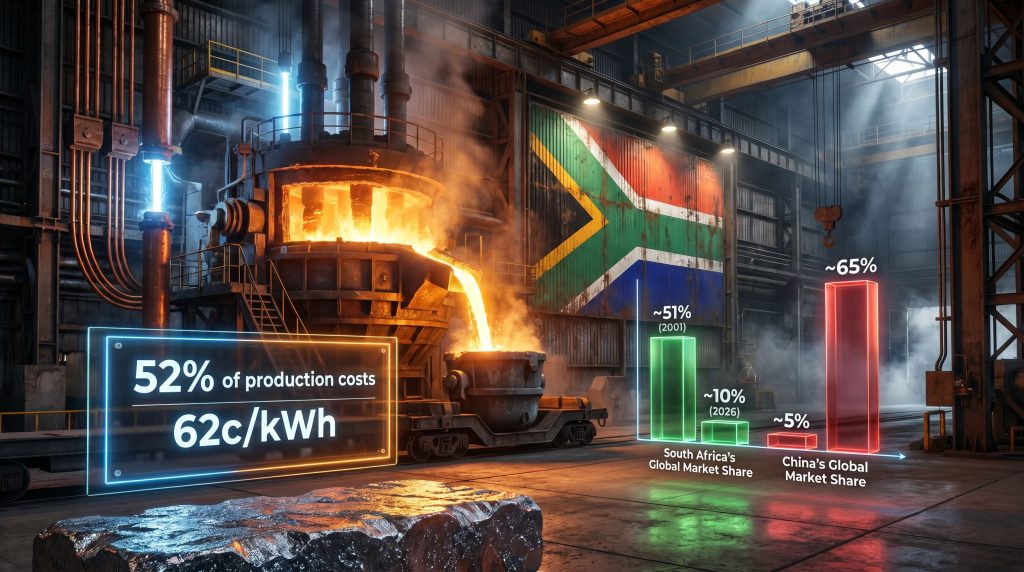
This is not a story about depleted orebodies, logistical failure, or a lack of technical expertise. It is, at its core, a story about electricity pricing. And right now, a single proposed tariff rate — the Eskom ferrochrome smelter tariff 62c/kWh — is determining whether South Africa's remaining ferrochrome smelting capacity survives or follows its predecessors into permanent closure.
When big ASX news breaks, our subscribers know first
The Collapse in Numbers: How South Africa Lost Its Ferrochrome Dominance
The scale of the market share erosion that has taken place over the past 25 years is difficult to overstate. In 2001, South Africa accounted for roughly 51% of global ferrochrome output. Today, that figure has contracted to approximately 10%. Over the same period, China's share expanded from around 5% to 65% of global production, despite China possessing negligible domestic chrome ore reserves of its own.
The mechanism driving this transfer is straightforward: Chinese smelters import chrome ore from South Africa and process it domestically using electricity priced far more favourably for industrial users than anything available to South African producers. The finished ferrochrome is then sold into global stainless steel supply chains at a cost structure South African smelters simply cannot match at prevailing Eskom tariff rates. Furthermore, ferroalloys in South Africa have long been considered critical to the country's industrial identity, making this decline all the more consequential.
The following table illustrates how dramatically the competitive landscape has shifted:
| Metric | 2001 | 2026 |
|---|---|---|
| South Africa global ferrochrome share | ~51% | ~10% |
| China global ferrochrome share | ~5% | ~65% |
| Active domestic smelters | 66 (nameplate) | 11 |
| Annual nameplate capacity | 4.9 million tonnes | Producing under 1 million tonnes |
A critical and often underappreciated detail within these figures is that much of the capacity shut down over this period is now considered permanently unrecoverable. Submerged arc furnaces that have been idle for extended periods cannot simply be restarted. Infrastructure deteriorates, skilled workforces disperse, and the capital required to recommission mothballed smelters frequently exceeds the economics of doing so.
Consequently, the industry's realistic production ceiling has been permanently compressed, even if tariff conditions were to improve dramatically overnight. Compounding this structural damage, Eskom's tariffs to ferrochrome smelters have increased by more than 500% since 2010. The standard industrial tariff currently exceeds 200 cents per kilowatt-hour, a rate at which South African smelter operations are commercially unviable.
The original negotiated pricing agreements held by Samancor Chrome and the Glencore-Merafe Chrome Venture were already significantly discounted at 136c/kWh, yet even this preferential rate proved insufficient to maintain competitiveness as ferrochrome prices softened and operational pressures intensified. Indeed, South Africa's mining decline has accelerated across multiple commodity sectors under similar pressures.
Why Electricity Is Unlike Any Other Production Input
Understanding why the Eskom ferrochrome smelter tariff 62c/kWh debate matters so profoundly requires appreciating a technical reality specific to the smelting process. Electricity is not simply one cost among many in ferrochrome production. It constitutes approximately 52% of total production costs, making it the single largest operational variable by a wide margin.
Unlike labour costs, which can be partially managed through productivity improvements, or raw material costs, which track underlying commodity markets, electricity pricing in South Africa is a policy-controlled variable. This means the government and its regulatory architecture have both caused the problem and hold the primary lever to address it. The 62c/kWh proposal is, in essence, an attempt to use that lever before the remaining operating capacity crosses the threshold of no return.
Ferrochrome is produced by smelting chromite ore with a reductant, typically coke or coal, in submerged arc furnaces operating at extremely high temperatures. These furnaces run continuously and consume enormous quantities of electricity. There is no energy-efficient alternative process commercially available at scale.
This technological constraint means that ferrochrome producers cannot simply invest their way out of a high electricity price environment the way a manufacturer might through automation or process redesign. The fundamental physics of smelting sets a floor on energy consumption. Moreover, commodity prices and mining performance are inextricably linked, and when input costs spiral, entire value chains become uncompetitive.
The Eskom 62c/kWh Tariff: Structure, Terms, and Revenue Protection
The proposed revised negotiated pricing agreement represents a further step down from the 87.74c/kWh interim hardship tariff that Nersa approved in January 2026 after Samancor Chrome and the Glencore-Merafe Chrome Venture invoked distress provisions within their existing contracts. That interim arrangement was itself already a concession from the 136c/kWh rate embedded in their original NPAs.
The proposed 62c/kWh structure differs importantly from a conventional tariff reduction. It is a commercially engineered agreement containing multiple mechanisms designed to protect Eskom's financial position:
- Samancor Chrome would enter a five-year agreement with a minimum three-year, 80% take-or-pay commitment, ensuring Eskom receives guaranteed revenue regardless of production volumes.
- Glencore-Merafe Chrome Venture would operate under a three-year agreement with a minimum two-year, 80% take-or-pay arrangement on equivalent terms.
- A deferred revenue mechanism applies during the early stages of both agreements, providing cash flow protection for Eskom during the ramp-up period.
- A 50/50 upside-sharing arrangement activates above a defined ferrochrome price threshold, allowing Eskom to participate in commodity price recovery if market conditions improve.
- Economic hardship relief provisions are only accessible after the minimum commitment period has been fulfilled, preventing premature invocation of concessionary terms.
These are not open-ended subsidies. The contracts contain embedded performance obligations, revenue floors, and profit-sharing triggers that structurally differentiate them from conventional tariff concessions. Eskom has also confirmed it will not make a profit from supplying electricity at 62c/kWh, but has argued that the alternative is financially far worse.
Eskom's own framing of the arrangement is instructive. Rather than characterising the deal as a discount extended to struggling industrial customers, the utility has positioned it as a load-retention intervention driven by its own financial calculus. According to BusinessTech, losing 12.8 TWh of annual baseload demand from the smelters would leave Eskom with stranded generation capacity, under-utilised coal infrastructure, and significant upward pressure on tariffs for all remaining customers.
The utility has quantified the downside risk from its take-or-pay coal contracts alone at R56 billion, while the contracted revenue it stands to protect over the NPA period amounts to R42.5 billion. Eskom has committed that any revenue shortfall arising from the discounted tariff will be ring-fenced and will not be recovered through the Multiyear Price Determination process. In practical terms, this means other customer categories, including households and commercial users, will not subsidise the arrangement through their own tariff increases.
The Economic Stakes: GDP, Employment, and Regional Dependency
The ferrochrome sector's contribution to the South African economy extends well beyond the production gates of individual smelters. The industry contributed R70 billion to South Africa's GDP in both 2023 and 2024 and supports up to 185,000 direct and indirect jobs across the full value chain, from chrome mining through smelting to logistics and ancillary services.
What makes the employment dimension particularly acute is the geographic concentration of that dependency. Ferrochrome smelters are the primary employers in multiple towns across Limpopo and the North-West provinces. The closure of a smelter in this context does not simply eliminate factory-floor jobs; it removes the economic foundation of entire communities, with cascading effects including reduced municipal revenue, declining local business activity, and population displacement.
The following scenario analysis illustrates the projected impact of NPA rejection:
| Outcome Category | Projected Impact |
|---|---|
| Active smelters | Likely reduction below current 11 |
| Annual production | Further decline below 1 million tonnes |
| Direct and indirect jobs at risk | Tens of thousands |
| Eskom contracted revenue loss | R42.5 billion over NPA period |
| Coal take-or-pay exposure | Up to R56 billion |
| Chrome ore export trajectory | Accelerated raw ore exports to China |
The last point in this table carries a strategic dimension that deserves emphasis. If domestic smelting capacity collapses further, South Africa transitions from a ferrochrome exporter to a raw chrome ore exporter, ceding all beneficiation value to offshore processors. This directly undermines the country's long-standing policy objective of retaining mineral processing domestically to maximise employment and export earnings per tonne of ore extracted.
Nersa's Regulatory Role and the Transparency Controversy
The National Energy Regulator of South Africa holds statutory authority over negotiated pricing agreements between Eskom and large industrial electricity users. Public hearings on the proposed 62c/kWh NPA were convened on 25 May 2026, with Nersa committing to finalise its determination before the end of May.
However, the hearing process generated significant procedural controversy that could have lasting consequences for the outcome's legal durability. Independent economic analysts raised concerns that Nersa's consultation paper identified the nature of the proposed arrangement without disclosing the underlying factual basis required for meaningful public engagement. Specifically, the following information was reportedly absent from the public record:
- The methodology used to derive the 62c/kWh price point.
- Eskom's actual cost of supplying electricity to these specific facilities.
- The precise financial impact on other customer categories and government fiscal exposure.
- Quantified employment modelling covering both approval and rejection scenarios.
- Analysis of whether equivalent concessions offered to other energy-intensive industries would produce comparable socioeconomic outcomes.
The critical concern raised at the hearings was that without this information, neither the public nor potentially Nersa itself could conduct a genuinely rational assessment of whether the proposed tariff represents the optimal policy outcome for South Africa.
The remedy proposed by analysts is procedurally straightforward: publish minimally redacted copies of the full NPA applications and draft agreements, retaining only genuinely commercially sensitive data, and allow a substantive second public comment period. Without this, the eventual Nersa determination carries meaningful exposure to judicial review, which would introduce further delays and commercial uncertainty at exactly the moment when the industry's remaining smelters are operating under maximum financial strain.
The transparency debate is not simply procedural. It goes to the heart of whether the 62c/kWh rate is, as advocates claim, the highest price the smelters can sustainably bear and the best available socioeconomic solution for the country. Without independently verifiable evidence placed before the public, that claim, however plausible, remains unsubstantiated within the formal regulatory record. Moneyweb has reported in detail on how crippled smelter operators have pursued this tariff lifeline through prolonged negotiations.
The next major ASX story will hit our subscribers first
The Strategic Picture: Chrome Reserves, Chinese Processing, and Supply Chain Risk
Viewed through a global supply chain lens, South Africa's ferrochrome decline represents a concentration risk of significant proportions for international stainless steel manufacturers. The stainless steel market depends on ferrochrome as its primary hardening agent, and approximately 65% of that ferrochrome now originates from a single country — China — which holds minimal domestic chrome ore and is itself entirely dependent on South African ore imports for a substantial portion of its feedstock.
This creates a layered dependency: global stainless steel producers rely on Chinese ferrochrome, and China's steel market in turn relies on South African chrome ore. South Africa's ability to re-emerge as a direct ferrochrome supplier would offer international buyers a meaningful supply chain diversification option, particularly relevant as procurement strategies evolve in response to geopolitical concentration risks identified across multiple critical mineral categories in recent years.
The NPA framework, if approved and successfully implemented, has been positioned by the producers themselves as a potential proof-of-concept for energy-intensive beneficiation policy more broadly. A successful outcome would demonstrate that structured electricity pricing agreements can preserve domestic processing capacity in a commodity sector where raw ore export is the path of least resistance but also the path of least economic value.
Is 62c/kWh Enough? The Limits of Tariff Relief Alone
It is important to be clear-eyed about what the Eskom ferrochrome smelter tariff 62c/kWh can and cannot achieve. The following comparison contextualises the proposed rate within the broader competitive landscape:
| Producer Region | Approximate Industrial Power Cost | Ferrochrome Cost Share |
|---|---|---|
| South Africa (proposed NPA) | 62c/kWh | ~52% of production cost |
| South Africa (standard Eskom tariff) | Over 200c/kWh | Exceeds viability threshold |
| China (approximate industrial average) | Significantly lower | Enables cost-competitive output |
Note: Chinese industrial electricity pricing varies significantly by province and policy regime. Direct comparison requires contextual adjustment and the gap with South African rates, even at 62c/kWh, remains material.
The producers themselves have been explicit on this point, describing the tariff as a platform for pursuing additional technology and policy interventions rather than a self-contained solution. The structural competitiveness gap with Chinese producers, who benefit from lower power costs, scale advantages, and integrated supply chains, cannot be closed by tariff relief alone. Complementary measures under discussion include upgrading smelter energy efficiency, chrome ore beneficiation mandates to limit raw ore exports, and trade policy measures addressing competitive distortions arising from Chinese industrial subsidies.
The historical peak of 51% global market share is almost certainly not recoverable within any realistic policy timeframe, particularly given the permanent loss of smelter capacity that has occurred over the past decade and a half. However, a more realistic objective is stabilising the remaining 11 active smelters, preserving the employment and GDP contribution they represent, and creating a foundation from which incremental capacity additions might eventually be justified if commodity prices and competitive conditions permit.
Frequently Asked Questions: Eskom Ferrochrome Tariff 62c/kWh
What is the Eskom 62c/kWh ferrochrome tariff?
The 62c/kWh tariff is a proposed negotiated electricity pricing agreement between Eskom and two major South African ferrochrome producers, Samancor Chrome and the Glencore-Merafe Chrome Venture. It represents a heavily discounted rate relative to Eskom's standard industrial tariff of more than 200c/kWh, structured to keep energy-intensive smelting operations commercially viable while incorporating revenue protections for Eskom.
Why is 62c/kWh the specific threshold proposed?
Eskom has indicated that 62c/kWh is the rate at which the NPA arrangement becomes commercially rational for both parties. Below the standard tariff, Eskom does not make a profit on these sales but avoids far larger financial consequences including stranded coal contract obligations and irrecoverable revenue losses from losing 12.8 TWh of baseload demand annually.
Will other Eskom customers pay more as a result of this deal?
Eskom has committed that the revenue shortfall from the discounted tariff will be ring-fenced and will not be cross-subsidised through the Multiyear Price Determination process. The utility argues the arrangement avoids larger systemic costs that would otherwise create broader tariff pressure across all customer categories.
What is Nersa's role in approving the ferrochrome NPA?
Nersa, as South Africa's electricity regulator, must formally approve any negotiated pricing agreement between Eskom and large industrial users. The regulator conducted public hearings on 25 May 2026 and committed to finalising its determination before the end of May 2026.
What happens to South African ferrochrome jobs if the tariff is rejected?
The ferrochrome sector directly and indirectly supports up to 185,000 jobs. Smelters are dominant employers in several towns across Limpopo and the North-West. Rejection of the NPA would likely accelerate closures among the 11 currently operating smelters, with cascading effects on regional economies and upstream chrome mining.
Can the Nersa decision be legally challenged?
Procedural transparency concerns raised at the public hearings suggest that insufficient information was placed in the public domain to allow meaningful stakeholder participation. If these deficiencies are not addressed, the eventual Nersa determination could be exposed to judicial review, potentially delaying implementation at a commercially critical moment for the industry.
Disclaimer: This article contains forward-looking statements, projections, and scenario analyses based on publicly available information and regulatory submissions. These do not constitute financial or investment advice. Readers should conduct independent research before making any investment or business decisions related to the South African ferrochrome sector or Eskom's regulatory environment.
Want To Stay Ahead of Major Mineral Discoveries Before the Broader Market Does?
Discovery Alert's proprietary Discovery IQ model delivers real-time alerts on significant ASX mineral discoveries, transforming complex commodity data into actionable investment insights for both short-term traders and long-term investors. Explore Discovery Alert's dedicated discoveries page to understand how historic mineral discoveries have generated substantial returns, and begin your 14-day free trial today to secure a market-leading advantage.