July 23, 2026
South Africa's Electricity Cost Crisis: Why Industrial Pricing Reform Is Now an Existential Mining Question
The economics of smelting have never been forgiving. High-intensity industrial processes that consume electricity around the clock leave operators with almost no flexibility when input costs inflate faster than the prices they receive for their output. For decades, South Africa's energy-intensive mining and minerals-processing sector absorbed escalating electricity tariffs through operational efficiencies, workforce adjustments, and balance-sheet endurance. By the mid-2020s, that absorptive capacity had reached its structural limit — and the case for formal regulatory intervention became impossible to ignore.
The Eskom mining tariff relief policy that has emerged from this pressure is not a simple discount programme. It is a carefully architected regulatory instrument built on eligibility thresholds, fiscal safeguards, and approval pathways that reflect how difficult it is to reconcile the competing demands of a financially stressed utility, energy-dependent industries, and millions of low-income electricity consumers — all within a single national pricing framework.
When big ASX news breaks, our subscribers know first
The Structural Economics Behind the Crisis
South Africa's electricity tariff trajectory over the past two decades represents one of the most sustained administered price escalations in the country's industrial history. Eskom's average tariff increases have consistently outpaced consumer price inflation, compressing the margins of industries where electricity is not merely an input cost but a primary determinant of global cost competitiveness.
For a ferrochrome or PGM smelter, electricity is not a variable that management can negotiate away or substitute. It is baked into the metallurgical process. Submerged arc furnaces, electric arc furnaces, and base metal refineries require continuous, large-volume power supply to maintain operating temperatures. When the cost of that power rises past a threshold relative to the market price of the metal being produced, the operation becomes structurally loss-making regardless of how lean the rest of the business is run.
This is the core dynamic that no amount of labour rationalisation or logistics optimisation can fully address. The following table illustrates how different cost pressures have affected sector competitiveness:
| Cost Category | Trend Direction | Competitiveness Impact |
|---|---|---|
| Electricity tariffs | Sharply upward, above CPI | High — existential for smelters |
| Labour compensation | Upward, above CPI | High — largest cost line |
| Administrative prices | Upward | Moderate to high |
| PGM and chrome commodity prices | Volatile, cyclically depressed | High — limits cost absorption capacity |
"When multiple input cost categories simultaneously escalate above inflation while output prices remain suppressed by global commodity cycles, operational efficiency gains alone cannot close the gap. Structural pricing reform becomes the only viable intervention."
Valterra Platinum's chairman Norman Mbazima captured the systemic nature of this problem in the company's 2025 annual report, observing that the absence of meaningful structural reform continues to weigh on the South African mining industry, with persistent cost pressures eroding the country's competitive edge as mining input costs — particularly electricity — have consistently outpaced consumer inflation (Valterra Platinum, 2025 Annual Report). Furthermore, the broader South Africa mining decline has compounded these pressures, leaving producers with diminishing capacity to absorb continued cost escalation.
What the Eskom Mining Tariff Relief Policy Actually Is
Negotiated Pricing Arrangements: The Mechanics
The Eskom mining tariff relief policy operates through a mechanism known as a Negotiated Pricing Arrangement (NPA). This is a formal, bilateral agreement between Eskom (or in some cases a municipal distributor) and an eligible industrial electricity consumer, requiring application, eligibility assessment, and approval by the National Energy Regulator of South Africa (NERSA).
The NPA framework is governed by the Department of Mineral Resources and Energy (DMRE) and distinguishes between two primary relief instruments:
| NPA Type | Duration | Primary Purpose |
|---|---|---|
| Short-Term NPA | 3 to 5 years | Restart or sustain threatened operations |
| Interim Long-Term NPA | 6 to 10 years | Retain strategic operations and incentivise beneficiation investment |
Several lesser-known features of the NPA framework are worth understanding:
- Relief is not a blanket sectoral discount — each application is assessed individually against defined eligibility criteria
- Applications must demonstrate that the operation is at genuine risk of curtailment or closure without pricing intervention
- Applicants must meet minimum electricity consumption thresholds and demonstrate that electricity represents a sufficiently high proportion of total operating costs
- Automatic disqualifiers include recent anticompetitive conduct findings, corruption-related regulatory breaches, and outstanding electricity arrears
The Fiscal Neutrality Principle
One of the most important — and least publicly understood — design features of the NPA framework is its fiscal neutrality requirement. Eskom must not be left in a financially worse position as a result of granting relief than it would have been without doing so.
This means the revenue shortfall created by below-standard tariffs is explicitly not recoverable from standard electricity consumers. It cannot function as a cross-subsidy extracted from households or non-beneficiary industrial users. The gap must instead be linked to government support mechanisms or state-backed funding instruments. This design principle is central to NERSA's approval rationale and distinguishes the NPA framework from an open-ended industrial subsidy.
The Ferrochrome Precedent: Numbers, Conditions, and What It Established
Why Chrome Smelters Became the Test Case
South Africa's ferrochrome industry — concentrated in the Glencore-Merafe Chrome Venture and Samancor Chrome — arrived at closure risk through a convergence of depressed global chrome prices and electricity costs that had rendered smelting operations uneconomic. The strategic stakes were significant: South Africa holds the world's largest known chromite reserves and is the dominant global supplier of ferrochrome to the stainless steel industry.
The negotiations between these producers and Eskom were described as protracted and technically complex, requiring both parties to identify a tariff level that restored operational viability without creating an unsustainable revenue gap for the utility. The outcome — formally approved by NERSA — established the first mining-sector NPA under the revised DMRE framework. In addition, the South African ferroalloys sector has long been regarded as a bellwether for how tariff policy shapes the competitiveness of the country's broader minerals-processing industry.
The Approved Tariff Numbers
| Metric | Pre-Relief Rate | Post-Relief Rate | Reduction |
|---|---|---|---|
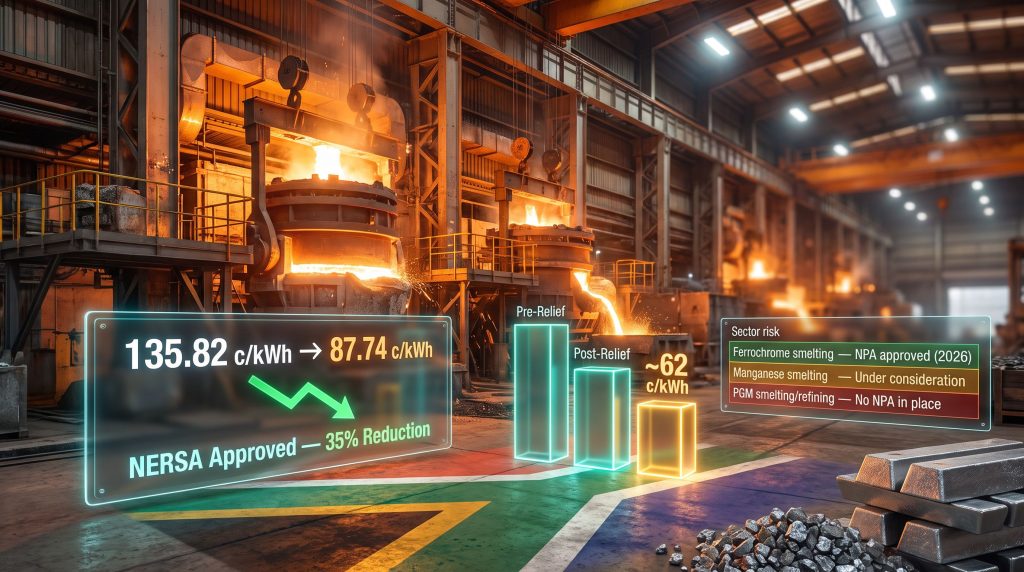
| NERSA-approved tariff | ~135.82 c/kWh | ~87.74 c/kWh | ~35% |
| Relief period | N/A | 1 January 2026 to 31 December 2026 | 12 months |
| Subsequent arrangement | N/A | ~62 c/kWh | Further reduction |
The movement from approximately 87.74 c/kWh toward a 62 c/kWh arrangement reflects the level at which South African ferrochrome production becomes internationally cost-competitive. This calibration is critical: the tariff is not set at a level that merely prevents closure — it is set at a level that restores global market viability.
Interruptible Load: The Obligation Side of Relief
A condition that receives insufficient attention in public commentary is the interruptible load requirement attached to all NPA arrangements. Beneficiaries must accept that Eskom retains the right to curtail their power supply during periods of grid stress. This is not a passive condition — it requires NPA recipients to maintain operational flexibility to reduce demand on short notice.
This condition serves the broader grid stability objective: relief recipients are not simply drawing subsidised power unconditionally. They are also functioning as demand-side management resources for a utility that continues to manage supply constraints.
Why a Sector-Wide Extension Is Not Yet Possible
Eskom CEO Dan Marokane addressed this directly at the Coal and Energy Transition Day investment conference in Johannesburg in July 2026, explaining that while the ferrochrome crisis made it the logical starting point for tariff relief, extending that relief simultaneously across all energy-intensive sectors was not operationally or financially feasible without a revised national electricity pricing policy first being published (MiningMX, July 2026).
The sequencing logic is regulatory rather than commercial. Without a published pricing policy establishing common rules applicable to all applicants, selective relief creates legal and competitive equity risks. Each sector's NPA application must be assessed against identical eligibility criteria to avoid regulatory challenges or perceptions of preferential treatment.
Marokane indicated that the revised policy — expected within approximately one month of his July 2026 comments — was being designed to address three concurrent objectives:
- Social protection — maintaining affordable electricity access for low-income households
- Strategic sector support — enabling competitive pricing for industries critical to national output and employment
- Generator sustainability — ensuring Eskom's revenue base is not structurally undermined
"These three objectives are not naturally compatible within a single pricing framework. Protecting the poor, supporting industrial users, and maintaining Eskom's financial viability simultaneously requires either substantial government fiscal transfers or a carefully tiered architecture — both of which carry significant political and budgetary risk."
The PGM Sector's Unresolved Exposure
The Equity Argument and the Workforce Cost
Platinum group metal producers represent one of South Africa's largest categories of energy-intensive industrial electricity consumers. PGM smelting and base metal refining operations require continuous high-volume electricity input to process ore concentrates into the platinum, palladium, rhodium, and base metal outputs that flow into global automotive, industrial, and investment markets.
Unlike ferrochrome, the PGM sector has not received a formal NPA — and the human cost of that gap is already measurable. Valterra Platinum CEO Craig Miller noted in July 2026 that the company had been compelled to reduce its headcount by approximately 3,500 positions in response to cost escalation and depressed commodity prices, raising pointed questions about why the ferrochrome industry received structured relief while PGM producers absorbed their cost crisis through workforce reductions alone (MiningMX, July 2026). These ongoing PGM market challenges illustrate precisely why the absence of a sector-wide tariff framework carries such severe human consequences.
This is not merely an equity argument. It points to a sequencing risk embedded in the current policy architecture: sectors that cannot access tariff relief before the revised pricing policy is published may reach irreversible closure or restructuring decisions in the interim.
Sector Risk Comparison
| Sector | Electricity Intensity | Current Relief Status | Near-Term Risk Level |
|---|---|---|---|
| Ferrochrome smelting | Very high | NPA approved (2026) | Partially resolved |
| Manganese smelting | High | Under active consideration | High |
| PGM smelting and refining | High | No NPA in place | High |
| Gold mining | Moderate | No NPA in place | Moderate |
| Diamond mining | Moderate to low | No NPA in place | Low to moderate |
The next major ASX story will hit our subscribers first
How South Africa's Approach Compares Internationally
Many resource-producing nations operate tiered or negotiated electricity pricing systems for energy-intensive industries, recognising that uniform national tariff structures can render strategic sectors globally uncompetitive. Common mechanisms used in other jurisdictions include:
- Interruptible supply contracts — used in Norway, Canada, and Australia — offering lower rates in exchange for demand-side flexibility
- Energy-intensive user tariff classes within the EU framework, separating industrial pricing from household retail pricing
- Direct government energy subsidies to strategic industries in China and parts of the Middle East, fully decoupling electricity cost from utility revenue requirements
South Africa's NPA model most closely resembles the interruptible contract approach, with the added complexity of a financially constrained utility and a mandatory regulatory approval step through NERSA. The table below identifies where the framework aligns with international best practice and where structural gaps remain:
| Design Feature | SA NPA Framework | International Best Practice |
|---|---|---|
| Fiscal neutrality for utility | Required | Standard |
| Interruptible load conditions | Required | Standard |
| Case-by-case eligibility assessment | Required | Can slow deployment |
| Sector-wide policy framework | Pending revision | Typically pre-established |
| Implementation speed | Slower due to regulatory sequencing | Generally faster in pre-established frameworks |
However, it is worth noting that broader industrial competitiveness also depends on progress with mining decarbonisation in Africa, which represents an additional layer of structural transition that energy-intensive producers must navigate alongside tariff reform.
The Dependency Chain Risk
The requirement that a revised national electricity pricing policy be published before broader NPA applications can be processed creates a sequential dependency that introduces material timeline uncertainty for sectors currently operating at the margins of viability.
The dependency chain runs as follows:
- Revised pricing policy is formally published by the relevant ministry
- NERSA consultation process is initiated and completed
- NPA application windows open for eligible sectors
- Individual applications are assessed and approvals are issued
Each stage carries its own procedural timeline. For a smelter or refinery already operating at marginal economics, that timeline is not an abstract regulatory inconvenience — it is the interval during which a board may decide that continued operation is no longer justifiable.
Smelter and refinery closures are not easily reversible. Industrial infrastructure that is mothballed for extended periods degrades. Specialised workforces disperse into other industries or emigrate. Long-term supply contracts migrate to competing jurisdictions in Kazakhstan, India, or Zimbabwe. The window for effective intervention is materially narrower than the policy timeline might suggest. Consequently, the mining sustainability transformation agenda depends, in part, on whether tariff reform can be delivered before irreversible structural damage occurs.
Ferrochrome producers, for instance, have publicly warned that even the interim relief approved to date may prove insufficient to prevent further job losses, underscoring how narrow the effective intervention window truly is.
Key Policy Takeaways
The Eskom mining tariff relief policy, as it stands in mid-2026, can be summarised through several critical structural realities:
- The framework is a case-by-case regulatory instrument, not a sector-wide discount — each NPA requires formal eligibility assessment and NERSA approval
- The ferrochrome precedent establishes a tariff reduction from approximately 135.82 c/kWh to 87.74 c/kWh (a 35% reduction), with movement toward 62 c/kWh representing the internationally competitive calibration point
- A revised national electricity pricing policy is the prerequisite for broader relief, with Eskom's leadership indicating publication was expected within approximately one month of July 2026 comments
- The fiscal neutrality principle is the structural safeguard preventing the NPA framework from functioning as a concealed cross-subsidy
- For PGM producers, manganese smelters, and other energy-intensive operators not yet covered, the regulatory sequencing timeline creates material near-term viability risk that the policy architecture, however well-designed, cannot currently neutralise
This article draws on publicly available statements and reporting from MiningMX (July 2026), the Valterra Platinum 2025 Annual Report, and Eskom's publicly disclosed position on negotiated pricing arrangements. Nothing in this article constitutes financial or investment advice. Forward-looking observations regarding policy timelines and sector outcomes involve inherent uncertainty and should not be relied upon as predictions.
Want to Track ASX Mineral Discoveries Before the Broader Market Does?
Discovery Alert's proprietary Discovery IQ model delivers real-time alerts on significant ASX mineral discoveries, transforming complex mineral data into clear, actionable insights for investors at every experience level — explore the historic returns major discoveries have generated and begin your 14-day free trial today to position yourself ahead of the market.