
June 21, 2026
What Does Eskom's Winter Preparedness Strategy Reveal About South Africa's Energy Transition?
Energy systems worldwide face mounting pressure from climate change, economic volatility, and technological disruption. In this context, South Africa's electricity sector presents a unique case study of transformation under stress. Eskom meeting winter electricity demand in South Africa demonstrates how traditional power utilities must navigate declining demand whilst maintaining system reliability and preparing for seasonal challenges. Furthermore, the mining decarbonisation benefits and renewable energy solutions are reshaping the entire energy landscape across the continent.
Grid Stability Metrics and Performance Indicators
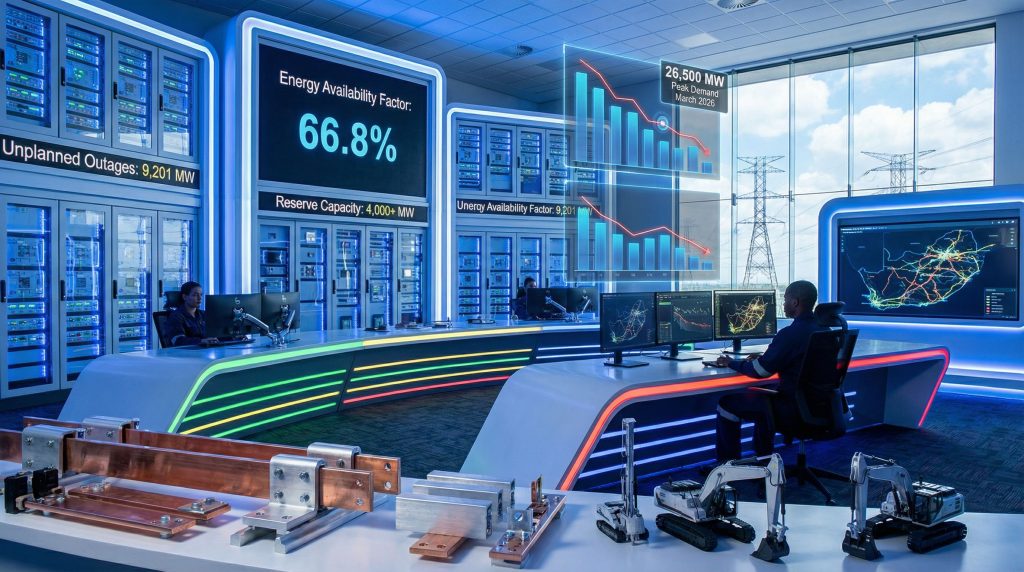
Eskom's Energy Availability Factor (EAF) provides crucial insights into grid preparedness capabilities. March 2026 data reveals an EAF of 66.8%, representing a decline from February's 68.3% performance level. This 1.5 percentage point deterioration heading into winter season raises questions about generation fleet reliability during peak demand periods.
The 66.8% March figure falls short of the 68% target established in the previous year's Integrated Resource Plan, highlighting persistent challenges in achieving optimal generation performance. However, context matters significantly when evaluating these metrics. More than 4,000 MW remains in immediately dispatchable reserve, creating substantial buffer capacity for rapid deployment when needed.
Key Performance Indicators (March 2026):
• Energy Availability Factor: 66.8% (down from 68.3% in February)
• Immediately dispatchable reserve: Over 4,000 MW
• Unplanned outages: 9,201 MW (improvement from 9,754 MW in February)
• Planned maintenance: Increased by 1,300 MW month-on-month
Unplanned outage management demonstrates positive momentum throughout 2026. Consistent performance below 10,000 MW represents improved asset management compared to historical periods when forced outages frequently exceeded this threshold. The March reduction of 553 MW in unplanned outages from February levels suggests enhanced maintenance effectiveness and operational discipline.
Reserve Capacity Management and Demand Forecasting
Open cycle gas turbine (OCGT) utilisation patterns reveal strategic fleet management rather than demand-driven dispatch. March 2026 witnessed slight increases in OCGT usage, but operators attribute this to optimisation testing at Gourikwa power station in the Western Cape rather than peak demand response requirements.
This distinction proves critical for winter planning. When OCGT facilities operate for testing purposes rather than necessity, it indicates sufficient base-load and mid-merit generation capacity to meet current demand levels. The deliberate maintenance scheduling shows proactive winter preparation rather than reactive crisis management.
Reserve margin calculations become complex when demand patterns shift structurally. Peak demand in March 2026 reached 26,500 MW compared to 28,905 MW in March 2025, representing a substantial 2,405 MW (8.3%) year-over-year decline. This demand reduction partially explains improved system reliability metrics.
The combination of declining demand and strategic maintenance optimisation creates opportunities for enhanced system resilience during winter months.
When big ASX news breaks, our subscribers know first
How Has South Africa's Electricity Consumption Landscape Fundamentally Shifted?
Industrial Demand Transformation Analysis
South Africa's electricity consumption patterns reveal profound structural changes affecting winter demand forecasting. Seasonally adjusted real electricity generation declined 3.8% year-on-year in February 2026, extending monthly generation declines dating back to June 2025. This eight-month trend suggests persistent rather than cyclical demand weakness.
| Production Metrics | Performance | Comparison Period |
|---|---|---|
| February 2026 YoY decline | 3.8% | vs February 2025 |
| Month-on-month decline | 0.2% | February vs January 2026 |
| Pre-COVID baseline gap | 8.7% below | January 2026 vs pre-pandemic |
| Long-term historical decline | 12.4% lower | January 2026 vs January 2019 |
The magnitude of these declines indicates fundamental shifts in South Africa's economic structure. Nearly six years after COVID-19 onset, electricity production remains 8.7% below pre-pandemic baselines, suggesting permanent rather than temporary demand destruction. The 12.4% reduction compared to January 2019 reveals a seven-year structural decline in electricity consumption.
Mining Sector Decoupling from National Grid Dependency
Historical relationships between mining production and electricity consumption have undergone dramatic transformation. Previously, these metrics demonstrated strong positive correlation around 0.68, meaning higher mining output typically associated with increased electricity production from the national grid.
Critical Turning Point: April 2025
From April 2025 onward, this relationship reversed completely. Higher mining production now associates with lower electricity production, indicating fundamental decoupling between mining activity and Eskom-supplied power. This correlation breakdown reflects structural shifts toward self-generation within the mining sector and aligns with broader critical minerals & energy transition initiatives.
Drivers of Mining Sector Independence:
• Cost competitiveness of self-generated versus Eskom-supplied electricity
• Reliability advantages of distributed generation systems
• Strategic energy security considerations for mining operations
• Regulatory framework changes enabling independent power production
The implications extend beyond simple demand reduction. Mining companies historically represented Eskom's largest industrial customers, providing predictable revenue streams and anchor demand for grid planning. This customer base erosion forces fundamental reassessment of utility business models and grid investment priorities.
What Economic Forces Are Reshaping South Africa's Power Market Dynamics?
Tariff Competitiveness and Industrial Migration Patterns
Electricity tariff uncompetitiveness drives industrial restructuring across multiple sectors. According to Eskom's latest grid stability reports, major industrial closures demonstrate the direct impact of pricing pressure on electricity demand patterns.
Ferrochrome smelter operations face suspension due to uncompetitive power costs relative to global benchmarks.
South32's Mozal aluminium smelter in Mozambique closed in March 2026 following failure to secure competitive electricity pricing arrangements.
These closures represent more than isolated business decisions. They signal broader industrial migration away from electricity-intensive manufacturing in Southern Africa. The Mozal closure particularly impacts regional electricity trade, reducing cross-border demand that previously supported Eskom's export strategy.
Industrial electricity consumers face stark economic choices when domestic tariffs exceed global competitive levels. Energy-intensive industries possess geographic flexibility, relocating production to jurisdictions offering more competitive power pricing. This dynamic creates permanent rather than cyclical demand destruction.
Export Market Opportunities and Constraints
Despite domestic demand challenges, South Africa maintains net electricity export status since May 2024. This export capacity provides alternative revenue streams whilst utilising surplus generation capacity. However, regional economic conditions limit export growth potential.
Export Market Constraints:
• Subdued economic growth in neighbouring countries reducing import demand
• Global geopolitical uncertainty affecting energy trade relationships
• Energy-related supply risks constraining cross-border infrastructure investment
• Regional industrial closures reducing anchor demand in export markets
The regional context matters significantly for winter planning. Neighbouring countries experiencing their own economic pressures offer limited absorption capacity for surplus South African electricity. Export revenue cannot fully compensate for domestic industrial demand losses.
How Do Maintenance Strategies Reflect Long-Term Grid Resilience Planning?
Preventive vs Reactive Maintenance Performance Metrics
Strategic maintenance scheduling demonstrates evolved grid management approaches. March 2026 planned maintenance increased 1,300 MW compared to February, indicating deliberate preparation for winter demand periods. This proactive scheduling contrasts with historical patterns of reactive maintenance driven by equipment failures.
| Maintenance Category | March 2025 | March 2026 | Year-over-Year Change |
|---|---|---|---|
| Total maintenance & outages | 13,601 MW | 9,201 MW | -4,400 MW improvement |
| Unplanned outages | 11,200 MW | 9,201 MW | -1,999 MW improvement |
| Planned maintenance | 2,401 MW | 3,701 MW | +1,300 MW increase |
The 4,400 MW improvement in total maintenance and outages compared to March 2025 represents substantial progress in fleet management. This improvement creates additional capacity margins for winter peak demand management whilst reducing system reliability risks.
Seasonal Preparedness and Risk Mitigation Protocols
Winter preparation extends beyond maintenance scheduling to comprehensive risk management strategies. Furthermore, cold storage capacity utilisation allows rapid activation of standby generation during peak demand periods. The maintenance improvements align with excess capacity holdings, creating multiple layers of system resilience.
Risk Mitigation Elements:
• Planned maintenance prioritisation ahead of winter season
• Cold storage capacity maintenance for rapid deployment
• Open cycle gas turbine optimisation testing for peak demand response
• Reserve margin management exceeding 4,000 MW immediately dispatchable capacity
Eskom's expressed confidence in meeting winter electricity demand reflects these comprehensive preparation measures. However, confidence must balance against underlying structural challenges affecting long-term system sustainability.
What Does the Mining-Energy Nexus Reveal About Industrial Self-Sufficiency Trends?
Self-Generation Economics and Strategic Implications
Mining sector energy independence reflects fundamental economic realities favouring distributed generation over centralised utility supply. Self-generated electricity costs consistently underprice Eskom-supplied power, creating compelling business cases for independent energy investments.
This cost differential extends beyond simple pricing comparisons. Self-generation provides:
• Enhanced operational reliability through reduced grid dependency
• Strategic energy security for critical production processes
• Predictable long-term energy cost structures
• Reduced exposure to utility tariff volatility
Mining production demonstrates resilience despite grid dependency reduction, indicating successful transition strategies. Companies maintain or increase output whilst reducing Eskom electricity consumption, proving business model viability under self-generation approaches.
Critical Minerals Sector Energy Independence Initiatives
Solar and renewable energy integration accelerates across mining operations as technology costs decline and reliability improves. Off-grid and hybrid energy systems provide operational flexibility whilst reducing environmental impacts and long-term cost structures.
Energy security considerations become paramount for strategic mineral production supporting global supply chains. Mining companies cannot afford grid reliability risks when producing materials essential for renewable energy technologies, electric vehicles, and critical infrastructure applications.
Investment Patterns in Mining Energy Systems:
• Solar photovoltaic installations at mine sites
• Battery energy storage systems for load balancing
• Hybrid renewable-thermal generation configurations
• Grid-tied systems with islanding capabilities for reliability
These investments represent permanent shifts rather than temporary adaptations. Once mining companies achieve energy independence, economic incentives favour continued self-generation over returning to utility dependency.
How Will Demand Recovery Patterns Shape South Africa's Energy Future?
Economic Growth Correlation with Electricity Consumption
Traditional relationships between economic growth and electricity consumption face disruption from efficiency improvements and structural economic changes. GDP electricity sector contraction of 4.3% in Q4 2025 reflects both demand weakness and sector-specific challenges affecting utility performance.
Weak domestic demand drivers suggest recovery timelines extending beyond typical economic cycles. Industrial activity indicators increasingly diverge from traditional electricity metrics as self-generation expands across multiple sectors.
Demand Recovery Timeline Factors:
• Electricity tariff trajectory relative to inflation and economic growth
• Industrial competitiveness recovery in global markets
• Self-generation technology cost trends
• Regulatory framework evolution supporting distributed energy
Economic fundamentals suggest recovery challenges persist regardless of supply-side improvements. Even perfect grid reliability cannot restore demand when underlying cost competitiveness issues remain unresolved.
Structural Change Implications for National Energy Policy
The electricity-economy relationship evolution requires policy adaptation to changing consumption patterns. Traditional centralised utility models face pressure from distributed generation trends, demanding new approaches to grid planning and investment priorities.
Investment priorities must balance grid modernisation needs against generation capacity expansion. When demand growth stagnates or declines, additional generation capacity provides limited value compared to grid flexibility and integration capabilities.
Policy Adaptation Requirements:
• Market structure reforms accommodating distributed generation
• Tariff design evolution for changing consumption patterns
• Grid modernisation prioritisation over capacity expansion
• Regional energy cooperation frameworks development
Long-term energy policy must acknowledge permanent structural changes rather than assuming demand recovery to historical patterns. Planning frameworks require fundamental reassessment based on new consumption reality.
The next major ASX story will hit our subscribers first
What Regional Energy Security Challenges Affect South Africa's Winter Outlook?
Cross-Border Energy Trade Dynamics
Regional economic conditions significantly influence South Africa's electricity export opportunities and winter demand management strategies. Neighbouring countries experiencing their own economic pressures offer limited growth prospects for electricity exports, constraining alternative revenue streams for surplus capacity.
Cross-border infrastructure constraints limit rapid expansion of electricity trade even when economic conditions improve. Regional integration requires substantial transmission infrastructure investments and coordinated regulatory frameworks currently lacking across Southern Africa.
Energy diplomacy considerations become increasingly important as countries develop domestic energy resources and reduce import dependence. South Africa's export strategy must account for evolving regional energy independence initiatives and government intervention insights across the region.
Global Market Integration and Competitiveness Factors
International tariff benchmarking reveals South Africa's competitive disadvantages in energy-intensive manufacturing sectors. Global industrial location decisions increasingly factor electricity costs as primary considerations, affecting long-term demand patterns.
Strategic positioning in global value chains requires competitive energy costs throughout the supply chain. Even companies not directly in energy-intensive industries face pressure when upstream suppliers relocate due to uncompetitive electricity pricing.
Global Competitiveness Challenges:
• Industrial electricity tariffs exceeding international benchmarks
• Energy-intensive industry migration to lower-cost jurisdictions
• Supply chain disruption from regional industrial closures
• Investment diversion to more competitive energy markets
These global dynamics create permanent headwinds for electricity demand recovery regardless of domestic supply improvements. Winter planning must account for continued structural demand challenges.
Strategic Outlook: Positioning South Africa's Energy Sector for Sustainable Growth
Investment Priorities and Infrastructure Development
Grid modernisation requirements intensify as consumption patterns evolve toward distributed generation and variable demand profiles. Traditional grid planning assumptions based on predictable demand growth require fundamental reassessment for new operational realities.
Renewable energy integration challenges multiply as self-generation expands across industrial and mining sectors. Grid stability technologies become essential for managing variable generation sources and maintaining system reliability despite reduced traditional baseload demand.
Critical Infrastructure Investment Areas:
• Smart grid technologies for distributed energy management
• Energy storage systems for grid stability and peak demand management
• Transmission infrastructure flexibility for bidirectional power flows
• Advanced metering and control systems for real-time grid optimisation
Investment prioritisation must balance immediate winter preparedness needs against long-term structural transformation requirements. Resources allocated to legacy generation expansion provide diminishing returns compared to grid flexibility and integration investments.
Policy Framework Evolution and Regulatory Adaptation
Market structure reforms become essential for accommodating expanding distributed generation whilst maintaining grid stability and reliability. Regulatory frameworks designed for centralised utility models require substantial modification for hybrid energy system integration.
Tariff design evolution must address changing consumption patterns whilst ensuring grid infrastructure cost recovery. Traditional volumetric pricing models face challenges when industrial customers reduce grid dependency through self-generation investments.
Regional energy cooperation frameworks offer opportunities for enhanced energy security through diversified supply sources and shared infrastructure investments. However, cooperation requires coordination among countries with different economic conditions and energy policy priorities.
The path forward demands acknowledgment of permanent structural changes rather than assumptions about demand recovery to historical patterns. This mining industry evolution reflects global trends toward decentralisation, renewable integration, and enhanced energy security through diversified supply sources.
Winter 2026 represents a critical test of these transformation strategies. Successful navigation of peak demand periods whilst managing structural challenges will demonstrate the viability of evolving energy sector models in emerging markets facing similar transformation pressures.
The current situation of Eskom meeting winter electricity demand in South Africa demonstrates both the utility's improved operational capabilities and the complex structural challenges facing the broader energy sector. As detailed by Mining Weekly's analysis, these developments reflect deeper transformation trends affecting the entire Southern African energy landscape.
This analysis incorporates data from the Minerals Council South Africa electricity update and Statistics South Africa generation figures. Investment and policy decisions should consider multiple factors beyond electricity sector trends when evaluating energy market opportunities.
Seeking Opportunities in Small-Cap Resource Companies?
Discovery Alert's proprietary Discovery IQ model provides real-time alerts on significant ASX mineral discoveries, empowering investors to identify actionable opportunities ahead of the broader market during periods of global energy transformation. Understand why historic mineral discoveries can generate substantial returns by exploring examples of exceptional market outcomes, and begin your 14-day free trial today to position yourself ahead of evolving commodity markets.