May 20, 2026
The Commodity Classification Gap That Keeps EU Alumina Flowing Into Russia
Sanctions regimes are only as effective as the precision of their commodity-level scope. History has repeatedly shown that when broad geopolitical intent meets the granular reality of industrial trade classification, gaps emerge, and those gaps are exploited, sometimes inadvertently, sometimes not. The debate now unfolding across EU institutions over EU alumina exports to Russia sanctions is a textbook illustration of this dynamic, and it raises questions that extend well beyond one refinery on the western edge of Ireland.
When big ASX news breaks, our subscribers know first
Understanding Why Alumina Was Left Out of EU Sanctions
When the European Union began assembling its sanctions architecture in response to Russia's 2022 invasion of Ukraine, the primary focus was on disrupting Russian export revenues. The bloc moved to restrict imports of primary Russian aluminium and select aluminium products, cutting off a revenue stream that had historically contributed to Russian industrial and fiscal capacity.
What the sanctions framework did not address, however, was the reverse flow: EU-origin alumina being exported into Russia for processing at Russian smelters. This absence was not an oversight born of ignorance, but rather a reflection of how commodity classification systems in EU trade law have historically operated. Alumina, technically aluminium oxide, is treated as a distinct precursor category, not as aluminium itself.
The distinction is chemically and industrially meaningful. Alumina must undergo energy-intensive electrolytic smelting, the Hall-Heroult process, before it becomes primary aluminium metal. Regulatory frameworks built around finished metal categories have routinely excluded upstream precursors from their scope, creating what critics now describe as a structurally embedded loophole. Furthermore, the broader implications for aluminum and alumina markets remain significant as this classification gap persists.
Key Insight: The EU bans imports of Russian primary aluminium but imposes no restriction on EU alumina exports flowing into Russia. This upstream-downstream classification gap has preserved a commercially significant trade channel that sits in direct tension with the broader intent of the sanctions regime.
The Scale of the Trade: What the Numbers Reveal
The refinery at the centre of this controversy is Aughinish Alumina, located in County Limerick on Ireland's Shannon Estuary. It is the largest alumina refinery in Europe by production capacity, and its operational significance to both the regional economy and the Atlantic Basin alumina market is difficult to overstate.
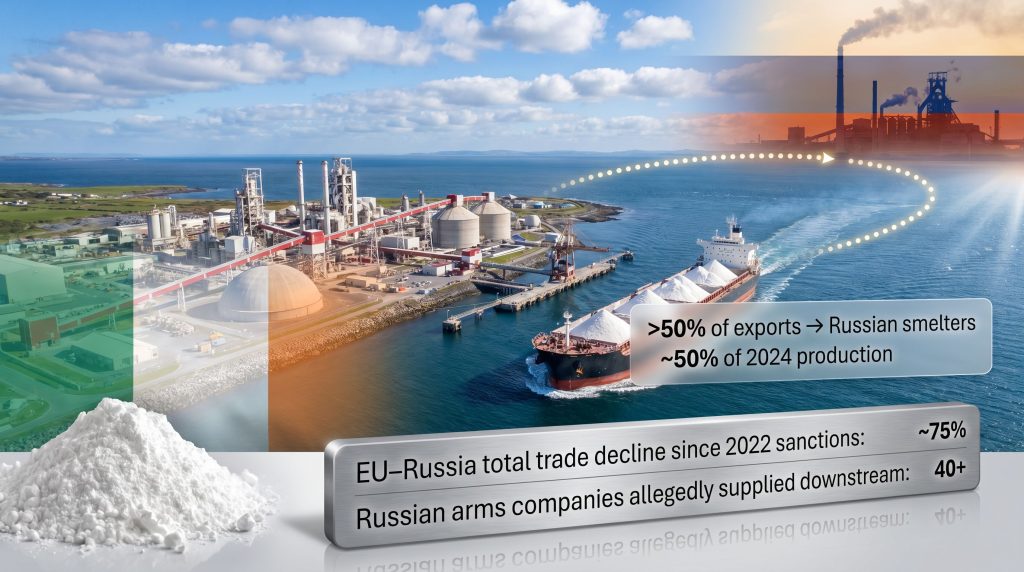
Investigations cited by European lawmakers indicate that more than half of Aughinish's alumina exports since 2023 have been directed toward Russian smelters, specifically those operated by Rusal, Russia's dominant aluminium producer. In 2024, approximately half of the refinery's total production output was reportedly shipped to Russian-linked smelting operations.
| Metric | Estimated Figure |
|---|---|
| Aughinish alumina export share to Russia (post-2023) | More than 50% of exports |
| Share of total 2024 production shipped to Russian smelters | Approximately 50% |
| EU-Russia total trade decline since 2022 sanctions | Around 75% |
| Russian defence manufacturers allegedly supplied downstream | More than 40 |
The aggregate picture is striking. At a time when overall EU-Russia trade has collapsed by roughly 75% following successive sanctions packages, one of Europe's largest industrial commodities operations has reportedly maintained, and in relative terms expanded, its commercial relationship with Russian state-aligned smelters. In addition, the commodity trade volatility created by these dynamics continues to ripple across global markets.
The Alleged Downstream Pathway to Russian Defence Manufacturing
The policy stakes escalate sharply when the downstream supply chain is traced beyond the smelter gate. Investigations cited by members of the European Parliament allege that aluminium produced from Aughinish-origin alumina was channelled through a Moscow-based trading entity. That intermediary company reportedly supplied more than 40 Russian defence manufacturers that are themselves listed under existing EU sanctions, companies allegedly involved in the production of missiles, tanks, and other weapons systems.
This is the indirect circumvention pathway that sanctions architects most struggle to close. The alumina itself is not a weapon. The smelter is a civilian industrial facility. The trading intermediary operates in a jurisdiction beyond EU enforcement reach. And yet the alleged end-use chain moves in a direct line from an EU-licensed refinery to sanctioned Russian weapons manufacturers.
Critical Supply Chain Risk: The alleged pathway from EU-refined alumina to sanctioned Russian defence manufacturers illustrates precisely the type of multi-stage indirect circumvention that commodity-level sanctions must anticipate but frequently fail to address in their initial design.
It is important to note that these allegations are drawn from investigative reporting and parliamentary submissions, not confirmed judicial findings. Aughinish Alumina operates legally under current EU law, and the refinery itself has not been found to have violated any applicable regulation.
Political Pressure Points: Who Is Pushing for Change
The institutional momentum building around this issue has been notable for its breadth. EU sanctions envoy David O'Sullivan acknowledged the findings publicly, characterising them as troubling and reaffirming the EU's intent to limit Russia's access to materials that could support military production. His remarks signal that the issue has reached senior Commission-level attention rather than remaining confined to parliamentary debate.
European Parliament Vice-President Pina Picierno formally posed the question to the Commission: could alumina be incorporated into the next sanctions package targeting Russia? Separately, a coalition of 39 Members of the European Parliament submitted a joint letter urging Kaja Kallas, the EU's foreign policy chief, and Maroš Šefčovič, the EU's trade commissioner, to scrutinise aluminium-related trade arrangements connected to Russia's defence sector. Belgium has also indicated it intends to advocate within EU Council structures for the loophole's closure.
Ireland's Position: Employment Realities vs. Geopolitical Obligations
Ireland's stance has been notably cautious. Taoiseach Micheál Martin confirmed that no restrictions currently apply to Aughinish Alumina and that the EU has not formally proposed any. His administration has flagged the potentially severe economic consequences that alumina export sanctions would carry for the refinery's hundreds of regional workers, a workforce that represents a significant employment anchor in County Limerick.
Both the Department of Enterprise and the Department of Foreign Affairs are conducting reviews of the matter, but no policy shift has been announced. Ireland's position encapsulates a tension that runs through the EU sanctions architecture more broadly: the collective geopolitical interest of closing an indirect circumvention channel versus the legitimate economic interests of individual member states with direct industrial exposure.
Policy Design Challenge: Any move to add alumina to EU sanctions would require consensus among all member states. Ireland's economic exposure to Aughinish Alumina's Russian trade volumes represents exactly the kind of proportionality argument that complicates legislative consensus in multi-member sanctions regimes.
Is Alumina a Dual-Use Commodity? The Classification Debate
At the heart of this policy question is whether alumina should be reclassified as a strategically sensitive material given its demonstrated role in supplying aluminium for defence applications. The EU's existing dual-use goods framework applies to technologies and materials with established direct military applications. Bulk industrial commodities with wide civilian uses have historically resisted this classification.
Alumina is used in ceramics, abrasives, catalysts, and electronics, in addition to its role as the exclusive precursor to primary aluminium. This breadth of application has made a straightforward dual-use classification difficult to sustain legally, particularly under the proportionality principles that govern EU regulatory design.
However, the iterative nature of EU sanctions development, which has now reached its fourteenth-plus package since 2022, demonstrates that commodity inclusions do expand over time as evidence of indirect military utility accumulates. The procedural pathway for adding alumina exists; the political pathway is the more contested terrain. Consequently, the broader context of global trade tensions makes resolving this question increasingly urgent for EU policymakers.
How Other Commodities Were Eventually Sanctioned
Several commodities excluded from early EU sanctions packages were later incorporated as investigative and intelligence evidence clarified their downstream military relevance. Industrial chemicals, electronic components, and specific metallurgical inputs followed this pattern. The alumina case is following a recognisably similar trajectory: initial exclusion, investigative scrutiny, parliamentary pressure, and now Commission-level acknowledgement.
The next major ASX story will hit our subscribers first
Scenario Analysis: What Happens If the Loophole Closes
| Scenario | Impact on Aughinish | Impact on Russian Aluminium Supply | Global Alumina Price Effect |
|---|---|---|---|
| Full alumina export ban | High, major market loss | Moderate, alternative sourcing required | Upward pressure likely |
| Targeted end-use restrictions | Medium, compliance cost increase | Low to moderate | Minimal |
| Status quo maintained | None in near term | None | Neutral |
Scenario 1: Full Export Ban
If alumina is incorporated into the next EU sanctions package, Aughinish would immediately lose its largest single export market. Russian smelters would need to accelerate sourcing from alternative suppliers, primarily Guinea in West Africa, India, and China. Guinea alone accounts for a substantial share of global bauxite extraction, the raw material from which alumina is refined, but understanding the full picture of bauxite supply dynamics reveals that converting bauxite access into reliable alumina supply involves refinery capacity that cannot be redirected overnight.
Scenario 2: Targeted End-Use Restrictions
A more measured regulatory response could involve mandatory end-use certification for alumina exports to Russian counterparties, alongside enhanced due diligence obligations for EU refiners. This approach would partially disrupt Aughinish's Russian-directed volumes without requiring a complete market exit and would preserve more political consensus across member states.
Scenario 3: Status Quo With Intensified Review
Political pressure continues building without near-term legislative action. The EU's credibility on sanctions enforcement faces reputational costs if a clearly documented indirect circumvention pathway remains unaddressed across multiple sanctions packages.
Global Alumina Market Implications
The Atlantic Basin alumina spot market is not a deep, liquid market in the way that base metal exchanges are. Supply-demand balances in this segment can shift meaningfully in response to relatively modest volume dislocations. Aughinish's Russian-directed shipments represent a non-trivial share of Atlantic Basin trade flows, and any abrupt cessation would create short-term tightness.
Australian alumina refiners, which collectively represent one of the world's largest production bases, could see increased demand enquiries if EU supply to Russia is curtailed. Middle Eastern and Asian refining capacity would similarly be positioned to absorb redirected trade flows. For Russia, the logistics and cost implications of shifting from proximate European supply to more distant West African or Asian sources would represent a meaningful increase in operating costs for Rusal's smelter network.
Russia's domestic bauxite reserves are limited relative to its smelting capacity requirements, making import dependency a structural feature of its aluminium industry rather than a temporary condition. This dependency is precisely what makes European alumina exports strategically significant, and why their continued flow, despite the broader sanctions environment, carries material relevance to Russia's industrial output.
Market Note: Alumina price volatility has already been demonstrated in response to supply chain disruptions and geopolitical events. Any formal EU restriction on Aughinish's Russian export volumes would likely register as a price-relevant signal in Atlantic Basin alumina spot markets, even if the physical volume effect took time to materialise.
Why Commodity-Level Loopholes Are Hard to Close
The structural challenge underlying the EU alumina debate is not unique to this commodity or this conflict. Complex industrial supply chains involve multiple jurisdictional handoffs, and third-party trading intermediaries can obscure the ultimate end-use of goods in ways that make enforcement difficult at the point of export.
The EU's capacity to enforce export controls on bulk commodities is constrained by the volume of trade flows involved, the number of intermediary entities, and the jurisdictional limits of member state customs authorities. Investigative journalism and parliamentary scrutiny have played a significant role in surfacing this particular loophole, pointing to a broader truth: formal enforcement mechanisms often lag behind the investigative identification of circumvention pathways.
Supply chain due diligence obligations, of the kind already embedded in the EU's battery regulation and conflict minerals frameworks, represent a complementary tool to outright bans. These obligations place the compliance burden on exporters and create legal liability for documented end-use violations. Furthermore, the evolving metals and mining geopolitics landscape makes robust supply chain oversight ever more critical for EU regulators.
The EU sanctions framework against Russia continues to evolve, with each successive package representing an opportunity to address commodity-level gaps that earlier iterations failed to anticipate.
Strategic Observation: The alumina case illustrates a recurring structural challenge in sanctions design. The gap between the intent of a sanctions regime and the technical precision of its commodity-level scope tends to close gradually, through a combination of investigative pressure, parliamentary advocacy, and incremental legislative consensus. That process appears to now be underway for EU alumina exports to Russia sanctions.
Key Takeaways
- The loophole is legally confirmed: EU alumina exports to Russia remain outside the sanctions framework as of mid-2026, despite a regime that bans imports of Russian primary aluminium
- The downstream risk is documented: Investigations allege a traceable pathway from EU-refined alumina through Russian smelters to sanctioned defence manufacturers
- Institutional momentum is building: Multiple EU bodies, parliamentary coalitions, and member states have formally engaged the issue, with Commission-level acknowledgement now on record
- Ireland's economic exposure creates real friction: Aughinish Alumina's regional employment significance gives Ireland legitimate grounds for caution, complicating consensus-based legislative change
- Global alumina markets would respond: Any formal restriction would affect Atlantic Basin pricing dynamics and force Russian smelters to restructure their supply chains toward more distant and costly sources
- The precedent matters beyond alumina: How the EU resolves this gap will shape its approach to other commodity-level loopholes in current and future sanctions regimes
Disclaimer: This article contains scenario analysis and forward-looking assessments based on publicly available information and investigative reporting. It does not constitute legal, financial, or investment advice. Allegations regarding downstream supply chains reflect claims made in parliamentary submissions and investigative reporting and have not been confirmed by judicial proceedings. Readers should consult primary regulatory sources for definitive guidance on EU sanctions obligations.
Want to Stay Ahead of Commodity Market Shifts Driven by Geopolitical Events Like These?
Discovery Alert's proprietary Discovery IQ model delivers real-time alerts on significant ASX mineral discoveries, instantly translating complex commodity and geopolitical developments into actionable investment insights for both traders and long-term investors. Explore how historic mineral discoveries have generated substantial returns and begin your 14-day free trial today to secure a market-leading edge before the broader market catches on.