August 23, 2026
The Hidden Contradiction at the Heart of Europe's Recycling Ambition
Recycling rates tell only part of the story. A region can simultaneously hold the world's most advanced circular economy credentials and function as one of its largest exporters of recyclable raw materials. This is precisely the situation unfolding across Europe's aluminium sector, where EU aluminium scrap exports to India and Thailand highlight a growing tension between domestic recycling ambitions and the economic pull of Asian markets.
Understanding this dynamic requires looking beyond headline recycling statistics and examining the economic mechanics that drive scrap toward export markets rather than domestic furnaces. Price differentials, smelting capacity gaps, and the competitive buying power of Asian secondary aluminium producers all play a role. What emerges is a trade system that is simultaneously logical, contested, and on the verge of significant policy disruption.
When big ASX news breaks, our subscribers know first
A Market Built on Volume Growth and Asian Demand
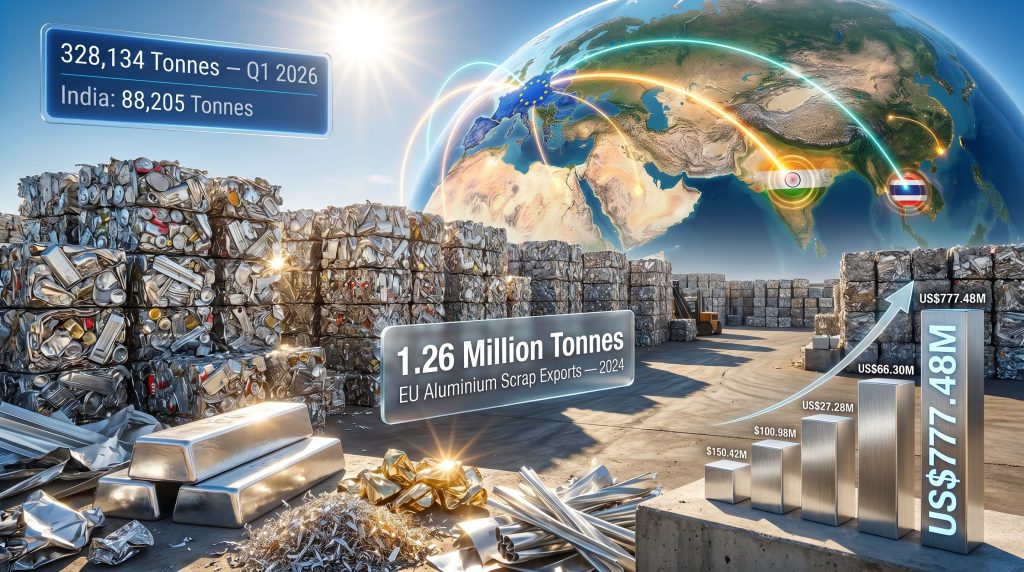
EU aluminium scrap exports have expanded by roughly 50% over the past five years, reaching approximately 1.26 million tonnes in 2024 according to Fastmarkets data. When combined with UK volumes, total European aluminium scrap exports reached approximately 1.6 million tonnes in 2024, as reported by Argus. In the first quarter of 2026 alone, Eurostat recorded 328,134 tonnes of EU aluminium scrap leaving the bloc.
This growth trajectory exists within a broader context that appears contradictory on the surface. The EU maintains an aluminium recycling rate exceeding 80%, with annual domestic scrap collection averaging around 8 million tonnes. Yet roughly 15% of that collected volume flows outward to international buyers each year. Furthermore, the scale of this outflow has made EU scrap a structurally important feedstock source for manufacturing economies across Asia.
Approximately 75% of EU aluminium scrap exports are absorbed by Asian markets, with India, Thailand, Malaysia, and China representing the primary destination cluster. This concentration creates meaningful dependency dynamics on both sides of the trade. Asian secondary aluminium producers rely on EU material to supplement domestic collection shortfalls, while EU scrap traders depend on Asian buyer competition to maintain price levels that make collection economically viable.
EU Aluminium Scrap Exports to India and Thailand: Diverging Data Signals
Within the broader Asian trade corridor, India and Thailand consistently occupy the top positions as destination markets for EU aluminium scrap exports to India and Thailand. Their roles, however, reflect distinct industrial profiles and different stages of supply chain development.
India: Largest Single-Country Buyer Navigating a Q1 Dip
India retained its position as the largest individual importer of EU aluminium scrap during Q1 2026, absorbing 88,205 tonnes over the January to March period. This represents a 7.27% year-on-year decline from the 95,122 tonnes recorded during the same quarter in 2025, which has prompted questions about whether a structural shift in trade relationships is underway.
The broader data set, however, argues against that interpretation. During the first nine months of 2025, India imported approximately 0.29 million tonnes of EU aluminium scrap, a 16% year-on-year increase compared to the same period in 2024. Measured in value terms, EU aluminium scrap exports to India grew from US$632.49 million in 2024 to US$777.48 million in 2025, indicating that even as Q1 2026 volumes softened, the trade relationship has been appreciating in both volume and price terms over the medium run.
The 7.27% volume decline recorded in Q1 2026 most likely reflects seasonal procurement cycles and near-term price dynamics rather than any fundamental recalibration of India's dependence on EU scrap feedstock. The 2025 full-year trajectory remains strongly upward.
India's secondary aluminium sector is structurally underpinned by a relatively underdeveloped domestic scrap collection and sorting infrastructure. The country's die-casting, foundry, and rolled products industries depend heavily on imported scrap to meet production requirements, making EU material a critical input rather than a marginal supplement. Value growth in EU-India scrap trade outpacing volume growth also signals tightening supply conditions and strengthening demand.
Thailand: Consistent Recipient Serving Southeast Asia's Industrial Base
Thailand's position in EU aluminium scrap trade flows is less granularly documented in public Eurostat releases than India's, but its structural significance is well established across industry reporting. European Aluminium consistently identifies Thailand as one of the primary Asian destinations alongside India, reflecting the country's role as a regional manufacturing hub.
Thailand's automotive and electronics manufacturing sectors generate sustained demand for secondary aluminium inputs. Aluminium die castings and alloy components produced using scrap-fed secondary smelting feed directly into supply chains serving Japanese and South Korean automakers operating regional production facilities. Consequently, this downstream industrial demand creates durable import appetite that extends beyond quarterly price movements.
| Metric | India | Thailand |
|---|---|---|
| Q1 2026 EU Import Volume | 88,205 tonnes | Identified top-tier destination |
| YoY Change (Q1 2026) | -7.27% | Consistent import pattern |
| EU Export Value (2024) | US$632.49 million | Not separately quantified |
| EU Export Value (2025) | US$777.48 million | Major Asian recipient |
| Jan-Sep 2025 Volume | ~0.29 million tonnes (+16% YoY) | Structural demand base |
Which EU Member States Are Supplying the Flow?
Not all EU member states contribute equally to outbound scrap volumes. Germany, Spain, Belgium, France, and Italy are identified as the five primary origin countries for aluminium scrap exported to Asian markets including India, Thailand, China, Hong Kong, Turkey, and Malaysia.
Several factors explain why these particular countries dominate the export picture:
- Industrial output density: Germany and northern Italy generate substantial manufacturing scrap volumes through automotive, aerospace, and mechanical engineering sectors.
- Port infrastructure: Belgium's Antwerp and Germany's Hamburg provide logistical gateways that reduce export friction for traders working with Asian buyers.
- Secondary smelting capacity gaps: In countries where domestic secondary aluminium production cannot competitively absorb all collected scrap, price signals push material toward export channels.
- Established trade relationships: Long-standing commercial ties between European scrap traders and Asian importers create efficient, high-volume trading corridors that are difficult to redirect quickly.
The Policy Pressure Building Behind Export Numbers
The European Commission has signalled legislative intent to introduce restrictions on aluminium scrap exports, a move that would represent one of the most significant interventions in European scrap markets in decades. These European supply chain pressures are part of a broader set of policy challenges already reshaping how the bloc manages its industrial raw materials. The policy instruments under active discussion include:
- Export duties targeting price-based friction to reduce the economic attractiveness of exporting over domestic processing.
- Volume quotas imposing hard annual caps on exportable tonnage by destination category.
- Licensing and permitting regimes requiring administrative approval for export transactions.
- Enhanced traceability and reporting requirements as a transparency-first precursor to harder controls.
It is important to note that a total ban on EU aluminium scrap exports is not currently under active consideration. The policy debate centres on graduated mechanisms designed to prioritise domestic secondary smelter access while preserving some degree of market function.
The core argument for restriction, advanced by European Aluminium, rests on the observation that sustained scrap outflows undermine the bloc's circular economy targets by depriving domestic secondary smelters of competitive feedstock. The 50% growth in export volumes over five years is cited as evidence that market forces alone are insufficient to retain material within the EU system.
Industry Counterpoint: The Bureau of International Recycling and aligned trade groups dispute the scarcity premise entirely. Critically, European Aluminium's own published data contains no evidence of a domestic aluminium scrap shortage, creating an internal contradiction within the restriction argument itself.
The economic risk embedded in export restrictions deserves careful attention. If duties or quotas suppress domestic scrap prices below the threshold at which collection remains economically viable for aggregators and processors, collection rates could decline. This would produce a perverse outcome: a policy designed to increase domestic scrap availability could ultimately reduce the total volume of aluminium being recycled within the EU, directly contradicting the circular economy rationale used to justify it. The aluminium tariffs impact already felt in global markets adds yet another layer of complexity to this supply and demand equation.
How Asian Supply Chains Would Absorb the Shock
India's Substitution Options and Structural Vulnerabilities
A material reduction in EU scrap availability would create immediate cost pressure across India's secondary aluminium sector. With EU exports valued at nearly US$780 million annually by 2025, the trade relationship is too large to replace overnight. Realistic substitution pathways include:
- Increased procurement from US, Japanese, and South Korean scrap exporters, all of which maintain established and scalable export markets.
- Accelerated investment in domestic scrap collection and sorting infrastructure, which has historically lagged behind industrial demand growth in India.
- Price-driven rationalisation in lower-value secondary aluminium product categories where margin compression can be absorbed.
The medium-term trajectory likely involves a combination of all three, but the transition period would carry meaningful cost inflation risk for India's downstream manufacturing sectors.
Thailand's Regional Repositioning
Thailand's response to any EU scrap restriction scenario would probably involve deepening trade relationships with alternative Asian scrap exporters, particularly Japan and South Korea, while exploring intra-ASEAN scrap trade development as a regional buffer mechanism. Japan, as a high-quality scrap generator with mature collection infrastructure, represents a natural alternative supply partner for Thai secondary aluminium producers.
The next major ASX story will hit our subscribers first
Three Scenarios for EU Scrap Trade Through 2027
| Scenario | Key Assumptions | Likely Outcome for India and Thailand |
|---|---|---|
| Gradual Restriction (Base Case) | Phased export duties introduced 2026-2027 | Supply diversification accelerates; short-term cost pressure |
| Policy Delay (Upside) | Legislative complexity stalls action beyond 2027 | India potentially exceeds 400,000 tonnes annually; continued feedstock access |
| Aggressive Restriction (Downside) | Hard quotas reduce Asian access materially | Near-term feedstock shortfall; secondary aluminium cost inflation |
What the Numbers Actually Mean for the Scrap Trade in 2026
The Q1 2026 Eurostat data presents a nuanced picture rather than a clean trend break. Total EU scrap exports remain at high absolute volumes. India's quarterly dip sits against a 2025 backdrop of strong year-on-year growth. Value metrics continue expanding even as certain volume indicators soften. Thailand, meanwhile, maintains its structural position as a core Asian destination.
What the data most clearly signals is that EU aluminium scrap exports to India and Thailand remain deeply embedded in global secondary aluminium supply chains, and that any policy intervention capable of disrupting those flows will have consequences extending well beyond European borders. For broader context, the aluminium operations transition already underway across major producers illustrates how swiftly the sector can be reshaped by policy and investment decisions.
For manufacturers, traders, and policymakers across both Asia and Europe, the period between now and 2027 represents a critical window. Understanding how the top aluminium companies are positioning themselves ahead of these changes will be equally important as the future architecture of one of the world's most important recycled materials trade corridors is determined. The circular economy logic that drives restriction proposals must ultimately be stress-tested against the economic mechanics that make scrap collection viable in the first place.
This article draws on trade data published by Eurostat, Fastmarkets, and Argus, as well as industry analysis published by European Aluminium and AL Circle. Forward-looking scenario projections involve assumptions and uncertainty; they should not be construed as forecasts or investment advice.
Want to Stay Ahead of the Next Major Mineral Discovery on the ASX?
While European scrap trade corridors and aluminium supply chains reshape global materials markets, Discovery Alert's proprietary Discovery IQ model scans ASX announcements in real time, instantly identifying significant mineral discoveries across more than 30 commodities — converting complex data into clear, actionable opportunities for traders and investors alike. Explore how historic ASX discoveries have generated substantial returns on Discovery Alert's dedicated discoveries page, and begin your 14-day free trial today to secure your market-leading edge.