June 23, 2026
The Race Beneath the Surface: Why Europe Is Redirecting Its Industrial Strategy Toward South America
For decades, the architecture of global critical mineral supply chains was treated as an afterthought by policymakers in Brussels. Raw material sourcing was a commercial matter, delegated to markets and multinational corporations. That assumption has been systematically dismantled by a sequence of structural shocks, from pandemic-driven logistics failures to the weaponisation of energy exports following Russia's invasion of Ukraine.
What has emerged in place of that passive posture is something far more deliberate: a European resource diplomacy strategy anchored, increasingly, in South America, and most importantly, in Brazil. The EU Brazil critical minerals partnership is not simply a procurement arrangement. It represents a fundamental repositioning of how Europe intends to secure the material inputs for its green industrial future, and the terms on which it chooses to engage resource-rich nations.
When big ASX news breaks, our subscribers know first
Understanding Europe's Structural Exposure to Chinese Mineral Dominance
How Concentrated Supply Creates Industrial Vulnerability
The degree to which European manufacturing depends on Chinese-controlled mineral flows is not widely understood outside specialist circles. China does not merely mine rare earth elements at scale. It dominates the entire value chain, from ore extraction through to the production of finished magnets, battery cathodes, and refined chemical precursors that feed directly into European factories.
This vertical integration is what makes Chinese supply chain dominance so difficult to displace. Replacing a mine is a decade-long undertaking. Replacing an entire processing ecosystem requires coordinated industrial policy across multiple jurisdictions simultaneously. Furthermore, Europe's critical minerals supply chain remains heavily exposed until these structural gaps are addressed.
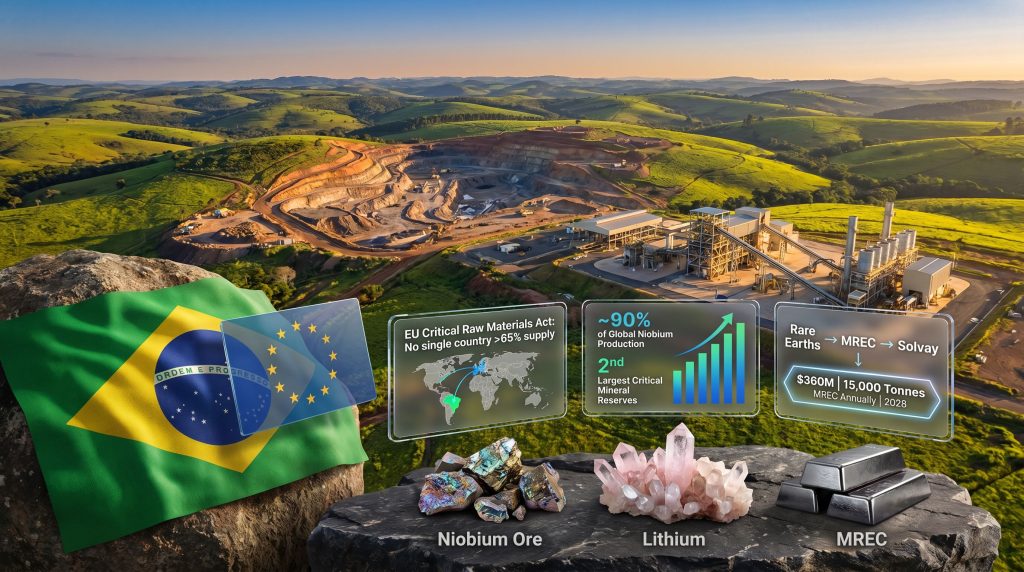
The EU's Critical Raw Materials Act, which came into force in 2024, formalised the bloc's response by establishing binding benchmarks:
- No single third country should supply more than 65% of any one critical material to the EU by 2030
- At least 10% of annual EU strategic mineral consumption must be extracted domestically by 2030
- A minimum of 40% must be processed within the EU by the same deadline
- At least 15% must be sourced from recycled material within the bloc
These targets are ambitious to the point of being structurally unachievable without a substantial and well-organised international partnership network. That is precisely why Brazil has become so central to European planning. Indeed, securing European critical raw materials supply at the required scale demands partnerships with nations holding significant reserve depth.
The Minerals at the Core of the EU-Brazil Strategic Relationship
| Mineral | Brazil's Global Position | Primary EU Application |
|---|---|---|
| Rare Earth Elements | 2nd largest global reserves | EV motors, wind turbines, defence electronics |
| Niobium | ~90% of global production | High-strength steel, aerospace alloys |
| Lithium | Significant and growing reserves | Battery cells, energy storage systems |
| Nickel | Substantial laterite deposits | Battery cathodes, stainless steel |
| Tantalum | Notable reserve base | Electronics, capacitors |
Brazil's niobium position deserves particular attention. The country controls approximately 90% of global niobium production, a degree of market concentration that rivals China's dominance in rare earths yet receives far less analytical coverage. Niobium's role in producing high-strength, lightweight steel alloys makes it essential not only for aerospace applications but increasingly for next-generation electric vehicle chassis design, where weight reduction directly translates into range efficiency.
What Positions Brazil as Europe's Most Strategically Valuable Latin American Partner
Reserve Depth Combined With Democratic Governance
Reserve size alone does not make a nation a reliable strategic partner. The Democratic Republic of Congo holds extraordinary cobalt reserves, yet persistent governance failures and supply chain opacity have driven European battery manufacturers to accelerate cobalt-free cathode chemistries. Brazil occupies a fundamentally different risk category.
Brazil combines:
- The world's second-largest critical mineral reserves across multiple strategic categories
- An established federal and state-level environmental licensing framework, however complex
- A democratic political system with transparent commercial law
- Existing export relationships with European industrial buyers
- A national industrial policy explicitly oriented toward moving up the mineral processing value chain
This last point is critically important. Brazil is not a passive resource exporter seeking capital. Its government has articulated a clear preference for partnerships that build domestic refining and processing capacity, creating higher-margin industrial activity within its borders rather than shipping raw ore offshore. This objective aligns precisely with Europe's preference for purchasing refined intermediate products rather than managing complex ore processing logistics independently.
The EU-Mercosur Framework as Strategic Scaffolding
The broader EU-Mercosur trade agreement provides the macro-level architecture within which bilateral mineral cooperation is developing. While full ratification remains pending, the framework includes provisions for tariff reductions on processed materials and investment facilitation mechanisms designed to incentivise in-country refining over raw ore export.
France's historically resistant posture toward the agreement, driven by agricultural competition concerns, represents the most significant ratification risk within the EU member state cohort. However, project-level cooperation between European companies and Brazilian mineral developers is advancing independently of the agreement's formal status, which means the partnership is building commercial depth even as the legal architecture remains incomplete.
From Diplomatic Framework to Physical Infrastructure: The Rare Earth Processing Model
A Pilot Facility That Could Become a Blueprint
The most tangible expression of the EU Brazil critical minerals partnership at the project level is a rare earth research and processing facility in Poços de Caldas, Minas Gerais, operated by an Australian-listed mining company. The facility, inaugurated in May, can process 100 kilograms of ore per hour, producing mixed rare earth carbonate (MREC) as a refined intermediate product suitable for downstream European processing.
MREC sits at a strategically important position in the rare earth supply chains discussion. It is sufficiently refined to be a meaningful commodity product, but it retains enough processing margin to give European chemical companies — particularly specialty chemical producers — the ability to apply their own separation and refining technologies to produce the specific oxide formulations required for magnet production or phosphor applications. The broader significance of rare earth supply chains to European industrial security cannot be overstated.
The commercial-scale plant planned for 2028 represents a $360 million capital investment and is designed to produce 15,000 tonnes of MREC annually across a licence area exceeding 228 km² in Minas Gerais. At that output scale, the facility would represent a genuinely meaningful contribution to European rare earth supply diversification, not merely a demonstration project.
A non-binding letter of intent between the Minas Gerais rare earth operation and Belgian specialty chemicals group Solvay signals the first concrete European off-take linkage, with discussions toward a binding commercial agreement reportedly at an advanced stage as of mid-2026.
Why Solvay's Involvement Matters Beyond the Off-Take Volume
Solvay's engagement is significant for reasons that extend beyond the volume of MREC it may eventually purchase. As one of Europe's leading specialty chemical producers with established rare earth processing capabilities, Solvay's participation provides the technological processing support dimension that transforms a simple purchase agreement into a genuine supply chain integration.
Consequently, the relationship has the potential to include technology transfer elements that accelerate Brazilian rare earth processing capability while giving Solvay preferential access to a non-Chinese source of feedstock.
Comparing Europe's Approach Against American and Chinese Competitive Strategies
Three Models for Mineral Partnerships: A Structural Comparison
| Partnership Dimension | EU Approach | US Approach | China Approach |
|---|---|---|---|
| Primary Incentive | Sustainability + technology transfer + off-take | Strategic loans + military alignment | Infrastructure investment + long-term offtake |
| Processing Philosophy | Local value-add actively encouraged | Variable by agreement | Raw material extraction historically dominant |
| Environmental Standards | High, EU taxonomy-aligned | Moderate | Low to variable |
| Trade Framework | EU-Mercosur (pending ratification) | Bilateral MOU and IRA-linked instruments | Belt and Road Initiative |
| Geopolitical Framing | Supply chain resilience | China decoupling | Strategic resource control |
The question of whether Europe has arrived late to the competition for Brazilian mineral assets is legitimate but somewhat misframed. China established deep relationships with Brazilian mining operators over the preceding two decades, and US interests under the Inflation Reduction Act framework are actively targeting the same asset pipeline. However, arrival timing matters less than structural fit.
Brazil's own industrial policy trajectory, which prioritises domestic value creation over raw material export, is more naturally aligned with the EU's offer of technology transfer, refining capacity development, and ESG-compliant partnership structures than with extraction-focused models that have historically captured value outside the host country.
The ESG Dimension as Competitive Differentiator
A less commonly analysed aspect of the EU's competitive position in Brazil relates to the EU Taxonomy for Sustainable Activities and its downstream effects on European corporate procurement. European battery manufacturers, automotive OEMs, and chemical producers operating under EU taxonomy disclosure requirements face regulatory incentives to source materials from ESG-compliant supply chains.
In practical terms, this means European buyers have a preference-weighted reason to source from EU-aligned Brazilian projects that goes beyond geopolitical diversification — it is embedded in their own compliance architecture. Furthermore, the growing critical minerals demand driven by the energy transition will only intensify these procurement pressures over the coming decade.
The Expanding Scope Beyond Rare Earths: Lithium and Nickel Priorities
Battery Supply Chain Completeness Requires More Than REEs
Rare earths capture the majority of public attention in critical mineral discussions, but a complete battery supply chain requires lithium, nickel, cobalt, manganese, and graphite in addition to the magnet materials. EU officials have confirmed that both lithium and nickel assets in Brazil are under active consideration as priority cooperation targets.
Brazil's lithium resources, concentrated in Minas Gerais and Bahia, remain significantly underdeveloped relative to those of Chile and Argentina, the two dominant members of the Lithium Triangle. However, Brazil's deposits include both hard rock spodumene and more unusual lithium-in-clay and lithium-in-brine formations that could, if successfully commercialised, add meaningful diversity to the global lithium supply mix. For comparison, Chile's lithium strategy demonstrates how a well-structured national resource policy can attract sustained European industrial investment.
Brazilian nickel laterite deposits offer a geopolitically lower-risk alternative to Indonesian sources, which carry both regulatory uncertainty following Indonesia's nickel export policy interventions and ESG concerns related to rainforest conversion associated with some laterite mining operations.
The next major ASX story will hit our subscribers first
Key Risks That Could Undermine Partnership Momentum
Where the Strategy Remains Structurally Vulnerable
The EU Brazil critical minerals partnership carries several meaningful risk dimensions that investors and policymakers should monitor closely:
- MOU formalisation gap: A government-to-government memorandum of understanding between the EU and Brazil remains under negotiation but has not been finalised. Project-level momentum is advancing faster than the formal diplomatic architecture, creating coherence risk if political priorities shift.
- Infrastructure deficit: Brazil's refining and processing capacity is substantially underdeveloped relative to its reserve base. The $360 million commercial plant investment represents a significant but single data point in what must become a much broader infrastructure development programme.
- Licensing complexity: Brazilian federal and state-level environmental licensing in ecologically sensitive areas like Minas Gerais adds material timeline risk to project development schedules. The Cerrado biome overlaps with significant mineral resource areas, creating ongoing tension between conservation obligations and resource extraction.
- Ratification uncertainty: The EU-Mercosur agreement's full implementation depends on parliamentary ratification across multiple member states, with the outcome remaining genuinely uncertain.
- Chinese incumbent relationships: Chinese state-linked entities maintain established commercial relationships across Brazil's mining sector, and Brazilian producers will continue to evaluate offers from all directions on commercial merit.
The most significant near-term vulnerability is the gap between diplomatic momentum and commercial execution. Off-take frameworks and MOU structures must translate into funded, permitted, and operational facilities to deliver strategic value at the scale European supply chain targets require.
How Brazil Fits Into Europe's Global Mineral Partnership Architecture
Mapping the EU's Critical Mineral Alliance Network
| Partner Country | Key Minerals | Partnership Status | Structural Advantage |
|---|---|---|---|
| Brazil | REEs, Niobium, Lithium, Nickel | Active negotiation + pilot projects | Reserve scale, democratic governance |
| Chile | Lithium, Copper | Strategic Partnership Agreement | World's largest lithium reserves |
| Argentina | Lithium | Early-stage engagement | Lithium Triangle access |
| Canada | Lithium, Cobalt, Nickel | Advanced bilateral cooperation | Shared regulatory standards |
| Namibia | REEs, Uranium | Emerging cooperation | Growing mining sector |
| Kazakhstan | Uranium, REEs | Existing trade flows | Proximity via rail corridor |
Brazil's position within this network is distinctive because it is one of the few partner nations capable of contributing meaningfully across multiple mineral categories simultaneously. Chile offers unparalleled lithium scale but limited rare earth relevance. Canada provides regulatory alignment but at higher cost structures.
Brazil's reserve breadth, combined with its processing ambition and political stability, makes it the most strategically versatile node in the EU's emerging supply chain partnership architecture. According to research from GIGA Hamburg, Europe's quest for critical raw materials in Latin America reflects a broader structural shift in how industrialised economies are approaching resource diplomacy — prioritising resilience over pure cost efficiency.
The geopolitical implication is increasingly clear: the global competition for critical mineral access is being decided not purely by capital deployment speed, but by the quality, sustainability, and mutual benefit embedded in partnership structures. Europe's long-term wager is that a model built on shared industrial development, technology transfer, and ESG alignment will prove more durable than extraction-first alternatives — and that Brazil, with its own sophisticated industrial policy objectives, is exactly the kind of partner for whom that proposition holds genuine appeal.
This article is intended for informational purposes only and does not constitute financial or investment advice. Mineral project timelines, capital expenditure estimates, and partnership outcomes are subject to material uncertainty and may differ significantly from current expectations. Readers should conduct independent due diligence before making any investment decisions.
Want to Capitalise on the Next Major Mineral Discovery Before the Broader Market?
Discovery Alert's proprietary Discovery IQ model scans ASX announcements in real time, instantly identifying significant mineral discoveries across critical commodities — from rare earths to lithium and nickel — and delivering actionable alerts directly to subscribers. Explore Discovery Alert's discoveries page to see how historic ASX mineral discoveries have generated substantial returns, and begin a 14-day free trial to position yourself ahead of the market.