June 23, 2026
The Invisible Architecture of Oil Sanctions: Why the Iran Waiver Changes Everything
Global energy markets are rarely disrupted by a single policy decision, but every few decades a regulatory shift arrives that fundamentally rewires the plumbing of international oil trade. The US authorizes Iranian oil sales through a 60-day general licence, and this moment represents exactly that kind of structural disruption. To understand its full weight, it helps to first grasp how deeply US sanctions had reshaped Iran's place in the global energy ecosystem, and how quietly that system was already beginning to crack before the formal authorisation arrived.
When big ASX news breaks, our subscribers know first
How Sanctions Reshaped Iran's Oil Market Position Over Decades
Iran holds the world's fourth-largest proven crude oil reserves and sits atop some of the most geologically significant petroleum basins in the Middle East. For much of the twentieth century, it was a central pillar of global supply. The progressive tightening of US sanctions, accelerating sharply under the maximum pressure campaign of the late 2010s, effectively cut Iran off from the international financial system and stripped it of access to mainstream tanker insurance markets.
This pressure pushed Iran's export operations into what analysts describe as the shadow economy of global oil trade. Crude oil volatility trends in the years following maximum pressure demonstrated just how dramatically sanctioned supply can reshape benchmark pricing across global markets.
The result was a parallel infrastructure built entirely to circumvent Western oversight:
- A fleet of tankers operating without standard tracking systems, routinely disabling AIS transponders to obscure voyage data
- Complex ship-to-ship transfer operations conducted in international waters to mask cargo origins
- Payment mechanisms routed through intermediary jurisdictions to avoid SWIFT-linked banking networks
- A near-exclusive dependency on Chinese refinery demand, with pricing structured to make Iranian barrels attractive despite the sanctions risk premium Chinese buyers were absorbing
This shadow architecture did not disappear overnight. It is the baseline against which the new general licence must be measured.
What the US Treasury's 60-Day General Licence Actually Authorises
The Office of Foreign Assets Control, or OFAC, is the administrative body within the US Treasury responsible for designing, implementing, and enforcing sanctions programmes. When OFAC issues a general licence, it creates a legal safe harbour for categories of transactions that would otherwise constitute sanctions violations.
Crucially, a general licence does not require individual applicants to seek case-by-case approval, which makes it structurally different from, and considerably broader than, a specific waiver issued to a named entity. According to Bloomberg's reporting on the Treasury authorisation, the scope of activity covered is notably wide.
| Authorisation Category | Included Under Licence |
|---|---|
| Iranian crude oil sales | Yes |
| Petrochemical product exports | Yes |
| Related banking and insurance services | Yes |
| Shipping and transportation services | Yes |
| US importation of Iranian crude (where required to complete a transaction) | Conditionally permitted |
| Transactions involving North Korea | Excluded |
| Transactions involving Cuba | Excluded |
The inclusion of ancillary services, specifically banking, insurance, and shipping, is particularly consequential. Previous Iran-related waivers under prior administrations often created ambiguity around whether service providers enabling oil transactions were themselves exposed to secondary sanctions risk. That ambiguity paralysed participation from European financial institutions and mainstream shipowners even when commodity-level waivers were technically in place.
The current authorisation attempts to resolve that barrier directly. Furthermore, the practical distinction also matters between this 60-day general licence and the shorter, narrower at-sea waiver issued in March 2026. That earlier instrument was limited in scope and duration, primarily designed to manage a specific logistical situation. The June authorisation is structurally broader and tied explicitly to the diplomatic framework signed on June 17.
The June 17 Peace Agreement and Its Supply-Side Consequences
The authorisation did not emerge in isolation. It flows from a formal agreement signed by President Donald Trump on June 17, 2026, ending the military conflict that had begun on February 28 of that year. The deal carries significant supply-chain implications beyond the immediate oil waiver:
- The United States committed to lifting its blockade of Iranian ports, which had been restricting physical cargo movements
- A phased release of frozen Iranian sovereign assets held across multiple jurisdictions is required under the framework
- Continued negotiations are expected to determine the trajectory of broader sanctions programmes over time
One of the most telling market signals emerged even before the formal licence was published. Iranian oil volumes had already begun accelerating into global supply channels in the days following the peace agreement announcement, as market participants anticipated the forthcoming regulatory change.
The general licence, in effect, provided legal legitimacy to cargo flows that were already building in anticipation of it.
This sequencing, where physical oil moves before formal authorisation is in place, illustrates a well-understood dynamic in sanctioned commodity markets: the shadow infrastructure responds to political signals faster than formal legal frameworks can be drafted.
WTI and Brent React: Reading the Price Signal
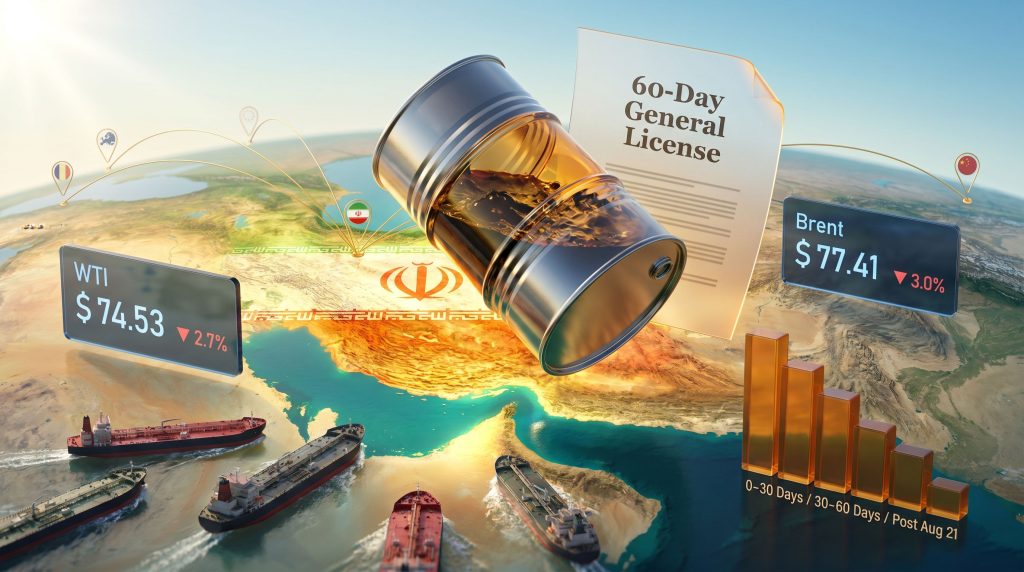
When the US authorizes Iranian oil sales, the immediate market arithmetic points in one direction. At the time of the announcement, WTI crude was trading at $74.53 per barrel, reflecting a decline of more than 2.7%. Brent crude sat at $77.41, down more than 3.0%. These moves were not panic selling; they represented a rational recalibration of near-term supply expectations.
The critical nuance is that Iranian barrels previously flowing almost exclusively to Chinese refiners at steep discounts are now theoretically available to a global buyer pool. That shift changes the competitive dynamics for every barrel of non-Iranian crude currently competing for refinery slot demand in Asia, Europe, and beyond. In addition, OPEC market influence on price floors becomes considerably more complex when a major non-quota producer re-enters legitimate trading channels.
| Timeframe | Market Dynamic |
|---|---|
| Immediate (0-30 days) | Compliance evaluation, logistics sourcing, and financing arrangements by traders and shipowners |
| Near-term (30-60 days) | Incremental Iranian supply enters non-China markets; pricing benchmarks adjust |
| Post-licence (post-August 21) | Outcome entirely dependent on whether the licence is extended or superseded |
| Long-term | Contingent on full sanctions architecture unwinding and Iran's production ramp-up timeline |
The logistical bottleneck is real and should not be underestimated. Companies that spent years building compliance programmes specifically designed to avoid any exposure to Iranian counterparties now face a compressed window to reverse that posture. Legal reviews, counterparty due diligence, trade finance arrangements, and cargo insurance must all be restructured.
China's Dominant Role and the Discount Pricing Dynamic
For years, Chinese independent refiners, often called teapots, served as the anchor demand for Iranian crude. These facilities were willing to absorb the compliance risk of processing sanctioned barrels in exchange for pricing that sat well below comparable Middle Eastern grades. The discount mechanism functioned as an implicit sanctions tax that Iran paid to maintain any export revenue at all.
With the general licence in place, that pricing dynamic faces structural pressure. If Iranian crude becomes legitimately accessible to European and other Asian buyers, the exclusive leverage Chinese refiners held over Iranian pricing weakens. However, this also intersects with the broader US-China oil price impact, which has already been reshaping Asian refinery procurement strategies throughout 2025 and into 2026.
Iran's negotiating position with its primary customer consequently improves, potentially compressing the discount spreads that made the shadow trade so attractive to Chinese buyers in the first place. This is one of the less-discussed but commercially significant downstream effects of the authorisation.
The next major ASX story will hit our subscribers first
Iran's Domestic Economy and the Stakes of Oil Revenue Recovery
The economic backdrop in Iran helps explain why the oil revenue dimension of this deal carries such political weight in Tehran. Sustained sanctions exposure had driven severe currency depreciation, with the Iranian rial losing a substantial portion of its purchasing value over successive rounds of pressure. Inflation had eroded household incomes across the country, and widespread anti-government protests had emerged in the months preceding the February 2026 conflict.
Oil export revenue represents the primary hard currency income source for the Iranian government's fiscal operations. According to US Energy Information Administration data, the United States had not recorded significant imports of Iranian crude or petroleum products since the 1990s, underscoring just how complete the economic severance had become over three decades of escalating restrictions.
The 60-day window, even if it does not lead to full sanctions relief, provides a near-term fiscal breathing space for Iranian authorities while negotiations continue.
The US Domestic Political Fault Lines
Why Does Domestic Opposition Matter?
The authorisation has not been universally welcomed within American political circles. Critics, including members of the Republican Party, have raised concerns that easing financial pressure on Tehran provides resources that could flow toward regional proxy networks and destabilising activities across the Middle East. This is not a fringe position; it reflects a longstanding debate within US foreign policy circles about whether sanctions relief functions as a diplomatic incentive or an unconditional concession.
This debate mirrors earlier arguments that surrounded the US policy shift on PDVSA, where opponents similarly questioned whether eased restrictions would produce verifiable diplomatic gains or simply provide revenue to adversarial governments.
Furthermore, sanctions on Russian oil have demonstrated how enforcement complexity scales when multiple major producers operate outside mainstream trading frameworks simultaneously. The administration's framing positions the waiver as an integral component of a conflict-resolution architecture, not a standalone concession.
Whether that framing holds politically depends heavily on whether the diplomatic process produces verifiable outcomes beyond the 60-day window.
Regulatory Scenarios After August 21
The licence's expiration date is the single most important variable for market participants to monitor. Three credible pathways exist:
| Scenario | Probability Driver | Oil Market Impact |
|---|---|---|
| Licence extended post-August 21 | Continued diplomatic progress between the US and Iran | Sustained supply increase; ongoing downward pressure on crude benchmarks |
| Licence lapses without renewal | Breakdown in US-Iran negotiations | Rapid supply withdrawal; bullish price rebound as shadow flows restructure |
| Multilateral sanctions unwinding | Broader international alignment with the US diplomatic framework | Structural expansion of Iranian export capacity; longer-term bearish supply shift |
The scenario in which the licence lapses is arguably underpriced by markets at present. If negotiations stall and the authorisation is not extended, Iranian barrels that have been legitimised over the 60-day window would face immediate re-sanctioning risk. Consequently, buyers would be compelled to rapidly exit positions and Iranian logistics would revert to shadow fleet operations.
That reversal would be sharper and faster than the initial market re-entry, creating an asymmetric risk profile for anyone building supply strategies around Iranian crude availability.
Frequently Asked Questions: US Authorisation of Iranian Oil Sales
What exactly did the US Treasury authorise regarding Iranian oil?
The Treasury issued a general licence permitting the production, sale, and delivery of Iranian crude oil, petrochemical products, and petroleum derivatives, along with associated banking, insurance, and shipping services, for a 60-day period through August 21, 2026.
How long does the Iranian oil sales authorisation last?
The current general licence runs for 60 days, expiring on August 21, 2026. Whether it is extended depends on the progress of ongoing US-Iran diplomatic negotiations.
Can the United States now import Iranian crude oil directly?
Conditionally yes. The licence permits US importation of Iranian crude where that step is necessary to complete an authorised transaction, though this remains a narrow provision given the absence of established US-Iran crude trade infrastructure since the 1990s.
How does this affect global oil prices in the short term?
The authorisation places downward pressure on crude benchmarks by expanding the addressable buyer pool for Iranian barrels and adding supply into a market already navigating post-Hormuz disruption dynamics.
What happens to the authorisation after August 21?
The outcome depends entirely on diplomatic developments. The licence may be extended, allowed to lapse, or superseded by a broader sanctions-unwinding framework depending on the state of US-Iran negotiations.
Does this mean all Iran-related sanctions have been lifted?
No. The general licence is a time-limited, scoped authorisation. Broader sanctions programmes remain in place, with their future contingent on the negotiation framework established under the June 17 agreement.
How does this differ from previous Iran sanctions waivers?
Prior waivers under previous administrations were typically narrower, shorter in duration, and often created residual ambiguity around service provider liability. The current licence explicitly covers ancillary services, making it structurally more comprehensive than most historical precedents.
Key Takeaways
- The 60-day Treasury general licence represents the most significant formal shift in US-Iran energy sanctions policy in recent decades
- Authorisation covers crude oil, petrochemicals, and all ancillary trade services including banking, insurance, and shipping
- Iranian volumes were already accelerating into global markets before the formal licence was published, reflecting shadow market responsiveness to political signals
- The waiver creates a defined but narrow operational window for market participants to re-engage with Iranian supply chains
- China's historical dominance as the exclusive buyer of Iranian crude faces competitive pressure as other markets gain legal access
- Domestic political opposition within the United States creates genuine uncertainty about whether the authorisation survives past August 21
- The asymmetric risk of a sudden licence lapse represents an underappreciated downside scenario for traders building Iranian supply strategies
This article contains analysis of regulatory developments, commodity market dynamics, and geopolitical scenarios. It does not constitute financial or investment advice. Readers should conduct independent due diligence before making decisions based on the information presented. All price data referenced reflects market conditions at the time of the original announcement on June 22, 2026.
Want to Capitalise on the Next Major Commodity Market Shift?
Discovery Alert's proprietary Discovery IQ model delivers real-time alerts on significant ASX mineral discoveries, instantly translating complex data across 30+ commodities into actionable investment insights — ensuring subscribers are positioned ahead of the broader market. Explore historic examples of major discoveries and their exceptional returns to understand the full potential, then begin your 14-day free trial today to secure a market-leading advantage.