June 23, 2026
The Geopolitics of a Dormant Refinery: Why Morocco's Samir Impasse Keeps Getting Harder to Solve
Across North Africa, the question of who controls the refining of crude oil has never been purely commercial. It sits at the intersection of sovereignty, industrial memory, and the kind of fiscal exposure that keeps finance ministers awake at night. Morocco's Samir refinery encapsulates every dimension of that tension, and the June 2026 vote by the country's Chamber of Counsellors to reject a renationalisation proposal has brought that tension back into sharp focus.
The Morocco Samir refinery state takeover rejection is not a simple story of a parliament blocking an energy security measure. It is the latest episode in a decade-long institutional deadlock shaped by judicial process, crude oil geopolitics, and a debt burden so large it has effectively frozen every attempted resolution since 2016.
When big ASX news breaks, our subscribers know first
Samir's Foundational Role in Morocco's Energy Architecture
Understanding why this refinery still commands such political attention requires going back to what it actually represented. Established in 1959 as a state-owned facility, Samir was Morocco's primary bet on domestic energy sovereignty during the post-independence era. For nearly four decades, it operated as a critical pillar of the country's industrial infrastructure before the Moroccan government privatised the asset in 1997, transferring ownership to Corral Morocco Holdings, a Sweden-registered entity linked to Saudi billionaire Sheikh Mohammed Hussein Al Amoudi.
At its operational peak, the refinery processed up to 200,000 barrels of crude oil per day from its strategically positioned site in Mohammedia, an Atlantic port city with direct access to seaborne crude imports. It supplied approximately 65% of Morocco's domestic fuel demand, functioning as the country's sole crude oil processing facility. That figure alone explains why its closure in 2015 created a structural gap in Morocco's energy supply chain that imports alone have never fully or cheaply replaced.
Key Metrics: Samir Refinery at a Glance
| Metric | Detail |
|---|---|
| Year Established | 1959 |
| Privatised | 1997 |
| Refining Capacity | 200,000 barrels per day |
| Domestic Supply Coverage (Peak) | ~65% of Morocco's fuel demand |
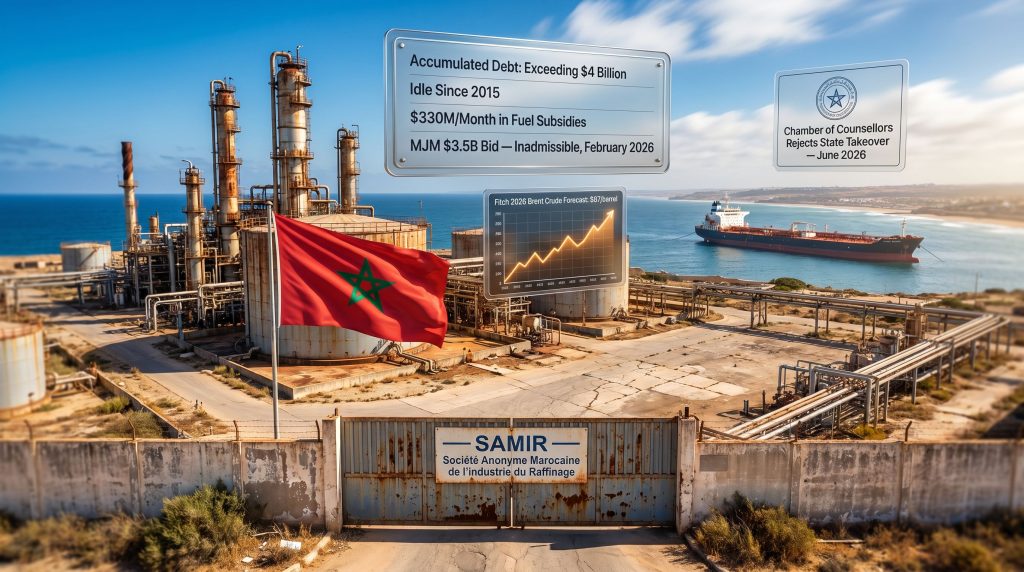
| Accumulated Debt at Closure | Exceeding $4 billion |
| Judicial Liquidation Ordered | 2016 (Casablanca Commercial Court) |
| Operational Status (2026) | Idle since 2015 |
Debt accumulation that eventually exceeded $4 billion forced the Casablanca Commercial Court to order judicial liquidation in 2016. Since then, the refinery has sat idle, its workforce displaced, its infrastructure deteriorating, and its legal status locked within a court-supervised process that has proven remarkably resistant to external intervention.
What the Renationalisation Proposal Actually Proposed
A legislative bloc within Morocco's upper house put forward a formal proposal to transfer Samir's industrial assets back into state hands, framing the argument primarily around fuel supply resilience. The reasoning was grounded in observable reality: Morocco currently imports virtually all of its refined petroleum products, a dependency that has become progressively more expensive and geopolitically precarious.
Proponents pointed to the human dimension as well. Hundreds of former Samir employees, organised under national labour unions, have maintained pressure on lawmakers through years of sustained public demonstrations demanding both facility reactivation and job reinstatement. The social weight of the Mohammedia region's industrial decline has been a persistent undercurrent in Moroccan political debate since the refinery's closure.
The case for state intervention gained additional urgency from the disruption to the Strait of Hormuz, which has forced the Moroccan government to allocate approximately 3 billion dirhams, or roughly $330 million, per month in fuel price subsidies, according to data reported by Arabian Gulf Business Insight (AGBI). That monthly outflow is difficult to sustain indefinitely and has sharpened the political argument for domestic refining capacity.
Why Parliamentary Opponents Blocked the Proposal
Despite the compelling energy security logic, opponents raised concerns that were equally structural. Their core objections centred on three issues:
- Active international arbitration proceedings linked to the liquidation process, which parliamentary critics warned could expose Morocco to significant additional legal liability if state intervention disrupted established dispute resolution mechanisms
- The scale of the accumulated debt, which exceeds $4 billion, raising the question of whether Morocco should absorb a financially distressed asset onto the public balance sheet without a credible plan to address that liability
- The integrity of the judicial liquidation process itself, which opponents argued must be allowed to proceed under its established legal framework without legislative interference that could compromise creditor rights or undermine investor confidence in Moroccan commercial law
The rejection was not simply a vote against energy security. It reflected a deeper institutional tension between legislative ambitions and the binding constraints of an active judicial liquidation process that no parliamentary vote can simply override.
The Hormuz Factor: How Global Disruption Amplifies a Domestic Problem
The timing of the renationalisation debate cannot be separated from its macroeconomic context. The de facto closure of the Strait of Hormuz has materially worsened Morocco's structural exposure as a zero-refining, fuel-importing economy. Furthermore, Fitch Ratings raised its 2026 Brent crude forecast to $87 per barrel, up from a prior estimate of $70, specifically citing prolonged supply disruption risk stemming from Hormuz instability. Monitoring the current crude oil prices remains essential for understanding the scale of Morocco's exposure.
For Morocco, that repricing environment is not abstract. Every dollar increase in crude prices translates directly into higher import costs and larger subsidy commitments from a public treasury that is simultaneously managing broader fiscal pressures.
Morocco's Fuel Import Exposure: Contextual Benchmarks
| Indicator | Value |
|---|---|
| Monthly Government Fuel Subsidy Cost | |
| Domestic Refining Capacity (Operational) | Zero (since 2015) |
| Fitch 2026 Brent Crude Forecast | $87/barrel |
| Samir's Historical Domestic Supply Share | ~65% |
What makes Morocco's position particularly exposed is that its vulnerability is not merely about crude price levels but about its complete absence from the value chain between raw crude and usable refined products. Countries with operational refining capacity can at least partially absorb crude price volatility through refining margins and local price controls. Morocco has no such buffer.
The Hormuz disruption has also reactivated a broader policy debate across North Africa about whether economies that previously held domestic refining infrastructure should treat its absence as an acceptable cost of market liberalisation or as a strategic error requiring correction. In addition, OPEC's market influence on global supply dynamics continues to shape the pricing environment that makes Morocco's import dependency increasingly costly.
The MJM Investments Rejection: What It Reveals About the Legal Barrier
One of the least widely understood dimensions of the Samir impasse is how demanding the legal framework around its liquidation has proven to be, even for well-capitalised private investors. In February 2026, Dubai-based MJM Investments submitted a formal acquisition proposal valued at approximately $3.5 billion for Samir's industrial assets. The Casablanca Commercial Court declared the bid inadmissible within the same month.
According to reporting by H24info, the court's analysis concluded that the conditions embedded in the investor's proposal were structurally incompatible with the procedural and legal requirements of the court-supervised sale process. The rejection was not a strategic or geopolitical objection. It was a procedural determination: the bid's legal architecture did not conform to court-defined parameters.
What Court-Supervised Liquidation Actually Requires
This is a critically important distinction that is often lost in political commentary about the Samir situation. Under Moroccan commercial law, assets held in judicial liquidation are subject to a tightly regulated sale process. Prospective acquirers must satisfy requirements covering:
- Debt settlement provisions that address the claims of secured and unsecured creditors in a manner acceptable to the supervising court
- Employment obligations, including commitments regarding the workforce and any associated social costs
- Operational continuity commitments that demonstrate the buyer's capacity and intent to restore productive use of the asset
- Precise legal conformity with court-defined bid terms, where any deviation can result in rejection regardless of financial merit
The rejection of a $3.5 billion bid on procedural grounds is a signal that the bar for compliant acquisition is exceptionally high. Any future buyer must engineer their proposal around the court's requirements first and their own commercial terms second, which fundamentally changes the deal structure that most private investors would naturally prefer.
The Casablanca Commercial Court's authority over Samir's liquidation supersedes both parliamentary proposals and private acquisition bids that fall outside court-defined parameters. Any resolution pathway must be built within this judicial framework, not as an alternative to it.
A Decade of Deadlock: The Structural Timeline
The persistence of the Samir impasse over more than a decade reflects interlocking barriers that have consistently prevented resolution regardless of which avenue has been attempted.
| Year | Key Event |
|---|---|
| 1959 | Samir established as state-owned refinery |
| 1997 | Privatised to Corral Morocco Holdings |
| 2015 | Refinery ceases operations |
| 2016 | Casablanca Commercial Court orders judicial liquidation |
| Post-2016 | Repeated labour union demonstrations; recurring parliamentary debates |
| February 2026 | MJM Investments $3.5 billion bid declared inadmissible |
| June 2026 | Chamber of Counsellors rejects renationalisation proposal |
Three structural barriers have consistently blocked resolution across every attempted pathway:
- Legal complexity: Active international arbitration proceedings and court-supervised liquidation create competing jurisdictional constraints that limit what any single actor, whether legislative, executive, or private, can accomplish unilaterally
- Financial scale: The $4 billion-plus debt burden makes any acquisition or state reabsorption financially demanding, and no credible debt restructuring plan has yet survived the court's scrutiny
- Political divergence: Competing legislative priorities between energy security advocates and fiscal discipline proponents have prevented the parliamentary consensus necessary to back any specific resolution model
The next major ASX story will hit our subscribers first
Three Scenarios for Resolution: Probability and Trade-offs
With the renationalisation pathway now closed and the most recent private bid rejected, three theoretical resolution scenarios remain.
Scenario A: Compliant Private Acquisition
A future investor constructs a bid that fully satisfies the Casablanca Commercial Court's procedural requirements. This means accepting the court's terms on debt settlement, employment obligations, and operational commitments before negotiating any commercial features. The February 2026 rejection of the MJM bid suggests this is technically possible but demands a buyer willing to cede significant negotiating flexibility to court-defined parameters.
Scenario B: State-Facilitated Hybrid Restructuring
Rather than outright renationalisation, the Moroccan government negotiates a structured intervention through a state-linked entity that satisfies court requirements while pursuing energy security objectives. This model would require legislative authorisation, careful court coordination, and a mechanism for addressing the debt burden that does not simply transfer it unresolved onto the public balance sheet.
Scenario C: Continued Asset Liquidation
The court proceeds with piecemeal disposal of individual refinery components to multiple buyers. This pathway preserves legal integrity and satisfies creditors incrementally but permanently forecloses any possibility of restarting integrated refining operations at Mohammedia. It resolves the legal problem while abandoning the energy security one entirely.
Each scenario carries distinct trade-offs between legal compliance, fiscal exposure, energy security outcomes, and the obligations owed to a workforce that has waited over a decade for resolution.
The Continental Policy Lens: State Ownership vs. Market Discipline
The Samir case is not uniquely Moroccan in its underlying tensions. Across North and Sub-Saharan Africa, governments have repeatedly faced the dilemma of whether strategic industrial assets should remain under sovereign control, even at fiscal cost, or be subjected to market disciplines that can produce efficiency gains but also create the kind of structural vulnerability Morocco now faces.
Countries including Algeria, Egypt, and Nigeria have maintained state-controlled refining infrastructure, effectively treating the associated subsidy and operational costs as a premium paid for sovereign energy security. Morocco's 1997 exit from refining, viewed through the lens of 2026's geopolitical environment and elevated crude prices, now appears to carry costs that were not fully priced into the privatisation decision at the time.
This does not mean privatisation was wrong in 1997. However, it means that the risk calculus for energy sector liberalisation in import-dependent economies shifts substantially when global supply chains face the kind of disruption currently emanating from Hormuz. Consequently, the geopolitical trade tensions reshaping the broader region are amplifying the strategic cost of Morocco's absent refining capacity. The lesson is less about ownership ideology and more about the long-tail risks of exiting strategic industrial sectors without preserving fallback capacity.
The Social Dimension That Statistics Cannot Fully Capture
Any analysis of the Morocco Samir refinery state takeover rejection that focuses exclusively on financial and legal mechanics risks missing a significant part of the picture. The Mohammedia workforce displaced by the 2015 closure has remained politically active and economically vulnerable for over a decade. Their sustained mobilisation, backed by national trade unions, has kept the issue alive in public discourse long after it might otherwise have faded.
This social dimension creates a distinctive political dynamic. Lawmakers cannot treat Samir purely as a commercial liquidation problem because the human cost of the closure remains visible, organised, and vocal. Any viable resolution pathway, whether through private acquisition, hybrid restructuring, or continued liquidation, will face a legitimacy test on workforce outcomes that is separate from and potentially more politically demanding than its legal and financial dimensions. The trade war economic impact on global commodity markets further complicates Morocco's ability to attract the kind of foreign investment that might otherwise resolve this impasse.
Frequently Asked Questions: Morocco Samir Refinery
Why did Morocco's upper house reject the Samir refinery state takeover?
The Chamber of Counsellors rejected the renationalisation proposal primarily because of concerns about active international arbitration proceedings linked to the liquidation and the risk of transferring a facility carrying more than $4 billion in accumulated debt onto the public balance sheet. Opponents argued that legislative intervention could compromise the court-supervised liquidation process and expose Morocco to additional legal liability.
What is the current status of the Samir refinery in 2026?
As of June 2026, the Samir refinery remains idle and under judicial liquidation overseen by the Casablanca Commercial Court. It has not processed crude oil since 2015. A $3.5 billion acquisition bid from Dubai-based MJM Investments was declared inadmissible in February 2026, and the parliamentary renationalisation proposal was rejected in June 2026.
How much debt does the Samir refinery carry?
Accumulated debt exceeded $4 billion at the time the Casablanca Commercial Court ordered judicial liquidation in 2016. This figure has remained the central financial obstacle to both private acquisition and state reabsorption.
What is Morocco's current fuel import situation?
Morocco currently imports virtually all of its refined petroleum products. The Hormuz disruption has intensified this dependency, with government fuel price subsidies running at approximately 3 billion dirhams (roughly $330 million) per month as of mid-2026, according to AGBI.
Could the Samir refinery ever reopen?
Reopening remains theoretically possible but faces compounding barriers: a court-supervised liquidation process with strict bid compliance requirements, over $4 billion in legacy debt, active international arbitration, and the need for a credible operational and investment plan. A compliant private acquisition or a carefully structured state-facilitated intervention represent the most viable, though still uncertain, pathways to resuming operations.
This article is intended for informational purposes only and does not constitute financial or investment advice. Forecasts cited, including Fitch Ratings' 2026 Brent crude price projection, represent third-party estimates subject to revision and should not be relied upon as definitive predictions of future market conditions.
Want to Stay Ahead of the Commodity Shifts Reshaping Global Energy Markets?
As geopolitical disruptions continue to drive crude oil price volatility and reshape supply chains, Discovery Alert's proprietary Discovery IQ model delivers real-time alerts on significant ASX mineral discoveries — transforming complex commodity data into actionable investment insights for both short-term traders and long-term investors. Explore how historic mineral discoveries have generated substantial returns and begin your 14-day free trial today to position yourself ahead of the market.