June 23, 2026
The Geology of Leverage: How Guinea Turned Rock Into Global Market Power
Most commodity markets shift gradually. Decades pass between the emergence of a dominant supplier and the moment that supplier recognises its own structural power. Guinea's trajectory through the global bauxite market has compressed that timeline dramatically, moving from marginal exporter to undisputed feedstock architect within a single decade. Understanding why this matters requires looking beyond the headline statistics and into the geological, economic, and geopolitical forces that have converged to make Guinea bauxite dominance reshaping aluminum supply one of the most consequential stories in global industrial commodities today.
When big ASX news breaks, our subscribers know first
Why Guinea's Bauxite Is Geologically Different From Almost Every Other Source
Bauxite is technically the third most abundant mineral group in the Earth's crust, yet this geological ubiquity is misleading. The vast majority of bauxite deposits worldwide are either too geographically dispersed, too chemically impure, or too low in aluminium oxide content to justify the economics of large-scale alumina refining. The critical differentiator is not simply volume but metallurgical grade.
Guinea's deposits occupy a rare tier of quality. The country's reserves are characterised by naturally low silica content, which is the single most important chemical variable in determining processing efficiency. High silica concentrations in bauxite create what refiners call reactive silica, which combines irreversibly with caustic soda during the Bayer refining process, destroying expensive reagent inputs and generating large volumes of problematic waste material known as red mud.
Low-silica Guinean ore avoids this penalty almost entirely, reducing both input costs and environmental liabilities for downstream refiners. This geological advantage translates directly into cost economics. Refineries processing high-purity Guinean bauxite can produce alumina at meaningfully lower cost per tonne than those processing lower-grade material from other origins. For Chinese alumina refiners who have built their entire cost model around access to this specific feedstock, the quality differential is not a preference but a structural dependency.
How Dominant Is Guinea in the Global Bauxite Market?
Breaking Down Guinea's Market Share by the Numbers
The scale of Guinea's position in global bauxite trade is without modern precedent for a single nation in this particular commodity. The bauxite production leaders of today look remarkably different from just a decade ago, and Guinea sits at the centre of that transformation.
| Metric | Data Point |
|---|---|
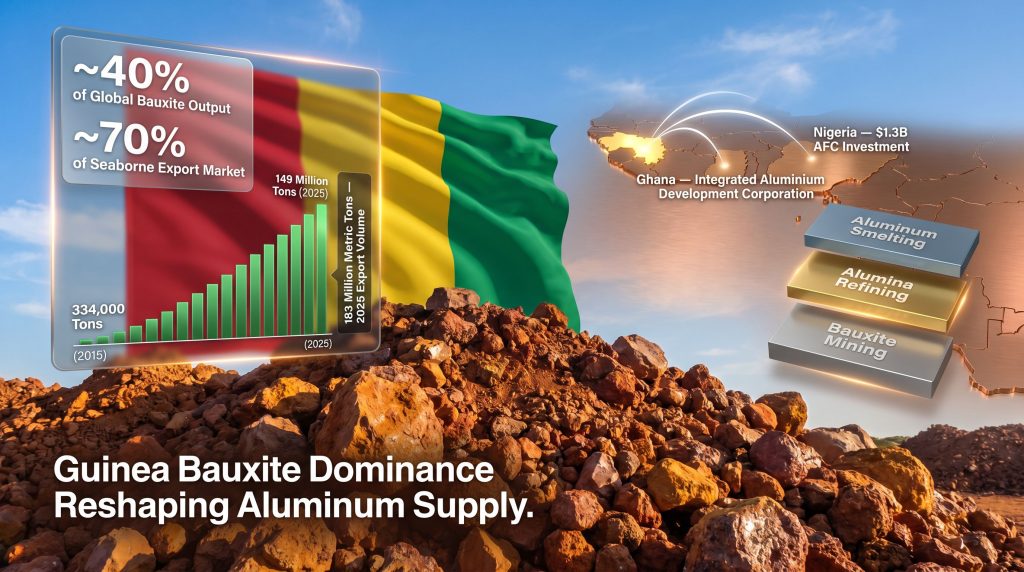
| Share of global bauxite output | ~40% |
| Share of seaborne export market | ~70% |
| Guinea's 2025 export volume | 183 million metric tons |
| Year-on-year export growth (2025) | +25% |
| China's Guinea bauxite imports (2015) | 334,000 tons |
| China's Guinea bauxite imports (2025) | 149 million tons |
| Guinea's share of China's total bauxite imports (2025) | ~74% |
| Bauxite price movement (2025 to early 2026) | Declined ~50% |
These figures reveal a structural paradox that sits at the heart of Guinea's current policy challenge. The country's market share grew so rapidly that it simultaneously created dominant supply power and destroyed the pricing power that dominance should theoretically provide. A nation controlling 70% of seaborne bauxite trade should command premium prices. Instead, unconstrained export growth flooded global markets and caused bauxite prices to collapse by approximately 50% between 2025 and early 2026.
When Did Guinea Overtake Australia and Why It Matters
Guinea surpassed Australia as the world's largest bauxite producer in 2023, a milestone driven almost entirely by Chinese capital flowing into West African extraction infrastructure. Australia had held its leading position for decades, supported by world-class logistics, established port infrastructure, and long-term supply contracts with Asian refiners. Furthermore, the largest bauxite mines globally have increasingly shifted toward West African operations as a result.
Guinea's displacement of this entrenched incumbent happened with remarkable speed, underscoring how quickly Chinese industrial capital can reshape global commodity geography when strategic necessity aligns with available resource endowment. The significance extends beyond a simple change in league table rankings. Australia's bauxite sector operates under transparent regulatory frameworks, stable property rights, and predictable export conditions. Guinea's rise introduces a fundamentally different risk profile into the global alumina supply chain, one that combines geological superiority with political volatility and an explicit government agenda to reshape market structure.
What Is the Resource Nationalism Playbook and How Does Guinea Fit In?
Indonesia, Congo, and the Emerging Template
Guinea is not pioneering a new strategy. It is adapting an increasingly familiar template that resource-rich developing nations have deployed with varying degrees of success across different commodities.
| Country | Commodity | Policy Mechanism | Primary Goal |
|---|---|---|---|
| Indonesia | Nickel | Export ban (2023) | Force domestic processing |
| DR Congo | Cobalt | Export quota system | Control oversupply |
| Guinea | Bauxite | Mixed quota model (proposed) | Pricing control + value capture |
Indonesia's nickel export ban provides the most instructive precedent. By prohibiting raw nickel ore exports and mandating domestic processing, Jakarta forced global battery supply chains to redirect capital toward Indonesian refining infrastructure. The strategy achieved its processing objective but also created significant market disruption, price volatility, and accusations of trade policy manipulation at the World Trade Organization.
Congo's cobalt experiment has been messier. Export quota announcements were poorly sequenced and inconsistently enforced, contributing to market confusion rather than the controlled price recovery the government sought. Guinea's policymakers have studied both cases carefully, with Conakry reportedly favouring a hybrid model that combines production quotas with export caps, specifically designed to prevent operators from exporting volumes beyond what their licensed mining quotas permit.
Why Oversupply Is the Trigger, Not Scarcity
A critical and counterintuitive aspect of Guinea's situation is that the policy intervention is being driven by abundance rather than depletion. This distinguishes Guinea's challenge from the conventional resource nationalism narrative, where governments typically act when rising prices attract excessive foreign extraction. According to Reuters, Guinea is now leveraging this abundance as a deliberate geopolitical and economic instrument.
Guinea's 25% year-on-year export growth in 2025, reaching 183 million metric tons, was the direct cause of the ~50% price collapse that followed. The government is not trying to protect a scarce resource from being exhausted. It is trying to impose discipline on an extraction sector that has grown so rapidly it is systematically destroying the economic value of the nation's primary asset.
This is a commodity market dynamic that rarely receives adequate attention: dominant producers can be simultaneously powerful and economically vulnerable, particularly when the production incentives of individual operators collectively undermine the market price that makes production worthwhile.
How Deeply Is China Exposed to Guinea's Bauxite Policy Shifts?
A Decade of Dependency Traced Through Import Data
The transformation of China's relationship with Guinean bauxite over a single decade represents one of the most dramatic supply chain concentration stories in modern industrial history. Chinese imports grew from 334,000 tons in 2015 to 149 million tons in 2025, an increase of approximately 44,600% over ten years. By 2025, Guinean material accounted for 74% of all Chinese bauxite imports.
This dependency did not develop accidentally. It reflects a deliberate Chinese industrial strategy of securing low-cost, high-quality feedstock to support massive domestic aluminum smelting capacity expansion. China has built out smelting infrastructure far beyond what its own depleted domestic bauxite reserves can support. Decades of intensive mining have drawn down China's higher-grade domestic deposits, leaving the country increasingly reliant on lower-quality domestic ore supplemented by imported Guinean material.
The Structural Lock-In Problem
The scale of this dependency means that China cannot meaningfully substitute away from Guinean bauxite within any realistic short-to-medium term planning horizon. Alternative sources, including Australia, Brazil, and India, do not collectively possess sufficient available export capacity to replace Guinean volumes, nor do they consistently offer the same low-silica quality specifications that Chinese refinery processes have been optimised around.
Chinese buyers demonstrated acute awareness of this vulnerability in March 2026, when monthly imports from Guinea hit a record 18 million tons in a single month, reflecting aggressive precautionary stockpiling ahead of anticipated export control announcements. This behaviour is itself a signal to Guinean policymakers that downstream dependency is real and that the threat of supply restriction carries genuine economic weight.
"The pattern of record-high stockpiling immediately preceding policy announcements is a classic feature of commodity markets facing structural supply uncertainty. It temporarily inflates demand signals while simultaneously building the inventory buffers that reduce short-term sensitivity to the very restriction being feared."
What Happens to China's Alumina Refinery Network Under Supply Restriction?
China's domestic alumina refining capacity has been built at a scale that requires continuous high-volume feedstock supply. Any meaningful reduction in Guinean bauxite availability would force Chinese refiners to choose between running at reduced utilisation rates, switching to lower-quality domestic or alternative-origin ore at higher processing cost, or bidding up prices for available Guinean material in a tighter market.
All three outcomes ultimately increase the cost of alumina production in China, which then flows through to domestic aluminum smelter input costs and ultimately to the price of finished aluminum products. The transmission mechanism from Guinea's export policy to global aluminum pricing, whilst not instantaneous, is structurally intact. Consequently, developments in the bauxite and alumina market are being watched closely by industry participants worldwide.
Is Guinea Capable of Moving Up the Aluminum Value Chain?
Understanding the Three-Stage Processing Ladder
The aluminum production chain involves three sequentially more complex and capital-intensive transformation stages:
-
Bauxite Mining — Raw ore extraction from surface or near-surface deposits. Guinea's current primary economic activity, characterised by relatively low capital intensity and high export volume.
-
Alumina Refining — The Bayer process converts bauxite into aluminium oxide powder. Requires significant capital investment in chemical processing infrastructure, caustic soda supply chains, and waste management systems. Adds substantial value per tonne compared to raw ore.
-
Aluminum Smelting — Electrolytic reduction of aluminium oxide into primary metal. Extremely energy-intensive, requiring access to large volumes of low-cost power. Currently beyond Guinea's infrastructure capacity.
Guinea's Alumina Target and the Chinese Refinery Commitment
Guinea's government has set an ambition to develop five or six alumina processing plants with a combined nameplate capacity of 7 million tons per year by 2030. This target represents a fundamental shift in the country's industrial structure, moving from a raw material exporter toward a first-stage processor capable of capturing significantly more value per tonne of bauxite extracted.
The clearest evidence that this strategy is gaining traction is Chalco's commitment to build a 1.2-million-ton-per-year alumina refinery in Guinea at a cost of approximately $1 billion. This represents the first major overseas alumina refinery investment by China's largest state aluminum producer, a significant departure from Beijing's traditional preference for processing raw material imports domestically. In addition, alumina refining investment more broadly is accelerating as global players position themselves for a tighter supply environment. Two additional Chinese-backed alumina refinery projects have also been announced in recent months.
The fact that Chinese state capital is flowing into Guinean refining capacity reflects a calculated response to the growing risk that Guinea will restrict raw bauxite exports. By establishing refining operations inside Guinea, Chinese entities position themselves to access alumina even in a scenario where bauxite export quotas make raw ore trade progressively less attractive.
The Friguia Legacy and the Emirates Warning
Guinea's only currently operational alumina refinery is the Friguia plant, a facility originally constructed in the 1960s that passed through French, American, and Russian ownership before being restarted after a six-year shutdown between 2012 and 2018. It currently operates below its 650,000-ton-per-year nameplate capacity, underscoring both the potential and the operational challenges of Guinea's existing processing infrastructure.
The Guinean government sent an unambiguous signal to foreign operators in 2025 when it seized mining assets from Emirates Global Aluminium following that company's failure to honour downstream processing commitments. The message was clear: Guinea will enforce its industrialisation agenda through asset-level consequences, not merely through regulatory paperwork. This represents a materially higher-risk operating environment for any company holding Guinean mining licences without credible processing plans attached.
The Energy Constraint That Limits Vertical Integration
Unlike Indonesia, which possesses abundant domestic coal-fired power generation capacity capable of supporting both alumina refining and aluminum smelting, Guinea lacks the energy infrastructure to advance meaningfully beyond the refining stage in the near term. Aluminum smelting requires enormous quantities of electricity, typically making it economically viable only in locations with access to very low-cost hydro or fossil fuel power. This constraint does not eliminate Guinea's value-capture ambitions but does define their ceiling for the current planning horizon.
The next major ASX story will hit our subscribers first
Could West Africa Become a New Global Alumina Hub?
A Regional Pattern Taking Shape
Guinea's industrialisation push is not occurring in isolation. Neighbouring West African nations with their own bauxite endowments are pursuing parallel strategies, suggesting that a regional processing cluster rather than a single-nation story may be the more accurate long-term frame. As Al Circle reports, Guinea's journey from discovery to global dominance is reshaping how the industry thinks about West African resource geography.
Nigeria has signed a $1.3 billion investment deal with the Africa Finance Corporation to develop domestic alumina refining capacity. Ghana is advancing plans under the Ghana Integrated Aluminium Development Corporation framework to develop its own bauxite-to-alumina processing capability. Neither country possesses Guinea's reserve scale or geological quality, but both add meaningful additional capacity to what could eventually function as an integrated West African alumina production corridor.
Scenario Modelling: Two Plausible Futures
Scenario A: Partial Transition (2026 to 2030)
Guinea implements export quotas, two or three new alumina refineries come online, and seaborne raw bauxite trade contracts modestly. West African alumina exports begin competing with Australian and Chinese refinery output at the margins of the global market.
Scenario B: Accelerated Hub Formation (post-2030)
Nigeria, Ghana, and Guinea collectively scale alumina refining toward 10 million tons or more per year. Chinese domestic alumina refiners face direct cost competition from the same country that supplies their primary feedstock, structurally compressing margins across Asia's aluminum production complex.
The key variable separating these two scenarios is energy infrastructure development. If Guinea and its neighbours can resolve power supply constraints through hydroelectric development or regional grid integration, the timeline for Scenario B compresses significantly.
What Are the Supply Chain Risks for Aluminum Consumers Globally?
Risk Matrix: Three Policy Scenarios
| Policy Scenario | Bauxite Price Impact | Alumina Price Impact | Aluminum Price Impact |
|---|---|---|---|
| No quota implementation | Continued price depression | Stable to declining | Modest downward pressure |
| Moderate export quota | Price recovery (+20 to 35%) | Upward pressure | Moderate cost-push inflation |
| Aggressive quota + processing mandate | Sharp price spike | Significant tightening | Elevated smelter input costs globally |
Governance and Infrastructure Caveats
Guinea's industrial ambitions carry material non-commercial risks that any supply chain analysis must incorporate. The country's governance environment has been characterised by political instability, regulatory unpredictability, and documented concerns around community benefit-sharing from extractive revenues. Infrastructure deficits beyond energy, including port capacity, road networks, and water supply for industrial processing, represent genuine constraints on the speed and scale of refinery buildout.
It is also worth noting that market dominance does not automatically translate into durable pricing power. Indonesia's nickel export ban successfully forced processing investment onshore but also accelerated the development of alternative battery chemistries that reduce nickel intensity in electric vehicle batteries. Guinea faces an analogous risk: if bauxite export restrictions push alumina prices high enough for long enough, they create economic incentives for investment in alumina refinery capacity in other jurisdictions, potentially undermining the very supply tightness that justifies the intervention.
Frequently Asked Questions: Guinea Bauxite and the Aluminum Supply Chain
Why Is Guinea's Bauxite Considered Higher Quality Than Other Global Sources?
Guinea's reserves are prized for their naturally low silica content and high metallurgical grade, making them particularly efficient for conversion into alumina with lower processing costs and energy requirements compared to lower-grade deposits found in other producing regions.
What Percentage of Global Bauxite Does Guinea Produce?
Guinea currently accounts for approximately 40% of total global bauxite production and controls around 70% of the seaborne export market, the largest concentration of bauxite supply power held by any single nation in the commodity's modern history. The top aluminium producers globally are consequently recalibrating their supply chain strategies in response.
How Would Guinea's Export Quotas Affect Aluminum Prices?
Tighter export controls on bauxite would reduce feedstock availability for alumina refineries, particularly in China, placing upward cost pressure across the entire aluminum production chain. The magnitude would depend on quota severity, enforcement consistency, and how quickly alternative supply sources or processing capacity could be developed elsewhere.
Is Guinea Planning to Ban Bauxite Exports Like Indonesia Did With Nickel?
Guinea is evaluating a hybrid policy model that combines production quotas with export caps rather than implementing an outright ban. The government's objective appears focused on slowing oversupply-driven price erosion while simultaneously incentivising domestic alumina refining investment from foreign operators.
What Role Does China Play in Guinea's Bauxite Sector?
Chinese capital has been the primary driver of Guinea's bauxite expansion, with imports growing from 334,000 tons in 2015 to 149 million tons in 2025. Chinese state-linked entities are also leading new alumina refinery investment inside Guinea, reflecting a strategic calculation that maintaining feedstock access under tighter export conditions requires establishing processing presence inside the country itself.
Could West Africa Replace China as the Dominant Alumina Producer?
Not in the near term. However, a coordinated West African alumina hub anchored by Guinea, Nigeria, and Ghana could meaningfully diversify global alumina supply away from Chinese refinery dominance over a 10 to 15 year horizon, particularly if energy infrastructure constraints are resolved through large-scale hydro or regional power grid development.
Key Takeaways: The Strategic Implications of Guinea's Bauxite Dominance
Guinea bauxite dominance reshaping aluminum supply is not a future scenario — it is an unfolding structural reality with immediate implications for pricing, supply chains, and industrial policy worldwide. The key points to retain are as follows:
- Guinea controls approximately 40% of global bauxite output and 70% of seaborne trade, giving it structural leverage unmatched by any prior single-nation position in this market
- The ~50% price collapse in bauxite values between 2025 and early 2026 is the direct consequence of unconstrained export growth, and this price destruction is the primary catalyst for Guinea's policy pivot toward export controls
- China's dependency on Guinean bauxite is structurally irreversible in the short to medium term, with 74% of its bauxite imports sourced from a single country whose government is actively reshaping supply conditions
- The shift from raw ore export to alumina refining represents a fundamental value-capture realignment that will compress margins for Chinese domestic refiners competing with their own primary feedstock supplier
- A West African alumina hub is an emerging long-term scenario, with Nigeria and Ghana advancing parallel investment programs that could collectively reshape global alumina trade flows
- Governance instability, energy infrastructure deficits, and local community benefit-sharing tensions remain material risks that could slow, destabilise, or partially reverse Guinea's industrial ambitions
- The geological specificity of Guinea's low-silica bauxite creates a quality-based dependency that goes beyond simple volume substitution, making Chinese refiners structurally sensitive to Guinean supply conditions in ways that cannot be resolved merely by sourcing alternative origins
Disclaimer: This article contains forward-looking analysis and scenario modelling based on publicly available data and structural market assessments. It does not constitute financial advice. Commodity market outcomes are subject to significant uncertainty, and actual developments in Guinea's export policy, bauxite pricing, and regional processing capacity may differ materially from the scenarios described. Readers should conduct independent research before making any investment decisions related to aluminum, bauxite, or associated supply chain equities.
Want to Track the Next Major Mineral Discovery Before the Broader Market Does?
Discovery Alert's proprietary Discovery IQ model delivers real-time alerts on significant ASX mineral discoveries — instantly cutting through complex geological and commodity data to surface actionable investment opportunities across aluminium, bauxite, and over 30 other commodities. Explore historic discoveries and their market returns, then begin your 14-day free trial at Discovery Alert to position yourself ahead of the next major find.