August 6, 2026
The Hidden Cost Beneath Europe's Critical Minerals Ambition
The commodity markets that underpin modern civilisation have always operated on an uncomfortable truth: whoever controls the chokepoints controls the price. For decades, that leverage resided within the oil-producing nations of the Middle East. Today, for a growing category of materials that power electric vehicles, wind turbines, semiconductors, and precision weapons systems, that chokepoint sits firmly within China's refining and processing infrastructure. Understanding why the European Union's response to this reality is both necessary and genuinely difficult requires stepping back from the politics and examining the structural mechanics at play.
Europe's push toward EU critical metals stockpiling is not simply a reactive policy measure. It reflects a fundamental reassessment of supply chain architecture that has been building for well over a decade, accelerated sharply by China's export restriction actions on gallium and germanium in 2023 and further amplified by its subsequent controls on rare earth exports. The challenge is not whether stockpiling is warranted. The challenge is whether it can be executed without becoming an enormously expensive exercise in fiscal exposure.
When big ASX news breaks, our subscribers know first
Europe's Structural Dependency: More Fragile Than It Appears
The depth of Europe's critical minerals supply chain vulnerability is frequently underestimated, even by informed observers. The conventional narrative focuses on mining: Europe doesn't mine enough of these materials domestically. That framing, while accurate, misses the more acute problem. Even where primary ore exists globally outside China, the processing and refining infrastructure needed to convert raw ore into usable industrial inputs is overwhelmingly concentrated in Chinese facilities.
China currently accounts for roughly 85 to 90% of global rare earth processing, approximately 80% of global tungsten production, and an estimated 80% of global gallium supply. Germanium, critical to fiber optics and infrared applications, sees around 60% of global supply flowing through Chinese operations. For cobalt, while significant ore originates in the Democratic Republic of Congo, approximately 70% of global refining capacity runs through China.
This is not accidental. China's dominance in critical minerals processing was built over several decades through sustained state investment, tolerance for lower environmental standards during the build-up phase, and strategic patience. Replicating this infrastructure outside China within any meaningful policy timeframe is genuinely difficult, as highlighted by ongoing rare earth processing challenges across the continent.
What the CRMA Actually Demands
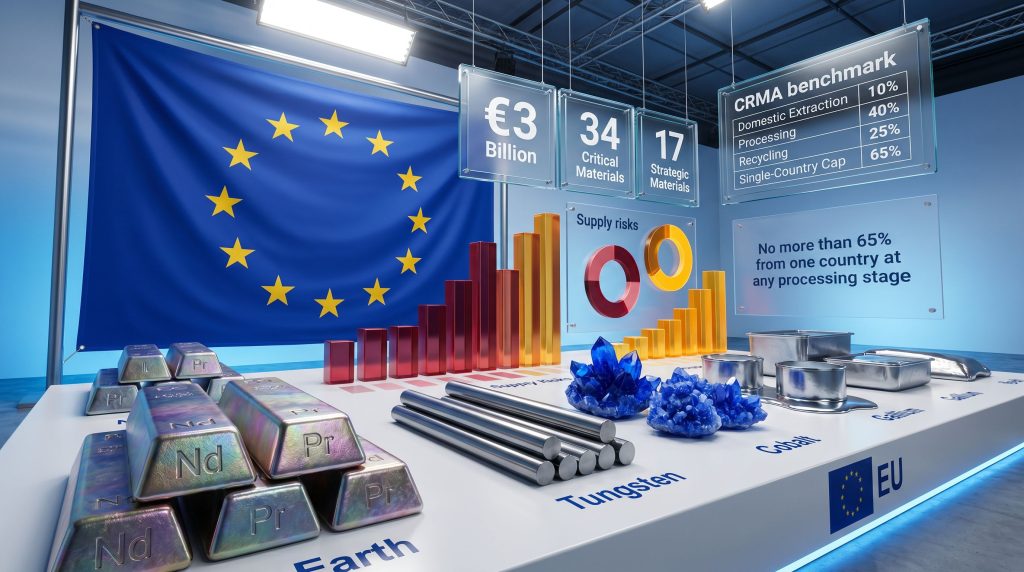
The critical raw materials facility established under the EU's Critical Raw Materials Act, which came into force in 2024, establishes a dual-tier classification covering 34 critical raw materials and 17 strategic raw materials. The strategic tier, which attracts the most intensive policy focus, includes lithium, cobalt, rare earth elements, graphite, silicon, nickel, copper, manganese, boron, gallium, germanium, titanium, tungsten, and platinum group metals.
The European Critical Raw Materials Act sets binding 2030 benchmarks that represent a significant structural departure from current EU capabilities:
| CRMA Target | Benchmark by 2030 |
|---|---|
| Domestic Extraction | At least 10% of annual EU needs |
| Domestic Processing | At least 40% of annual EU needs |
| Domestic Recycling | At least 25% of annual EU needs |
| Single-Country Import Cap | No more than 65% from any one country |
The 65% single-country import cap is arguably the most strategically significant provision. It is, in effect, a direct legislative response to China's refining dominance. Meeting it requires either dramatic expansion of European processing capacity or successful diversification to alternative supplier nations, including Australia, Canada, and emerging African producers. Neither pathway is fast or cheap.
The €3 Billion Question: What Can It Actually Buy?
The European Commission has allocated €3 billion (approximately $3.5 billion USD) in 2026 to reduce supply dependency on China, including the creation of a new institutional body to oversee strategic investments and manage the development of physical stockpiles. The ambition is clear. The arithmetic, however, presents significant complications.
To contextualise that figure: Europe's annual import exposure across all critical and strategic raw materials runs into the tens of billions of euros. A €3 billion initial commitment represents a meaningful signal of intent, but falls considerably short of fully funding the buffer stocks needed to provide genuine supply security across the full strategic materials list. Furthermore, the critical minerals demand surge driven by the energy transition is compressing procurement timelines across the board.
For comparison, the United States manages strategic materials stockpiles through the Defense Logistics Agency with a multi-decade institutional history and dedicated congressional appropriations. Japan's rare earth stockpile program, established following China's 2010 export restriction episode, was designed to maintain 60-day supply buffers for key materials and required years of sustained procurement to build.
The more acute fiscal challenge, however, lies not in the headline commitment but in the price differential problem.
Why Procurement Costs in Europe Are Structurally Elevated
A less widely understood dimension of EU critical metals stockpiling is that European spot prices for many of these materials are materially higher than prevailing Chinese market prices. This divergence is not arbitrary. It reflects two compounding factors:
- Supply scarcity outside China: because Chinese processing infrastructure dominates global output, non-Chinese supply available to European buyers is structurally limited, pushing prices above Chinese benchmarks
- Market opacity: without liquid, transparent European spot markets, price discovery is inefficient, counterparty risk is elevated, and buyers cannot accurately assess whether they are procuring at fair value
When a government begins acquiring physical stockpiles under these conditions, it absorbs the price differential between inflated European spot prices and lower Chinese benchmark prices. This is not a one-time cost. Storage, management, insurance, and eventual liquidation or drawdown mechanisms add ongoing fiscal exposure. EIT RawMaterials, an EU-funded group that works to secure critical minerals supplies for the bloc, has explicitly flagged this risk, characterising stockpiling and floor pricing as potentially transformative but also potentially very expensive for taxpayers.
Stockpiling and floor pricing may represent necessary transitional measures, but without price transparency infrastructure already in place, governments risk systematically overpaying with no reliable market signal to validate their procurement decisions.
The Price Transparency Problem: The Missing Infrastructure Layer
Perhaps the least discussed but most consequential barrier to effective EU critical metals stockpiling is the near-complete absence of credible, liquid European pricing benchmarks for most strategic materials. This is not a minor technical gap. It is a structural obstacle that undermines every other element of the policy toolkit.
Consider the investment chain logic:
- A European mining or refining project needs project finance to proceed
- Project finance requires bankable economics, which depend on credible price assumptions
- Credible price assumptions require transparent, liquid spot market data
- That spot market data does not currently exist for most European critical minerals markets
- Without it, lenders and institutional investors cannot underwrite the risk, so projects stall
This circular dependency explains why European mining and refining projects have historically struggled to secure financing even when the underlying geology is sound and the strategic case is clear. The absence of price transparency doesn't just complicate stockpiling. It suppresses the private sector investment that would otherwise reduce the need for government stockpiles in the first place.
Building the Benchmark Infrastructure
Metalshub, a metals sourcing and supply platform, is working alongside EU-funded bodies to generate the spot price data needed to develop credible European price indices. The platform currently facilitates trading in cerium, antimony, vanadium, cobalt sulfate, and battery materials, with its battery supply chain network recently expanding to include cobalt sulfate transactions following Jervois Finland's participation as a seller.
The core argument from Metalshub's co-founders is pointed: without liquid, transparent markets, any government stockpiling programme carries a high inherent risk of wasting public money. Private investors require price clarity before capital can flow into new supply projects. Off-take agreements, which provide producers with demand certainty and form a key pillar of the CRMA's supply security toolkit, become significantly harder to structure and price without credible benchmark references.
For comparison, the London Metal Exchange model for base metals, or Platts pricing for energy commodities, demonstrates that transparent, third-party-verified benchmarks directly enable financing, hedging, and long-term contracting across entire supply chains. Critical minerals currently lack an equivalent European architecture.
Price Floors: Strategic Tool or Fiscal Trap?
The US has been actively pushing allied nations, including the EU, to adopt coordinated price floor frameworks for critical minerals. A price floor functions as a government-backed minimum price guarantee for producers, designed to ensure that Chinese below-cost competition cannot render domestic or allied-nation supply economically unviable.
The EU has acknowledged that price floors could form part of a broader policy toolbox, alongside stockpiling, off-take agreements, domestic mining incentives, and recycling mandates. The table below summarises how these tools compare:
| Policy Tool | Primary Purpose | Key Risk | Time Horizon |
|---|---|---|---|
| Strategic Stockpiling | Buffer against supply disruption | High fiscal cost, market distortion | Short-to-medium term |
| Price Floors | Producer viability protection | Taxpayer subsidy exposure | Medium term |
| Off-Take Agreements | Demand certainty for producers | Government commitment risk | Medium-to-long term |
| Domestic Mining Incentives | Supply base expansion | Permitting delays, capital intensity | Long term |
| Recycling Mandates | Circular supply development | Technology and scale limitations | Long term |
| Import Diversification | Reduce single-source dependency | Geopolitical complexity | Ongoing |
The critical concern raised by policy analysts is sustainability. Price floors and off-take agreements may be necessary transitional interventions, but they are not permanent structural solutions. If the underlying price transparency and investment infrastructure is not built in parallel, these mechanisms become indefinite fiscal commitments rather than time-limited bridge instruments.
There is also a geopolitical risk dimension that receives insufficient attention. Large-scale government procurement at above-market prices can create artificial demand signals that push prices higher for industrial consumers. More significantly, overt stockpiling campaigns targeting specific materials could provoke retaliatory export restriction measures from China, precisely the scenario such programmes are designed to hedge against.
Which Metals Face the Highest Supply Risk
Not all strategic materials carry equal urgency. A practical prioritisation framework combines three variables: supply concentration risk, strategic application criticality, and substitutability. Materials that score poorly on all three represent the most acute vulnerabilities. In particular, the antimony supply risks for defence and industrial applications have drawn growing concern from European policymakers.
| Metal | Primary Strategic Use | China's Share of Supply | EU Vulnerability Level |
|---|---|---|---|
| Rare Earth Elements | Permanent magnets, EVs, wind turbines | ~85-90% of global processing | Critical |
| Tungsten | Defence, cutting tools, aerospace | ~80% of global production | Critical |
| Gallium | Semiconductors, defence electronics | ~80% of global supply | Critical |
| Germanium | Fibre optics, infrared optics | ~60% of global supply | High |
| Cobalt | EV batteries, aerospace alloys | ~70% of refining via China | High |
| Antimony | Flame retardants, military munitions | ~50%+ of global supply | High |
| Vanadium | Steel alloys, grid-scale batteries | Significant Chinese production | Moderate-High |
Supply concentration figures are approximate and reflect current global market assessments.
Tungsten deserves particular attention. Its applications in defence-grade cutting tools, ammunition penetrators, and aerospace components make it a material where supply disruption carries direct national security implications beyond economic inconvenience. China's approximately 80% share of global tungsten production, combined with its demonstrated willingness to use export controls as geopolitical leverage, places it at the top of most stockpile priority assessments.
The next major ASX story will hit our subscribers first
Lessons From Established Stockpile Models
Europe is not building from a blank slate. Instructive precedents exist, though their direct applicability requires careful evaluation.
Japan established its rare earth stockpile programme in the aftermath of China's 2010 export restriction episode, which saw Chinese rare earth export quotas reduced dramatically and prices spike by several hundred percent within months. The Japanese programme was designed to maintain roughly 60-day supply buffers for critical materials and is managed through a combination of government and industry-held reserves.
The lesson Japan drew was that stockpiling alone was insufficient: it simultaneously invested heavily in supply diversification, materials substitution research, and efficiency improvements to reduce rare earth intensity in key manufacturing processes.
The US Defense Logistics Agency manages a strategic materials stockpile focused specifically on defence-critical minerals, with congressional oversight and defined acquisition criteria. The key structural difference from what the EU is proposing is institutional clarity: defined drawdown triggers, transparent acquisition processes, and alignment with specific defence industrial requirements.
The EU faces an additional coordination challenge that neither Japan nor the US confronts at the same scale: aligning 27 member states with divergent industrial bases, energy mixes, and strategic priorities around a unified stockpiling framework. According to recent reporting, Italy, France, and Germany are currently leading the EU's critical materials stockpiling planning efforts. A country with significant automotive manufacturing exposure has different priority minerals than one focused on aerospace or semiconductor production.
The Path From Emergency Buffers to Supply Sovereignty
Effective EU critical metals stockpiling cannot be evaluated in isolation. It is one instrument within a multi-horizon strategy that must ultimately deliver structural supply sovereignty rather than perpetual emergency preparedness.
The sequencing matters enormously:
- Near-term: Develop price transparency infrastructure, establish benchmarks for highest-risk materials, acquire emergency buffers for materials with greatest supply concentration and lowest substitutability
- Medium-term: Scale off-take agreements backed by credible price indices, activate domestic project pipelines, advance recycling capacity toward CRMA 2030 targets
- Long-term: Achieve the 10% extraction, 40% processing, and 25% recycling benchmarks, build European pricing authority comparable to LME for base metals, structurally reduce import dependency below the 65% single-country threshold
The investment financing challenge is central to this progression. Without price benchmarks, project economics cannot be validated. Without bankable project economics, neither commercial lenders nor institutional investors will commit capital at the scale needed. The European Investment Bank and EU development finance instruments have a role to play in bridging this gap during the transition period, but they cannot substitute indefinitely for functional private capital markets.
The foundational infrastructure that makes EU critical metals stockpiling fiscally defensible is not physical warehousing capacity. It is the pricing architecture that allows governments and investors alike to know what they are actually paying for.
FAQs: EU Critical Metals Stockpiling Explained
What is the EU's Critical Raw Materials Act?
The CRMA is the EU's primary legislative framework for securing strategic and critical raw material supply chains. It sets 2030 targets for domestic extraction (10%), processing (40%), and recycling (25%) of annual EU needs, whilst capping reliance on any single third-country supplier at 65% at any processing stage.
Which metals is the EU prioritising for stockpiling?
The highest-priority materials include rare earth elements, tungsten, gallium, germanium, cobalt, antimony, and vanadium. The full CRMA strategic list covers 17 minerals across green technology, defence, aerospace, and digital applications.
Why is EU critical metals stockpiling so expensive?
European prices for many critical minerals are substantially higher than Chinese market prices due to supply scarcity and the absence of transparent European spot markets. Governments acquiring materials under these conditions must absorb the price differential, creating significant and potentially ongoing fiscal exposure on top of storage and management costs.
What is a critical minerals price floor?
A price floor is a minimum price guarantee provided to producers, ensuring that below-cost competition from dominant suppliers cannot make domestic or allied-nation production economically unviable. The US has been actively promoting coordinated price floor adoption among allied nations including the EU.
How does price transparency affect critical minerals investment?
Without reliable price benchmarks, private investors cannot accurately assess project economics, making it difficult to secure financing for new mining and refining operations. Transparent price indices reduce counterparty risk in off-take agreements and provide the clarity institutional investors require before committing capital.
Is stockpiling a long-term solution?
Stockpiling is widely regarded as a transitional or emergency buffer measure rather than a structural solution. Long-term supply security requires investment in domestic extraction, processing, and recycling capacity, combined with diversified import relationships and robust pricing infrastructure.
Disclaimer: This article is intended for informational purposes only and does not constitute financial or investment advice. Figures relating to supply concentration, market shares, and policy commitments reflect current publicly available assessments and are subject to change. Readers should conduct independent research before making any investment or policy-related decisions.
Want To Identify ASX Mineral Discoveries Before the Broader Market Does?
Discovery Alert's proprietary Discovery IQ model delivers real-time alerts on significant ASX mineral discoveries across critical and strategic commodities, turning complex mineral data into actionable investment insights for both short-term traders and long-term investors. Explore historic examples of major discoveries and their returns to understand the opportunity, then begin your 14-day free trial to position yourself ahead of the market.