June 15, 2026
What Is Driving Europe's Current Energy Security Crisis?
The EU energy transition crisis represents one of the most complex challenges facing European policymakers today. European energy markets are confronting unprecedented disruptions that expose fundamental vulnerabilities within the continent's industrial architecture. The convergence of geopolitical tensions, infrastructure limitations, and market structure weaknesses threatens to reshape the competitive landscape for energy-intensive manufacturing across the European Union. These challenges emerge at a critical juncture when the bloc attempts to balance immediate energy security concerns with long-term decarbonisation objectives.
Geopolitical Supply Chain Vulnerabilities
The European energy system remains critically exposed to global market volatility despite efforts to diversify supply sources following Russian sanctions. Recent Middle East conflicts have demonstrated how rapidly geopolitical events can translate into severe market disruptions across European trading hubs.
The Dutch TTF natural gas benchmark experienced dramatic price volatility, surging more than 40 percent during a single trading session as military actions disrupted production facilities. Furthermore, examining natural gas trends reveals how quickly global events impact European markets.
QatarEnergy suspended liquefied natural gas production at its Ras Laffan Industrial City complex following reported attacks on critical infrastructure. This suspension affects approximately 8-10 percent of European LNG imports, creating immediate supply constraints. Additionally, the OPEC production impact demonstrates how production decisions affect global energy security.
Key vulnerability factors include:
- Transit route dependencies: Critical energy shipments traverse geopolitically sensitive corridors including the Strait of Hormuz and Suez Canal
- Concentrated supplier base: Qatar represents roughly 40 percent of global LNG trade capacity
- Limited alternative activation speed: Backup suppliers require weeks or months to increase production and delivery
Storage Infrastructure Deficits
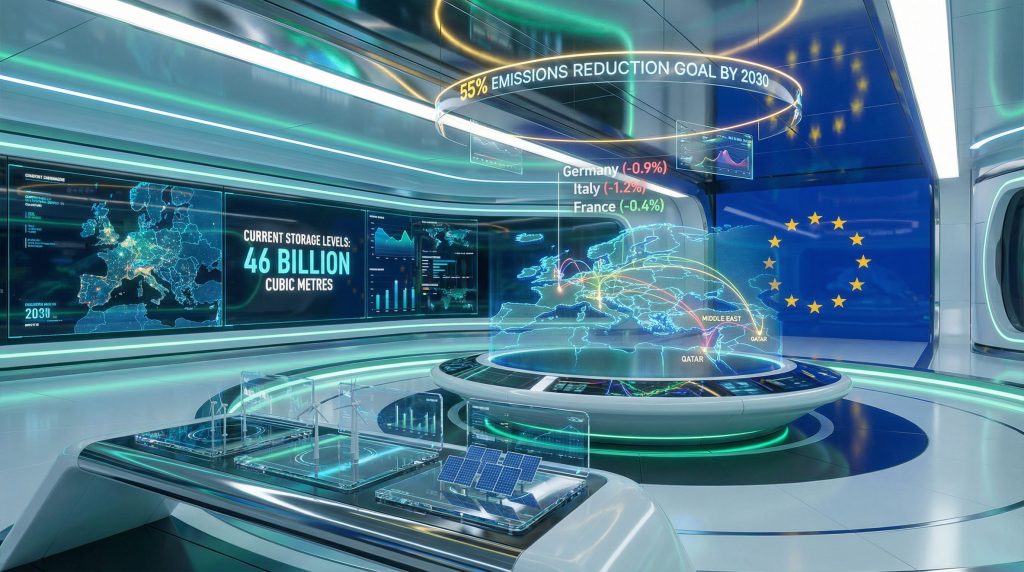
European gas storage levels present concerning trends that amplify crisis vulnerabilities. Current storage capacity stands at 46 billion cubic metres as of late February 2026, representing a significant decline from historical benchmarks.
Storage Level Comparison:
| Year | Storage Volume (BCM) | Percentage Change |
|---|---|---|
| 2024 | 77 billion cubic metres | Baseline |
| 2025 | 60 billion cubic metres | -22.1% |
| 2026 | 46 billion cubic metres | -40.3% from 2024 |
This 23.3 percent year-over-year decline creates substantial buffer constraints during supply disruptions. Lower storage levels complicate refilling operations during critical spring and summer months when facilities typically rebuild reserves for winter demand periods.
Regional storage distribution varies significantly across member states, with Germany, France, and Italy maintaining the largest capacity shares. However, interconnection limitations prevent efficient redistribution during localised shortages, creating pockets of heightened vulnerability.
Market Structure Weaknesses
European energy markets exhibit structural characteristics that amplify price volatility during supply disruptions. The transition away from long-term Russian contracts has increased reliance on spot market purchases, exposing buyers to immediate price fluctuations.
The gas-to-electricity price transmission mechanism creates cascading effects throughout the energy system. Natural gas plants frequently operate as marginal price-setting units during peak demand periods, meaning wholesale gas price increases directly impact electricity costs across all generation sources.
The continued reliance on imported fossil fuels traded on volatile global markets maintains Europe's exposure to geopolitical shocks, even after shifting dependencies from Russia to alternative suppliers.
Market fragmentation across member states prevents efficient price discovery and resource allocation during crisis periods. Regulatory differences and limited cross-border trading capacity constrain the system's ability to optimise available supplies regionally.
When big ASX news breaks, our subscribers know first
How Are Rising Energy Costs Reshaping European Industrial Competitiveness?
Manufacturing Sector Impact Analysis
Energy-intensive industries face mounting pressure from sustained cost increases that erode profit margins and competitive positioning. Chemical manufacturers, steel producers, ceramics companies, and pulp facilities experience disproportionate impacts due to energy comprising 15-40 percent of total production costs.
The price transmission effects from natural gas markets create immediate operational challenges:
- Direct fuel costs: Natural gas used for heating, steam generation, and chemical feedstock
- Electricity price increases: Gas-fired power plants set marginal electricity prices during peak periods
- Contract renegotiation impacts: Long-term energy agreements expire and require renewal at elevated market rates
European manufacturers increasingly face cost disadvantages relative to competitors in regions with lower energy prices, particularly China and the United States. This competitive erosion threatens industrial base retention and investment attraction for energy-intensive sectors.
Economic Output Consequences
Macroeconomic modelling suggests potential 0.8 percent reduction in European industrial output by 2026 if current energy cost trends persist. Country-specific impacts vary based on industrial composition and energy market structures:
- Germany: Projected -0.9% output decline reflecting heavy industrial base
- Italy: Estimated -1.2% reduction due to limited domestic energy resources
- France: Moderate -0.4% impact supported by nuclear electricity generation
These projections assume continued elevated energy prices and limited supply chain improvements. Sectors most vulnerable to output reductions include:
- Chemical manufacturing: Ethylene crackers and ammonia synthesis facilities
- Primary steel production: Electric arc furnaces and integrated mills
- Glass and ceramics: High-temperature continuous process operations
- Aluminium smelting: Electricity-intensive electrolytic reduction processes
Supply Chain Reorganisation Trends
European companies increasingly evaluate operational relocations to regions offering lower energy costs and greater supply security. Investment flows redirect toward facilities in North America, Southeast Asia, and other markets with competitive energy pricing.
Strategic industry retention policies emerge as governments recognise the economic and strategic implications of industrial base erosion. Policy tools include:
- Energy cost subsidies: Temporary support for energy-intensive manufacturers
- Accelerated depreciation: Tax incentives for energy efficiency investments
- Green transition funding: Subsidised financing for renewable energy adoption
However, these measures create fiscal burdens and potential trade disputes regarding state aid compatibility with international commerce rules. Moreover, understanding decarbonisation benefits helps industries balance transition costs with long-term advantages.
What Role Does Renewable Energy Play in Crisis Mitigation?
Current Renewable Energy Achievements
Wind and solar technologies achieved a historic milestone in 2025 by generating more electricity than fossil fuel sources across the European Union. This transition represents fundamental progress toward energy independence, though challenges remain in addressing seasonal variability and storage requirements.
Renewable capacity expansion rates accelerated significantly, with member states adding approximately 42 GW of new wind capacity and 56 GW of solar installations during 2025. Germany, Spain, and France led deployment efforts, while Eastern European nations increased installation rates substantially.
Grid integration challenges accompany rapid renewable expansion:
- Intermittency management: Wind and solar output fluctuations require flexible backup generation or storage systems
- Transmission congestion: Renewable resources often locate distant from major consumption centres
- Frequency stability: Large renewable penetration affects grid stability and requires sophisticated control systems
Energy Efficiency Gains and Innovation
Efficiency improvements across industrial processes and building systems contribute approximately 3 percent annual energy demand reduction, partially offsetting supply constraints. Directed technical change accelerates innovation in energy-saving technologies as elevated prices incentivise efficiency investments.
Key innovation areas include:
- Industrial process optimisation: Heat recovery systems and process integration
- Building envelope improvements: Insulation, windows, and thermal management
- Smart energy management: Automated demand response and load optimisation
- Waste heat utilisation: Industrial symbiosis and district heating integration
Research and development investment patterns shift toward clean energy technologies, with private sector funding responding to market signals created by sustained energy price premiums.
Transition Timeline and Targets
The European Union maintains its 55 percent emissions reduction target by 2030 relative to 1990 levels, requiring continued acceleration of renewable deployment and efficiency measures. Renewable Energy Directive updates establish binding targets for member states aligned with overall decarbonisation objectives.
Electrification strategy implementation proceeds across multiple sectors:
- Transport electrification: Electric vehicle adoption and charging infrastructure expansion
- Industrial heat pumps: Replacing gas-fired heating systems with electric alternatives
- Green hydrogen production: Electrolysis capacity expansion for industrial applications
Timeline achievement depends critically on resolving grid infrastructure limitations and developing adequate energy storage capacity to manage renewable intermittency at scale. Additionally, securing energy transition minerals remains crucial for renewable technology manufacturing.
How Are EU Policymakers Responding to Energy Security Challenges?
2026 Commission Work Programme Priorities
European policymakers prioritise energy security measures within the broader Green Deal framework, recognising the intersection between climate objectives and supply security concerns. The planned Electrification Strategy launch in Q1 2026 addresses systematic barriers to renewable energy adoption and grid modernisation.
The EU's comprehensive approach to addressing energy challenges involves multiple policy instruments working in coordination.
Energy Security Package components under development include:
- Supply diversification requirements: Minimum supplier portfolio standards for member states
- Strategic reserve enhancement: Expanded storage capacity and emergency response protocols
- Infrastructure resilience standards: Cybersecurity and climate adaptation requirements
Energy Union Governance framework updates aim to improve coordination mechanisms among member states during crisis periods and optimise resource allocation across regional markets.
Carbon Pricing and Market Integration
The European Emissions Trading System (ETS) faces fragmentation challenges as proposed ETS2 expansion to buildings and transport creates parallel carbon pricing mechanisms. Policy harmonisation proposals target 2031 implementation to unify carbon markets and reduce compliance complexity.
Current ETS carbon prices range between €80-100 per tonne, creating competitiveness concerns for energy-intensive industries competing against regions with lower or absent carbon pricing. Market linkage mechanisms with other carbon trading systems could reduce overall compliance costs through expanded trading opportunities.
Cost reduction strategies include:
- Free allocation adjustments: Protecting trade-exposed industries while maintaining decarbonisation incentives
- Carbon border adjustments: Proposed import tariffs on carbon-intensive products from non-participating countries
- Innovation funding: Revenue recycling toward clean technology development and deployment
Infrastructure and Grid Resilience Measures
Interconnection projects receive accelerated development priority to enhance energy solidarity among member states. Key infrastructure investments include:
- Cross-border electricity lines: Expanding transmission capacity between regional markets
- LNG terminal additions: Diversifying import infrastructure beyond existing facilities
- Hydrogen pipeline networks: Preparing infrastructure for future hydrogen economy development
Emergency response coordination mechanisms establish protocols for rapid information sharing and resource deployment during supply disruptions. Climate adaptation requirements address extreme weather impacts on energy infrastructure reliability.
Consequently, European raw materials supply strategies become increasingly important for supporting infrastructure development.
What Are the Long-Term Implications for European Energy Independence?
Import Dependency Reduction Strategies
European energy independence requires systematic reduction of fossil fuel import dependencies currently representing approximately 60 percent of primary energy consumption. Domestic renewable production scaling offers the most promising pathway toward supply security, though implementation timelines extend across multiple decades.
Critical mineral supply chain diversification emerges as a parallel challenge, with renewable technologies requiring lithium, cobalt, nickel, and rare earth elements predominantly sourced from geopolitically sensitive regions. Strategic partnerships with reliable suppliers and domestic processing capacity development become essential components of long-term security planning.
Offshore wind resources present particularly significant expansion opportunities, with North Sea, Baltic Sea, and Atlantic coastal areas offering substantial untapped capacity. However, grid infrastructure investments and maritime spatial planning coordination require substantial lead times and investment commitments.
Technology Innovation Pathways
Nuclear energy maintains relevance for baseload power provision, offering 80-90 percent capacity factors that complement intermittent renewable sources. Current EU nuclear capacity totals approximately 100 GW across 17 member states, though new construction faces 10-15 year development timelines and substantial cost escalation risks demonstrated by recent UK and French projects.
Green hydrogen economy development progresses through electrolysis capacity expansion, targeting industrial applications in steel production, chemical manufacturing, and refining sectors. Cost parity challenges persist with current green hydrogen production costs of €4-6 per kilogram compared to fossil-based hydrogen at €1-2 per kilogram.
Energy storage technology advancement addresses renewable intermittency through multiple approaches:
- Battery storage systems: 4-6 hour duration for daily cycling applications
- Pumped hydroelectric storage: 12-24 hour capacity for longer-term balancing
- Power-to-gas systems: Hydrogen or methane synthesis from excess renewable generation
Economic Resilience Building
Industrial policy adaptations support energy transition while maintaining manufacturing competitiveness through targeted investment incentives and regulatory frameworks. Regional development strategies focus on areas with high renewable energy potential to create new economic opportunities in rural and coastal regions.
The transition creates both challenges and opportunities for European economic resilience. Energy-intensive industries face continued pressure, while renewable energy equipment manufacturing, grid technology development, and energy services sectors experience growth opportunities.
Research indicates that strategic planning approaches can help balance immediate crisis response with long-term sustainability objectives.
How Do Recent Blackouts Highlight Grid Modernisation Needs?
Infrastructure Vulnerability Assessment
Recent power outages affecting Spain, Portugal, and Southern France demonstrate grid vulnerability during extreme weather events and highlight integration challenges accompanying renewable energy expansion. These disruptions reveal coordination weaknesses between transmission system operators and inadequate backup systems for critical infrastructure protection.
Grid stability challenges intensify as renewable energy penetration increases, requiring sophisticated forecasting systems and flexible generation resources to manage output variability. Traditional grid management approaches designed for predictable fossil fuel generation prove inadequate for managing distributed, intermittent renewable sources.
Weather-related disruption patterns show increasing frequency and severity, with climate change creating more extreme events that stress ageing transmission infrastructure. Adaptation measures require substantial investment in underground cables, storm-resistant tower designs, and redundant routing options.
Smart Grid Technology Requirements
Advanced grid technologies become essential for managing complex energy flows from distributed renewable sources and optimising system efficiency. Real-time demand management systems enable automatic load adjustments during supply fluctuations, reducing outage risks and improving overall system resilience.
Key technology components include:
- Advanced metering infrastructure: Real-time consumption monitoring and bidirectional communication
- Distributed energy resource management: Coordinating small-scale generation and storage systems
- Predictive maintenance systems: Sensor networks and analytics for proactive infrastructure management
- Automated demand response: Consumer devices that adjust consumption based on grid conditions
Investment requirements for comprehensive grid modernisation span multiple decades and require coordinated planning among member states to ensure interoperability and cost optimisation.
The next major ASX story will hit our subscribers first
What Contingency Plans Exist for Future Energy Disruptions?
Emergency Response Protocols
European energy security protocols establish monitoring systems for LNG supply chains and early warning mechanisms for potential disruptions. Coordinated demand reduction procedures enable rapid consumption decreases during supply emergencies through industrial load curtailment and consumer conservation measures.
Strategic reserve deployment procedures provide frameworks for releasing stored natural gas and activating backup generation capacity during crisis periods. These mechanisms require regular testing and updating to ensure effectiveness during actual emergencies.
Communication systems among member states enable rapid information sharing about supply conditions and coordinate regional response measures to optimise available resources across the European Union.
Regional Cooperation Frameworks
Cross-border energy sharing agreements establish legal and technical frameworks for mutual assistance during supply disruptions. Joint procurement initiatives leverage collective bargaining power to secure alternative energy sources and reduce individual member state vulnerabilities.
Crisis coordination protocols designate responsible authorities and establish clear decision-making procedures during emergency conditions. Regular exercises test these systems and identify improvement opportunities before actual deployment becomes necessary.
Regional solidarity mechanisms ensure that supply constraints distribute equitably across member states rather than creating severe shortages in individual countries while others maintain adequate reserves.
Market Stabilisation Tools
Price volatility mitigation instruments include circuit breakers that temporarily halt trading during extreme price movements and strategic reserve releases that inject supply during market stress periods. These tools aim to prevent panic buying and excessive speculation during crisis conditions.
Supply contract diversification strategies reduce dependency on single suppliers or transportation routes through portfolio requirements and long-term agreement structures. Alternative energy source activation procedures establish pre-negotiated arrangements for emergency supply increases from backup providers.
Financial market interventions provide liquidity support for energy trading systems during stress periods and prevent market dysfunction that could amplify physical supply disruptions through financial constraints.
Balancing Affordability, Security, and Decarbonisation
Short-Term Stabilisation Priorities
Immediate energy security measures focus on supply diversification, storage capacity enhancement, and emergency response system optimisation. Price shock mitigation strategies include temporary subsidies for vulnerable consumers and strategic reserve utilisation during market stress periods.
Industrial competitiveness protection requires balanced approaches that support energy-intensive manufacturers while maintaining decarbonisation momentum. Targeted assistance programmes and accelerated efficiency investments can reduce vulnerability without compromising long-term climate objectives.
Long-Term Strategic Vision
European energy independence pathways require sustained investment in renewable energy capacity, grid modernisation, and energy storage systems across multiple decades. Climate goal alignment with security objectives creates synergies where domestic renewable production simultaneously reduces import dependencies and emissions.
The EU energy transition crisis presents both immediate challenges and long-term opportunities for economic transformation. Success requires coordinated policy implementation, substantial infrastructure investment, and technological innovation while maintaining social and political consensus for sustained effort across changing electoral cycles.
Furthermore, addressing the EU energy transition crisis necessitates comprehensive planning that considers both technical and political dimensions. In addition, the EU energy transition crisis highlights the interconnected nature of energy security, economic competitiveness, and environmental sustainability.
This analysis reflects current market conditions and policy developments. Energy markets remain subject to rapid changes based on geopolitical events, technological developments, and policy decisions that may affect future outcomes.
Looking to Capitalise on Critical Minerals Driving Europe's Energy Transition?
Discovery Alert's proprietary Discovery IQ model delivers real-time alerts on significant critical mineral discoveries essential for Europe's renewable energy infrastructure, instantly empowering subscribers to identify actionable opportunities ahead of the broader market. Visit Discovery Alert's dedicated discoveries page to understand why historic discoveries can generate substantial returns, then begin your 14-day free trial today to position yourself ahead of the market.