
July 13, 2026
When Trade Becomes a Weapon: Understanding the EU's Gold Sanctions Against Sudan
Commodity markets have long operated on a foundational assumption: that the price of gold reflects supply, demand, and macroeconomic sentiment. What that assumption quietly ignores is the portion of global gold supply that never appears on any audited balance sheet, never passes through a certified refinery, and never carries a verified country of origin. In conflict-affected regions, gold is not merely a store of value. It is a battlefield currency, and the EU restrictions on trading Sudanese gold represent one of the most direct regulatory challenges to that shadow economy in recent memory.
When big ASX news breaks, our subscribers know first
The Conflict Economy Behind Sudan's Gold Trade
Sudan ranks among Africa's top five gold producers, with output estimates ranging from 60 to over 100 tonnes annually depending on whether artisanal and small-scale mining (ASM) volumes are included in official figures. The distinction matters enormously, because ASM operations account for the majority of Sudan's gold production and represent the segment most vulnerable to diversion by armed groups.
The civil conflict that erupted between Sudan's national army (the Sudanese Armed Forces) and the paramilitary Rapid Support Forces (RSF) in April 2023 has now persisted for more than three years. According to the United Nations, the conflict has displaced over 11 million people internally and pushed the country toward one of the worst humanitarian crises in the world. What has received comparatively less attention is the economic architecture sustaining both sides of the war.
Gold extraction is central to that architecture. The RSF, in particular, has been extensively documented by the UN Panel of Experts on Sudan as exercising control over significant gold mining areas in Darfur and Jebel Amer. Revenue from gold sales has been used to fund weapons procurement, troop pay, and logistical operations. Entities linked to RSF leadership, including Al-Junaid Multi Activities Co, have been sanctioned by Western governments for their role in facilitating transnational gold export networks that bypass formal oversight entirely.
Why Gold Is Uniquely Difficult to Trace
Unlike oil, which flows through fixed pipelines and measurable export terminals, or rough diamonds, which carry physical characteristics that trained gemologists can sometimes link to specific deposits, gold is easily transformed at the point of processing. Once smelted, gold loses all physical traceability to its source. This property makes it the preferred monetary instrument for conflict financing globally, not just in Sudan.
Artisanal miners in Sudan predominantly use mercury amalgamation to extract gold from alluvial deposits. This process, while environmentally destructive, requires only basic equipment and widely available chemical inputs. Mercury and cyanide are the two principal processing chemicals involved at different stages of artisanal and small-scale gold recovery. Their availability is a direct operational enabler for informal gold production.
Breaking Down the EU's New Sanctions Package
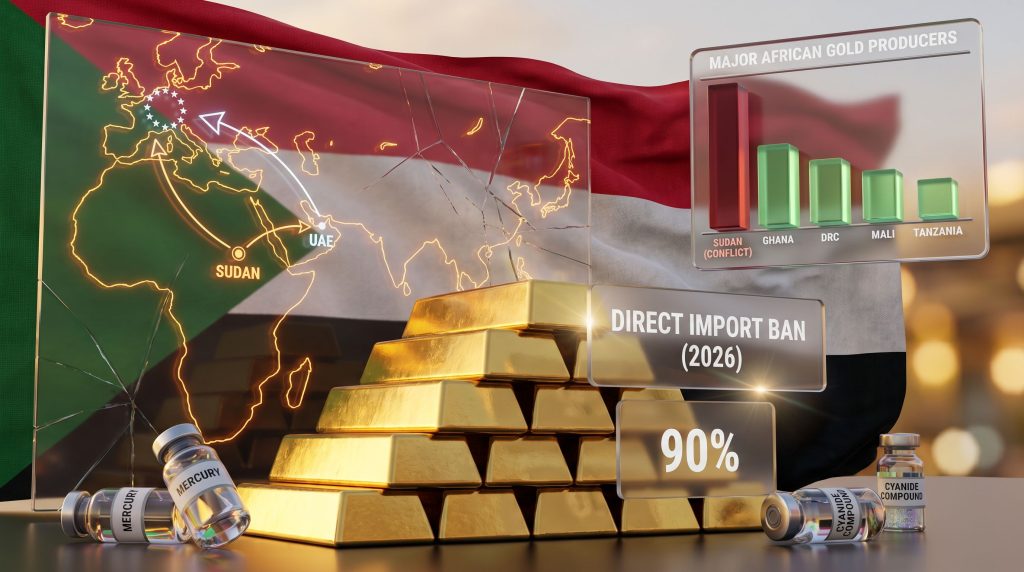
The Council of the EU announced in July 2026 a package of targeted measures addressing Sudan's conflict-linked gold trade through two parallel mechanisms. The first is a direct prohibition on the purchase, import, or transfer of gold originating in Sudan into EU member states. The second is a ban on the sale, supply, transfer, or export of mercury and cyanide to Sudan.
These two prongs are not equivalent in their likely operational impact, and that asymmetry is worth examining carefully.
How This Differs from the Existing Conflict Minerals Framework
The EU's Conflict Minerals Regulation, which came into force in January 2021, established mandatory due diligence requirements for EU importers of tin, tungsten, tantalum, and gold (collectively referred to as 3TG). Importers were required to conduct OECD 5-step due diligence aligned with the OECD Due Diligence Guidance for Responsible Supply Chains of Minerals from Conflict-Affected and High-Risk Areas.
The critical distinction is that the 2021 regulation was a procedural obligation. It required companies to verify and document their supply chains, but it did not categorically prohibit imports from any specific country. The new sanctions package crosses that threshold for the first time with respect to Sudan. Furthermore, the gold market outlook for 2025 and beyond will need to account for these evolving regulatory constraints.
| Dimension | EU Conflict Minerals Regulation (2021) | New Sudan Sanctions (2026) |
|---|---|---|
| Legal Instrument | Regulation (EU) 2017/821 | EU Council Sanctions Package |
| Mechanism | Supply chain due diligence | Direct import prohibition |
| Geographic Scope | All conflict-affected and high-risk areas | Sudan-specific |
| Chemical Controls | Not addressed | Mercury and cyanide export ban |
| Enforcement | Member state audits | Sanctions penalties |
| Compliance Burden | Documentation and verification | Zero-tolerance import ban |
How Sudanese Gold Reaches Global Markets
Understanding why an EU import ban alone may have limited effectiveness requires understanding the transit architecture that conflict gold uses to enter the formal market.
An estimated 90% of Sudan's gold exports flow through the United Arab Emirates, particularly through Dubai's gold trading and refining ecosystem. The UAE is home to some of the world's largest gold refineries and serves as a critical price-discovery and liquidity hub for physical gold from across the Middle East, Africa, and South Asia. Its relatively light regulatory posture on origin documentation has historically made it the preferred entry point for gold from conflict-affected jurisdictions.
The Re-Smelting Problem
The most significant technical challenge in enforcing any origin-based gold ban is the practice of re-smelting and blending. Conflict gold transported from Sudan through informal corridors via Chad, South Sudan, or Egypt arrives at intermediate processing points where it is smelted together with gold from other sources. Once blended and re-cast into new bars, the resulting product carries no physical evidence of its original source.
This process allows gold that originated in a conflict zone to be re-certified at an intermediary refinery under a different country of origin, effectively laundering its provenance before it enters formal commodity channels. LBMA gold markets attempt to address this through the Responsible Gold Guidance, requiring refiners on the Good Delivery List to conduct enhanced due diligence. However, enforcement relies heavily on self-reporting and third-party audits rather than forensic origin verification.
Conflict gold rarely enters global markets under its actual country of origin. It is typically re-smelted, blended with legitimate material, and re-certified at intermediary refineries, making forensic origin verification one of the most technically intractable problems in commodity compliance.
The Mercury and Cyanide Ban: A More Surgical Intervention?
While the gold import prohibition has attracted the most attention, the ban on exporting mercury and cyanide to Sudan may ultimately prove more operationally disruptive to conflict-linked mining activity.
Mercury amalgamation is the dominant gold recovery technique in Sudanese artisanal mining. The process works by introducing liquid mercury to crushed ore or alluvial sediment, where mercury selectively bonds with gold particles to form an amalgam. The amalgam is then heated, vaporising the mercury and leaving behind a gold sponge. It is simple, portable, and extraordinarily effective at recovering fine gold particles that would otherwise be lost.
The supply of mercury to Sudan is therefore not merely an environmental or public health concern, though it is both of those things. It is a direct operational input to the informal gold production chain that funds armed factions. Restricting mercury supply creates a genuine logistical constraint that a gold import ban, which operates at the export end of the chain, does not. Cyanide fits a different part of the processing chain, used in heap leaching and carbon-in-pulp circuits more commonly associated with larger semi-formal operations. Its inclusion in the ban targets a slightly more sophisticated tier of informal production.
Who Absorbs the Displaced Supply?
A critical question for market analysts is whether an EU-specific ban meaningfully reduces total global demand for Sudanese gold or simply redirects it toward buyers outside EU jurisdiction.
The honest answer, based on existing trade patterns, is largely the latter. Chinese, Indian, and Gulf-state refiners represent enormous absorptive capacity for gold that cannot enter EU markets. Without equivalent restrictions from the United States, the United Kingdom, China, India, and Gulf Cooperation Council member states, the EU restrictions on trading Sudanese gold function more as a market segmentation measure than a comprehensive supply disruption.
Comparative Risk Profile: Major African Gold Producers
| Country | Approximate Annual Output | Conflict Risk Level | Current EU Regulatory Status |
|---|---|---|---|
| Sudan | 60-100+ tonnes (incl. ASM) | Active armed conflict | Direct import ban (2026) |
| DRC | 30-40 tonnes | Ongoing armed groups | 3TG due diligence required |
| Mali | 60-70 tonnes | Political and security instability | 3TG due diligence required |
| Ghana | 130+ tonnes | Low conflict risk | Standard import rules |
| Tanzania | 50+ tonnes | Low conflict risk | Standard import rules |
Sudan's share of global gold supply, estimated at roughly 3–5% of world mine output when informal production is included, is not large enough to create structural price disruption at the global level. Price impacts from the EU ban are expected to be marginal in the near term. However, a scenario in which multilateral coordination significantly narrows the pool of willing buyers could introduce supply-side friction with more meaningful price implications. In addition, central bank gold demand remains a key structural driver of global pricing dynamics that could amplify any longer-term supply constraints.
The next major ASX story will hit our subscribers first
Lessons from Other Conflict Commodity Regimes
The EU's approach invites comparison with prior attempts to regulate conflict commodities at the international level.
The Kimberley Process Certification Scheme, established in 2003 to stem the flow of conflict diamonds, is the most frequently cited precedent. Its core weakness was definitional: it defined conflict diamonds narrowly as stones used to finance rebel movements against legitimate governments, which allowed diamonds from state-sponsored abuses to continue flowing freely. Gold presents an even greater challenge because its physical transformation during processing eliminates the forensic traceability that diamonds at least partially retain.
The US Dodd-Frank Act Section 1502, which required publicly listed companies to disclose their use of conflict minerals from the DRC region, demonstrated both the potential and the limits of disclosure-based approaches. It raised awareness and imposed compliance costs, but did not eliminate conflict mineral flows and created significant administrative burden without proportionate impact on financing.
What a genuinely effective multilateral gold certification mechanism would require is forensic isotopic or trace-element fingerprinting technology applied at the point of refining, combined with legally binding origin warranties from refiners and coordinated sanctions enforcement across all major consumer markets. Current frameworks fall well short of that standard.
Compliance Obligations for EU Gold Importers
For European gold traders, refiners, jewellers, and financial institutions holding physical gold, the new Sudan-specific ban creates immediate legal obligations that go beyond the existing 3TG due diligence framework. Consequently, understanding where gold as a safe haven sits within broader portfolio and compliance strategies becomes more important than ever for EU-based participants.
Practical Due Diligence Checklist
- Verify and document the country of origin for all gold shipments entering EU jurisdiction.
- Confirm refinery accreditation status against recognised responsible sourcing standards, including the LBMA Responsible Gold Guidance and the Responsible Minerals Initiative's Responsible Minerals Assurance Process (RMAP).
- Apply enhanced due diligence to any shipments transiting through the UAE, Chad, Egypt, or South Sudan given their role in documented gold transit corridors from Sudan.
- Screen all counterparties, brokers, and intermediaries against current EU consolidated sanctions lists prior to transaction.
- Assess whether existing contracts for gold delivery involve supply chains with any Sudan exposure, and obtain legal opinions on transitional obligations.
- Maintain complete, auditable chain-of-custody documentation for a minimum period consistent with applicable member state enforcement requirements.
- Engage qualified legal counsel with sanctions expertise to assess specific exposure under the new prohibition.
Penalties and Enforcement Considerations
Violations of EU sanctions carry serious consequences, including substantial financial penalties, trading licence suspension, and reputational damage that can permanently impair relationships with correspondent banks and institutional counterparties. Enforcement intensity varies across EU member states, with Germany, France, and the Netherlands historically among the most active in sanctions compliance actions within the commodities sector.
Frequently Asked Questions on the EU Sudan Gold Restrictions
Does the ban cover all gold from Sudan regardless of when it was extracted?
The prohibition applies to gold originating in Sudan entering EU jurisdiction. Traders should seek specific legal guidance on transitional provisions applicable to shipments already in transit or under contracts signed prior to the sanctions entry into force, as these are governed by the specific terms of the sanctions regulation and any transitional exemptions included therein.
Why are mercury and cyanide specifically targeted?
Mercury enables artisanal gold recovery through amalgamation, the dominant technique in Sudan's informal mining sector. Cyanide is used in more sophisticated leaching processes at semi-formal operations. Restricting supply of these chemicals targets the production inputs rather than the export outputs of conflict-linked mining, representing a fundamentally different intervention point in the supply chain.
Will this meaningfully reduce conflict financing in Sudan?
The EU restrictions on trading Sudanese gold create real friction and reputational costs for European market participants who might otherwise engage with Sudanese gold supply chains. However, without coordinated action from the UAE, China, India, and other major gold-consuming markets, total demand for Sudanese gold is unlikely to fall dramatically. The mercury and cyanide export ban may prove more practically disruptive to production volumes than the gold import restriction.
What does this mean for gold prices?
Sudan represents a relatively modest share of global gold output. The near-term price impact of EU-specific restrictions is expected to be marginal. A more material price effect would require multilateral restriction significantly constraining the universe of willing buyers, which is not the current state of international coordination. Furthermore, the role of gold in the monetary system means that any sustained supply disruption would carry broader systemic implications worth monitoring closely.
The Geopolitical Dimension: Sanctions as Normative Signalling
The EU's decision to move from procedural due diligence to direct prohibition signals a meaningful evolution in how the bloc conceptualises its role in conflict commodity governance. Whether other major jurisdictions follow is the central question for anyone assessing the long-term effectiveness of this framework.
The UN Panel of Experts on Sudan has produced extensive documentation linking gold revenue to conflict financing on both sides of the war. The gap between that documentation and coordinated multilateral action remains wide, and closing it would require political will from governments whose commercial relationships with the UAE and Gulf trading ecosystems complicate unilateral pressure.
For EU-based gold market participants, the compliance obligations are clear and immediate. For the broader question of whether targeted trade restrictions can meaningfully reduce conflict financing in Sudan, the evidence from comparable regimes suggests that the answer depends almost entirely on whether the EU's measures catalyse coordinated international action, or remain an isolated jurisdictional constraint that conflict gold simply routes around.
This article is intended for informational purposes only and does not constitute legal or compliance advice. Entities subject to EU sanctions obligations should seek qualified legal counsel regarding their specific circumstances. Readers are encouraged to monitor official EU Council publications for the precise terms, transitional provisions, and entry-into-force dates of the new sanctions measures.
Want to Stay Ahead of the Next Major ASX Mineral Discovery?
While regulatory frameworks reshape global commodity flows, Discovery Alert's proprietary Discovery IQ model scans ASX announcements in real time, instantly identifying significant mineral discoveries across gold and 30+ other commodities — visit the Discovery Alert discoveries page to explore historic examples of exceptional returns, and begin your 14-day free trial to ensure you're positioned ahead of the broader market.