
July 13, 2026
When Infrastructure Becomes the Prize: Understanding the New Logic of Australian Gold M&A
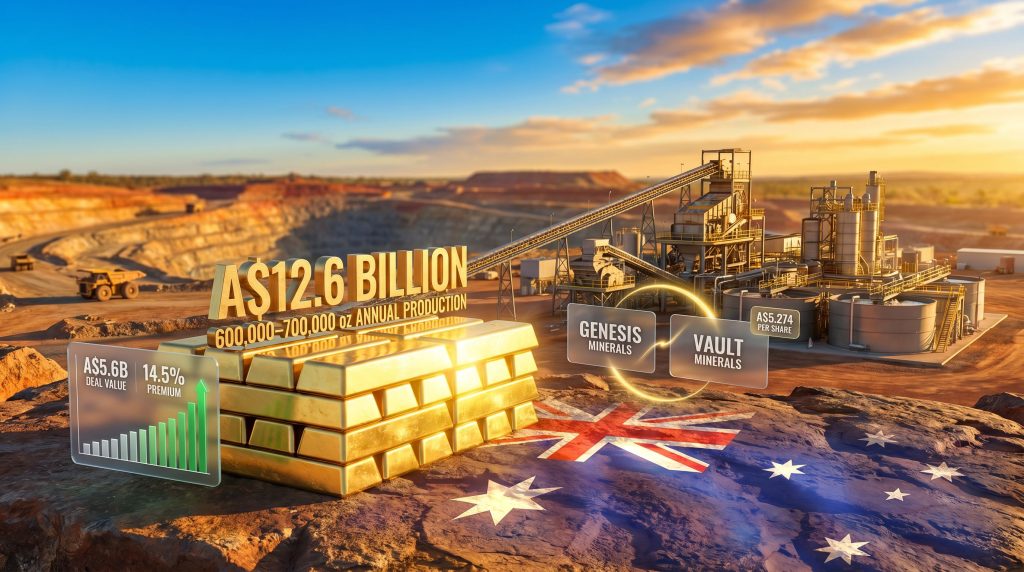
There is a structural shift underway in how the world's gold miners assign value to assets. For decades, reserve size and grade dominated acquisition calculus. Today, processing infrastructure has emerged as the defining variable in takeover premiums across Western Australia's Goldfields region. The company that controls the mill controls the district. That principle sits at the heart of the Genesis Minerals Vault takeover, a A$5.6 billion (approximately US$3.9 billion) transaction that has reshaped competitive dynamics across the Leonora gold corridor and set a new benchmark for mid-tier consolidation on the ASX.
When big ASX news breaks, our subscribers know first
How the Genesis Minerals Vault Takeover Offer Stacks Up Financially
Breaking Down the Cash-and-Scrip Structure
The offer presented to Vault Minerals shareholders consists of 0.7629 Genesis shares plus A$0.475 cash for every Vault share held, implying a per-share value of A$5.274. That represents a 14.5% premium over the competing all-scrip proposal that had been tabled by Regis Resources. Furthermore, this Australian gold M&A activity marks one of the most significant mid-tier consolidation moves seen in recent years.
The cash component is more strategically significant than its face value suggests. At A$0.475 per share, it provides Vault shareholders with immediate, certain value delivery, which is particularly important in a volatile gold price environment where scrip-only offers carry forward uncertainty. Simultaneously, limiting the cash element preserves Genesis's balance sheet flexibility and ensures its shareholders retain approximately 60% ownership of the enlarged entity.
Key Financial Metrics at a Glance
| Metric | Figure |
|---|---|
| Total Deal Value | A$5.6 billion (approx. US$3.9 billion) |
| Per-Share Offer Price | A$5.274 |
| Premium to Competing Bid | 14.5% |
| Cash Component Per Share | A$0.475 (approx. US$0.33) |
| Scrip Component Per Share | 0.7629 Genesis shares |
| Pro-Forma Combined Market Cap | A$12.6 billion (approx. US$8.82 billion) |
| Genesis Shareholder Ownership Post-Merger | Approximately 60% |
| Annual Gold Production (Combined) | 600,000 to 700,000 ounces |
Contextualising the Premium Within ASX Gold M&A History
A 14.5% uplift over a competing bid is not simply a financial manoeuvre. It signals a high degree of strategic conviction. Within Australian mid-tier gold M&A, premium contests of this nature are relatively uncommon, and the willingness to pay above a rival proposal typically indicates that the acquirer has modelled specific synergies that justify the incremental outlay.
In this case, those synergies centre on processing infrastructure, an asset class that is increasingly difficult to replicate from scratch given permitting timelines, capital intensity, and community engagement obligations in Western Australian mining regions. For context, the gold price impact on equities has also played a meaningful role in shaping deal valuations across the sector.
"Key Insight: The cash component of A$0.475 per share serves a dual purpose. It differentiates the Genesis offer on immediate value delivery while limiting the dilutive impact on Genesis shareholders, who retain approximately 60% ownership of the enlarged entity."
What Strategic Assets Does Vault Minerals Bring to the Table
King of the Hills: The Anchor Asset
Vault's flagship King of the Hills operation sits within the Eastern Goldfields of Western Australia, a region that has produced gold continuously for over a century and remains one of the most geologically prospective gold corridors on the planet. The Eastern Goldfields broadly hosts greenstone belt geology, where gold mineralisation typically occurs along shear zones and in association with mafic and ultramafic sequences.
King of the Hills benefits from this favourable structural setting, contributing a meaningful production profile to Vault's overall output. The geographic proximity of King of the Hills to Genesis's existing Leonora district asset base is, consequently, foundational to the entire synergy thesis. When two mine complexes sit within trucking distance of a central processing hub, the economics of toll milling, ore blending, and shared logistics shift dramatically in favour of the operator who controls that hub.
Processing Infrastructure as a Structural Moat
In Australian gold mining, a carbon-in-leach (CIL) or carbon-in-pulp (CIP) processing plant represents years of capital investment, permitting work, and operational commissioning. For a competitor to replicate such a facility from scratch in the Leonora region would require not only substantial capital expenditure, estimated at over A$2 billion in the case of the proposed Tower Hill plant that Genesis now aims to avoid constructing, but also extended approval timelines that could run to several years under Western Australian environmental and native title frameworks.
This is what transforms Vault's processing assets from an operational tool into a structural competitive moat. Control of the processing infrastructure effectively gives the merged entity leverage over:
- Third-party toll milling arrangements for smaller regional operators
- Ore routing decisions across multiple satellite deposits
- Per-ounce cost structures that benefit from higher throughput utilisation rates
- Future acquisition optionality for nearby deposits that lack their own processing capacity
Five Mines, One Integrated Platform
The combined Genesis-Vault entity would operate five active mines, creating a diversified production platform that reduces exposure to any single asset's operational variability. Geographic clustering across the Leonora district enables:
- Shorter ore haulage distances, directly reducing mining costs per tonne
- Shared workforce deployment, smoothing labour demand across the operating cycle
- Unified procurement for consumables, reducing unit input costs
- Blended ore feed strategies that can optimise plant recoveries and throughput
This last point deserves particular attention. Ore blending across multiple sources is a less-discussed but practically significant advantage of multi-mine processing hubs. By combining ore streams with varying grades and mineralogical characteristics, plant operators can manage head grades to maximise recovery efficiency and extend the operational life of processing circuits.
Why Genesis Outbid Regis Resources and What It Reveals About Strategic Intent
The Competing Bid Timeline
Regis Resources had secured a A$5.1 billion all-scrip merger agreement with Vault in May 2026. Genesis entered the contest in July 2026, submitting a competing proposal that triggered a formal matching period. Regis was given five business days, expiring July 10, 2026, to respond with a counter-offer that met or exceeded Genesis's terms. Regis declined to exercise this right, citing investment return thresholds that its internal modelling could not satisfy at the higher price point.
Vault is consequently expected to terminate its arrangement with Regis, triggering a break fee payment of approximately A$50.7 million to Regis.
Return Discipline Versus Strategic Imperative
Regis's withdrawal from the bidding process is instructive. It reflects the tension that all acquirers face between strategic ambition and financial discipline. The ceiling price problem in gold M&A is real: beyond a certain acquisition premium, the per-ounce cost of acquired reserves becomes difficult to justify through operational synergies alone, particularly if gold prices retreat from current elevated levels above US$2,500 per ounce.
Regis's decision to stand aside rather than escalate suggests its internal return model did not support the higher price, regardless of the strategic appeal of Vault's assets. This is not a failure of vision; it is return threshold discipline in practice, a quality that long-term shareholders generally reward.
For Genesis, the calculation was evidently different. The company's leadership, under CEO Raleigh Finlayson, has consistently pursued a Leonora district consolidation strategy, and the Tower Hill processing plant avoidance thesis provides a specific, quantifiable rationale for the premium paid.
The Tower Hill Avoidance Thesis: A$2 Billion in Avoided Capital
Without the Vault acquisition, Genesis faced a capital decision of considerable magnitude: construct the Tower Hill processing plant to handle expanding ore volumes, or find an alternative path to increased throughput capacity. Tower Hill construction was estimated to require capital expenditure that Genesis has projected would exceed A$2 billion in total value terms when accounting for construction costs, financing expenses, and opportunity cost over the plant's operational life.
By acquiring Vault's existing processing infrastructure instead, Genesis effectively converts a future capital outflow into a present acquisition premium, but at a cost structure that its modelling suggests is materially more favourable. This is the core financial logic underpinning the Genesis Minerals Vault takeover decision.
"Strategic Scenario: If Genesis successfully integrates Vault's processing infrastructure, the merged entity could potentially reduce all-in sustaining costs (AISC) per ounce by eliminating duplicated capital expenditure. This structural cost advantage would compound over the life of the combined mine plan."
Projected Synergies: How Credible Is the A$2 Billion Case
Unpacking the Synergy Sources
The synergy case rests on multiple pillars of varying certainty and timeframe. Understanding the hierarchy of synergy types is essential for investors assessing whether the acquisition premium is ultimately justified.
| Synergy Category | Estimated Contribution | Realisation Timeframe | Risk Level |
|---|---|---|---|
| Tower Hill capex avoidance | High | Immediate (pre-construction) | Low |
| Shared processing infrastructure | Medium-High | 12 to 24 months post-merger | Low-Medium |
| Workforce and logistics consolidation | Medium | 6 to 18 months post-merger | Medium |
| Ore blending and throughput optimisation | Medium | 24 to 48 months post-merger | Medium-High |
| Supply chain procurement savings | Low-Medium | 12 to 36 months post-merger | Low |
The Tower Hill capex avoidance is the most credible and least risky synergy category because it is a spending decision that has not yet been made. Avoiding it does not require integration execution or operational change; it simply requires that the decision not to build the plant is confirmed following merger completion.
Three Scenarios for Synergy Delivery
- Bull case: Full A$2 billion in synergy realisation within five years, underpinned by seamless integration and gold prices sustained above US$2,500 per ounce throughout the period
- Base case: A$1.2 billion to A$1.5 billion achieved over seven years, incorporating moderate integration friction and workforce transition costs that partially offset operational savings
- Bear case: Synergy delivery delayed or reduced by regulatory conditions attached to ACCC clearance, integration complexity across five operating mines, or a gold price correction to below US$2,000 per ounce
How Markets Responded and What the Share Price Signals Mean
Reading the Immediate Price Movements
Market reactions to deal announcements contain embedded information about investor sentiment and risk assessment that repays careful analysis.
- Vault Minerals shares rose 11.6% to A$5.09 following the Genesis proposal announcement, reflecting the premium being ascribed to Vault shareholders
- Genesis shares initially declined 4.1% to A$6.03, a classic acquirer discount reflecting deal premium and integration risk priced into the near term
- Regis Resources shares fell 1.4% to A$6.43 following its confirmation that it would not match the Genesis offer
- Vault shares subsequently eased to approximately A$4.82 following Regis's formal withdrawal, as the deal certainty arbitrage spread narrowed
The Genesis share price movement requires contextualisation. A short-term decline in the acquirer's stock following a major deal announcement is not unusual; it reflects the market's immediate assessment of deal risk, integration complexity, and dilution from the scrip component. It does not necessarily reflect the market's view of long-term value creation. Historical patterns in Australian gold M&A suggest that acquirer share prices often recover and appreciate materially once integration milestones are achieved and synergies become visible in production cost data.
The A$12.6 Billion Entity: ASX Gold Sector Positioning
A pro-forma market capitalisation of A$12.6 billion positions the merged Genesis-Vault entity as a significant force within the ASX gold sector, placing it in a tier occupied by a small number of large-scale Australian gold producers. This scale matters for several reasons:
- Larger market capitalisation entities attract greater institutional investor attention and index inclusion eligibility
- Bigger balance sheets support cheaper debt financing, reducing the weighted average cost of capital applied to future development decisions
- Scale increases negotiating leverage with equipment suppliers, power providers, and contract mining companies
The next major ASX story will hit our subscribers first
Regulatory and Procedural Pathway to Completion
The Matching Period and Break Fee Mechanics
Regis's five-business-day matching window expired on July 10, 2026 without a counter-offer being submitted. This contractual outcome allows Vault to formally terminate its merger agreement with Regis and enter into a definitive binding agreement with Genesis. The A$50.7 million break fee payable to Regis compensates it for deal costs and foregone opportunity, but does not materially alter the Genesis acquisition economics given the transaction's overall scale.
Key Approval Hurdles
Several conditions must be satisfied before the Genesis Minerals Vault takeover can be formally implemented:
- Vault shareholder approval meeting the required threshold for scheme of arrangement approval
- Independent expert determination confirming the transaction is fair and reasonable for Vault shareholders
- Court approval of the scheme under the Corporations Act 2001
- ACCC review examining competitive effects, particularly given the concentration of processing infrastructure in the Leonora district that the merged entity would control
- ASX listing rule compliance for the issuance of Genesis shares as scrip consideration
The ACCC review represents the most uncertain procedural element. A transaction that creates a dominant processing infrastructure owner across a defined mining district could attract scrutiny regarding third-party access and competitive dynamics for smaller regional operators. Regulators may seek undertakings around toll milling access terms or processing capacity commitments as conditions of clearance.
What This Deal Means for the Broader ASX Gold Sector
The Infrastructure Scarcity Premium
The Genesis Minerals Vault takeover provides a clear market signal about where value is concentrated in the current Australian gold cycle. Processing infrastructure, not ore reserves per se, is commanding the largest premiums. This has direct implications for how investors should assess other mid-tier gold companies with proprietary processing assets in established districts.
The scarcity dynamic is real: in mature gold districts like the Eastern Goldfields, there is simply no more room to cheaply construct new processing plants in proximity to established ore bodies. Permitting timelines under Western Australia's environmental assessment framework can span multiple years, and native title and heritage considerations add further complexity. Companies that already own surplus processing capacity relative to their current mine plans hold a structural advantage that the market is beginning to price more aggressively.
The Mid-Tier Consolidation Playbook
The Genesis-Vault transaction reinforces a trend visible across global gold markets: mid-tier producers face a binary choice between consolidating aggressively or becoming acquisition targets themselves. The economics of scale in gold mining are pronounced, and the capital markets increasingly reward size, diversification, and infrastructure ownership over single-asset exploration stories.
For investors monitoring the ASX gold sector, the key question following this deal is which other Leonora or wider Eastern Goldfields operators possess processing assets, established ore routes, or district-adjacent resources that could make them attractive to a newly enlarged Genesis entity seeking further bolt-on acquisitions once integration is complete. This dynamic mirrors patterns seen in other high-profile deals, such as the Gold Fields takeover offer for Gold Road Resources, where infrastructure and processing scale were equally central to the strategic rationale.
However, the Gold Road bid rejection demonstrated that target boards are increasingly willing to push back when they believe the offered premium undervalues long-term infrastructure worth. In addition, the Gruyere production outlook serves as a pertinent reminder of just how consequential processing capacity is to sustained production performance.
"Investment Consideration: The A$12.6 billion pro-forma market capitalisation positions the merged Genesis-Vault entity as a significant force within the ASX gold sector. Investors should monitor integration milestones, synergy delivery timelines, and gold price movements as key indicators of whether the deal's strategic premium is ultimately justified."
Frequently Asked Questions: Genesis Minerals Vault Takeover
What is the Genesis Minerals Vault Takeover Offer Worth?
The offer values Vault Minerals at approximately A$5.6 billion (US$3.9 billion), structured as 0.7629 Genesis shares plus A$0.475 cash per Vault share, implying a per-share value of A$5.274.
Why Did Regis Resources Withdraw From the Bidding Contest?
Regis determined that the financial terms required to match Genesis's superior offer were inconsistent with its internal investment return thresholds, making it economically irrational to escalate its bid further. Analysts have noted that Regis's restraint reflects broader discipline among mid-tier acquirers in the current cycle.
What Synergies Does Genesis Expect From Acquiring Vault?
Genesis projects more than A$2 billion in long-term synergies, primarily derived from avoiding the capital expenditure associated with constructing the planned Tower Hill processing plant and consolidating shared operational infrastructure across the Leonora district.
What Happens to Vault's Existing Agreement With Regis Resources?
Vault is expected to formally terminate its merger agreement with Regis Resources, triggering a break fee of approximately A$50.7 million payable to Regis.
How Large Will the Combined Genesis-Vault Entity Be?
The merged company would carry a pro-forma market capitalisation of approximately A$12.6 billion (US$8.82 billion), with annual gold production capacity of 600,000 to 700,000 ounces across five operating mines.
What Ownership Split Will Genesis and Vault Shareholders Have?
Genesis shareholders will hold approximately 60% of the enlarged entity, with Vault shareholders receiving the remaining 40% stake plus the cash component of the offer.
Execution Will Determine Whether the Premium Was Warranted
The strategic logic underpinning the Genesis Minerals Vault takeover is coherent and well-constructed. Controlling processing infrastructure in a mature gold district, avoiding A$2 billion in future capital expenditure, and assembling a five-mine platform with shared logistics economics represents a genuinely differentiated value creation pathway compared to organic growth alone.
The distance between deal announcement and value delivery, however, is measured in operational execution. Integration across five active mines, workforce transitions, and ore routing optimisation all carry friction that can delay synergy realisation. Add gold price sensitivity to the equation, and the bear case scenarios outlined earlier become plausible under specific market conditions.
What this transaction does unambiguously establish is that infrastructure ownership has become the primary currency of competitive advantage in the Leonora gold district. That reality will shape M&A pricing, capital allocation decisions, and investor positioning across the ASX gold sector for years to come.
This article is intended for informational purposes only and does not constitute financial advice. Investors should conduct their own due diligence and consult a licensed financial adviser before making investment decisions. Forward-looking statements, synergy projections, and scenario analyses represent estimates only and are subject to material risks and uncertainties.
Want to Stay Ahead of the Next Major ASX Gold Discovery?
While consolidation plays like the Genesis-Vault merger reshape the Leonora district, the most transformative returns in the gold sector have historically come from being positioned early in significant new discoveries — and Discovery Alert's proprietary Discovery IQ model delivers real-time alerts the moment major ASX mineral announcements hit, turning complex data across 30-plus commodities into actionable insights for investors at every level. Explore historic discovery returns on Discovery Alert's dedicated discoveries page and begin a 14-day free trial to ensure you're positioned ahead of the broader market when the next significant find is announced.