August 12, 2026
Understanding the EU Methane Emissions Regulation Framework
The European Union's approach to reducing methane emissions from energy imports represents one of the most significant regulatory shifts in global energy markets since carbon pricing mechanisms first emerged. As the oil industry seeks EU methane regulation pause, this comprehensive framework fundamentally alters how energy importers must document and verify the environmental footprint of their supply chains, creating ripple effects across international commodity flows.
Core Requirements and Compliance Thresholds
The regulation establishes a Monitoring, Reporting, and Verification (MRV) system that applies to all crude oil, natural gas, and coal imports under contracts concluded or renewed after August 4, 2024. The implementation timeline creates a compressed adjustment period, with full MRV equivalence recognition required by January 2027.
Under this framework, importers must demonstrate compliance through two primary pathways:
• Direct methane emissions data from upstream suppliers
• Contractual evidence documenting methane emissions throughout the supply chain
• Third-party verification protocols meeting EU accreditation standards
The regulation requires member states to avoid actions that would "endanger" security of supply when applying penalties, suggesting built-in flexibility mechanisms. However, the European Commission has maintained that these provisions do not compromise the regulation's environmental objectives.
Regulatory Scope and Coverage
The scope encompasses all fossil fuel imports entering EU territory, with coverage extending beyond simple volume thresholds to include comprehensive supply chain documentation. Contract renewal and conclusion triggers became active in August 2024, meaning any new or renewed supply agreements must incorporate methane reporting requirements.
Member state enforcement mechanisms vary in their penalty structures, though the regulation provides minimum standards for compliance verification. The absence of recognised equivalence agreements with any exporting nation as of March 2026 indicates the challenges facing international coordination on verification standards.
Current compliance readiness stands at approximately 7% of global oil and gas production meeting the required reporting standards, according to industry analysis commissioned by FuelsEurope and IOGP. This figure highlights the scale of supply chain adjustments needed across producing regions to maintain access to EU markets.
When big ASX news breaks, our subscribers know first
What Are the Projected Supply Chain Disruptions?
Quantitative Impact Assessment
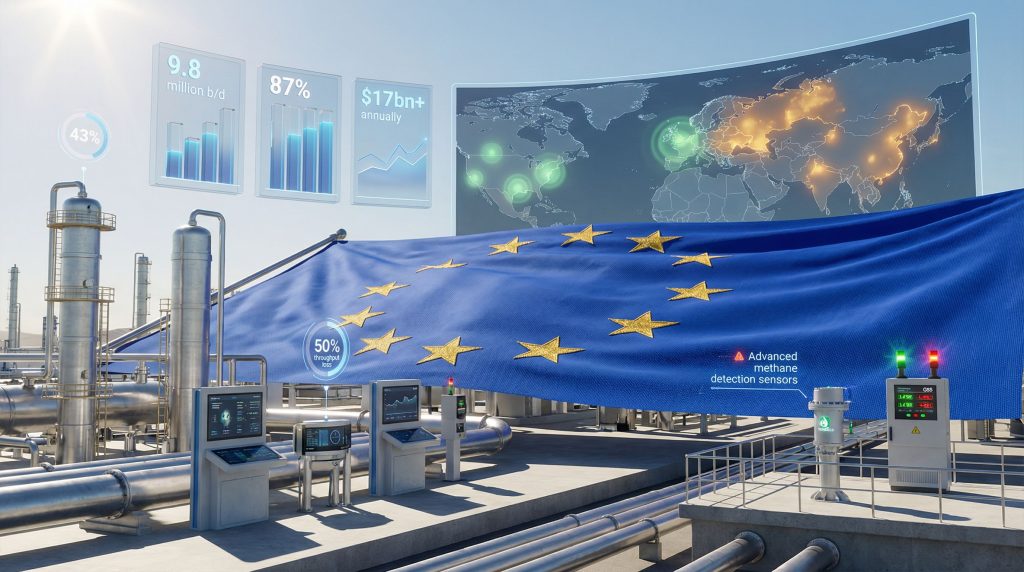
Table: Projected EU Energy Import Vulnerabilities (2027-2030)
| Energy Source | Non-Compliant Volume | Percentage at Risk | Economic Impact |
|---|---|---|---|
| Crude Oil | 9.8 million b/d | 87% | $17bn+ annually |
| Natural Gas | 114 billion m³ | 43% | Price doubling risk |
| Refinery Capacity | 4.6 million b/d | 50% throughput loss | 40 refineries equivalent |
These projections, based on 2024 import volumes, reveal the potential magnitude of supply disruptions under strict regulatory implementation. The refinery throughput reduction of 4.6 million barrels per day would represent the equivalent operational impact of closing approximately 40 European refineries simultaneously.
Under more flexible implementation scenarios, the impacts diminish but remain substantial:
• Natural gas exclusions: 20% (53 billion m³) versus 43% under strict enforcement
• Crude oil exclusions: 38% (4.3 million b/d) versus 87% under strict enforcement
• Persistent supply constraints with graduated compliance timelines
Geographic Vulnerability Mapping
The disruption pattern reveals significant geographic concentration of risk. Traditional European energy suppliers lacking MRV equivalence recognition face potential market exclusion, forcing importers to seek alternative sources from regions with compliant verification systems.
Strategic reserve adequacy becomes critical when considering that the projected supply reductions could exceed the volumes disrupted during the 2022 energy crisis following Russia's invasion of Ukraine. Furthermore, the compressed timeline for developing alternative supply routes amplifies vulnerability concerns across member states while creating energy security challenges across multiple sectors.
Import cost escalation mechanisms include both supply reduction premiums and verification compliance costs. The projected annual fuel import bill increase exceeding $17 billion reflects these combined factors, though analysis suggests natural gas price increases would remain below 2022 crisis peaks despite potential doubling from current levels.
How Do Global Compliance Standards Create Market Fragmentation?
MRV Equivalence Recognition Challenges
The absence of any EU-recognised equivalent MRV standards among exporting countries creates a binary market structure where suppliers either meet EU requirements or face exclusion. This fragmentation extends beyond simple compliance costs to fundamental infrastructure development needs.
Technical barriers to achieving EU standard alignment include:
• Lack of internationally standardised verification protocols
• Insufficient third-party verifier capacity in producing regions
• Absence of mutual recognition agreements for cross-border verification
Major exporting regions currently lack the regulatory framework and technical infrastructure to satisfy EU MRV requirements within the implementation timeline. The 7% global production compliance rate indicates that the vast majority of international oil and gas production operates under monitoring systems incompatible with EU standards.
Third-Party Verification Infrastructure Gaps
The regulation's reliance on accredited third-party verifiers exposes critical capacity constraints in the global verification infrastructure. Current accredited verifier networks lack sufficient geographic coverage and technical capacity to process the volume of verification required for EU import compliance.
Protocol standardisation requirements create additional complexity, as existing international frameworks such as ISO standards and voluntary initiatives may not align with EU-specific MRV technical specifications. This misalignment necessitates parallel verification systems that increase costs and complexity for international suppliers.
Cross-border verification complexities arise from differences in legal frameworks, technical standards, and regulatory oversight mechanisms across jurisdictions. In addition, the absence of reciprocal recognition agreements means suppliers must navigate multiple verification requirements to access different markets.
What Economic Scenarios Emerge Under Different Implementation Pathways?
Strict Implementation Scenario Analysis
Under rigid regulatory enforcement, the economic impacts cascade through multiple market levels. Refinery closure effects would concentrate in regions most dependent on non-compliant crude oil imports, with facilities processing heavy and medium crude grades facing particular vulnerability.
The consumer price transmission mechanism operates through reduced refining capacity and increased import costs for compliant crude oil. Regional price disparities would emerge based on member states' access to alternative supply sources and existing strategic reserve levels.
Supply security implications extend beyond immediate price impacts to include:
• Reduced market competition among suppliers
• Increased dependency on compliant source regions
• Strategic vulnerability to disruptions in compliant supply chains
Adaptive Implementation Framework
Flexible MRV equivalence recognition could significantly reduce disruption severity while maintaining environmental policy objectives. Graduated compliance timelines would enable infrastructure development and supplier adaptation programmes, reducing the risk of acute supply shocks.
Under adaptive scenarios, market participants gain time to develop:
• Verification infrastructure capacity in producing regions
• Contractual frameworks for methane emissions documentation
• Alternative sourcing strategies aligned with compliance requirements
The economic trade-offs involve accepting persistent but manageable supply constraints in exchange for avoiding severe market disruption. This approach allows premium pricing mechanisms for compliant sources to develop gradually rather than through crisis-driven price spikes, while companies can implement market volatility hedging strategies to manage transitional risks.
Why Are Industry Groups Seeking Regulatory Modifications?
Supply Security Risk Assessment
Industry organisations frame their regulatory modification requests within the context of European energy security rather than opposition to environmental policy. The comparison to 2022 energy crisis disruptions emphasises the scale of potential supply impacts under current implementation timelines.
According to Argus Media, François-Régis Mouton of IOGP Europe emphasised the time-limited nature of industry requests, stating that the sector seeks discussion and amended regulation that can be implemented without requiring extensive regulatory overhaul. This positioning suggests pragmatic adaptation rather than fundamental opposition to methane emissions reduction objectives.
Geopolitical vulnerability amplification occurs when regulatory requirements coincide with international tensions affecting energy markets. The March 2026 Middle East conflict context, including disruptions to Strait of Hormuz traffic, demonstrates how regulatory supply constraints compound geopolitical supply risks.
Implementation Timeline Concerns
The less than nine-month timeline until MRV requirements become mandatory creates fundamental misalignment with infrastructure development lead times. Verification system establishment, supplier compliance programme development, and alternative sourcing arrangements require longer implementation periods than the regulation allows.
Regulatory certainty requirements for investment planning become critical when companies must commit resources to compliance infrastructure without clarity on recognition standards or enforcement flexibility. However, the absence of recognised equivalence agreements with any exporting country creates uncertainty about which investments will satisfy regulatory requirements.
Current global production compliance readiness at 7% suggests that supply disruptions under strict enforcement would affect the vast majority of existing energy trade relationships between the EU and international suppliers. Consequently, this situation creates pressure for regulatory flexibility as the oil industry seeks EU methane regulation pause to allow adequate preparation time.
How Does This Regulation Intersect with EU Climate Policy Architecture?
Emissions Trading System (ETS) Integration
European Commission executive vice-president Teresa Ribera emphasised that suspending carbon price signals would send negative messages to markets and could derail clean energy transition efforts. The methane regulation operates alongside the ETS rather than replacing carbon pricing mechanisms.
Long-term decarbonisation pathway alignment requires maintaining investment incentives for clean energy infrastructure while managing short-term supply security concerns. The Commission's position suggests that climate policy architecture remains non-negotiable despite energy security pressures.
Green transition investment protection mechanisms become essential when regulatory uncertainty could strand early-mover investments in clean energy and emission reduction technologies. For instance, policy coherence across climate initiatives prevents conflicting signals that might discourage private sector decarbonisation investments while managing energy transition challenges.
Energy Security vs. Climate Ambition Balance
The Commission's resistance to regulatory rollback reflects broader EU strategic priorities balancing immediate energy security with long-term climate objectives. Dedicated short-term measures are preferred over framework changes that might compromise investment certainty for green industry development.
Member state implementation flexibility provisions allow adaptation to local supply security circumstances while maintaining overall regulatory integrity. The requirement that enforcement actions not "endanger" supply security provides built-in adjustment mechanisms for crisis situations.
Crisis response mechanism activation thresholds remain undefined, creating uncertainty about circumstances that might trigger flexibility provisions. The ongoing Middle East conflict provides a real-world test of how supply security provisions might operate during actual energy disruptions, particularly given recent oil price rally dynamics.
The next major ASX story will hit our subscribers first
What Alternative Compliance Pathways Exist for Market Participants?
Contractual Evidence Mechanisms
The regulation permits compliance through contractual evidence of methane emissions data, creating alternatives to direct MRV system integration. This pathway enables importers to satisfy requirements through supply chain documentation rather than comprehensive verification infrastructure development.
Documentation requirements include verified methane emissions data covering upstream production activities, with chain-of-custody evidence linking emissions measurements to specific import volumes. Supplier certification processes must align with EU technical specifications while accommodating international operational variations.
Risk allocation in supply agreements becomes critical when contractual evidence pathways distribute compliance responsibilities between importers and suppliers. Clear allocation frameworks help manage regulatory compliance costs and verification responsibilities across international supply chains.
Regional Sourcing Strategy Adaptations
Compliant supplier identification and development programmes require long-term planning and investment coordination. Premium pricing for verified low-emission sources reflects both compliance costs and market positioning advantages for early-adopter suppliers.
Long-term contract restructuring approaches include:
• Integration of methane emissions specifications into supply agreements
• Development of verification cost-sharing mechanisms
• Establishment of compliance timeline coordination between buyers and suppliers
Geographic diversification strategies must balance compliance readiness with supply security and cost optimisation objectives. Concentration risk emerges when limited numbers of compliant suppliers serve large portions of EU import demand.
Comparing EU Methane Regulation with Global Regulatory Trends
International Methane Reduction Initiatives
The Global Methane Pledge framework provides a broader context for understanding EU regulatory development, though implementation approaches vary significantly across participating countries. National regulatory frameworks demonstrate different priorities and technical approaches to methane emissions reduction.
Multilateral coordination mechanisms remain limited, with few reciprocal recognition agreements between major economies on methane verification standards. This fragmentation creates compliance complexity for international energy companies operating across multiple regulatory jurisdictions.
The EU regulation represents the most prescriptive approach to import-based methane requirements, potentially establishing precedent for similar measures in other jurisdictions. However, implementation experiences will likely influence adoption patterns in other regions.
Trade Policy Implications
WTO compatibility considerations arise when environmental regulations create trade barriers that disproportionately affect certain exporting countries. The regulation's technical requirements and verification standards must satisfy non-discrimination principles while achieving environmental objectives.
Carbon border adjustment mechanism parallels suggest EU willingness to use trade policy tools for climate objectives, despite potential international trade friction. The methane regulation extends this approach to specific sectoral emissions rather than economy-wide carbon pricing.
Extraterritorial jurisdiction concerns emerge when EU regulations effectively require changes to production practices in non-EU countries to maintain market access. This dynamic creates international relations implications beyond trade policy considerations, particularly when tariffs impact markets and create additional compliance complexities.
What Strategic Responses Are Energy Companies Implementing?
Supply Chain Diversification Strategies
Geographic risk distribution approaches focus on developing supplier relationships in regions with higher compliance readiness or stronger regulatory alignment with EU standards. This diversification reduces concentration risk while building resilience against regulatory disruptions.
Compliance-ready supplier development programmes include:
• Technical assistance for verification infrastructure development
• Long-term purchase agreements supporting compliance investment
• Joint venture arrangements sharing compliance costs and benefits
Vertical integration considerations become relevant when companies evaluate internal control over compliance processes versus reliance on external supplier certification. Integration decisions balance capital requirements with regulatory risk management objectives.
Technology Investment Acceleration
Methane detection and reduction technology deployment accelerates as regulatory requirements create market demand for verification capabilities. Digital monitoring system implementation enables real-time emissions tracking and automated compliance reporting.
Verification infrastructure development extends beyond individual company operations to industry-wide capability building. Third-party verifier capacity expansion requires coordination between equipment providers, certification bodies, and regulatory authorities.
Technology investment priorities reflect both compliance requirements and competitive positioning advantages. Early adoption of advanced monitoring systems can differentiate suppliers in markets increasingly focused on environmental performance verification.
Frequently Asked Questions About EU Methane Regulation Implementation
Timeline and Enforcement Questions
When do reporting requirements become mandatory?
MRV equivalence recognition requirements take effect in January 2027, applying to contracts concluded or renewed after August 4, 2024. Importers must demonstrate compliance through either direct MRV information or contractual evidence of methane emissions data.
What penalties apply for non-compliance?
Member states establish specific penalty structures within EU framework requirements, though penalties must not "endanger" supply security. Enforcement mechanisms vary across jurisdictions while maintaining minimum compliance standards.
How will member states coordinate enforcement?
Coordination mechanisms focus on recognition of verification standards and mutual acceptance of compliance documentation. However, implementation flexibility allows member states to adapt enforcement to local supply security circumstances.
Compliance Strategy Questions
What documentation satisfies contractual evidence requirements?
Acceptable evidence includes verified methane emissions data with chain-of-custody documentation linking measurements to specific import volumes. Third-party verification may be required depending on supplier certification status.
How can importers assess supplier compliance readiness?
Assessment frameworks evaluate supplier verification capabilities, regulatory alignment in producing regions, and timeline compatibility with EU requirements. Due diligence processes must account for both technical capacity and regulatory framework development.
What role do third-party verifiers play in the process?
Accredited verifiers provide independent certification of methane emissions data and compliance with EU technical specifications. Verifier availability and capacity constraints may affect compliance costs and timeline feasibility.
Long-term Implications for European Energy Markets
Market Structure Evolution
Refining capacity geographical redistribution will likely result from differential compliance costs and supply access across EU regions. Facilities with better access to compliant crude supplies or lower compliance costs may gain competitive advantages.
Import dependency pattern shifts reflect both supplier compliance development and EU strategic preferences for specific source regions. These patterns may reduce traditional supply relationships while strengthening others based on regulatory alignment.
Price volatility and risk premium incorporation become permanent features of EU energy markets as compliance costs and supply security concerns influence pricing mechanisms. Risk premiums for regulatory compliance add structural cost elements to energy pricing.
Investment and Innovation Catalysts
Clean energy transition acceleration occurs as regulatory compliance costs increase fossil fuel import expenses relative to renewable energy alternatives. Investment calculus shifts favour domestic clean energy development and energy efficiency improvements.
Methane reduction technology market development expands as regulatory requirements create commercial demand for monitoring and verification solutions. Innovation focuses on cost-effective, scalable technologies suitable for international deployment.
Supply chain transparency enhancement drives broader adoption of environmental monitoring and reporting systems beyond regulatory requirements. Enhanced transparency capabilities support marketing differentiation and investor relations objectives.
The ongoing regulatory debate continues as the oil industry seeks EU methane regulation pause, highlighting the complex balance between environmental objectives and energy security concerns. As reported by Reuters, industry representatives continue to engage with policymakers to find workable solutions that maintain both climate ambitions and supply security.
Disclaimer: This analysis involves projections and regulatory interpretations that may change as implementation proceeds. Economic projections are based on industry studies and current market conditions, which may not reflect actual outcomes. Readers should consult current regulatory guidance and professional advisors for specific compliance decisions.
Ready to Navigate Changing Energy Markets?
Discovery Alert's proprietary Discovery IQ model delivers real-time alerts on significant mineral discoveries across the Australian Stock Exchange, helping investors identify emerging opportunities in the evolving energy transition landscape. With methane regulations reshaping global energy markets, positioning yourself ahead of critical mineral discoveries becomes increasingly valuable for portfolio diversification and market advantage.