August 6, 2026
Understanding the Mechanisms of Secondary Metal Supply Chains
The European metal recycling sector operates through complex interconnected systems where scrap material availability, energy-intensive reprocessing operations, and regulatory frameworks create intricate pricing dynamics. Understanding these operational mechanics reveals how EU secondary aluminium prices fluctuate based on supply chain disruptions that cascade through secondary aluminium markets, affecting everything from raw material costs to final product pricing structures.
Secondary aluminium production relies on sophisticated metallurgical processes that transform post-consumer and post-industrial scrap into high-quality alloys through controlled remelting operations. These facilities must balance energy consumption, material quality specifications, and operational efficiency whilst managing volatile input costs and unpredictable supply availability.
When big ASX news breaks, our subscribers know first
Raw Material Scarcity and Collection Network Failures
European secondary aluminium markets face unprecedented challenges as domestic scrap generation networks experience significant operational constraints. Collection operators report severely reduced material inflows, with traditional sources of industrial scrap experiencing prolonged supply disruptions that directly impact EU secondary aluminium prices.
The mechanics of scrap generation directly correlate with manufacturing activity levels across key industrial sectors. When automotive production facilities reduce output, the volume of machining turnings and fabrication offcuts decreases proportionally.
Similarly, construction sector slowdowns limit the availability of architectural extrusions and structural components entering recycling streams. Furthermore, these challenges have prompted mining companies to explore comprehensive waste management solutions to optimise resource recovery.
Material Quality and Alloy Specifications
Technical specifications for secondary aluminium products require precise control over chemical composition, with silicon content, copper levels, and magnesium percentages determining final alloy properties. Quality degradation occurs when collection networks mix incompatible alloy grades or when contamination levels exceed acceptable thresholds.
Key quality parameters for pressure diecasting applications include:
- Silicon content: 9.0-10.0% for optimal fluidity and casting characteristics
- Copper levels: Maximum 3.5% to prevent hot cracking during solidification
- Iron contamination: Below 1.3% to maintain mechanical properties
- Magnesium content: 0.10% maximum for standard DIN226/A380 specifications
Production Cost Structure Analysis Under Stress
Energy-intensive remelting operations consume approximately 600-800 kWh per tonne of secondary aluminium production, making facilities vulnerable to electricity price volatility. Current European industrial electricity rates have created margin compression scenarios where production costs approach or exceed selling prices for certain alloy grades.
Labour efficiency metrics reveal capacity utilisation challenges, with many facilities operating reduced schedules to manage fixed costs during periods of constrained material availability. In addition, transportation logistics add additional complexity, as container shortages and delivery scheduling conflicts increase per-unit distribution expenses.
Export Competition and Trade Flow Dynamics
International market pressures create complex arbitrage opportunities that affect European scrap availability. Asian markets traditionally offer premium pricing for certain scrap grades, creating competitive tension between domestic consumption and export opportunities.
Recent currency movements have added complexity to these trade dynamics. The euro's position near €1.17 against the US dollar affects the relative competitiveness of European materials in global markets. However, according to Fastmarkets analysis, underlying supply constraints currently override currency-driven trade advantages.
Regional Price Differentials and Market Segmentation
Geographic variations in EU secondary aluminium prices reflect regional cost structures, energy pricing, and logistics efficiency differences. Northern European facilities benefit from access to renewable energy sources, whilst Southern European operations may have advantages in terms of proximity to Mediterranean shipping routes.
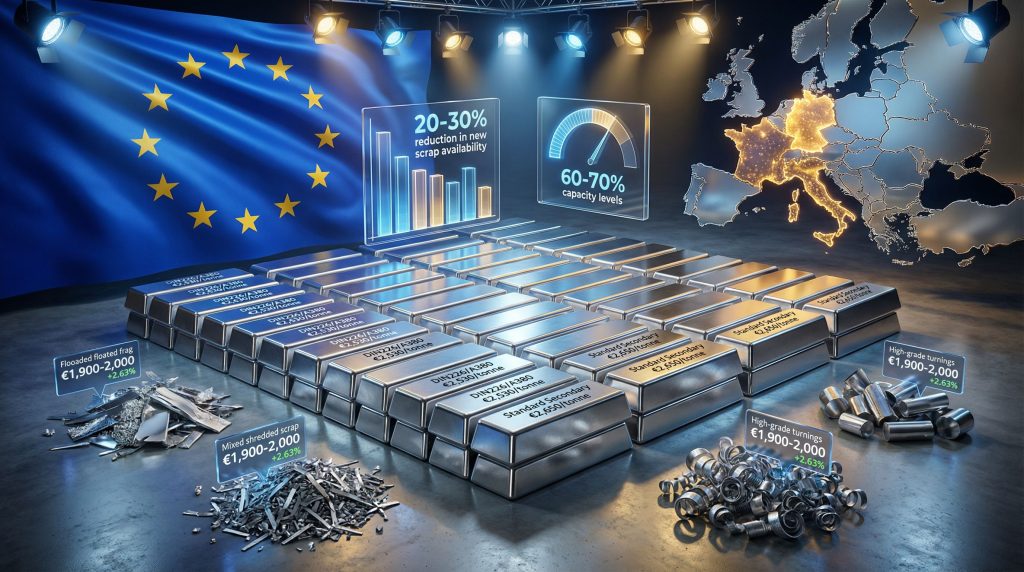
Current market assessments show pressure diecasting ingot trading at €2,430-2,530 per tonne, with modest weekly increases of approximately €10 reflecting supply-driven rather than demand-driven pricing strength. These developments align with broader industry innovation trends shaping the metals sector.
Regulatory Framework Evolution and Market Impact
The anticipated implementation of export restrictions in spring 2026 has created anticipatory positioning effects throughout European scrap markets. Collection yards report limited material inflows as market participants adjust inventory strategies ahead of regulatory changes.
Consequently, these regulatory shifts may also influence tariff impact on markets across various sectors.
Carbon Border Adjustment Mechanism Effects
CBAM implementation creates competitive advantages for domestic secondary aluminium producers by increasing the cost structure for imported primary materials. Secondary aluminium production requires approximately 90% less energy than primary smelting operations, resulting in significantly lower embedded carbon emissions.
The mechanism imposes costs based on carbon content, with typical embedded emissions for secondary aluminium ranging from 0.5-1.5 tonnes CO₂ equivalent per tonne compared to 8-12 tonnes CO₂ equivalent for primary aluminium production. This shift supports broader sustainability transformation initiatives across the industry.
Strategic Inventory Management
Market participants employ sophisticated positioning strategies to navigate regulatory transitions. These include:
- Buffer stock accumulation: Building strategic reserves ahead of export restriction implementation
- Contract timing optimisation: Adjusting supply agreement schedules to capture regulatory advantages
- Grade-specific stockpiling: Focusing on high-value alloy specifications with limited import competition
- Logistics network adaptation: Repositioning inventory to optimise delivery capabilities
Operational Efficiency Under Constraint
Secondary aluminium facilities implement various operational strategies to maintain profitability during challenging market conditions. Production scheduling optimisation becomes critical when energy costs fluctuate and material availability varies unpredictably.
Technical improvements in sorting technology allow facilities to extract higher value from mixed scrap streams. For instance, advanced optical sorting systems can identify and separate specific alloy grades, improving yield rates and reducing processing losses.
Technological Adaptation and Process Innovation
Modern secondary aluminium operations integrate several technological advances that complement emerging renewable energy transitions in the sector:
| Technology Type | Application | Efficiency Gain |
|---|---|---|
| Optical Sorting | Alloy separation | 15-25% yield improvement |
| Inductive Heating | Energy efficiency | 20-30% power reduction |
| Automated Charging | Labour optimisation | 40% handling cost reduction |
| Real-time Analysis | Quality control | 95% specification compliance |
Market Psychology and Sentiment Analysis
Current market sentiment reflects cautious optimism tempered by supply-side uncertainty. Industry participants acknowledge that pricing strength derives from material scarcity rather than robust end-user demand, creating psychological tension about sustainability of current price levels.
Trade sources indicate a "wait-and-see" mentality regarding future market development, particularly concerning the interaction between regulatory changes and demand recovery patterns. This cautious approach affects procurement decisions and inventory management strategies across the supply chain.
Demand Sector Performance Analysis
Mixed downstream demand patterns reflect broader European economic conditions. Automotive sector consumption remains subdued due to production adjustments and inventory management initiatives. Construction applications show seasonal weakness typical for winter months, though underlying infrastructure spending provides some support.
Packaging applications demonstrate relative resilience, though growth rates remain modest compared to historical trends. Meanwhile, aerospace applications maintain technical specification requirements but with reduced volume commitments reflecting production schedule adjustments.
The next major ASX story will hit our subscribers first
Price Discovery Mechanisms and Market Structure
European secondary aluminium price formation occurs through complex interactions between spot transactions, contract negotiations, and benchmark pricing relationships. Floated frag scrap pricing at €1,900-2,000 per tonne represents a 2.63% weekly increase, demonstrating rapid price adjustment mechanisms responding to supply tightness.
Furthermore, detailed producer price data from Eurostat provides additional context for understanding these pricing dynamics within the broader European industrial landscape.
Financial Risk Management Strategies
Market participants employ various hedging approaches to manage price volatility and currency exposure:
- Forward contract structures: Locking in future delivery prices for both scrap inputs and ingot sales
- Currency hedging: Managing euro-dollar exposure through financial instruments
- Inventory valuation: Strategic timing of purchases and sales to optimise margin capture
- Credit risk assessment: Evaluating counterparty stability during volatile periods
Future Market Development Scenarios
Multiple factors will influence EU secondary aluminium prices evolution over the next 6-18 months. Export restriction implementation effectiveness depends on enforcement mechanisms and market participant adaptation strategies. CBAM impact magnitude varies based on primary aluminium import patterns and carbon pricing development.
Industrial demand recovery timing remains uncertain, with manufacturing sector performance dependent on broader European economic conditions. Energy market stabilisation could reduce production cost pressures, though renewable energy transition costs may offset some benefits.
Investment Implications and Strategic Planning
Current market conditions favour facilities with operational flexibility and efficient cost structures. Strategic investments in sorting technology, energy efficiency improvements, and logistics optimisation provide competitive advantages during constrained supply periods.
Long-term outlook suggests continued emphasis on circular economy principles, with secondary aluminium production playing an increasingly important role in meeting sustainability objectives. Regulatory support for domestic recycling capabilities creates investment opportunities for technologically advanced facilities.
Disclaimer: This analysis reflects current market conditions and regulatory expectations as of January 2025. Secondary aluminium prices remain subject to significant volatility based on scrap availability, industrial demand patterns, regulatory implementation, and broader economic conditions. Investment decisions should incorporate comprehensive risk assessment and professional financial advice.
Ready to Capitalise on Metal Market Opportunities?
Discovery Alert's proprietary Discovery IQ model delivers real-time alerts on significant ASX mineral discoveries, instantly empowering subscribers to identify actionable investment opportunities ahead of the broader market. Begin your 30-day free trial today and secure your market-leading advantage in the evolving metals sector.