July 11, 2026
The Architecture of Restriction: How EU Steel Trade Policy Reached Its Most Interventionist Moment in a Decade
Global steel markets have long operated under the shadow of structural overcapacity, a condition that has persisted for more than two decades and intensified considerably since China's industrial expansion accelerated in the early 2000s. For European steelmakers, the consequences have been cumulative and corrosive: suppressed margins, underutilised capacity, and a persistent inability to compete on price against subsidised import volumes. The new EU steel quotas that took effect on 1 July 2026 represent the most forceful regulatory response to this challenge that the bloc has produced, fundamentally reshaping how imported steel enters one of the world's largest consuming markets.
Understanding this framework requires moving beyond the headline numbers. The policy architecture introduced on 1 July 2026 is not simply a tightening of existing safeguards. It is a structural redesign of EU steel trade governance, embedding geopolitical logic, compliance obligations, and access hierarchies into a single regulatory instrument. For importers, traders, and downstream buyers, the consequences will be felt for years.
When big ASX news breaks, our subscribers know first
From Emergency Safeguard to Permanent Quota Architecture: The Regulatory Transition
The EU's journey toward formalised steel import controls began in 2018, when the bloc introduced provisional safeguard measures in response to trade diversion created by the US steel and aluminium tariffs. Those early measures were explicitly framed as temporary and emergency in nature, designed to prevent redirected steel flows from flooding European markets after the US restricted access.
Over successive years, the safeguard mechanism was extended, revised, and progressively tightened, but it retained the legal character of a temporary instrument. The framework that expired on 30 June 2026 was the final iteration of that emergency architecture. What replaced it is qualitatively different in regulatory design.
The European Parliament approved the replacement framework in May 2026, with the Council formally adopting the regulation on 8 June 2026. This compressed timeline between approval and implementation created a situation where the official legislative text was released on 30 June 2026, just one day before the measures came into force. That rushed drafting process has produced tangible regulatory gaps that market participants are still attempting to navigate.
Key Structural Parameters of the New Import Regime
The numerical scale of the change is considerable. The following table summarises the core parameters of the new framework against the prior safeguard architecture:
| Parameter | New Framework (from 1 July 2026) | Prior Framework |
|---|---|---|
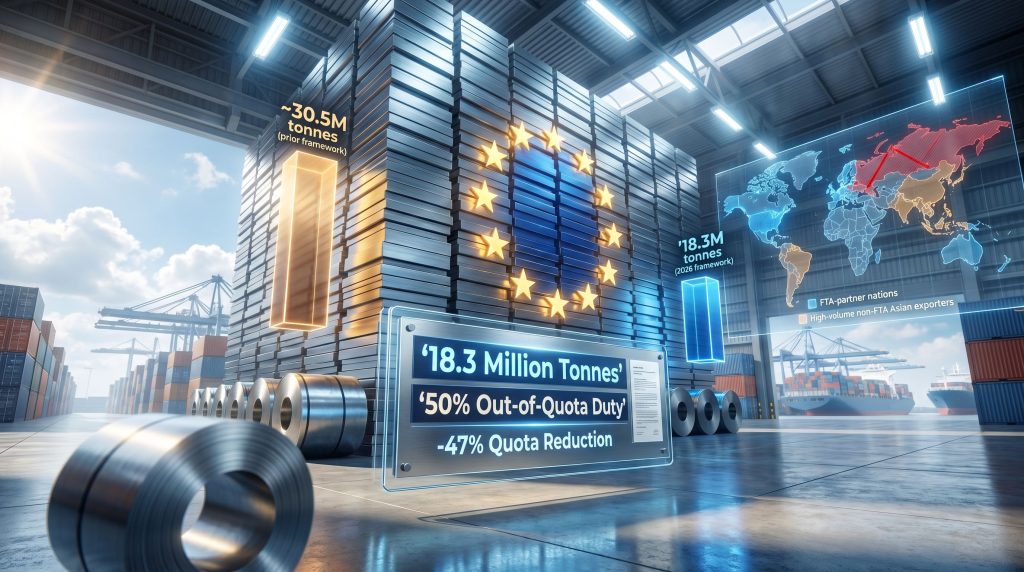
| Annual tariff-free quota | 18.3 million tonnes | ~30.5 million tonnes |
| Quota reduction | 47% lower | Baseline |
| Out-of-quota duty | 50% | 25% |
| Steel product categories covered | 26 to 30 categories | Global safeguard system |
| Russian/Belarusian imports | Banned outright | Restricted |
| FTA partner quota reservation | 50% of quota pool | Country-specific allocation |
| Quota carry-over | Within-year quarterly only | Variable |
The doubling of out-of-quota duties from 25% to 50% is arguably the most commercially significant parameter change. For non-FTA exporters operating at the margins of quota allocations, this shift fundamentally alters landed cost economics and market access viability.
Why Did the EU Slash Steel Import Volumes by 47%? The Industrial Policy Logic
Global Overcapacity as the Primary Driver
The foundational justification for the new quota regime centres on the persistent problem of global steel overcapacity, with China functioning as the primary source of structural supply excess. The China steel market challenges have consistently generated export volumes that suppress pricing across global markets. For EU producers, this dynamic has manifested as a years-long margin squeeze that threatens the commercial viability of European steelmaking operations.
The EU's stated benchmark for industrial health is a capacity utilisation rate of approximately 80% across European steel production. Achieving that threshold under conditions of unrestricted or loosely managed import competition has proved structurally impossible for much of the past decade. The new quota architecture is explicitly designed to compress import supply sufficiently to allow domestic utilisation rates to recover toward that target.
EUROFER's Assessment and the Industrial Sovereignty Argument
European steelmakers, organised principally through the EUROFER industry association, characterised the new measures as a landmark defensive intervention. The framing from the industry position was consistent with a broader EU industrial sovereignty agenda that has gained considerable political momentum since the supply chain disruptions of the early 2020s.
Crucially, the new quota framework does not exist in isolation. It intersects with the EU's Green Deal industrial transition objectives, under which European steelmakers are expected to invest heavily in hydrogen-based direct reduced iron production and electric arc furnace technology. The commercial logic is that higher domestic steel prices, enabled by tighter import controls, can help finance that capital-intensive decarbonisation transition. Furthermore, the green steel pricing dynamics in this environment remain an open and contested question.
The Russia and Belarus Import Ban: Embedding Geopolitics into Trade Law
One of the most structurally significant features of the new framework is the explicit prohibition on steel imports from Russia and Belarus. This is not a quota reduction or a duty escalation for those origins. It is a complete exclusion, regardless of quota availability or product category.
The practical implications extend beyond bilateral trade flows. Prohibitions of this kind historically create incentives for supply chain rerouting, where steel originating from excluded jurisdictions is processed or certified through third-country facilities before re-entering the market under a different origin classification. The new framework's requirement for origin certification based on smelting and casting location, rather than country of export, is a direct counter-measure to this risk, though its enforcement effectiveness will depend on customs vigilance across 27 member states.
How Does the New EU Steel Quota System Actually Work?
The Three-Tier Access Architecture
The new framework operates through a layered access structure that creates meaningfully different market positions for exporters depending on their trade agreement status and quota eligibility:
-
Tier 1 (Global quota pool): The 18.3 million tonne annual ceiling is distributed across 26 to 30 steel product categories. All eligible exporters can compete for access within this pool, subject to category-specific allocations.
-
Tier 2 (FTA partner reservation): Fifty percent of the available quota in each category is ring-fenced exclusively for countries that hold both a free trade agreement with the EU and a country-specific quota for the relevant product. This reservation creates a protected access lane that insulates FTA partners from competition with non-FTA exporters within that portion of the quota.
-
Tier 3 (FTA-CSQ residual quota): This is an entirely new category introduced in the 2026 framework. It provides FTA-CSQ eligible countries with access to overflow volumes on a first-come, first-served basis, drawing from any unutilised portion of the global quota pool.
What Is the FTA-CSQ Residual Quota and Why Is It Creating Compliance Confusion?
The FTA-CSQ residual quota is the element of the new framework generating the most significant market uncertainty. The concept itself is straightforward: eligible exporters should be able to access surplus quota capacity that would otherwise go unfilled. The implementation problem is that the legislative text released on 30 June 2026 does not provide procedurally clear guidance on how the transfer of volumes between the country-specific quota and the residual category actually works.
Compliance Alert: As of 10 July 2026, the European Commission had not issued definitive guidance on FTA-CSQ volume transfer procedures, leaving importers across multiple jurisdictions operating under conflicting interpretations of the same regulation.
The practical result is that market participants are applying at least two competing interpretations simultaneously:
-
Conservative interpretation (prevailing trader view): Excess volumes sitting within country-specific quotas cannot be automatically transferred to the FTA-CSQ residual category. Importers must clear at the applicable pro-rated duty rate unless they can withdraw their volume applications through customs.
-
Liberal interpretation (mill-side view): Excess CSQ volumes automatically cascade into the residual quota if capacity exists within that category, removing the need for manual reapplication.
Both interpretations are currently legally defensible given the absence of authoritative Commission guidance. That ambiguity is not merely an administrative inconvenience. With out-of-quota duties set at 50%, the financial exposure created by a misclassification is substantial.
Origin Certification: The Smelting and Casting Location Requirement
A compliance burden that has received less attention than the quota volumes themselves is the mandatory origin certification requirement. Under the new framework, origin is determined by where the steel was smelted and cast, not where it was most recently processed or from which country it was exported.
For importers sourcing from multi-stage international supply chains, where steel may pass through several processing facilities across different jurisdictions before reaching the EU, this requirement creates significant documentation obligations. Misclassification risk is elevated, and the financial consequences of an incorrect origin determination under a 50% out-of-quota duty environment are considerable.
What Are the Unresolved Compliance Questions Facing EU Steel Importers?
The 14-Day Blocking Period
One of the most operationally disruptive features of the new framework is the unusually extended 14-day blocking period at quota opening. During this window, customs authorities are not permitted to release material into the market, even where importers hold valid quota allocations.
Market participants widely attribute the extended blocking period to the unresolved questions surrounding FTA-CSQ volume transfers, noting that it is difficult to calculate payable duties with certainty while the allocation mechanism remains ambiguous. Importers requiring clearance during this period face a stark commercial choice: wait for resolution or proceed by lodging a 50% duty deposit, accepting the financial exposure in exchange for access to their material.
Volume Transfer Ambiguity and Geographic Asymmetry
The compliance picture is further complicated by a geographic asymmetry in available remedies. Customs authorities in Italy, Spain, Portugal, and Estonia are understood to permit a withdrawal mechanism, allowing importers to remove volumes from a country-specific quota application and reapply for clearance under the FTA-CSQ residual category. This option is not universally available across EU member states, creating meaningfully different compliance pathways depending on where an importer's customs clearance is processed.
Whether this withdrawal mechanism remains accessible at all given the current regulatory uncertainty is itself a point of active debate among traders and legal counsel. Industry participants have reported that enquiries directed to the European Commission and to legal advisers had not produced definitive clarity as of mid-July 2026.
"The combination of rushed legislative drafting, an absence of Commission guidance, and a 14-day blocking period has created a compliance environment where operationally significant decisions are being made on the basis of interpretation rather than authoritative regulatory instruction."
Several market participants have indicated that they expect the Commission to introduce amendments to the regulation within approximately six months of implementation. This expectation is grounded in the evident drafting gaps rather than any formal indication from the Commission itself.
What Are the Trade Flow and Pricing Implications of the New EU Steel Quotas?
Import Volume Compression and Supply Tightening
The arithmetic of the quota reduction is unambiguous. Moving from approximately 30.5 million tonnes of annual tariff-free access to 18.3 million tonnes represents a removal of over 12 million tonnes from the available import supply pool. The distribution of that compression across 26 to 30 product categories means that some segments of the market will experience more acute tightening than others, depending on historical import concentration by product type.
Flat products, including hot-rolled coil and cold-rolled coil, which have historically been among the highest-volume import categories into the EU, face particularly significant exposure to quota compression. Downstream sectors with high steel intensity and limited pricing power, including automotive manufacturing, construction, and white goods production, will absorb a meaningful portion of any price transmission resulting from tighter import supply.
Price Transmission Effects: The 50% Duty Threshold as a Market Divider
A 50% out-of-quota duty does not simply increase the cost of non-compliant imports. It creates a pricing cliff that effectively excludes a large portion of non-FTA supply from commercial viability in the EU market, shifting the competitive calculus in favour of both FTA-eligible imports and domestically produced EU steel.
The landed cost implications are asymmetric by exporter origin. FTA-eligible exporters retain access to the quota reservation and the residual category, limiting their duty exposure. Non-FTA exporters face the full 50% duty once their allocation is exhausted, making EU market access commercially unviable beyond the global quota pool. Indeed, key EU steel imports could drop by over 30% for certain origins under this regime.
Winners and Losers: Which Exporting Nations Are Most Affected?
| Exporter Category | Impact Assessment |
|---|---|
| FTA partner nations (with CSQ) | Protected via 50% quota reservation; eligible for FTA-CSQ residual access |
| Non-FTA exporters | Fully exposed to 50% out-of-quota duty beyond global quota allocation |
| Russia and Belarus | Completely excluded under explicit import ban |
| High-volume Asian exporters (non-FTA) | Significant access reduction; probable trade diversion to alternative markets |
| EU domestic producers | Positioned to benefit from compressed import supply and potential domestic price recovery |
The next major ASX story will hit our subscribers first
How Does the New Framework Compare to Previous EU Steel Safeguard Measures?
Evolution of EU Steel Import Controls: 2018 to 2026
The trajectory from the 2018 provisional safeguard through to the 2026 permanent quota architecture reflects a consistent directional logic: each iteration has progressively tightened access, escalated duty rates, and refined country-specific targeting. What began as an emergency response to US-driven trade diversion has evolved into a normalised permanent instrument of industrial protection.
The most significant conceptual shift in the 2026 framework is the abandonment of the emergency safeguard framing entirely. By embedding the new measures in permanent quota legislation rather than extending the safeguard mechanism, the EU has signalled that import volume management for steel is now a standing feature of its trade policy architecture. Furthermore, the broader EU action plan for steel reflects this same long-term industrial sovereignty logic rather than a temporary deviation from open market principles.
Regulatory Design Comparison: EU vs. Global Steel Protection Frameworks
| Jurisdiction | Mechanism | Out-of-Quota Duty | FTA Exemptions |
|---|---|---|---|
| European Union (2026) | Tariff-rate quota (26-30 categories) | 50% | Partial (50% reservation) |
| United States | Section 232 tariffs | 25% (base rate) | Negotiated exclusions |
| United Kingdom | Steel safeguard quotas | 25% | Developing framework |
| India | Anti-dumping duties (selective) | Variable | Limited |
The EU's 50% out-of-quota duty now significantly exceeds the base rate applied under US Section 232, positioning the EU as the most restrictive major steel-importing jurisdiction in terms of the penalty applied to above-quota volumes. Consequently, the global steel outlook for non-FTA exporters targeting European markets has deteriorated markedly.
What Should Steel Importers, Traders, and Buyers Do Now?
Immediate Compliance Priorities
Given the complexity and unresolved ambiguities within the new framework, importers operating in the EU steel market should treat the following as priority actions:
-
Audit current import volumes against the new quota allocations for each relevant product category to identify exposure to above-quota duty rates.
-
Verify FTA eligibility and country-specific quota status for all active supply origins, distinguishing between Tier 1 global pool access and Tier 2 FTA-reservation access.
-
Review origin certification documentation for compliance with the new smelting and casting location requirement, particularly for supply chains involving multi-stage processing across jurisdictions.
-
Engage customs legal counsel in Italy, Spain, Portugal, and Estonia specifically, to evaluate whether the withdrawal mechanism is currently available and operationally viable.
-
Model the financial exposure of the 50% duty deposit scenario for any material requiring clearance during the 14-day blocking period.
-
Monitor the Commission's publication schedule for clarification guidance, with particular attention to any legislative amendment proposals expected within the first six months of implementation.
Strategic Sourcing Adjustments for Downstream Consumers
For steel-consuming industries, the new EU steel quotas introduce a structural shift in the make-versus-buy calculus for steel procurement. Several strategic considerations merit active evaluation:
-
Diversifying supply origins toward FTA-eligible exporters will maximise quota reservation access and reduce exposure to the 50% out-of-quota duty.
-
Domestic EU production may for the first time in several years become cost-competitive against certain import alternatives, particularly for standard flat and long product grades, once above-quota duty exposure is factored into total landed cost comparisons.
-
Longer-term supply contracts with EU mills or FTA-origin suppliers can reduce procurement timing risk created by quarterly quota depletion dynamics.
The Carbon Border Adjustment Mechanism Interaction: A Compounding Barrier
One dimension of the new framework that has attracted insufficient attention in market commentary is its interaction with the Carbon Border Adjustment Mechanism (CBAM). Steel is one of the primary product categories covered by CBAM, with full enforcement obligations applying from 2026 onward.
For exporters in jurisdictions without domestic carbon pricing mechanisms, the combination of CBAM carbon cost obligations and the potential for 50% out-of-quota duties creates a compounding cost barrier to EU market access. The financial burden layered onto high-emission steel imports from non-FTA origins is now among the highest of any major importing market globally.
This dual barrier dynamic may have unintended consequences for green steel investment incentives outside the EU. Exporters investing in lower-emission production technologies might find EU market access partially restored through reduced CBAM liability, but only if they can also secure quota access within an already heavily compressed allocation pool. The interaction between carbon pricing and quota governance is one of the less-examined structural tensions in the new framework.
Frequently Asked Questions: New EU Steel Import Quotas 2026
What is the new EU steel import quota volume for 2026?
The framework establishes an annual tariff-free quota of 18.3 million tonnes across 26 to 30 steel product categories, representing a 47% reduction from the approximately 30.5 million tonnes previously available under the safeguard regime.
What duty applies to steel imports above the EU quota?
Steel volumes exceeding the tariff-free allocation are subject to a 50% customs duty, double the 25% rate applied under the previous safeguard measures.
When did the new EU steel quotas take effect?
The measures came into force on 1 July 2026, following European Parliament approval in May 2026 and Council adoption on 8 June 2026.
Can Russian or Belarusian steel enter the EU under the new system?
No. The framework includes an explicit prohibition on steel imports originating from Russia and Belarus, irrespective of quota availability.
What is the FTA-CSQ residual quota?
A newly introduced quota category accessible on a first-come, first-served basis to exporters from countries holding both an EU free trade agreement and a country-specific quota for a given product. The precise administration of this mechanism remained subject to active regulatory interpretation as of mid-July 2026.
Can unused quota volumes carry over to the following year?
No. Carry-over is permitted only between quarters within the same calendar year and cannot extend across annual periods.
Why is there a 14-day blocking period at quota opening?
The blocking period prevents customs from releasing material into the market immediately upon quota activation. This extended window, longer than in prior quota cycles, has been further complicated by the unresolved guidance on FTA-CSQ volume transfer procedures.
Disclaimer: This article is intended for informational purposes only and does not constitute legal, financial, or trade compliance advice. The regulatory framework described was subject to ongoing interpretation as of mid-July 2026. Market participants should seek independent legal and customs advice before making procurement or compliance decisions based on the information presented here. Forecasts, price projections, and regulatory outcome predictions involve inherent uncertainty and should not be relied upon as definitive guidance.
Want to Capitalise on the Commodity Market Shifts Driven by Major EU Steel Restrictions?
Discovery Alert's proprietary Discovery IQ model delivers real-time alerts on significant ASX mineral discoveries, instantly converting complex market data across 30+ commodities into clear, actionable insights — empowering investors to identify opportunities ahead of the broader market. Explore historic discoveries and their extraordinary returns, then begin your 14-day free trial at Discovery Alert to position yourself ahead of the next major market move.