August 5, 2026
The Quiet Reordering of Global Mineral Power
For decades, the prevailing logic of global trade was built on efficiency: source inputs wherever they are cheapest, process them wherever costs are lowest, and let comparative advantage determine supply chain architecture. That model delivered remarkable industrial productivity, but it also concentrated extraordinary leverage in the hands of a small number of nations, particularly in the processing of materials that underpin the entire modern technological economy.
Critical minerals, ranging from lithium and cobalt to rare earth elements and gallium, are not simply commodities. They are industrial prerequisites. Without them, electric vehicle batteries cannot be built, semiconductor fabrication stalls, and advanced defence systems cannot be manufactured. The countries that control the processing of these materials hold a form of structural power that goes far beyond ordinary trade relationships, and Western policymakers have spent the better part of a decade coming to terms with what that means for their own industrial security.
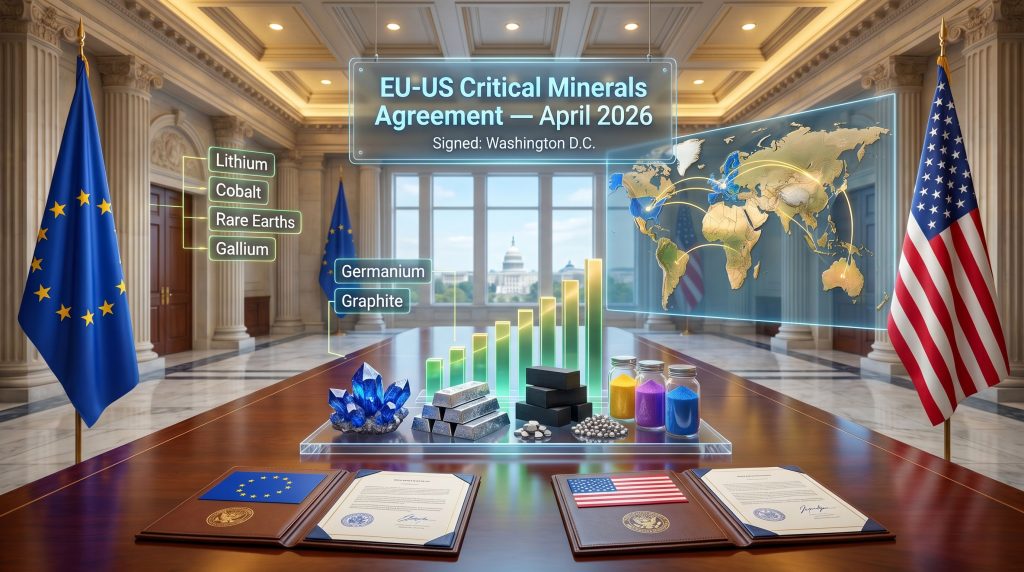
The EU US critical minerals agreement signed in Washington D.C. on 24 and 25 April 2026 represents the most substantive institutional response to that recognition yet. However, to understand what was actually agreed, and what it will take to deliver on the ambitions it contains, it helps to start not with the signing ceremony, but with the underlying architecture of vulnerability it is designed to dismantle.
When big ASX news breaks, our subscribers know first
Why Critical Minerals Became a Geopolitical Flashpoint
The Processing Bottleneck Problem
A common misconception about rare earth supply chains is that the core risk lies in who owns the ore in the ground. In practice, geological diversity is relatively achievable: lithium is found across Australia, Chile, Argentina, and parts of Africa; cobalt deposits exist in the Democratic Republic of Congo, Australia, and the Philippines. The real chokepoint is not extraction — it is what happens next.
Processing and refining critical minerals into battery-grade or semiconductor-grade materials requires substantial capital investment, sophisticated chemistry, extensive permitting, and years of operational development. China invested heavily in building this processing infrastructure over multiple decades, often at below-market cost structures enabled by state industrial policy.
The result is a situation where even minerals mined in politically friendly jurisdictions may be shipped to China for processing before returning to Western markets as refined inputs. The mining geography may be diverse, but the processing geography is not.
This distinction matters enormously for policy design. Trade agreements that focus only on sourcing diversity without addressing processing capacity are solving the wrong half of the problem. The EU US critical minerals agreement appears to recognise this, with the Action Plan's language explicitly targeting the processing supply chain, not just raw extraction geography.
China's Geo-Economic Leverage in Practice
China's dominant position in critical mineral processing has, on multiple occasions, been translated into direct policy leverage. China's rare earth export restrictions on gallium and germanium — both essential to semiconductor manufacturing and optoelectronics — represent documented instances of this mechanism being activated. Price suppression in specific mineral markets has periodically undermined the economics of competing processing investments in Western jurisdictions, effectively preventing the diversification that policymakers were trying to incentivise.
The US-EU Action Plan describes pervasive non-market policies and practices as having left critical minerals supply chains of market-oriented economies vulnerable to a wide range of disruptions, including economic coercion. This is diplomatic language with a specific target.
The phrase "economic coercion" signals that Western governments no longer view China's mineral market conduct as standard commercial behaviour. It represents a substantive policy reframing that has direct implications for the trade mechanisms being contemplated in the Action Plan, particularly the border-adjusted price floor concept.
From Diplomatic Intent to Signed Documents: The Path to April 2026
The Institutional Lineage
The EU US critical minerals agreement did not emerge fully formed. Its institutional lineage traces through multiple predecessor frameworks, including the Mineral Security Partnership, a multilateral coordination vehicle drawing in the United States, European Union, Canada, Australia, Japan, South Korea, and the United Kingdom. The MSP established the political norm of treating allied-nation mineral security as a shared project rather than a series of competing national industrial policies.
Furthermore, at the bilateral level, the United States had already signed comparable critical minerals action plans with Japan and Mexico before turning its attention to the EU. These earlier agreements served as proof-of-concept frameworks, demonstrating that reference price mechanisms and coordinated trade policies could be structured within existing bilateral trade relationships.
The EU agreement represents a qualitative escalation in ambition, given the economic weight of the transatlantic relationship and the sophistication of both parties' domestic critical minerals legislation. Critical minerals and energy security concerns have underpinned much of this legislative momentum on both sides of the Atlantic.
The February 2026 Inflection Point
The formal trajectory toward the April signing accelerated in February 2026 when US Vice President JD Vance publicly outlined the concept of a preferential trade bloc for critical minerals, including the idea of coordinating price floors across allied nations. This was not a technocratic trade announcement: it was a political signal that the US administration was prepared to use trade architecture as an instrument of mineral supply chain policy in a manner that went substantially beyond previous bilateral engagement.
The February announcement set the parameters within which the April agreements were subsequently negotiated, transforming what might have been a symbolic partnership declaration into a structured framework with specific mechanism categories and implementation timelines.
Breaking Down What Was Actually Signed
Two Documents, One Strategic Purpose
A point of frequent confusion in coverage of the EU US critical minerals agreement is the relationship between the two instruments signed simultaneously. The Memorandum of Understanding, signed by US Secretary of State Marco Rubio and EU Trade and Economic Security Commissioner Maros Sefcovic, establishes the political and institutional framework for partnership: a commitment to diversify mineral sourcing, reduce geographic concentration, and launch pilot projects before the end of 2026.
The Critical Minerals Action Plan, announced separately through US Trade Representative Jamieson Greer, is the more operationally specific document. It designates itself as the primary coordination mechanism for trade policies on critical minerals, with the explicit longer-term objective of concluding a binding plurilateral agreement on trade in these materials.
The distinction is significant. The MoU creates the relationship; the Action Plan creates the pathway toward something enforceable.
The Trade Mechanisms Under Discussion
The Action Plan identifies a specific toolkit of trade instruments for coordinated development. These are not yet implemented policies but rather the categories within which concrete measures will be designed:
| Mechanism | Strategic Purpose |
|---|---|
| Border-Adjusted Price Floors | Prevent below-cost import dumping that undercuts allied-nation production investment |
| Standards-Based Markets | Create shared technical and environmental benchmarks for mineral sourcing |
| Price Gap Subsidies | Bridge the cost differential between domestically produced and artificially suppressed import prices |
| Offtake Agreements | Long-term purchase commitments designed to de-risk capital investment in new production capacity |
| Stockpiling Cooperation | Coordinated strategic reserves to buffer supply disruptions |
| Investment Screening Cooperation | Aligned frameworks to prevent adversarial acquisition of strategic mineral assets |
Beyond these mechanisms, the Action Plan encompasses regulatory cooperation on mining, processing, and recycling standards, as well as coordinated rapid response frameworks to address supply crises before they escalate into industrial disruptions.
Understanding Border-Adjusted Price Floors
The border-adjusted price floor concept deserves particular attention because it is both the most commercially significant mechanism and the most technically complex to implement. In essence, a price floor establishes a reference price for an imported mineral. If import prices fall below that threshold, a border adjustment is applied to bring the effective price up to the reference level.
This is designed specifically to counter the strategy of below-cost pricing used to suppress competitor investment in allied nations. Commissioner Sefcovic has indicated that initial pilot projects testing this mechanism could begin before year-end 2026, which suggests the parties are treating it as the most urgent near-term implementation priority.
What Minerals Are in Scope and Why They Were Chosen
The agreement targets what it describes as mutually agreed select critical minerals and associated supply chains — language that preserves operational flexibility while indicating priority targeting. Based on the strategic context, the mineral categories most likely in scope include:
- Rare earth elements: Essential for permanent magnets in electric motors and wind turbines, where China's processing dominance is most pronounced
- Lithium: The foundational input for EV battery cathode and electrolyte chemistry, with processing concentrated despite geographically diverse ore sources
- Cobalt: Critical for battery energy density, with both mining and processing concentration creating layered supply risk
- Nickel: Central to next-generation battery chemistries and stainless steel production
- Manganese: An important battery component where supply chain development has lagged other critical minerals
- Graphite: Used as battery anode material, where natural graphite processing is heavily concentrated
- Gallium and germanium: Semiconductor-critical materials that have already been subject to Chinese export restrictions, making them highly relevant to the broader issue of critical minerals for semiconductors
The IRA Dimension: Why EU Industrial Access Matters
One of the EU's primary negotiating objectives in these discussions relates to the US Inflation Reduction Act. The IRA's domestic content requirements and clean energy subsidy provisions were structured around Free Trade Agreement partners, a category that includes Japan and South Korea but not the European Union. This created a competitive disadvantage for European EV battery manufacturers and clean energy equipment producers seeking access to US market incentives.
The MoU's trade facilitation provisions are designed to create a pathway for EU-sourced or processed critical minerals to qualify for IRA-linked treatment, establishing a more level competitive framework for European industrial players operating in or supplying the US market. This has downstream significance for European battery manufacturers, renewable energy equipment producers, and the broader industrial base that feeds into those supply chains.
The next major ASX story will hit our subscribers first
The Emerging Plurilateral Minerals Architecture
The EU US critical minerals agreement is most accurately understood not as a standalone bilateral deal but as one node in an emerging network of coordinated mineral security frameworks among like-minded nations.
| Framework | Parties | Primary Focus |
|---|---|---|
| EU-US Critical Minerals MoU and Action Plan | United States, European Union | Supply chain diversification, price floors, trade standards |
| US-Japan Critical Minerals Action Plan | United States, Japan | Processing capacity, allied sourcing |
| US-Mexico Critical Minerals Action Plan | United States, Mexico | Regional supply chain integration |
| Mineral Security Partnership | US, EU, Canada, Australia, Japan, South Korea, UK and others | Multilateral project finance and coordination |
| EU Critical Raw Materials Act | European Union (domestic) | Strategic stockpiles, extraction targets, third-country partnerships |
These frameworks are explicitly designed to be mutually reinforcing. The Action Plan's stated longer-range objective is developing a binding plurilateral initiative, suggesting that current bilateral instruments are intended to serve as building blocks for a more comprehensive, legally enforceable architecture. The establishment of a critical raw materials facility within the EU's broader strategy further reinforces this ambition.
Emerging producer nations across Africa, Latin America, and Southeast Asia will be central to the supply-side foundation of any successful diversification strategy, and investment promotion provisions within the agreement are designed to channel capital toward allied and partner-nation projects in these regions.
Critical Challenges: Where the Agreement Faces Its Hardest Tests
The Execution Gap
Commissioner Sefcovic's own framing of the implementation challenge is instructive. He acknowledged that the real test will be transforming signed agreements into concrete, tangible projects that deliver measurable outcomes for industrial operators. This is not false modesty: it reflects a genuine structural challenge in translating diplomatic instruments into supply chain reality.
The timeline problem is perhaps the most fundamental obstacle. New mineral projects — from exploration through permitting, construction, and first production — routinely require a decade or more before they reach commercial scale. The urgency driving the agreement, shaped by escalating geopolitical risk and documented Chinese export controls, operates on a political timescale of years, not the industrial timescale of decades. Stockpiling cooperation and offtake agreements represent the most viable near-term tools for managing this gap while longer-term infrastructure investment matures.
WTO Compatibility and Legal Risk
Border-adjusted price floors and coordinated trade measures occupy contested legal territory under existing WTO obligations. If these mechanisms are effectively structured as coordinated tariffs applied to non-aligned supplier nations, they face potential challenge under multilateral trade rules. The design challenge is to build a minerals security architecture that is robust enough to achieve its supply chain objectives while structured in a manner that can withstand legal scrutiny. This is not a hypothetical concern: it will shape which specific implementation options are viable as the Action Plan moves from discussion categories to concrete policy design.
Political Durability
Both the United States and European Union are subject to electoral cycles that can produce significant shifts in trade and industrial policy priorities. The agreement's durability across government transitions on both sides of the Atlantic represents a risk that institutional design will need to account for. Embedding the framework within legally binding instruments — which the Action Plan explicitly targets as its longer-term objective — provides more protection against policy reversal than a reliance on political commitment alone.
Benchmarks for Assessing Whether the Agreement Delivers
Rather than accepting the agreement's ambitions at face value, investors, industry operators, and policy analysts would be better served by tracking concrete indicators of implementation progress:
- Launch of pilot projects, particularly those testing price floor mechanisms, before the end of 2026
- Progress in negotiations toward a binding plurilateral agreement with additional like-minded partners
- Measurable increases in processing capacity within allied-nation jurisdictions
- Formal adoption of shared technical standards for mining, processing, and recycling
- Evidence that price floor mechanisms are sustaining investment economics in non-Chinese mineral supply chains
- Effectiveness of investment screening cooperation in preventing adversarial capital from acquiring strategic mineral assets
These benchmarks matter because the history of critical mineral policy is littered with frameworks that generated significant political activity and limited industrial change. The processing bottleneck that makes China's position so entrenched took decades to build and will take sustained, well-capitalised effort to meaningfully diversify.
Frequently Asked Questions: EU-US Critical Minerals Agreement
What is the EU-US Critical Minerals Agreement?
A Memorandum of Understanding and accompanying Action Plan signed in April 2026 by the United States and European Union to coordinate trade policies, diversify mineral supply chains, and reduce dependence on geographically concentrated sources of materials essential to clean energy, defence, and advanced manufacturing.
What minerals does the EU-US agreement cover?
The agreement targets a mutually agreed selection of critical minerals, most likely encompassing rare earth elements, lithium, cobalt, nickel, manganese, graphite, gallium, and germanium — materials central to semiconductor production, EV battery manufacturing, and defence system fabrication.
How does the EU-US Critical Minerals Agreement address China's market dominance?
The Action Plan identifies non-market policies and practices, including price suppression and selective export controls, as having distorted global critical minerals supply chains. Mechanisms such as border-adjusted price floors are designed specifically to counteract artificially low pricing that undermines investment in allied production and processing capacity.
What is a border-adjusted price floor in the context of critical minerals?
A trade mechanism that establishes a reference price for imported minerals. When import prices fall below that threshold, a border adjustment is applied to bring the effective import price up to the reference level, protecting the economic viability of domestic or allied-nation mineral production from below-cost competition.
Is the EU-US Critical Minerals Agreement legally binding?
The MoU and Action Plan are not themselves binding agreements. However, the Action Plan explicitly states that its purpose is to serve as the coordination mechanism for concluding a binding plurilateral agreement on trade in critical minerals, making the current documents a structured pathway toward a future enforceable framework.
How does this agreement relate to the US Inflation Reduction Act?
A central EU objective is securing treatment for EU-sourced critical minerals equivalent to that afforded to Free Trade Agreement partners under IRA provisions, enabling European manufacturers to access US clean energy subsidies on a competitive basis with South Korean and Japanese counterparts.
What similar agreements has the US signed with other partners?
The United States has signed comparable Critical Minerals Action Plans with Japan and Mexico, and participates in the broader Mineral Security Partnership alongside the EU, Canada, Australia, Japan, South Korea, and the United Kingdom. Reporting from Reuters highlights how these partnerships are being deepened with an eye toward a broader binding framework.
The Decade Ahead: What This Agreement Actually Signals
The EU US critical minerals agreement is best understood as a marker of a paradigm shift that was already underway rather than as the event that caused it. Western governments have progressively moved from treating critical mineral supply chains as a commercial matter best left to market forces toward treating them as strategic infrastructure requiring the same deliberate policy attention historically reserved for energy security or defence industrial capacity.
That shift carries significant implications for global commodity markets. If price floor mechanisms are successfully implemented and sustained, the economics of mineral project development in allied nations will change materially. Projects that were previously unviable against suppressed import prices may become bankable. Processing infrastructure investment that was deterred by the risk of Chinese price competition may find a more supportive market structure.
The investment flows that follow successful implementation could reshape the global geography of mineral production over the course of the decade. Consequently, the sectors most directly affected by successful implementation span battery manufacturing, semiconductor fabrication, renewable energy equipment production, and advanced defence platforms. For operators in those industries, the trajectory of this agreement from diplomatic instrument to industrial reality is not an abstract geopolitical question — it is a material factor in long-term supply chain planning and capital allocation decisions.
Disclaimer: This article is intended for informational purposes only and does not constitute financial, investment, or legal advice. Statements regarding policy mechanisms, implementation timelines, and market outcomes are subject to change based on evolving geopolitical, regulatory, and commercial conditions. Readers should conduct independent research and consult qualified professionals before making investment or business decisions based on any information contained herein.
Want to Capitalise on the Next Major Mineral Discovery Before the Market Catches On?
The geopolitical reshaping of critical mineral supply chains is creating significant new opportunities across ASX-listed exploration and resources companies — and Discovery Alert's proprietary Discovery IQ model delivers real-time alerts the moment significant ASX mineral discoveries are announced, turning complex data across more than 30 commodities into clear, actionable insights. Explore why historic mineral discoveries have generated substantial returns and start your 14-day free trial today to position yourself ahead of the market.