June 25, 2026
The Circular Economy Squeeze: How Europe's Resource Retention Agenda Is Reshaping Asia's Scrap Markets
Global scrap metal trade has always operated at the intersection of industrial necessity and geopolitical convenience. For decades, a relatively predictable logic governed the flow of recyclable materials: wealthier economies generated surplus scrap, while rapidly industrialising nations absorbed it as a cost-effective manufacturing input. That arrangement is now under structural pressure. Europe's accelerating commitment to circular economy principles is producing regulatory frameworks that fundamentally challenge the economics of cross-border scrap trade, and India's aluminium recycling sector sits directly in the crosshairs.
The EU Waste Shipment Regulation impact on India aluminium scrap imports is not merely a compliance story. It is a signal that the global recyclable materials market is entering a new era, one defined by resource nationalism, environmental conditionality, and the weaponisation of waste classification frameworks as instruments of industrial policy. Furthermore, Europe's supply chain strategy increasingly treats high-value recyclables as strategic assets rather than exportable surplus.
When big ASX news breaks, our subscribers know first
India's Structural Dependency: More Fragile Than It Appears
Understanding the scale of India's exposure requires looking beyond headline import volumes. The country sources between 80 and 85 percent of its aluminium scrap requirements from international markets, a dependency ratio that would be alarming in any strategic commodity context. What makes this particularly acute is that recycled aluminium contributes approximately 30 percent of India's total aluminium production output, meaning the recycling sector is not a peripheral activity but a load-bearing pillar of national metals supply.
Total aluminium scrap imports reached 2.02 million tonnes in 2025, a figure that reflects both the maturity of India's secondary aluminium industry and the structural gap between domestic scrap generation and industrial demand. India's end-of-life material recovery infrastructure, while growing, remains insufficient to bridge that gap through internal supply alone.
Within that import base, the EU occupies a uniquely critical position. European-origin scrap is not simply large in volume; it is qualitatively distinct. Advanced sorting technologies, strict contamination controls, and mature waste management systems embedded in European regulatory frameworks produce scrap streams with consistency and purity levels that are difficult to replicate from alternative sourcing regions.
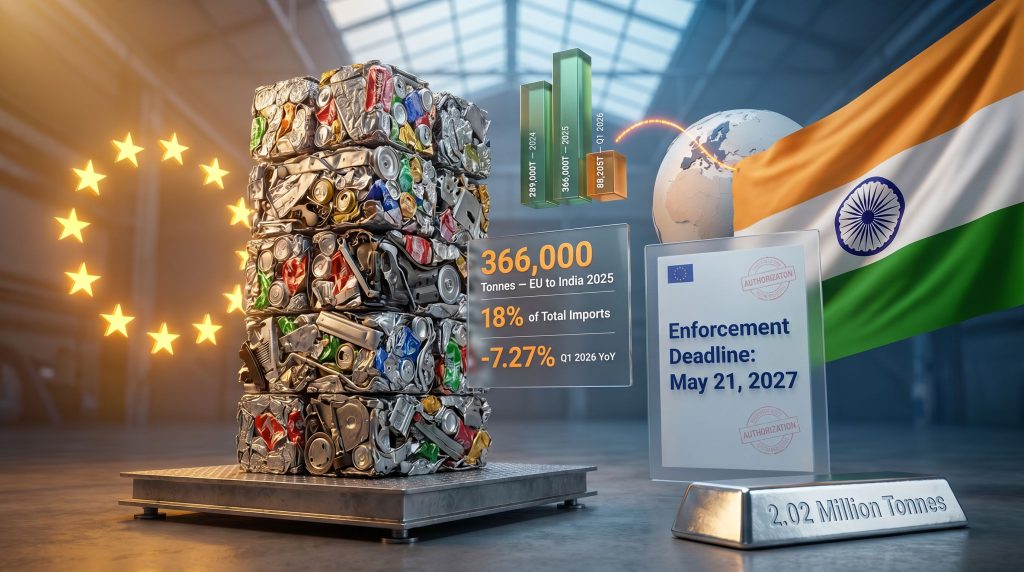
In 2025, India imported 366,000 tonnes of aluminium scrap from the EU, representing approximately 18 percent of total import volume and marking a 26.64 percent year-on-year increase from the 289,000 tonnes sourced in 2024. That growth trajectory makes the early signs of deceleration all the more significant: in Q1 2026, India's EU scrap intake fell to 88,205 tonnes, down 7.27 percent from 95,122 tonnes in Q1 2025.
The pre-enforcement contraction in Q1 2026 suggests that procurement managers at Indian recycling facilities are already repositioning their sourcing strategies in anticipation of regulatory tightening, a behavioural shift that could accelerate feedstock competition across Asian secondary aluminium markets before the 2027 deadline even arrives.
Decoding the EU Waste Shipment Regulation: What It Actually Does
The EU Waste Shipment Regulation is frequently characterised in trade commentary as an environmental measure. That framing is accurate but incomplete. The regulation is simultaneously a tool of industrial policy, designed to retain high-value recyclable feedstock within the EU's own processing ecosystem rather than allowing it to flow to lower-cost jurisdictions. The European raw materials push reflects a broader strategic intent to secure domestic supply chains for the decades ahead.
The Authorization Architecture
The WSR's core mechanism is a tiered authorization system that creates fundamentally asymmetric access rights based on OECD membership. Countries within the OECD face relatively streamlined pathways for continued scrap imports. Non-OECD nations, a category that includes India, must formally apply to the European Commission for authorization to receive EU-classified waste streams.
Key regulatory milestones under the framework include:
- The authorization application deadline passed on February 21, 2025, requiring non-OECD facilities to have already submitted documentation
- Full enforcement activates on May 21, 2027, at which point facilities without confirmed authorization face a complete prohibition on receiving EU-origin scrap
- All receiving facilities must pass independent third-party environmental audits verifying compliance with environmentally sound management standards before authorization is granted
- EU exporters must digitise all shipment documentation and submit records through a dedicated European Commission surveillance portal for imports and exports of metal scrap
The digital documentation requirement deserves specific attention. While it may appear administrative in nature, it creates a compliance burden that scales poorly for smaller operators on both the export and import sides of the transaction. Indian recycling businesses without dedicated compliance infrastructure face disproportionate exposure.
Why Trade Agreements Cannot Solve This Problem
A critical and underappreciated dimension of the WSR challenge is that scrap metal trade operates under environmental law rather than conventional trade agreement frameworks. The Basel Convention, to which both India and the EU are signatories, governs the transboundary movement of waste materials, and its provisions interact directly with the WSR's authorization system.
This legal architecture means that bilateral tariff concessions, preferential trade arrangements, or free trade agreement provisions cannot override waste classification rules. India's traditional diplomatic toolkit for trade disputes is largely inapplicable here, which explains why the Ministry of Commerce's engagement is seeking structured bilateral dialogue rather than formal dispute resolution mechanisms.
Mapping the Financial Exposure: What the Numbers Reveal
| Trade Metric | 2024 | 2025 | Change |
|---|---|---|---|
| India total aluminium scrap imports | Not specified | 2.02 million tonnes | Growing |
| EU volume to India | 289,000 tonnes | 366,000 tonnes | +26.64% |
| EU share of India's total imports | Lower | ~18% | Expanding |
| Q1 2026 EU imports | 95,122 tonnes | 88,205 tonnes | -7.27% |
Beyond volume metrics, the cost transmission effects of the WSR carry significant industrial weight. Proposed EU export tariffs in the range of 25 to 30 percent on scrap shipments to non-OECD destinations could translate into an estimated €50 to €150 per tonne in additional landed costs for Indian importers. Given that secondary aluminium production operates on relatively thin margins, cost increases of this magnitude represent genuine threats to sectoral viability for mid-tier operators.
Compounding the pressure is India's existing 2.5 percent import duty on aluminium scrap, a levy that the Material Recycling Association of India argues should be eliminated precisely because it amplifies the cost burden created by supply-side regulatory restrictions. Consequently, the cumulative effect on the EU Waste Shipment Regulation impact on India aluminium scrap imports could reshape the economics of secondary production entirely.
Industry Segmentation: Who Wins, Who Loses
The WSR's impact will not distribute evenly across India's aluminium recycling sector. The compliance barrier creates a structural advantage for larger, better-capitalised operators while exposing smaller and unorganized recyclers to existential risk.
| Operator Segment | Risk Level | Core Vulnerability |
|---|---|---|
| Large integrated producers | Moderate | Partial buffer from domestic scrap access |
| Mid-tier secondary producers | High | EU dependency without diversified sourcing |
| Small-scale and unorganized recyclers | Critical | Cannot absorb audit and compliance costs |
| Accredited large-format recyclers | Lower | Positioned to capture market share |
This bifurcation effect is consistent with a broader pattern observed when environmental compliance standards are introduced to industries with heterogeneous operator structures. Regulatory complexity tends to accelerate consolidation, eliminating smaller participants while strengthening the competitive position of compliance-capable majors. From an industry structure perspective, the WSR may ultimately reshape the Indian secondary aluminium landscape as much as it reshapes its supply chains.
The Quality Premium Problem: Why Substitution Is Harder Than It Looks
One of the less-discussed dimensions of the EU scrap dependency challenge is the difficulty of finding genuinely equivalent replacement supply. European aluminium scrap commands a quality premium that reflects systemic investment in waste processing infrastructure accumulated over decades.
The EU's regulatory environment for waste management has progressively raised sorting standards, reduced contamination rates, and improved alloy segregation practices across member states. The result is a scrap stream with predictable metallurgical characteristics that allows Indian secondary producers to plan melt chemistry with precision, reducing energy consumption and improving yield rates in the furnace.
Alternative supply sources present meaningful limitations:
- United States: The other primary source of premium-grade scrap, but subject to its own evolving trade policy dynamics and increasingly competitive internal demand
- Southeast Asia and Middle East: The southeast Asian scrap trade can offer partial volume substitution but generally cannot replicate the grade consistency and contamination control of EU-origin material
- Domestic Indian scrap: Structurally insufficient in volume and quality given the country's still-developing end-of-life material recovery infrastructure
Processing lower-grade scrap from alternative origins requires additional sorting, pre-treatment, and dross management investment at the smelter level, partially or fully offsetting any per-tonne cost savings from supply diversification. This quality-cost trade-off is frequently underweighted in discussions that focus exclusively on tonnage volumes. In addition, the battery recycling economics emerging in Asia illustrate how quickly feedstock competition can intensify when regulatory pressure redirects material flows.
The next major ASX story will hit our subscribers first
India's Policy Response: Domestic Reform Demands
The Material Recycling Association of India has articulated a comprehensive domestic policy agenda in response to the WSR challenge. Rather than relying solely on diplomatic engagement, the industry body is pushing for structural reforms that would reduce pre-existing cost burdens and improve competitiveness under a more constrained supply environment.
Key MRAI policy demands include:
- Elimination of the 2.5% import duty on aluminium scrap, reducing landed cost pressures across the value chain
- Reduction of GST on metal scrap from 18% to 5%, lowering the tax burden on secondary aluminium production
- Exemption of imported non-ferrous scrap from Extended Producer Responsibility obligations that would otherwise add further compliance costs
- Removal of the mandatory Pre-Shipment Inspection Certification system, which adds procedural friction and logistics costs to import operations
The Engineering Export Promotion Council has added its institutional voice to India's diplomatic engagement with European authorities, framing uninterrupted scrap access as a matter of industrial continuity rather than purely environmental compliance.
Diplomatic Signalling: Reading the EU's Position
India's Ministry of Commerce initiated formal diplomatic engagement following an internal Department of Commerce assessment circulated in a memorandum dated June 8, which directed the FT (Europe) Division to evaluate the WSR's implications for secondary raw material access. The engagement signals that India views this as a strategic trade matter warranting government-level attention rather than purely a private sector compliance challenge. For further context, S&P Global reports that India is actively seeking EU approval for scrap imports under the new waste shipment rules.
The EU Ambassador to India offered a measured but constructive signal on the audit process, indicating that ongoing assessments of Indian recycling facilities had to that point yielded no negative findings. This statement, while deliberately cautious, implies that India's larger and better-organised recycling operators may be more audit-ready than the broader industry anxiety suggests.
The Ambassador's characterisation of audit outcomes as encouraging is significant because it shifts the narrative from inevitable restriction to conditional continuity, suggesting that the path to maintained EU scrap access exists for facilities that proactively engage with environmental sound management verification processes.
The Broader Scrap Import Ecosystem at Risk
Aluminium is the most immediately affected commodity, but India's scrap import dependency extends across multiple material categories. The country imports approximately 9 million tonnes of ferrous scrap, 4 million tonnes of non-ferrous scrap, and 1.5 million tonnes of paper scrap annually. The WSR's framework, if extended or used as a template for other waste categories, could create compounding supply disruptions across steel, copper, and paper recycling industries simultaneously.
This systemic dimension elevates the EU Waste Shipment Regulation impact on India aluminium scrap imports from a sectoral compliance challenge to a strategic trade policy issue with macroeconomic implications. Furthermore, global steel scrap demand trajectories suggest that upstream feedstock competition will only intensify as decarbonisation targets tighten across major steel-producing economies.
Three Futures for India's Aluminium Scrap Security
The trajectory of India's aluminium scrap supply through and beyond 2027 will be determined by decisions made in the next 12 to 18 months. Three plausible scenarios frame the range of outcomes:
Scenario 1: Successful Integration
Major Indian recycling facilities complete third-party audits, secure European Commission authorization, and bilateral diplomatic engagement produces a structured compliance pathway. Supply continuity is maintained with moderate cost increases absorbed across the value chain. Industry consolidation accelerates but does not destabilise overall production capacity.
Scenario 2: Sector Bifurcation
Large accredited operators achieve compliance and retain EU scrap access, while smaller facilities are effectively excluded. The outcome reshapes industry structure through accelerated consolidation, with compliance-capable majors gaining feedstock advantages and expanding market share at the expense of smaller competitors.
Scenario 3: Authorization Failure and Supply Shock
Authorization delays or denials trigger a sharp reduction in EU scrap availability from May 2027. India faces a structural supply gap requiring emergency domestic policy intervention, accelerated development of alternative sourcing corridors, and potentially significant short-term production disruptions in the secondary aluminium sector.
The single most consequential variable determining which scenario materialises is the speed and quality of India's engagement with EU authorization procedures between now and the 2027 enforcement deadline. Market participants that treat this as a future problem rather than a present compliance imperative face the highest exposure to Scenario 3 outcomes.
Frequently Asked Questions
What is the EU Waste Shipment Regulation's enforcement timeline for non-OECD countries like India?
The authorization application window closed on February 21, 2025. Full enforcement activates on May 21, 2027. Facilities without confirmed authorization by that date face a prohibition on receiving EU-origin scrap.
How much aluminium scrap does India import from the EU annually?
India imported 366,000 tonnes of EU aluminium scrap in 2025, representing approximately 18% of its total global aluminium scrap imports of 2.02 million tonnes.
What audit requirements must Indian facilities meet?
All Indian recycling facilities receiving EU-origin scrap must complete independent third-party environmental audits confirming compliance with environmentally sound waste management standards as a condition of authorization.
What cost increases could Indian recyclers face under the new framework?
Proposed EU export tariffs of 25 to 30 percent on scrap shipments to non-OECD countries could add an estimated €50 to €150 per tonne to import costs, compounding India's existing 2.5% import duty burden.
Can India use free trade agreements to bypass the WSR restrictions?
No. Scrap metal trade is governed by environmental law frameworks, including the Basel Convention, rather than conventional trade agreements. Bilateral tariff concessions cannot override waste classification rules under the WSR.
Disclaimer: This article contains forward-looking analysis, scenario projections, and cost estimates that are inherently speculative. Trade policy outcomes, regulatory timelines, and market responses are subject to change. This content is intended for informational purposes only and does not constitute investment, legal, or commercial advice.
Want to Stay Ahead of the Commodity Shifts Reshaping Global Markets?
Discovery Alert's proprietary Discovery IQ model scans ASX announcements in real time, instantly identifying significant mineral discoveries across more than 30 commodities — translating complex data into actionable investment insights before the broader market reacts. Explore historic discovery returns on Discovery Alert's dedicated discoveries page and begin your 14-day free trial to position yourself ahead of the next major market move.