June 25, 2026
When the World's Most Critical Oil Chokepoint Blinks: Reading the Middle East HSFO Recovery
Every few decades, a sustained disruption to a major energy corridor forces producers, shippers, and buyers to fundamentally rewire how they think about supply security. The 1973 Arab oil embargo redirected decades of energy policy. The 1990 Gulf War reshaped tanker routing strategies across Asia. What is unfolding in the Middle East in mid-2026 belongs to that same category of structural market events, not because of its immediate price impact, but because of the lasting infrastructure changes it is accelerating beneath the surface.
The fact that Middle East fuel oil exports June four-month high data now headlines commodity market analysis reflects something more telling than a simple directional bounce. It reveals a region in the middle of a forced and potentially permanent reorganisation of how its energy products reach global markets. Furthermore, understanding the oil market dynamics at play here is essential for any serious market participant.
When big ASX news breaks, our subscribers know first
Understanding HSFO: The Commodity That Drives Ships, Powers Grids, and Feeds Refineries
High-sulphur fuel oil occupies an unusual position in the global energy complex. Unlike crude oil, which commands headlines and investor attention daily, HSFO operates in the background of industrial civilisation, quietly powering the systems that keep everything else moving.
Its three primary demand segments each carry distinct market characteristics:
- Marine bunkering is the dominant use case globally, with large container ships, bulk carriers, and tankers burning HSFO as their primary propulsion fuel on long-haul routes
- Power generation across price-sensitive economies in South and Southeast Asia relies heavily on HSFO imports from the Middle East, particularly during periods of peak electricity demand
- Refinery processing uses HSFO as a feedstock input, where it undergoes further upgrading into lighter distillates
What makes the Middle East specifically critical to this market is the region's ability to produce HSFO as a natural by-product of its heavy, sulphur-rich crude slate. Refineries processing Arab Heavy or Basra Heavy crude grades generate large volumes of residual fuel oil, much of which gets exported rather than absorbed domestically. Before the current conflict, the region exported between 5.5 million and 6.0 million metric tons of HSFO per month, with Iraq, Kuwait, Iran, and the UAE functioning as the dominant volume contributors.
The Strait of Hormuz, a narrow waterway barely 33 kilometres wide at its narrowest navigable point, serves as the exit valve for the vast majority of this output. At peak activity, the strait handles an estimated 12 million barrels per day of total oil traffic, making it the single most consequential maritime chokepoint in global energy logistics. When that valve partially closes, the consequences cascade across shipping, power generation, and refinery operations simultaneously.
The Anatomy of a Supply Shock: How Deep Is the Current Gap?
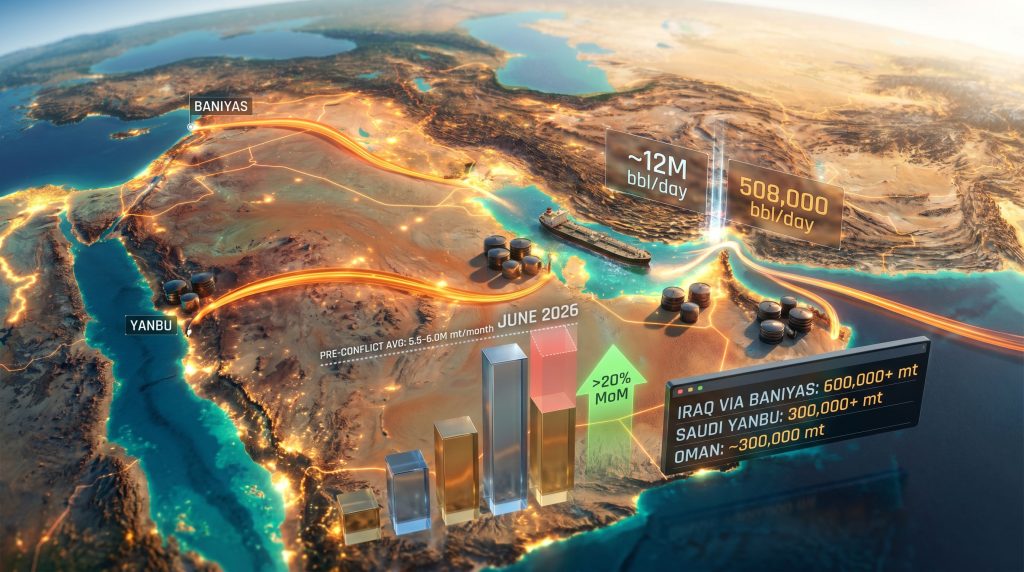
June 2026 export projections of approximately 2.4 million metric tons (508,000 barrels per day) represent genuine directional progress. The month-on-month improvement of over 20% from May volumes is meaningful, and the Strait of Hormuz throughput recovery from a low of roughly 9.6 million barrels per day in May back toward 12 million barrels per day in early June signals that the worst of the disruption may have passed.
However, framing the June figure as a recovery story without contextualising the structural gap risks misleading market participants. Consider what the numbers actually reveal:
| Metric | Pre-Conflict Baseline | June 2026 Projection | Gap |
|---|---|---|---|
| Monthly HSFO exports | 5.5 to 6.0 million metric tons | ~2.4 million metric tons | ~55 to 60% below baseline |
| Strait of Hormuz throughput | ~12 million bpd | Recovering toward 12 million bpd | Partial recovery |
| Month-on-month export change | Stable | +20% vs May | Positive direction |
| Export volumes as % of pre-war norm | 100% | ~40 to 45% | Structural impairment persists |
"The June rebound is a signal of directional momentum, not a declaration of normalisation. A market operating at 40 to 45% of its pre-war export capacity remains deeply impaired regardless of what the month-on-month improvement looks like in isolation."
This distinction matters enormously for buyers planning supply contracts, shippers calculating voyage economics, and refiners managing feedstock availability. The recovery trajectory and the pace at which the remaining gap closes will define market conditions for the remainder of 2026. The IEA's latest oil market report provides additional context on how these regional disruptions feed into global supply forecasts.
Three Structural Drivers Behind the June Export Rebound
Iraq's Syrian Corridor: A Hormuz-Independent Export Pathway Emerges
The most structurally significant development in regional HSFO logistics is Iraq's activation of an entirely new export corridor through Syria's Baniyas port. This route, operational for the first time since March 2026, involves Iraqi fuel oil being transported overland by truck across Syrian territory before maritime loading at Baniyas for onward export via the Mediterranean.
The scale of this operation has surprised even close market observers. June volumes through the Baniyas corridor exceeded 600,000 metric tons, a record high for the route and a figure that demonstrates the corridor has genuine operational capacity, not merely symbolic value. Before the conflict, Iraq exported the overwhelming majority of its HSFO from the southern Khor al-Zubair port, which feeds directly into Hormuz-dependent shipping lanes.
The strategic calculus here is straightforward: by routing supply through Syria, Iraq has created an export pathway that is entirely decoupled from Strait of Hormuz risk. Industry analysis from FGE NexantECA indicates that Iraq's commitment to this corridor reflects a deliberate, long-term strategy of export route diversification. That framing has significant implications for the future geography of global HSFO supply, particularly given the broader oil market disruptions reshaping trade flows worldwide.
Saudi Arabia's Red Sea Diversion via Yanbu
Saudi Arabia's response to Hormuz uncertainty has taken a different but complementary form. Rather than developing new overland corridors, Saudi producers redirected existing volumes to the Red Sea port of Yanbu, a facility on Saudi Arabia's western coastline with direct maritime access to European and East African markets without requiring any Persian Gulf or Hormuz passage.
Projected June exports from Yanbu exceed 300,000 metric tons, marking a five-month high for the route. The Red Sea diversion demonstrates that Saudi Arabia possesses meaningful dual-coast export infrastructure that can absorb volume when Hormuz access becomes uncertain. This geographic flexibility, built over decades of infrastructure investment, provides Saudi producers with a strategic resilience that most other Gulf exporters lack.
Oman's Production and Geographic Advantage
Oman's emergence as a volume grower in this environment reflects a structural advantage that often goes underappreciated in commodity market analysis: the country's coastline faces the Arabian Sea directly, meaning its export activity is entirely independent of Strait of Hormuz passage. Oman is not a Hormuz-bypass story so much as a never-needed-to-bypass story.
June export volumes from Oman are projected to reach approximately 300,000 metric tons, the highest monthly figure in more than two years. This growth reflects both production capacity expansion and a shift in market share as Hormuz-dependent competitors face export constraints. From a supply chain perspective, Omani HSFO has become increasingly attractive to Asian buyers seeking non-Hormuz-exposed volume during the current period of uncertainty.
The Interim Peace Deal: What the U.S.-Iran Agreement Actually Changes
The U.S.-Iran interim agreement introduced a 60-day sanctions waiver framework that theoretically reopens Iranian fuel oil trade to international buyers. Early shipping data provided a concrete signal of changing conditions: the Aframax tanker Gamsunoro, loaded with approximately 80,000 metric tons of Iraqi-origin fuel oil, transited the strait and headed for Fujairah in what market participants read as evidence of renewed Hormuz passage activity.
HSFO prices at Singapore, the primary East-of-Suez price discovery hub, declined following the deal announcement as market participants priced in the expectation of improved regional supply availability. However, the market's cautious response to the interim framework reflects a sophisticated understanding of its limitations. Sanctions and oil trade dynamics from recent years clearly demonstrate how swiftly legal permissions can diverge from operational realities.
The critical insight that trading sources emphasise is that Iranian fuel oil exports will remain structurally capped regardless of the sanctions waiver's legal status. The reason is operational rather than regulatory: banking and payments infrastructure supporting Iranian energy trade has been frozen for years, and a 60-day waiver cannot restore correspondent banking relationships, payment processing capacity, or trade finance availability on any meaningful timeline.
Why the Recovery Has a Structural Ceiling
Five distinct constraints will limit how quickly Middle East fuel oil exports June four-month high volumes can progress toward pre-conflict levels:
- The 60-day waiver horizon creates planning uncertainty for long-haul cargo commitments that require multi-month voyage and storage visibility
- Iranian banking infrastructure barriers persist independently of the legal sanctions framework, capping Iranian volume recovery regardless of diplomatic progress
- Refinery run flexibility constraints mean that months of suppressed production cannot be rapidly compensated by increased throughput rates, as refinery scheduling and maintenance cycles operate on their own timelines
- Peak summer domestic demand absorption diverts HSFO from export channels into regional power generation, which surges during Middle Eastern summer months as air conditioning load peaks
- Cumulative production deficits accumulated over months of disruption leave limited surplus inventory available for accelerated export scheduling
"The physical, financial, and geopolitical infrastructure required to restore full throughput cannot be rebuilt inside a 60-day diplomatic window. Market participants pricing in a rapid V-shaped recovery are likely to be disappointed by the pace at which the structural gap actually closes."
The next major ASX story will hit our subscribers first
How the Regional Exporter Hierarchy Has Been Permanently Reshuffled
One of the most consequential and underreported aspects of the current disruption is the degree to which it has permanently altered the competitive landscape among regional HSFO exporters.
| Exporter | Pre-War Standing | Current Status | Structural Change |
|---|---|---|---|
| Iraq | Top-tier via Khor al-Zubair | Active via Syrian corridor | Route diversification established |
| Saudi Arabia | Major exporter | Five-month high via Yanbu | Red Sea infrastructure activated |
| Oman | Secondary exporter | Two-year high volumes | Market share beneficiary |
| Iran | Major exporter | Capped despite sanctions waiver | Banking barriers persist |
| Kuwait | Top-tier exporter | Reduced, Hormuz-dependent | Recovery constrained |
| UAE | Top-tier exporter | Partial, Hormuz-dependent | Gradual recovery |
| Syria (Baniyas) | Not an exporter | Emerged as transit hub | New entrant to export map |
The emergence of Syria as a transit and re-export node is particularly striking. Before March 2026, Baniyas had no meaningful role in HSFO export flows. It now handles record monthly volumes of Iraqi-origin fuel oil and has effectively entered the global HSFO supply chain as a functioning port node. This is not a temporary phenomenon, as the infrastructure investment, logistics relationships, and operational experience being built around this corridor represent durable competitive changes.
Downstream Consequences: Who Bears the Cost of a 55% Export Shortfall?
The demand segments most directly affected by the Middle East supply disruption are not uniformly distributed across the global economy. The impact falls disproportionately on specific buyer categories:
- Asian power generators, particularly in price-sensitive markets such as Bangladesh, Pakistan, and parts of Southeast Asia, depend heavily on Middle Eastern HSFO imports for baseload electricity generation. A sustained 55 to 60% reduction in export availability translates directly into higher electricity generation costs and supply security risk
- Independent tanker operators face a paradoxical environment: higher freight rates driven by volume recovery and voyage complexity improvements alongside structural uncertainty about cargo availability and routing
- Marine bunker buyers at major East-of-Suez hubs face elevated oil price volatility and supply uncertainty as Singapore and Fujairah absorb the pricing implications of constrained regional supply
The tanker market's response has been notable. Gulf oil tanker rates have nearly doubled as Middle Eastern producers ramped up export activity, according to market data, reflecting both higher cargo volumes and the increased voyage complexity created by route diversification. This rate environment benefits tanker owners but adds cost pressure to every downstream link in the supply chain. Furthermore, OPEC's market influence on production allocation decisions will play a key role in determining how quickly aggregate export volumes can recover.
The Singapore Price Signal and What It Cannot Tell You
Singapore's HSFO market functions as the primary price discovery mechanism for East-of-Suez fuel oil trade. The price decline that followed the interim peace deal announcement reflects a classic forward-pricing dynamic: the market is not responding to actual Iranian barrels flowing, but to the expectation that conditions permitting those barrels to flow have improved.
This distinction is worth examining carefully. When markets price in expectations rather than actuals, the risk of expectation disappointment becomes the dominant trading variable. Given the structural constraints on Iranian volume recovery outlined above, there is a credible scenario in which HSFO prices partially retrace their post-deal decline as the market recalibrates to actual export data. Analysts at Reuters have noted that physical crude markets remain mired in discounts even as Middle East supply ramps up, reinforcing this caution.
The seasonal demand dynamic adds a further complicating layer. Middle Eastern summer peak demand for power generation typically absorbs meaningful volumes of HSFO that would otherwise be available for export, creating a natural ceiling on how much of any production recovery translates into incremental export availability during the June-to-September window. Consequently, the Middle East fuel oil exports June four-month high figure, while genuinely encouraging, represents the beginning of a recovery rather than its conclusion.
Disclaimer: This article presents analysis of publicly available market data and industry commentary for informational purposes only. It does not constitute investment advice or a recommendation to trade any financial instrument or commodity. Forecasts, projections, and market scenarios discussed involve inherent uncertainty and may not reflect actual market outcomes.
Frequently Asked Questions
What is the Strait of Hormuz and why does it matter so much to fuel oil markets?
The Strait of Hormuz is a narrow maritime passage connecting the Persian Gulf to the Gulf of Oman and Arabian Sea. Approximately 20% of global oil trade transits this chokepoint, making it the most strategically significant waterway in global energy logistics. At peak activity, it handles an estimated 12 million barrels per day of oil traffic. Disruptions to passage through the strait have immediate and cascading consequences for fuel oil supply chains, tanker routing economics, and downstream energy costs across Asia, Europe, and Africa.
Why are Iranian fuel oil exports still limited despite the sanctions waiver?
The 60-day sanctions waiver introduced under the U.S.-Iran interim agreement provides legal permission for Iranian energy trade to resume. However, the operational infrastructure required to actually execute those trades, including correspondent banking relationships, payment processing systems, and trade finance capacity, remains effectively frozen from years of sanctions enforcement. Legal permission and operational capacity are two different things. Banking and payments are expected to remain the primary bottleneck constraining Iranian volume recovery even if the diplomatic framework holds.
How significant is the Iraq-Syria Baniyas export corridor?
It is one of the most structurally significant developments in Middle Eastern energy logistics in years. By routing fuel oil overland by truck through Syrian territory for maritime export via the Mediterranean-facing Baniyas terminal, Iraq has created an export pathway that is completely independent of Strait of Hormuz risk. June 2026 volumes through this corridor exceeded 600,000 metric tons, a record high, demonstrating genuine operational scale. Industry analysis suggests this route is being positioned as a long-term strategic alternative rather than a temporary measure.
What does the June export rebound mean for HSFO prices at Singapore?
Prices at Singapore declined following the interim peace deal announcement as the market forward-priced expectations of improved Middle Eastern supply availability. However, the structural constraints limiting a full export recovery, particularly Iranian banking barriers and the 60-day waiver horizon, are likely to moderate the extent of any sustained price correction. A full return to pre-conflict price levels would require Middle East fuel oil exports to approach the 5.5 to 6.0 million metric ton monthly baseline, which analysts consider a multi-quarter rather than multi-week timeline.
Want to Track the Next Major Commodity Market Shift Before the Crowd Does?
Discovery Alert's proprietary Discovery IQ model scans ASX announcements in real time, instantly identifying high-potential mineral discoveries across more than 30 commodities — turning complex market data into clear, actionable opportunities for both traders and long-term investors. Explore historic discoveries and their returns, then begin your 14-day free trial to position yourself ahead of the broader market.