June 25, 2026
The Structural Fragility Hiding Inside Every American Aluminium Product
Think about the last time a supply chain failure made headlines. Semiconductors in 2021. Baby formula in 2022. Each crisis revealed the same underlying pattern: decades of offshoring a critical input, followed by a sudden, painful reckoning with just how exposed domestic industry had become. Primary aluminium is quietly following the same trajectory, and the numbers tell a stark story.
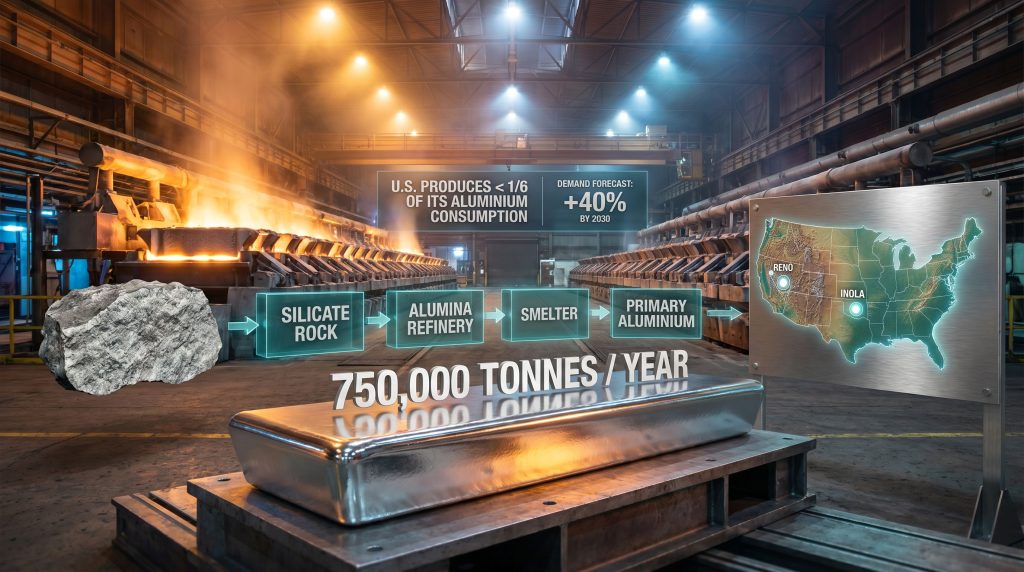
The United States currently produces less than one-sixth of the aluminium it consumes domestically. China, by contrast, controls approximately 60% of global alumina and aluminium production, a concentration that creates a single point of failure for Western manufacturers who depend on the metal for everything from fighter jet airframes to electrical transmission lines. What makes this particularly difficult to solve is not a lack of demand or investment appetite. It is geology.
No commercially viable bauxite deposits exist within U.S. borders. Bauxite, the ore from which alumina is refined, and alumina, the intermediate compound from which aluminium metal is smelted, are geographically locked in subtropical regions: Guinea, Australia, and Brazil. Every domestic aluminium smelter in the United States, regardless of how efficiently it operates, begins its production process with a cargo ship arriving from overseas. That is the structural vulnerability that the Brimstone Century Aluminium MoU primary aluminium production agreement is specifically designed to eliminate.
When big ASX news breaks, our subscribers know first
Why Bauxite Dependency Is a Different Kind of Supply Chain Problem
Most supply chain risks can be addressed by diversifying suppliers or holding larger inventories. Bauxite dependency is categorically different because it is rooted in geology rather than logistics. There is no domestic alternative feedstock within the conventional Bayer Process framework, the century-old industrial method that converts bauxite into alumina through a high-temperature caustic digestion process.
The Bayer Process works as follows:
- Bauxite is mined from tropical or subtropical deposits, typically from laterite or karst geological formations enriched in aluminium hydroxide minerals such as gibbsite, boehmite, and diaspore.
- The ore is dissolved in hot sodium hydroxide solution, which selectively extracts aluminium as sodium aluminate while leaving iron oxides and silicates behind as red mud waste.
- Aluminium hydroxide is precipitated from the solution and then calcined at high temperature to produce alumina, a white powder also known as aluminium oxide.
- Smelter-grade alumina is then fed into electrolytic reduction cells, known as Hall-Heroult cells, where electrical current separates aluminium metal from oxygen at temperatures exceeding 960 degrees Celsius.
Every step after the first can be performed domestically. Step one requires bauxite, and bauxite does not exist in the U.S. in commercially meaningful quantities. This is the single constraint that has made American primary aluminium production structurally dependent on imports for generations. Furthermore, the leading bauxite production countries remain geographically and politically distant from U.S. industrial centres, compounding the logistical risk.
The conventional wisdom in the industry has long held that domestic alumina production in the United States is simply not geologically possible. Brimstone's technology directly challenges that assumption by replacing the feedstock, not modifying the country.
What the Brimstone Century Aluminium MoU Actually Establishes
The Brimstone Century Aluminium MoU primary aluminium production agreement, signed in mid-2026, creates a formal supply relationship under which Brimstone Energy will provide Century Aluminium with smelter-grade alumina produced entirely from domestically sourced feedstock. This is not a conventional supply diversification agreement. It is an architectural decision to reconstruct the first link in the primary aluminium production chain from scratch, using American geology.
Several features distinguish this MoU from prior supply arrangements in the sector:
- Feedstock origin: The alumina will be derived from calcium-bearing silicate rock, not bauxite, meaning no overseas mineral extraction is involved at any point in the supply chain.
- Domestic vertical integration: From quarrying through refining through smelting, every stage of production will occur within U.S. borders.
- Supply chain anchoring: By committing Century's future alumina procurement to a domestic source, the agreement reduces Century's exposure to geopolitical disruptions affecting overseas shipping lanes and producer nations.
- Strategic industrial intent: The MoU reinforces a broader objective of rebuilding U.S. critical mineral self-sufficiency for materials with direct defence and infrastructure applications.
Century Aluminium holds the distinction of being the largest American primary aluminium producer, with current annual production capacity of approximately 1,016,000 tonnes. Despite that scale, the company has historically sourced its alumina entirely from imports, a dependency this agreement is designed to address over time. In addition, the broader group of global aluminium producers are closely watching this development as a potential model for domestic supply chain reconstruction.
Brimstone's Silicate Process: The Technical Innovation That Makes Domestic Alumina Possible
Brimstone's proprietary process represents one of the more consequential technical departures in the aluminium industry in decades. Rather than relying on bauxite, the process uses calcium-bearing silicate rock as its primary input. This geological category is not rare or regionally concentrated. It is found across broad swathes of U.S. territory, making domestic feedstock sourcing both logistically and economically viable.
The following table illustrates how Brimstone's approach compares to the conventional Bayer Process across key parameters:
| Parameter | Conventional Bayer Process | Brimstone Silicate Process |
|---|---|---|
| Primary feedstock | Bauxite (imported) | Calcium-bearing silicate rock (domestic) |
| U.S. feedstock availability | None commercially viable | Widely distributed across U.S. geology |
| Geopolitical exposure | High | Minimal |
| Supply chain geography | Multi-country import dependency | Fully domestic mine-to-metal |
| Cost positioning | Subject to global commodity pricing | Designed for domestic cost parity |
| Waste profile | Significant red mud byproduct | Different residue chemistry |
One lesser-known aspect of this technology is its potential implications for co-product streams. Silicate rock processing can yield calcium carbonate and other mineral byproducts alongside alumina. Depending on process design and market conditions, these co-products could contribute to project economics in ways that bauxite-based refining cannot, potentially improving the unit economics of alumina production even before scale effects are fully realised.
Development Timeline and Production Milestones
Brimstone's path to industrial scale follows a staged approach typical of process innovation in the minerals sector:
- 2028: Commercial demonstration plant in Reno, Nevada is targeted for operational start. This phase is critical for validating process chemistry, energy consumption, and cost assumptions at meaningful throughput before committing full capital to industrial scale.
- 2034: First industrial-scale plant projected to reach completion, with an expected annual output of 350,000 metric tonnes of smelter-grade alumina.
The demonstration plant phase carries particular significance for investors and analysts assessing project risk. Process technologies that perform well at laboratory or pilot scale frequently encounter unexpected scaling challenges, including reagent consumption rates, heat integration efficiency, and waste handling logistics. The 2028 Reno facility will serve as the definitive validation event for Brimstone's commercial model.
Century Aluminium's Broader Domestic Expansion: Context Beyond the Agreement
The MoU does not exist in isolation. Century Aluminium has been executing a multi-pronged domestic expansion strategy that, when viewed alongside the Brimstone partnership, begins to look like a deliberate effort to rebuild primary aluminium production capacity at a generational scale. However, external policy factors also shape the operating environment; for instance, US aluminium tariffs have added further urgency to the case for domestic supply chain independence.
Mt. Holly: Near-Term Capacity Recovery
Century recently committed $50 million to restart idle capacity at its Mt. Holly plant, generating more than 100 direct jobs and delivering an immediate 10% increase in domestic primary aluminium production capacity upon first metal output. For an industry where new capacity typically requires years of permitting and construction, the Mt. Holly restart represents a rapid-deployment strategy to close the production gap while longer-term projects advance.
Inola, Oklahoma: A Generational Investment
The more significant development is Century's joint project with Emirates Global Aluminum (EGA) to construct a new primary aluminium smelter in Inola, Oklahoma. The scale of this project warrants careful attention:
- Planned capacity: 750,000 tonnes of primary aluminium per year at full operation
- Historical significance: The first new domestic aluminium smelter constructed in the United States in approximately 50 years
- Capacity impact: At full output, the Inola facility alone would more than double current U.S. domestic primary aluminium production relative to consumption
- Timeline: Production expected to commence before the end of the 2020s
The Inola project's 750,000-tonne annual capacity, placed in context, represents a larger single-facility output than many entire national aluminium industries. It is not an incremental expansion. It is a structural reset of the U.S. primary aluminium production base.
The Demand Equation: Why Timing Matters More Than It Appears
The urgency underlying these investments becomes clearer when aluminium demand trajectories are examined. Industry analysts project a 40% surge in global aluminium consumption by 2030, driven by three converging forces:
- Grid infrastructure expansion: Aluminium is the dominant conductor material in high-voltage transmission lines. As grid modernisation programmes accelerate across the U.S., aluminium demand from the power sector is rising sharply.
- AI data centre construction: Large-scale data centre builds require aluminium for cooling infrastructure, structural components, and power distribution systems. The AI infrastructure buildout currently underway represents a demand category that did not meaningfully exist a decade ago.
- Defence and aerospace procurement: Primary-grade aluminium cannot be substituted with recycled material in many defence applications. Military aircraft, missile systems, and naval platforms require consistent, high-specification primary aluminium with controlled metallurgical properties.
Consequently, the broader critical minerals demand surge is placing additional pressure on governments and industry alike to secure reliable domestic supply chains. Against this demand backdrop, the U.S. production deficit is not merely a trade balance issue. It is a national security vulnerability that deepens as demand grows faster than domestic supply capacity can be rebuilt.
The next major ASX story will hit our subscribers first
The Mine-to-Metal Supply Chain: How It Works End to End
If the Brimstone Century Aluminium MoU primary aluminium production pathway reaches its intended outcome, the U.S. will have, for the first time in recent memory, a fully domestic primary aluminium supply chain. The operational sequence would function as follows:
- Feedstock quarrying: Calcium-bearing silicate rock is extracted from domestic U.S. geological formations, eliminating any overseas mining dependency.
- Alumina refining: Brimstone's industrial-scale plant processes the silicate rock into smelter-grade alumina using its proprietary process chemistry.
- Domestic delivery: Refined alumina is transported to Century Aluminium's smelting operations under the terms of the MoU supply arrangement.
- Electrolytic reduction: Century's Hall-Heroult reduction cells convert alumina into primary aluminium metal using electrical current.
- Downstream distribution: Primary aluminium enters U.S. manufacturing supply chains serving defence contractors, grid infrastructure builders, automotive manufacturers, and industrial fabricators.
U.S. vs. Global Production: Quantifying the Imbalance
| Metric | United States | China | Global Implication |
|---|---|---|---|
| Share of global alumina production | Minimal | ~60% | Single-nation concentration risk |
| Share of global aluminium production | Minimal | ~60% | Western import dependency |
| Domestic production vs. consumption | Less than 1/6 of consumption | Net exporter | Structural U.S. deficit |
| Last new domestic smelter built | Approximately 50 years ago | Ongoing capacity expansion | U.S. capacity in long-term decline |
| Projected demand growth by 2030 | +40% globally | Positioned to supply | U.S. deficit likely to widen without intervention |
Furthermore, the leading aluminium mining companies operating outside the U.S. are expanding capacity at a pace that risks entrenching the current imbalance further. According to the International Aluminium Institute, global primary aluminium output continues to be dominated by a small number of nations, reinforcing the structural exposure facing U.S. manufacturers.
The Employment and Economic Case for Domestic Primary Aluminium
Beyond national security considerations, primary aluminium production carries a compelling economic development argument. These facilities are capital-intensive, high-wage industrial operations that generate significant multiplier effects in regional economies.
- The Mt. Holly restart generated over 100 direct jobs from a $50 million capital deployment, an employment intensity that compares favourably to many other forms of industrial investment.
- The Inola, Oklahoma facility, at 750,000 tonnes annual capacity, represents a regional economic development opportunity of generational significance for the surrounding area.
- Brimstone's industrial-scale plant, when operational by 2034, will create upstream employment in mining, mineral processing, and logistics in addition to the refinery workforce itself.
Disclaimer: This article contains forward-looking statements regarding production timelines, capacity targets, and demand forecasts. These projections are based on publicly available information and company announcements. Actual outcomes may differ materially from projections due to technological, regulatory, financial, or market factors. This article does not constitute financial advice. Readers should conduct independent research before making any investment decisions.
FAQ: Brimstone, Century Aluminium, and U.S. Primary Aluminium Production
What is the Brimstone Century Aluminium MoU?
It is a Memorandum of Understanding under which Brimstone Energy will supply Century Aluminium with domestically produced smelter-grade alumina, creating what is anticipated to be the first fully U.S.-sourced mine-to-metal Brimstone Century Aluminium MoU primary aluminium production chain in recent memory.
Why does the U.S. import most of its aluminium inputs?
The United States has no commercially viable bauxite deposits, the conventional feedstock for alumina production. This geological reality has forced every domestic smelter to rely on imported alumina or aluminium, a dependency that has deepened as domestic smelter capacity declined over the past five decades.
What makes Brimstone's technology different from existing alumina production?
Brimstone uses calcium-bearing silicate rock, which is widely available across U.S. geology, rather than bauxite. This eliminates the need for imported feedstock entirely and enables a fully domestic production chain.
When will Brimstone's plants be operational?
The commercial demonstration plant in Reno, Nevada is targeted for 2028. The first full industrial-scale facility, with an expected annual capacity of approximately 350,000 metric tonnes of smelter-grade alumina, is projected for completion by 2034.
What is the Inola, Oklahoma project?
Century Aluminium, in partnership with Emirates Global Aluminum, is developing a 750,000-tonne-per-year primary aluminium smelter in Inola, Oklahoma. It will be the largest such facility ever built in the U.S. and the first new domestic smelter in approximately 50 years.
How significant is the current U.S. aluminium production deficit?
The U.S. produces less than one-sixth of the aluminium it consumes domestically. China accounts for approximately 60% of global production of both alumina and aluminium, making U.S. manufacturers structurally dependent on a geopolitically concentrated global supply chain.
Want to Track the Next Major Mineral Discovery Before the Market Does?
The structural shifts reshaping critical mineral supply chains — from aluminium to bauxite and beyond — highlight just how quickly commodity dynamics can create significant investment opportunities. Discovery Alert's proprietary Discovery IQ model scans ASX announcements in real time, instantly identifying significant mineral discoveries and turning complex data into actionable insights across more than 30 commodities. Explore historic discoveries and the returns they generated, then begin your 14-day free trial at Discovery Alert to position yourself ahead of the next major find.