June 22, 2026
The Quiet Drain on Europe's Green Ambitions
Across global commodity markets, few materials carry the environmental credentials of recycled aluminium. Producing secondary aluminium from scrap consumes roughly 95% less energy than smelting primary metal from bauxite ore, making it one of the most powerful decarbonisation tools available to heavy industry. Europe has invested decades in building the collection infrastructure to capitalise on this advantage, and the results are visible: recycling rates exceed 80% across several aluminium segments on the continent.
Yet a striking paradox has taken hold. Even as collection performance reaches historic highs, Europe aluminium scrap exports are accelerating in the opposite direction. The continent is losing more of its recycled material to foreign markets than ever before, and the gap between what Europe collects and what it actually keeps is widening into a strategic liability.
Understanding why this is happening, and what it means for European industrial policy, requires moving beyond recycling rate statistics and examining the deeper economics of scrap retention.
When big ASX news breaks, our subscribers know first
Record Export Volumes Reveal a Structural Fault Line
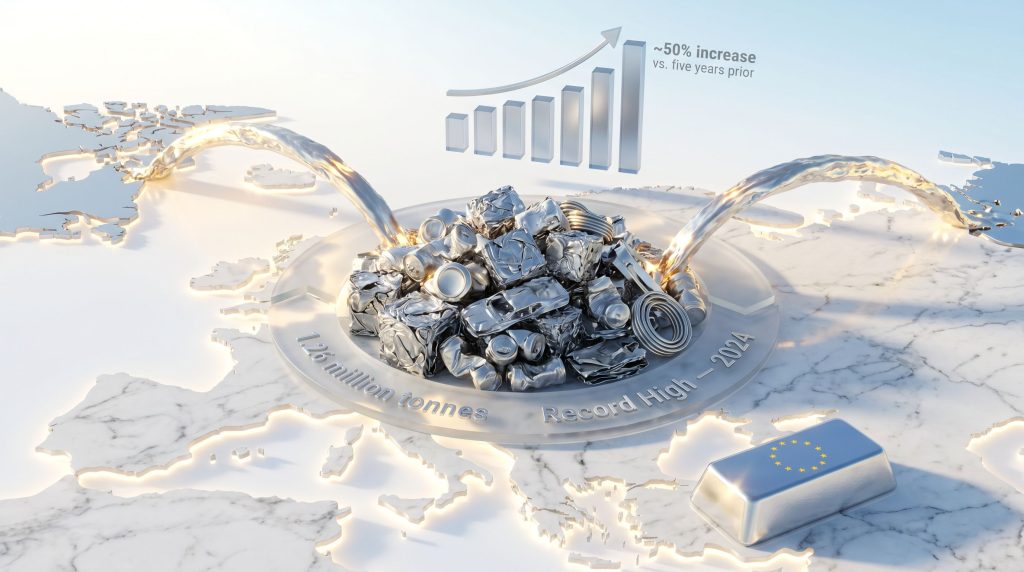
The headline numbers are unambiguous. European Union aluminium scrap exports reached approximately 1.26 million tonnes in 2024, a figure that represents a record high and reflects roughly a 50% increase compared to levels recorded five years earlier. That growth trajectory has continued even as European policymakers have championed circular economy principles and invested in green industrial policy.
The coexistence of record recycling rates and record export volumes is not a coincidence or a temporary anomaly. It is a signal that the European aluminium system has a structural misalignment between its capacity to collect scrap and its ability, or willingness, to process that scrap domestically.
Key Insight: High recycling rates measure collection success. Scrap retention rates measure circular economy success. These are not the same metric, and Europe is increasingly performing well on the former while falling short on the latter.
The volume data deserves closer examination:
| Metric | Value |
|---|---|
| EU aluminium scrap exports (2024) | ~1.26 million tonnes (record high) |
| Growth versus five years prior | ~50% increase |
| Share of EU aluminium consumption from recycled material | ~40% |
| Recycling rates in key segments | Above 80% in several categories |
With approximately 40% of EU aluminium consumption currently sourced from recycled material, the strategic importance of domestic scrap supply cannot be overstated. Every tonne that exits the continent represents both a lost decarbonisation opportunity and a tightening of feedstock availability for European secondary smelters. Furthermore, the mining decarbonisation benefits of retaining scrap domestically are increasingly well-documented and carry significant policy weight.
Where Is European Scrap Flowing?
The primary destinations for Europe aluminium scrap exports include Asian markets and, with increasing significance, the United States. These trade flows are not random. They reflect deliberate arbitrage behaviour driven by price differentials between what domestic European processors will pay and what foreign buyers, particularly in Asia, are willing to offer.
Asian remelters have historically been willing to pay premium prices for high-grade European wrought alloy scrap. The reason is straightforward: regions with lower domestic scrap generation need to import feedstock to sustain their secondary aluminium industries, and European scrap, often characterised by relatively consistent alloy composition and lower contamination levels, commands a quality premium in those markets.
US trade policy changes have added a further layer of complexity. Shifts in tariff structures have rerouted some global scrap flows, indirectly affecting the volumes and pricing dynamics that shape European export decisions. The result is a trading environment where European scrap collectors face persistent incentives to look outward rather than inward.
Three Forces Pushing European Scrap Toward Export Markets
The export surge is not driven by any single cause. It reflects the convergence of three distinct structural forces, each of which would require a separate policy response to address effectively.
1. Price Arbitrage and Thin Margins in the Scrap Trade
Scrap trading is a margin-sensitive business. Collectors and traders operating on thin spreads are structurally motivated to sell to whoever pays the most, and for much of the past five years, that buyer has been located outside Europe. Currency dynamics, LME aluminium price movements, and regional supply imbalances all contribute to the price differential that makes export economically attractive. Without a policy mechanism to alter this calculus, market forces will continue to favour outbound trade.
2. Domestic Processing Capacity and Energy Cost Constraints
Not every tonne of aluminium scrap collected in Europe can be efficiently absorbed by existing domestic secondary smelters. Contaminated streams, complex alloy mixes, and the cost of advanced sorting technology all create friction in the domestic processing pipeline. More fundamentally, European industrial electricity prices remain among the highest in the world, placing energy-intensive remelting operations at a structural cost disadvantage relative to competitors in regions with cheaper power.
This energy cost gap is particularly damaging for secondary smelters processing lower-grade or mixed scrap streams, where processing margins are thinner and any additional cost pressure can make domestic processing economically unviable. In this context, renewable energy solutions for industrial processing represent one of the more promising pathways to restoring cost competitiveness for European remelters.
3. Trade Policy Disruptions and Global Rerouting
Changes in US trade measures have introduced new volatility into global aluminium scrap flows. Material that previously moved through established trade corridors has been rerouted, altering the competitive landscape for European scrap in ways that domestic policy has not yet fully addressed. Industry associations have flagged this dynamic as compounding an already challenging retention environment.
The EU Policy Response: A Proposed Instrument for Scrap Retention
The European Commission has formally recognised aluminium scrap availability as a strategic concern linked to the EU's decarbonisation objectives and its broader industrial autonomy agenda. A targeted policy instrument addressing aluminium scrap leakage from European markets was under active development, with proposed measures targeted for delivery by the second quarter of 2026. The EU metals action plan provides the broader strategic framework within which these scrap retention measures are being designed.
The policy consultation process has framed scrap retention as a supply-side tool for meeting the EU's industrial emissions reduction commitments. The measures under consideration span a range of intervention types:
- Export fees or levies: Financial disincentives applied to outbound scrap shipments, designed to narrow the price gap between export and domestic sale
- Licensing and monitoring regimes: Administrative frameworks requiring exporters to register shipments, enabling volume tracking and potential threshold enforcement
- Preferential domestic supply obligations: Requirements that a defined minimum share of collected scrap be offered to domestic processors before export becomes permissible
| Policy Stage | Target Period |
|---|---|
| Commission consultation on scrap leakage | 2025 |
| Proposed retention instrument delivery | Q2 2026 |
| Implementation and enforcement | Subject to full legislative process |
Policy Watch: Introducing export fees on aluminium scrap would mark a significant departure from the EU's traditionally open trade stance and would need to be carefully designed to withstand scrutiny under World Trade Organisation rules, which generally restrict export barriers. This legal tension represents one of the most complex design challenges facing policymakers.
According to Fastmarkets analysis of EU scrap export restrictions, the Commission's consultation has attracted significant industry response, reflecting the breadth of stakeholders whose business models would be directly affected by any new retention mechanism.
A Divided Industry: Who Wants Restrictions and Who Opposes Them
The debate over export restrictions has exposed a deep fault line within Europe's aluminium recycling sector. The division is not ideological. It reflects the structurally different economic interests of different parts of the value chain.
The Case for Retention Measures
European Aluminium, the sector's primary trade association, has been a consistent advocate for export fee mechanisms. The argument rests on the premise that aluminium scrap is a finite, strategically valuable resource that should be prioritised for domestic circular economy use. Secondary smelters and primary producers broadly share this position, recognising that domestic scrap availability directly underpins investment cases for European recycling capacity and reduces reliance on high-carbon primary imports.
From a climate perspective, the logic is compelling. Every tonne of aluminium scrap processed domestically rather than exported represents a potential displacement of primary smelting, with associated emissions savings of approximately 15 tonnes of CO₂ per tonne of primary aluminium avoided. Indeed, efforts such as the low-carbon aluminium partnership emerging across Europe demonstrate the industry's growing appetite for circular, low-emission production models.
The Case Against Restrictions
Independent scrap collectors and export-oriented traders present a countervailing argument. Artificially suppressing export demand would compress domestic scrap prices, reducing the economic return for collection activities. Lower collection returns could, over time, reduce the volume of scrap brought into the recycling system, undermining the very recycling rates that make Europe's circular aluminium credentials credible.
Some within this group also argue that the fundamental problem is not export volumes per se, but rather insufficient domestic processing capacity and uncompetitive energy costs. Restricting exports without simultaneously addressing these underlying constraints would, in this view, simply redistribute economic pain without solving the structural problem.
| Stakeholder Group | Position on Export Restrictions | Primary Concern |
|---|---|---|
| European Aluminium (trade body) | Supportive of export fees | Domestic feedstock availability |
| Primary aluminium producers | Generally supportive | Reducing high-carbon primary reliance |
| Secondary smelters | Broadly supportive | Feedstock security and margin stability |
| Scrap collectors and traders | Opposed or cautious | Price depression and collection incentives |
| Export-oriented recyclers | Opposed | Loss of premium market access |
Analytical Note: This debate reflects a textbook circular economy tension. Upstream material generators and downstream material processors have fundamentally different price preferences. Policy instruments that benefit one group typically impose costs on the other, and effective design requires mechanisms that share the adjustment burden across the value chain.
The Hidden Complexity: Alloy Integrity and Closed-Loop Recycling
One dimension of the scrap retention debate that receives insufficient attention is the technical challenge of alloy-to-alloy recycling. Not all aluminium scrap is equal. Wrought alloys, which dominate applications in automotive body panels, aerospace components, and beverage cans, require very different reprocessing conditions than cast alloys used in engine blocks and industrial castings.
A significant proportion of European scrap, particularly from end-of-life vehicles and construction demolition, arrives at recycling facilities as a mixed stream containing multiple alloy types. Without sophisticated sorting and pre-processing technology, remelting this material often results in alloy downgrading, where wrought scrap is converted into cast alloy products because the blended composition cannot meet wrought quality specifications.
This downgrading represents both an economic and environmental loss. It reduces the value recovery from the scrap and diminishes the carbon savings achievable through recycling, since higher-purity wrought alloys require more energy-intensive primary blending to compensate for recycled content limitations. Consequently, advances in climate-efficient smelting offer instructive parallels for how European aluminium processors might approach this challenge.
Closing this gap requires investment in:
- Advanced sensor-based sorting technology capable of identifying alloy composition at processing speeds
- Automated shredding and separation systems that minimise cross-contamination between alloy families
- Closed-loop supply chain agreements between automotive OEMs, scrap collectors, and remelters that preserve alloy provenance from end-of-life vehicle to new product
- Pre-consumer scrap recovery programs that capture manufacturing offcuts before they enter mixed streams
The next major ASX story will hit our subscribers first
Can Europe Realistically Retain Over One Million Tonnes Annually?
The scale of the challenge is significant. Retaining an additional 400,000 to 500,000 tonnes of aluminium scrap within European processing systems annually would require coordinated action across policy, infrastructure, and energy markets simultaneously.
Assume Europe retains an additional 400,000 to 500,000 tonnes of aluminium scrap annually through a combination of export fee mechanisms and targeted capacity investment. At an average carbon saving of approximately 15 tonnes of CO₂ per tonne of primary aluminium displaced, this volume could represent a potential annual emissions reduction of between 6 and 7.5 million tonnes of CO₂ equivalent. To contextualise that figure, it is roughly equivalent to removing between 1.3 and 1.6 million passenger vehicles from European roads each year.
Note: This is an illustrative calculation based on standard lifecycle emissions differentials between primary and secondary aluminium production. Actual outcomes would depend heavily on energy mix, alloy type, processing efficiency, and the extent to which retained scrap genuinely displaces primary production rather than simply substituting imported recycled aluminium.
The capacity question is particularly pressing. If export restrictions tighten domestic scrap supply without a corresponding expansion of secondary smelting capacity, the result could be price distortions, feedstock queuing, and underutilisation of collected material rather than increased circularity.
CBAM, Carbon Policy, and the Evolving Economics of Secondary Aluminium
The EU Carbon Border Adjustment Mechanism adds a further dimension to this picture. As CBAM progressively prices the embodied carbon of imported aluminium products, the competitive position of domestically produced secondary aluminium improves relative to higher-carbon imports. This creates a policy tailwind for European secondary smelters, provided they can secure sufficient scrap feedstock to scale their operations.
However, CBAM does not directly address the scrap export dynamic. It applies to finished product imports, not to outbound raw material flows. The proposed scrap retention instrument is specifically intended to fill this gap, creating a complementary policy layer that addresses the supply side of the secondary aluminium equation.
The interaction between CBAM pricing signals, scrap export policy, LME aluminium benchmarks, and European energy costs will collectively define the investment environment for secondary aluminium through the latter half of this decade. Manufacturers across automotive, packaging, and construction sectors — all of whom face growing pressure to demonstrate verified recycled content and low-carbon supply chains — have a direct stake in whether European policymakers can resolve this equation.
For European secondary aluminium to fulfil its role as a genuine pillar of industrial decarbonisation, Europe aluminium scrap exports must be addressed through a coherent, trade-compliant policy framework. That framework must be matched by the infrastructure investment and energy reform strategies outlined by European Aluminium needed to make domestic processing genuinely competitive and to ensure that the continent's considerable recycling achievements translate into lasting circular economy outcomes.
Want to Stay Ahead of the Commodity Trends Shaping the Next Generation of Mining Investment?
Discovery Alert's proprietary Discovery IQ model scans ASX announcements in real time, delivering instant alerts on significant mineral discoveries — from the critical materials underpinning aluminium's green transition to the next generation of exploration breakthroughs — so investors can act before the broader market catches on. Explore historic discovery returns on Discovery Alert's discoveries page and begin your 14-day free trial to secure a market-leading edge.