June 22, 2026
The Geopolitical Architecture Behind the Switzerland Negotiations
Few chokepoints in the global economy carry the symbolic and physical weight of the Strait of Hormuz. Roughly one-fifth of the world's seaborne oil passes through this narrow corridor between Iran and Oman, making it simultaneously the most important and most vulnerable artery in global energy supply chains. When that artery constricts, the effects ripple outward almost instantly, manifesting in fuel costs, inflation figures, and the political fortunes of governments from Washington to Tokyo. Understanding the current Iran US talks Lebanon ceasefire and Strait of Hormuz dynamics requires stepping back from the immediate headlines and examining the structural forces that brought these three interlocked crises to a single negotiating table in Switzerland in June 2026.
What Is Driving the US-Iran Diplomatic Engagement in 2026?
Switzerland's reputation as a neutral diplomatic venue is well established, and its selection for these technically complex negotiations signals that both sides understood the need for a controlled, low-provocation environment. Qatar and Pakistan were chosen as joint mediators, a pairing that reflects a particular kind of regional logic: Qatar maintains open channels with both Washington and Tehran and has a direct financial stake in Hormuz stability given its vast LNG export infrastructure. Pakistan offers a different kind of leverage, functioning as a bridge between the Islamic world and a country that is simultaneously a nuclear state and a long-standing US security partner.
The discussions were structured around a two-month target window for reaching a more comprehensive agreement following an interim memorandum of understanding signed the previous week. That memorandum had already produced tangible early outcomes: a ceasefire extension, the partial reopening of the Strait of Hormuz, and the beginning of sanctions relief on Iranian oil and petrochemical exports. Furthermore, crude oil price geopolitics continue to shape every dimension of these talks.
Who Is at the Table? Key Delegations and Their Mandates
| Delegation | Key Representatives | Primary Mandate |
|---|---|---|
| United States | JD Vance, Jared Kushner, Steve Witkoff | Nuclear containment, sanctions sequencing, Hormuz stability |
| Iran | Mohammad Bagher Ghalibaf (Parliament Speaker) | Economic relief, Lebanon ceasefire terms, oil export restoration |
| Mediators | Qatar and Pakistan (joint) | De-escalation facilitation, communication bridging |
The decision to send US Vice President JD Vance rather than a career State Department diplomat carries significant symbolic weight. It signals that the White House regards this as a politically owned process rather than a bureaucratic one, which cuts both ways: it gives the talks greater executive authority while also exposing them to domestic political turbulence. Vance indicated he would likely be present for only a few days, leaving the technical work to Jared Kushner and special envoy Steve Witkoff.
On the Iranian side, the presence of Mohammad Bagher Ghalibaf, Speaker of Parliament, rather than a purely diplomatic figure, suggests Tehran is seeking domestic political legitimacy for any agreement that emerges. Parliamentary buy-in is not incidental in Iran's political architecture; it is essential for durable implementation.
Four structural outcomes emerged from the initial overnight sessions that are worth noting:
- A high-level oversight committee established to supervise the broader negotiating process
- Separate working groups for nuclear issues and sanctions arrangements
- A dedicated de-confliction cell specifically designed to manage the cessation of military operations in Lebanon
- A direct US-Iran maritime communication line to reduce incident risk in the Strait of Hormuz
When big ASX news breaks, our subscribers know first
How Does the Lebanon Ceasefire Factor Into the US-Iran Nuclear Framework?
Lebanon as the Defining Variable in the Broader Peace Architecture
What makes the current set of Iran US talks Lebanon ceasefire and Strait of Hormuz negotiations qualitatively different from previous diplomatic engagements is the explicit linkage Iran has drawn between all three tracks. Tehran has not treated Lebanon as a peripheral issue to be managed separately. Instead, Iranian Foreign Minister Abbas Araghchi publicly described Lebanon as the first real test of the interim arrangement, effectively making the ceasefire a prerequisite for progress on nuclear and sanctions discussions.
The Lebanon war reignited in early March 2026 when Hezbollah resumed missile and drone operations against northern Israel in a show of solidarity following US and Israeli military strikes on Iran. The renewed conflict produced thousands of casualties and displaced more than one million Lebanese civilians, generating humanitarian pressure that is now registering in every diplomatic calculation. Israeli strikes in southern Lebanon have continued to test the ceasefire's durability throughout this period.
The absence of mutual trust between Iran and the United States is identified by senior Middle East policy analysts at the International Institute for Strategic Studies as the most structurally complicating factor in these negotiations, particularly around the sequencing of concessions. Each party is waiting for the other to move first, creating a classic diplomatic deadlock that mediators must resolve through phased commitment mechanisms.
The Israel Problem: Why Tel Aviv Is Not at the Table but Cannot Be Ignored
Israel is not a party to the Switzerland talks, yet its position effectively determines whether any Lebanon agreement can be operationalised. The Israeli government, through its UN Ambassador Danny Danon, has made clear that its forces will not withdraw from southern Lebanon until the Lebanese Armed Forces physically control the territory and Hezbollah is verifiably unable to threaten Israeli communities with rockets and drones. This is not a negotiating position easily reconciled with Iran's demand for a rapid Israeli military withdrawal as the price of continued engagement on nuclear and economic matters.
Hezbollah's formal designation as a terrorist organisation by the United States creates an additional structural complication. The de-confliction cell established in Bürgenstock is designed to manage military operations between parties that do not formally recognise each other's legitimacy, which makes even basic communication about troop movements and withdrawal timelines extraordinarily difficult.
What Does a Lebanon Resolution Actually Require?
A durable ceasefire is not a single event but a sequenced process. Breaking it down reveals exactly where the fault lines are most acute:
- Formal cessation of Hezbollah rocket and drone operations targeting northern Israel
- Verified deployment of Lebanese Armed Forces into Israeli-held areas in southern Lebanon
- Phased Israeli military withdrawal contingent on confirmed LAF deployment
- Iranian cessation of financial and logistical support to Hezbollah proxy networks
- Integration of Lebanon stabilisation commitments into the broader US-Iran memorandum of understanding
Each step is conditioned on the previous one, meaning a breakdown at any stage collapses the entire sequence. The trust deficit identified by analysts at the International Institute for Strategic Studies is most acute precisely here, where the gap between what each party claims it will do and what the other party believes it will actually do is widest.
What Is the Current Status of the Strait of Hormuz and Why Does It Matter?
The Strait of Hormuz: A Chokepoint That Moves Global Energy Prices
The Strait of Hormuz is approximately 33 kilometres wide at its narrowest navigable point, yet it serves as the transit corridor for roughly 20 percent of global seaborne crude oil and a significant share of the world's liquefied natural gas, particularly from Qatar. When the strait is fully operational, this flow is invisible to most consumers. When it is disrupted, the consequences materialise at petrol stations, in airline ticket prices, and in central bank inflation models within days.
Iran reopened the strait following the interim memorandum of understanding, and shipping volumes have begun recovering. However, traders and logistics operators caution that the recovery remains partial. The physical and logistical lag between a political agreement and the full restoration of maritime trade flows is substantial: tanker operators reconfigure routes conservatively, insurers adjust war-risk premiums slowly, and long-term chartering decisions require sustained confidence before returning to pre-conflict patterns. Consequently, Brent and WTI futures remain elevated relative to pre-conflict baselines.
Hormuz Shipping Volume Recovery: Where Things Stand
| Metric | Pre-Conflict Baseline | Status as of June 2026 | Recovery Timeline Estimate |
|---|---|---|---|
| Overall shipping volumes | 100% (baseline) | Partial recovery, well below baseline | Months to potentially over a year |
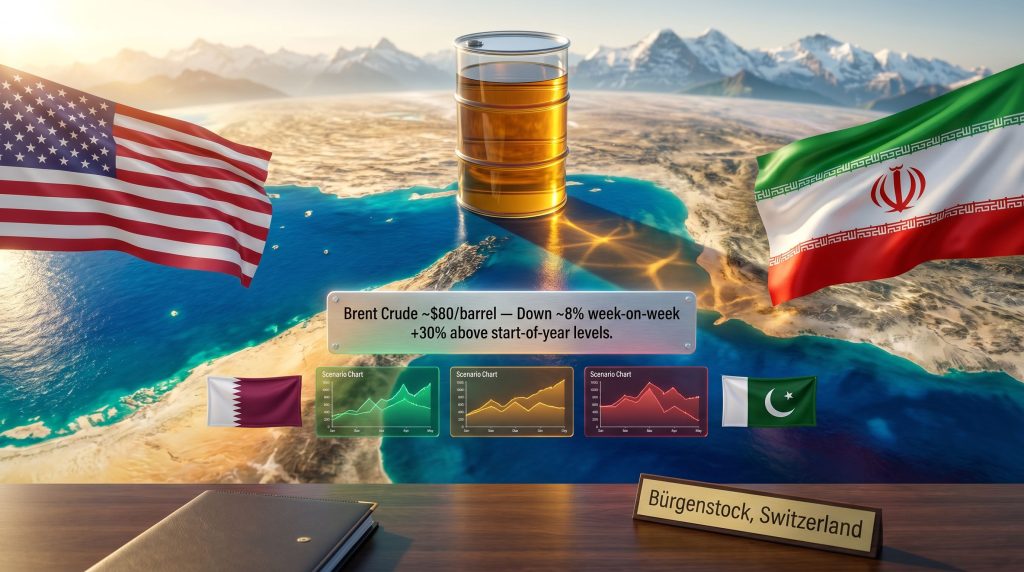
| Brent crude price | Pre-surge levels | ~$80/barrel (down ~8% week-on-week) | Gradual normalisation expected |
| LNG transit flows | Full operational | Disrupted, partial resumption | Extended timeline |
| Year-to-date oil price change | Baseline | More than 30% above start-of-year | Contingent on deal durability |
Brent crude fell approximately 8 percent in the week following the interim agreement, trading around $80 per barrel in early sessions on June 22. However, the year-to-date gain of over 30 percent underscores how much geopolitical risk premium had accumulated in energy prices during the conflict period. That premium will not evaporate overnight. Market participants understand that even a fully successful diplomatic outcome does not immediately translate into restored oil and LNG flow volumes.
Trump's Toll Threat: What It Means for Hormuz Governance
One of the more unusual interventions in the negotiations came from President Trump himself, who suggested the United States could begin collecting tolls on Hormuz shipping traffic if a deal fails to materialise. No nation has ever successfully imposed a transit toll on a recognised international strait under the United Nations Convention on the Law of the Sea, which classifies the Hormuz passage as a strait used for international navigation where transit passage rights apply to all nations. The legal obstacles to such a policy are formidable.
The more analytically useful interpretation of this statement is as a coercive negotiating signal rather than a policy blueprint. It communicates to Iran, Gulf states, and major oil-importing nations in Asia that the US is willing to escalate its economic leverage over the strait if talks collapse. For shipping operators and energy buyers in Asia, this kind of rhetoric adds uncertainty costs that are ultimately priced into long-term supply contracts. In addition, reports of Iran again closing the strait have periodically unsettled market confidence throughout the negotiation period.
What Are the Economic Stakes for Iran in the Current Deal?
Sanctions Relief as the Engine of Iranian Compliance
Iran's participation in the Switzerland process is fundamentally driven by economic necessity. The naval blockade imposed by the US had been compressing Iran's primary source of hard currency — oil export revenue — at a pace that was structurally unsustainable. The interim memorandum addressed this directly through several immediate provisions:
- US waivers on Iranian oil and petrochemical exports, restoring access to critical Asian markets
- Release of frozen Iranian sovereign assets held in third-party jurisdictions including Qatar
- Lifting of the naval blockade that had been physically interdicting Iranian oil tankers
- A broader reconstruction and development plan referenced by Foreign Minister Araghchi, though the funding sources and detailed terms of this package remain subject to ongoing negotiation
The Oil Export Restoration Equation
Iran holds significant spare production capacity that was suppressed during the blockade period. As the naval interdiction is lifted, Iranian crude exports are expected to ramp upward relatively quickly in physical terms, given that production infrastructure was largely preserved. The more complex dynamic involves which buyers can absorb restored Iranian volumes under the existing US waiver framework and how that framework interacts with separate EU and UK sanctions regimes that have not been modified.
Asian buyers, particularly in China and India, are the most immediately positioned to absorb Iranian crude. These markets had maintained varied degrees of Iranian oil purchasing during earlier sanctions periods through third-party intermediaries, and a formal US waiver substantially reduces the compliance risk premium embedded in those transactions. However, the trade war oil impact on Asian demand adds a layer of complexity to how quickly these buyers can scale their purchasing commitments.
The petrochemical sector deserves attention here because it is frequently overlooked in analysis focused on crude oil flows. Iran's petrochemical export capacity is substantial, and the inclusion of petrochemical waivers in the interim memorandum is economically significant, providing a revenue stream that is somewhat less visible politically than crude oil but equally important to the Iranian economy.
Critics of the memorandum, including voices within the Israeli government and among Iran hawks in the US political system, argue that the financial relief package delivers substantial economic oxygen to Tehran without securing verifiable commitments on Iran's ballistic missile development programme or the cessation of proxy group funding across the Middle East. This tension is expected to remain a persistent fault line throughout the technical negotiation phase.
How Do the 2026 Talks Compare to the 2015 JCPOA Framework?
Structural Similarities and Key Differences
| Dimension | 2015 JCPOA | 2026 Switzerland MOU |
|---|---|---|
| Negotiation timeline | Approximately 20 months to finalise | Two-month target window |
| Parties involved | P5+1 (US, UK, France, Russia, China, Germany) | US and Iran (Qatar and Pakistan as mediators) |
| Nuclear focus | Centrifuge limits, enrichment caps, IAEA inspections | Nuclear working group established; scope not yet defined |
| Sanctions relief | Phased, multilateral coordination | Immediate waivers on oil and petrochemicals |
| Ballistic missiles | Not covered | Not yet addressed |
| Proxy group activity | Not covered | Not yet addressed |
| US withdrawal | 2018 under Trump's first term | Current deal initiated by Trump's second term |
The structural comparison reveals a central irony: the same political figure who dismantled the most comprehensive nuclear containment agreement ever reached with Iran is now attempting to architect a successor arrangement within a fraction of the timeline and with a fraction of the multilateral structure. The 2015 Joint Comprehensive Plan of Action required approximately 20 months of intensive negotiation involving six world powers and produced detailed inspection protocols, enrichment limits, and centrifuge reduction schedules. The current framework has set a two-month window for technical discussions that have not yet defined the scope of nuclear commitments.
Analysts familiar with both processes note that the compression of the timeline creates significant execution risk. The issues left unresolved in the 2015 JCPOA — specifically ballistic missiles and proxy group funding — remain entirely outside the current framework's stated agenda. The political pressure on the Trump administration to show results before the November 2026 midterm elections adds another layer of urgency that may push parties toward superficially attractive commitments that lack verification architecture.
What Are the Biggest Risks That Could Derail the Switzerland Process?
Near-Term Threat Vectors to Watch
The Switzerland process faces several concrete threat vectors that deserve direct assessment. Furthermore, the global market recession risks amplified by prolonged energy disruption make a successful resolution economically critical for major importing nations.
- The trust deficit: Iran came close to suspending the talks entirely on Sunday after President Trump issued military threats related to Iranian funding of regional proxy groups. Mediators from Qatar and Pakistan intervened to prevent a walkout. This near-collapse, occurring within the first days of technical discussions, illustrates the fragility of the architecture.
- Israel's unilateral latitude: Israeli military decisions in Lebanon operate independently of the Switzerland framework. Any significant escalation by Israeli forces outside the de-confliction cell's coordination perimeter could fracture the ceasefire architecture entirely.
- Energy infrastructure vulnerability: An explosion and fire at Qatar's Barzan gas supply facility on June 22, 2026 injured 54 people and left 18 missing. The incident is a pointed reminder that Middle Eastern energy infrastructure remains exposed to accidents and sabotage precisely at the moment when it is being ramped back up.
- Iranian domestic politics: Parliamentary hardliners in Tehran face their own constituency pressures and may resist concessions that are perceived as legitimising US demands without reciprocal security guarantees on Iran's border.
- US policy oscillation: Trump's pattern of alternating between declaring an imminent deal and threatening fresh military action creates credibility problems for mediators who need consistent signals to manage the sequencing of concessions.
Scenario Modelling: Three Possible Outcomes
Scenario A: Comprehensive Agreement Within Two Months
Full Hormuz normalisation, a formalised Lebanon ceasefire, and verifiable nuclear working group commitments are achieved. Brent crude would be expected to normalise toward the $65 to $70 per barrel range over a 6 to 12 month horizon. Global inflation pressures in energy-importing economies would ease materially.
Scenario B: Partial Agreement with Persistent Fragility
Lebanon remains unresolved, Hormuz operates at reduced capacity, and sanctions relief is phased but incomplete. Oil prices stabilise in the $75 to $85 per barrel range with an elevated volatility premium sustained by ongoing uncertainty. Technical negotiations extend well beyond the two-month window with diminishing political momentum.
Scenario C: Negotiation Collapse and Renewed Escalation
A Hormuz closure is reinstated, Lebanon conflict intensifies, and US military postures are reactivated. Brent crude surges back above $100 per barrel, global supply chains face acute disruption, and the Republican Party absorbs further electoral damage ahead of November 2026 midterms.
Disclaimer: Scenario projections and oil price forecasts presented above are analytical constructs based on publicly available information and should not be construed as financial advice or investment recommendations. Energy price trajectories are subject to a wide range of unpredictable geopolitical, macroeconomic, and operational variables.
The next major ASX story will hit our subscribers first
Frequently Asked Questions: Iran US Talks, Lebanon Ceasefire and Strait of Hormuz
What progress has been made in the US-Iran Switzerland talks?
Following overnight technical discussions at the Swiss resort of Bürgenstock, Iran described the outcome as representing meaningful forward movement across all active negotiating tracks. Qatar and Pakistan confirmed encouraging progress in a joint statement. Structural outcomes from the initial sessions included the establishment of a high-level oversight committee, nuclear and sanctions working groups, and a Lebanon de-confliction cell.
Why is the Lebanon ceasefire connected to the nuclear negotiations?
Iran has explicitly conditioned forward movement on nuclear and sanctions tracks on progress toward resolving the Lebanon conflict. Tehran views Israeli military operations in Lebanon as a direct threat to its regional influence exercised through Hezbollah, meaning any nuclear agreement that leaves Lebanon unresolved lacks sufficient political value for Iranian decision-makers to sustain.
Is the Strait of Hormuz currently open to shipping?
The strait was reopened following the interim memorandum, but shipping volumes remain significantly below pre-conflict levels. A direct US-Iran maritime communication line has been established specifically to reduce incident risk. Full normalisation of oil and LNG transit flows is expected to take months even under optimistic diplomatic conditions.
What sanctions relief has Iran received?
Under the interim memorandum, the US issued waivers on Iranian oil and petrochemical exports, lifted the naval blockade, and facilitated the unfreezing of some Iranian assets held in third-party countries. A broader reconstruction and development package has been referenced by Iranian officials, though its full terms remain under negotiation.
How does the 2026 framework compare to the 2015 JCPOA?
The current framework moves faster and provides more immediate economic relief to Iran, but lacks the multilateral structure, verification mechanisms, and definitional scope of the 2015 agreement. Critical issues including ballistic missile development and proxy group funding remain outside the current negotiating agenda.
Key Takeaways for Energy Markets and Regional Stability
The convergence of the Iran US talks Lebanon ceasefire and Strait of Hormuz dynamics into a single negotiating framework represents the most consequential diplomatic engagement between Washington and Tehran in over a decade. In addition, the geopolitical mining landscape is also feeling the downstream effects of sustained Middle Eastern instability. Several conclusions stand out for investors, policymakers, and energy market participants:
- Hormuz normalisation will lag any diplomatic breakthrough by months, meaning the geopolitical risk premium in energy prices will persist even in a positive outcome scenario
- Lebanon is not a peripheral issue in this framework but the central variable determining whether the broader memorandum survives its two-month test window
- The two-month negotiating timeline is extraordinarily compressed relative to the 20 months required to finalise the 2015 JCPOA, suggesting significant execution risk
- Brent crude's year-to-date gain of over 30 percent reflects accumulated geopolitical risk that will only partially unwind with a deal, given structural lags in shipping volume restoration
- The Qatar Barzan gas facility incident on June 22, 2026 is a reminder that energy infrastructure risk in the region remains elevated throughout the transition period
- The absence of ballistic missile and proxy group provisions from the current framework leaves Iran hawks in Washington and Tel Aviv with legitimate grounds to contest the arrangement's strategic adequacy throughout the technical negotiation phase
For further coverage of ongoing developments in global energy markets and Middle East geopolitics, Rigzone provides continuous industry-focused reporting on the Strait of Hormuz situation and related diplomatic developments.
Want to Know Which ASX Resource Companies Could Benefit From Shifting Global Energy Dynamics?
Discovery Alert's proprietary Discovery IQ model scans ASX announcements in real time, instantly identifying significant mineral discoveries across more than 30 commodities — including those positioned to benefit from geopolitical supply disruptions like the ongoing Strait of Hormuz situation. Explore historic discoveries and their returns to understand the scale of opportunity, then begin a 14-day free trial at Discovery Alert to secure an immediate market-leading edge.