August 14, 2026
Europe's Regulatory Framework: An Energy Independence Facade
European energy policy has entered uncharted territory as Brussels attempts to engineer a complete separation from Russian natural gas and LNG through regulatory mechanisms. Yet beneath the surface of ambitious timelines and political declarations lies a complex web of enforcement challenges, market realities, and structural dependencies that may render these regulations more symbolic than substantive.
The continent's energy security landscape has become a testing ground for whether centralised regulatory authority can override market forces, geopolitical pragmatism, and national sovereignty concerns. As the December 2025 announcements fade into implementation reality, the true measure of Europe's planned phase-out of Russian gas and LNG will depend not on legislative ambition but on the practical ability to monitor, enforce, and sustain alternative supply arrangements across 27 diverse member states.
When big ASX news breaks, our subscribers know first
What Does Europe's 2026-2027 Russian Gas Ban Actually Include?
Breaking Down the Legal Framework
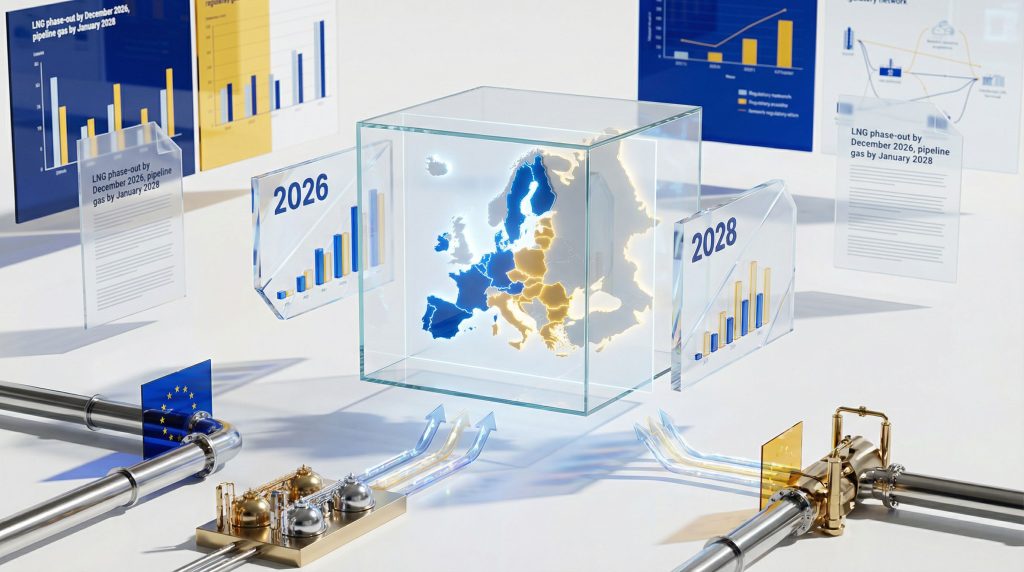
Europe's planned phase-out of Russian gas and LNG operates through a carefully structured timeline that reveals both regulatory precision and inherent flexibility. The December 3, 2025 EU regulation establishes a cascading prohibition system designed to eliminate Russian energy imports while providing multiple adjustment mechanisms.
Timeline Implementation Structure:
• LNG import phase-out: Complete cessation by December 2026
• Pipeline gas termination: Full prohibition by January 2028
• Short-term contract elimination: Mid-2026 deadline for contractual terminations
• Authorisation system deployment: Mandatory across all 27 member states
The regulatory framework requires each member state to implement authorisation procedures for any remaining Russian energy imports, coupled with comprehensive transparency and reporting obligations for energy companies. This documentation-based compliance system demands tracking of origin, volume, and delivery mechanisms across interconnected European infrastructure.
Critical insight: The regulation embeds multiple emergency derogations that activate during supply disruptions, winter demand spikes, infrastructure outages, and market volatility episodes. These contingencies represent what energy analysts describe as structural features rather than temporary measures, given Europe's historical pattern of converting emergency exceptions into permanent arrangements.
Defining "Russian Gas" in EU Regulatory Terms
The technical challenge of defining Russian gas within EU legal frameworks reveals fundamental enforcement vulnerabilities. Russian energy imports encompass direct pipeline flows via existing infrastructure, LNG cargoes with Russian feedstock origin, mixed cargoes requiring blended product classification, and third-country transit arrangements that complicate origin verification.
Turkey's Strategic Position:
Approximately 16 billion cubic meters (BCM) of Russian pipeline gas reached European customers via Turkstream throughout 2025, with most volumes targeting Hungary and several Balkan states. These flows enter EU territory under non-Russian origin certificates, exploiting Turkey's role as a transit and blending hub where Ankara processes discounted Russian gas before issuing alternative origin documentation.
The regulatory definition problem extends beyond pipeline infrastructure to LNG markets, where Russia's 28.4 million tons of LNG exports (January-November 2025) represent only a 2% decline year-on-year despite sanctions pressures. November 2025 Russian LNG shipments increased by 10% compared to November 2024, aided by fresh capacity additions from Arctic LNG 2 facilities.
Market Reality Check: The global LNG market's liquidity and origin-masking capabilities create what industry observers describe as the primary constraint on achieving successful EU sanctions enforcement. Certification of origin protocols planned for 2026 face technical limitations when applied to fungible commodities moving through multi-source, multi-directional pipeline systems.
Why Are Enforcement Mechanisms Already Under Pressure?
Member State Sovereignty vs. EU Energy Policy
The December 2025 regulation faced immediate legal challenges that expose fundamental tensions between national sovereignty and centralised EU energy authority. Furthermore, Hungary challenged the regulation at the European Court of Justice within hours of the announcement, arguing that energy security falls squarely within national constitutional competencies rather than Brussels' regulatory jurisdiction.
Political Opposition Dynamics:
• Hungary's legal strategy: Claims Brussels overstepped constitutional authority boundaries
• Slovakia's resistance: Expressed total opposition to centralised energy regulations
• Constitutional limits: National energy security considerations vs. EU regulatory harmonisation
• Pro-Russian alignment: Member states maintaining alternative geopolitical preferences
Slovakia has similarly indicated institutional resistance to unified EU action, creating what energy security analysts describe as permanent structural divisions that complicate enforcement coordination. These disagreements reflect deeper questions about the scope of EU authority in areas where national security and economic stability intersect.
Emergency Derogation Triggers Built Into the Regulation
The EU regulation incorporates multiple exemption mechanisms that activate automatically under specified conditions, creating what observers characterise as enforcement fragility by design rather than oversight.
Automatic Exemption Activation Conditions:
| Trigger Event | Activation Threshold | Duration Limits | Historical Precedent |
|---|---|---|---|
| Supply disruption events | Volume shortfalls exceeding regional capacity | Undefined extension periods | Druzhba pipeline exemption since 2022 |
| Winter demand spikes | Price volatility beyond member state tolerance | Seasonal adjustment allowances | Emergency clause utilisation pattern |
| Infrastructure outages | Critical distribution system failures | Emergency repair timeframes | Multi-source system monitoring gaps |
| Market volatility escape | Consumer cost political sensitivity thresholds | Market stabilisation periods | Temporary measures becoming permanent |
Precedent Analysis: The Druzhba pipeline exemption implemented in 2022 demonstrates how temporary emergency measures become permanent structural arrangements. When the EU banned Russian crude oil, the pipeline received an exemption that allowed Hungary and Slovakia to increase imports above pre-war levels, creating documented evidence that enforcement remains vulnerable to political and market pressures.
Technical Enforcement Reality: Brussels can implement documentation requirements and paperwork controls, but cannot effectively monitor molecular pathways through interconnected pipeline infrastructure. This technical limitation undermines the fundamental premise that regulatory frameworks can control actual gas flows across multi-directional European energy systems.
What Alternative Supply Sources Can Europe Actually Secure?
Global LNG Market Capacity Constraints
Europe's shift toward LNG alternatives faces structural supply limitations that constrain replacement capacity regardless of regulatory timelines. The global LNG market operates under long-term contract arrangements that limit available volumes for European import substitution.
Regional Supply Analysis:
| Supply Region | Current EU Deliveries (BCM) | Expansion Constraints | Timeline Challenges |
|---|---|---|---|
| Qatar | 15-20 | Long-term Asian contract commitments | New capacity additions delayed until 2027+ |
| United States | 45-50 | Export permit approval bottlenecks | Gulf Coast infrastructure limitations |
| Algeria | 25-30 | Political reliability concerns | Ageing pipeline infrastructure maintenance |
| Norway | 100-110 | Geological production plateau | Declining oil production projections |
Qatar's Strategic Warning: Qatar has explicitly warned Brussels of potential LNG shortages later in the decade, with expansion potential limited by existing Asian long-term contracts. Rising Asian demand competition creates additional supply tightness that constrains European access to non-Russian LNG volumes.
Norwegian Production Constraints: Norway, currently Europe's largest single gas supplier at 100-110 BCM annually, operates near peak output with declining field production projections. This geological reality means Norway cannot serve as the primary alternative to Russian supplies within the regulatory phase-out timeline.
Infrastructure Readiness Assessment
European LNG terminal capacity requires significant expansion to accommodate volume replacement of pipeline gas imports, with current infrastructure operating at utilisation rates that preclude major supply substitutions without substantial investment.
Infrastructure Investment Requirements:
| Investment Category | Estimated Cost (€ Billions) | Completion Timeline | Regulatory Status |
|---|---|---|---|
| Additional LNG terminals | 15-25 | 2026-2030 | Planning and permitting phase |
| Pipeline interconnections | 8-12 | 2025-2028 | Environmental review processes |
| Storage capacity expansion | 5-8 | 2026-2027 | Mixed approval progress |
| Grid flexibility upgrades | 20-30 | 2025-2035 | Varied member state advancement |
Terminal Capacity Bottlenecks: Existing EU LNG terminal infrastructure lacks sufficient regasification capacity for winter supply security requirements, particularly in Mediterranean and Baltic import hubs. Current storage facilities cannot provide adequate buffering for the historical 175-180 BCM Russian supply baseline without major capacity additions.
Interconnection Deficits: Pipeline interconnections between EU member states lack capacity to redistribute alternative supplies during disruption events. Multi-directional flow capability remains limited, constraining flexibility in redirecting non-Russian supplies to member states with highest import dependencies.
How Are Russia and Transit Countries Adapting to EU Regulations?
Moscow's Regulatory Circumvention Strategies
Russia has leveraged the extended phase-out timeline to implement systematic adaptations that maintain energy export capabilities while developing alternative market channels. The gradual implementation provides what analysts describe as exactly what Moscow needs: strategic adjustment time rather than immediate supply disruption.
Arctic LNG 2 Production Expansion:
• 2025 capacity additions: Fresh production contributing to November export increases
• 10% year-on-year growth: November 2025 LNG shipments exceeded 2024 levels
• Sanctions resilience: Production maintained despite Western technology restrictions
• Timeline advantage: 2027 regulatory deadline provides adaptation period
Shadow Fleet Operations Development:
Moscow has constructed an extensive shadow fleet utilising ageing tankers, obscure ownership arrangements, and non-Western insurance providers operating primarily through UAE, Hong Kong, and smaller jurisdictional bases. These vessels conduct ship-to-ship transfers in opaque waters including the Laconian Gulf and Canary Islands region, operating beyond G7 enforcement capabilities.
Alternative Market Diversification: Russia has deepened energy partnerships with China and India, which now absorb most Russian crude exports. This demand-side diversification strategy allows Moscow to treat European market access as secondary rather than existential, reducing compliance pressure with EU regulatory frameworks.
Third-Country Blending and Re-Export Mechanisms
Turkey's Transit Hub Optimisation:
Turkey serves as the primary transit and blending hub for Russian gas entering EU territory, processing approximately 16 BCM annually through Turkstream infrastructure. Ankara exploits discounted Russian gas pricing while issuing non-Russian origin certificates for flows targeting Hungarian and Balkan customers, creating regulatory arbitrage opportunities that undermine EU sanctions effectiveness.
Certificate of Origin Manipulation: The planned 2026 requirement for certificates of origin faces fundamental enforcement limitations when applied to fungible commodities. However, oil and gas products can obscure feedstock origins through refinery processing, with intermediaries maintaining strong economic incentives to disguise Russian supply sources through third-country documentation.
India and Turkish Refinery Processing: European companies continue importing substantial volumes of refined fuels from India and Turkey, with significant portions produced from Russian crude feedstock. This indirect supply chain maintains Russian energy access to European markets despite direct import regulations.
What Are the Compliance Monitoring Challenges?
Molecular Tracing vs. Paper Trail Enforcement
The fundamental challenge facing EU regulatory enforcement lies in the technical impossibility of tracking individual gas molecules through interconnected European pipeline systems. While Brussels can implement documentation-based compliance frameworks, the physical reality of multi-source, multi-directional infrastructure creates insurmountable monitoring limitations.
Technical Enforcement Constraints:
• Molecular pathway tracking: Technically impossible through integrated pipeline networks
• Documentation verification: Paper-based compliance vs. physical supply confirmation
• Multi-source system complexity: Blended flows obscure origin identification
• LNG cargo masking: Ship-to-ship transfers enable origin concealment
Global LNG Market Opacity: The current success of global LNG markets in providing liquid trading and origin-masking options creates the primary constraint on successful EU sanctions enforcement. Market participants can purchase Russian LNG through third-party traders, re-route cargoes through global terminals, and utilise complex ownership structures to buffer regulatory compliance requirements.
Cross-Border Regulatory Coordination Issues
Jurisdictional Enforcement Gaps:
| Challenge Category | Current Regulatory Gap | Enforcement Capability | Circumvention Risk |
|---|---|---|---|
| Transit country oversight | Limited EU extraterritorial authority | Diplomatic coordination required | High evasion potential |
| Trading hub monitoring | Opaque corporate ownership structures | Financial transaction tracking | Moderate detection capability |
| Financial settlement alternatives | Cryptocurrency and non-SWIFT systems | Intelligence cooperation dependent | Low interdiction probability |
| International waters operations | Ship-to-ship transfer activities | Naval surveillance limitations | Minimal enforcement reach |
Coordination Complexity: Cross-border regulatory harmonisation requires standardised authorisation procedures, unified penalty structures, coordinated emergency response protocols, and integrated market surveillance systems across 27 distinct legal jurisdictions with varying enforcement capabilities and political commitments.
The next major ASX story will hit our subscribers first
How Do Market Dynamics Undermine Regulatory Objectives?
Price Volatility Impact on Compliance
Energy market volatility creates systematic pressure for regulatory flexibility that undermines long-term compliance objectives. Emergency clause activation during price spikes generates member state pressure for temporary exemptions that historically become permanent structural features of EU energy policy.
Market Pressure Mechanisms:
• Industrial competitiveness concerns: Manufacturing sector lobbying for cost stability
• Consumer energy cost sensitivity: Political pressure during price escalation
• Emergency exemption precedent: Druzhba pipeline permanent exception model
• Winter demand seasonal stress: Predictable supply security challenges
These oil price movements create additional complexity for European energy planners attempting to maintain stable supply arrangements whilst phasing out Russian imports.
Global Energy Market Integration Effects
Fungible Commodity Characteristics: Natural gas and LNG operate as globally integrated commodities where origin control faces inherent limitations. Asian demand competition for non-Russian supplies, seasonal demand patterns creating supply stress, and long-term contract obligations constraining spot market availability combine to limit European regulatory effectiveness.
Supply Chain Arbitrage Opportunities: The integrated nature of global energy markets enables systematic regulatory arbitrage through third-country processing, complex ownership structures, and financial settlement alternatives that maintain Russian energy access despite direct prohibition frameworks. Furthermore, tariffs impact markets globally, creating additional complications for European energy independence strategies.
What Does Successful Implementation Actually Require?
Infrastructure Investment Prerequisites
Achieving genuine energy independence requires massive infrastructure investments that exceed current EU member state commitments and face substantial timeline misalignments with regulatory phase-out schedules.
Critical Infrastructure Gaps Analysis:
| Infrastructure Category | Investment Requirement (€ Billions) | Construction Timeline | Current Approval Status |
|---|---|---|---|
| Additional LNG terminals | 15-25 | 2026-2030 | Planning stage development |
| Pipeline interconnections | 8-12 | 2025-2028 | Environmental review processes |
| Storage capacity expansion | 5-8 | 2026-2027 | Mixed permitting progress |
| Grid flexibility enhancement | 20-30 | 2025-2035 | Varied implementation stages |
Timeline Misalignment: LNG terminal construction lead times exceed regulatory phase-out deadlines, interconnector pipeline approval processes face environmental impact assessment delays, and local community opposition creates additional project timeline extensions beyond policy implementation schedules.
Regulatory Harmonisation Requirements
Standardisation Imperatives:
• Authorisation procedure uniformity: Consistent processing across 27 member states
• Penalty structure coordination: Unified sanctions for non-compliance violations
• Emergency response integration: Coordinated supply disruption protocols
• Market surveillance systems: Integrated monitoring and enforcement mechanisms
Implementation Complexity: Regulatory harmonisation faces constitutional limits on EU authority, varying national energy security priorities, differential enforcement capabilities across member states, and political economy constraints affecting long-term policy sustainability.
Why Might the Timeline Prove Unrealistic?
Technical Implementation Barriers
The 2026-2027 phase-out timeline faces substantial technical constraints that may render compliance impossible without major emergency exemptions or timeline extensions.
Infrastructure Development Constraints:
• LNG terminal construction delays: Lead times exceeding regulatory deadlines
• Environmental approval bottlenecks: Impact assessment requirements extending project timelines
• Local opposition challenges: Community resistance to infrastructure development
• Interconnector construction complexity: Cross-border coordination and approval requirements
Political Economy Limitations
Industrial Lobby Pressure: Manufacturing sectors maintain strong incentives to advocate for extended transition periods, regional economic disparities create differential adaptation capabilities, and coalition government stability affects long-term policy commitment sustainability across electoral cycles.
Electoral Cycle Impacts: Energy policy continuity faces disruption through changing government priorities, voter sensitivity to energy cost increases, and opposition party criticism of regulatory implementation failures creating political pressure for policy modification or abandonment. These challenges intersect with broader concerns about US tariffs and inflation affecting European economic competitiveness.
What Are the Broader Implications for EU Energy Governance?
Precedent Setting for Future Energy Regulations
The Russian gas phase-out creates precedential frameworks for future EU energy governance that will determine the balance between centralised authority and national sovereignty in energy security matters.
Governance Framework Evolution:
• Emergency powers scope: Duration and breadth of crisis-based authority expansion
• Market intervention tools: Effectiveness of regulatory vs. economic instruments
• International law compliance: Unilateral trade restriction compatibility with WTO frameworks
• Member state exemption precedents: Constitutional limits on centralised energy authority
Geopolitical Regulatory Competition
Global Standards Influence: EU regulatory standards create spillover effects on global energy governance frameworks, with regulatory arbitrage opportunities benefiting non-EU jurisdictions willing to accommodate Russian energy flows. Alliance coordination requirements for effective sanctions implementation face limitations when partners maintain alternative economic interests or strategic priorities.
WTO Compliance Challenges: Discriminatory trade measures targeting specific country origins face potential challenges under international trade law, creating legal vulnerabilities that may undermine long-term regulatory sustainability and effectiveness. These regulatory tensions compound energy security challenges facing European policymakers.
How Should Stakeholders Prepare for Implementation Challenges?
Energy Company Compliance Strategies
Corporate Adaptation Requirements:
• Supply chain diversification planning: Alternative supplier relationship development timelines
• Documentation system upgrades: Tracking and reporting capability enhancement
• Legal risk assessment frameworks: Transitional arrangement compliance evaluation
• Financial hedging strategies: Price volatility and supply disruption risk management
Energy companies face substantial compliance costs and operational complexity increases that may affect competitiveness and investment decision-making across European energy markets.
Member State Regulatory Preparation
National Implementation Frameworks:
• Legislation alignment requirements: EU directive transposition into national law
• Emergency response plan development: Supply disruption management protocols
• Cross-border cooperation agreements: Regional coordination mechanism establishment
• Public communication strategies: Consumer and industrial stakeholder engagement
Coordination Imperatives: Member states require standardised authorisation procedures, unified penalty structures, coordinated emergency response protocols, and integrated market surveillance systems to achieve effective regulatory implementation across diverse national contexts and capabilities.
What Are the Long-Term Energy Security Implications?
Strategic Autonomy vs. Market Efficiency Trade-offs
Europe's planned phase-out of Russian gas and LNG represents a fundamental shift from market efficiency toward strategic autonomy in energy policy. This transition requires accepting higher energy costs, reduced supply flexibility, and increased investment requirements in exchange for reduced geopolitical vulnerability.
The strategic calculus underlying Europe's planned phase-out of Russian gas and LNG demonstrates how geopolitical considerations now override traditional market-based decision-making in energy policy. However, European leaders reach agreement on these measures whilst acknowledging significant implementation challenges ahead.
Long-term Strategic Considerations:
• Energy price volatility: Reduced supply diversity increases vulnerability to market shocks
• Industrial competitiveness impacts: Higher energy costs affecting manufacturing competitiveness
• Investment allocation efficiency: Strategic priorities vs. market-driven resource allocation
• Geopolitical risk concentration: Increased dependency on alternative supplier relationships
Regulatory Reality Assessment: The European Union's ambitious timeline for eliminating Russian gas and LNG imports by 2026-2027 represents a significant regulatory undertaking that faces substantial implementation challenges. While political commitment remains strong, the practical realities of alternative supply limitations, infrastructure constraints, enforcement complexities, and market dynamics suggest that achieving complete energy independence within the specified timeframe may require significant flexibility, substantial additional investments, and potentially extended transition periods beyond current regulatory projections.
This analysis is based on publicly available information and regulatory developments as of December 2025. Energy market conditions and regulatory frameworks continue evolving rapidly, and stakeholders should consult current official sources for the most recent policy updates and implementation guidance.
Looking to Capitalise on Energy Market Disruptions?
Europe's complex energy regulatory framework creates significant market volatility opportunities across commodities and related mining sectors. Discovery Alert's proprietary Discovery IQ model provides real-time insights into ASX mineral discoveries, helping investors identify actionable opportunities as European energy independence drives demand for critical resources.