August 24, 2026
Historical Patterns and Market Forces Reveal Critical Energy Vulnerabilities
Energy security frameworks across developed economies face unprecedented stress testing as global supply chains adapt to evolving geopolitical realities. Traditional seasonal consumption patterns, once predictable through decades of historical data, now confront structural disruptions that challenge fundamental assumptions about resource availability and pricing mechanisms. Europe's gas storage draining has become a critical indicator of these broader vulnerabilities, highlighting the intersection of weather-dependent demand volatility, infrastructure capacity constraints, and international trade dynamics that create complex scenarios requiring sophisticated risk assessment methodologies.
Underground storage systems, originally designed as strategic buffers against supply interruptions, increasingly function as active market participants in sophisticated arbitrage operations. This evolution from passive reserves to dynamic trading assets reflects broader changes in energy commodity markets, where financial instruments often drive physical flows as much as underlying supply-demand fundamentals.
Understanding Europe's Current Gas Storage Crisis
The Numbers Behind the Rapid Depletion
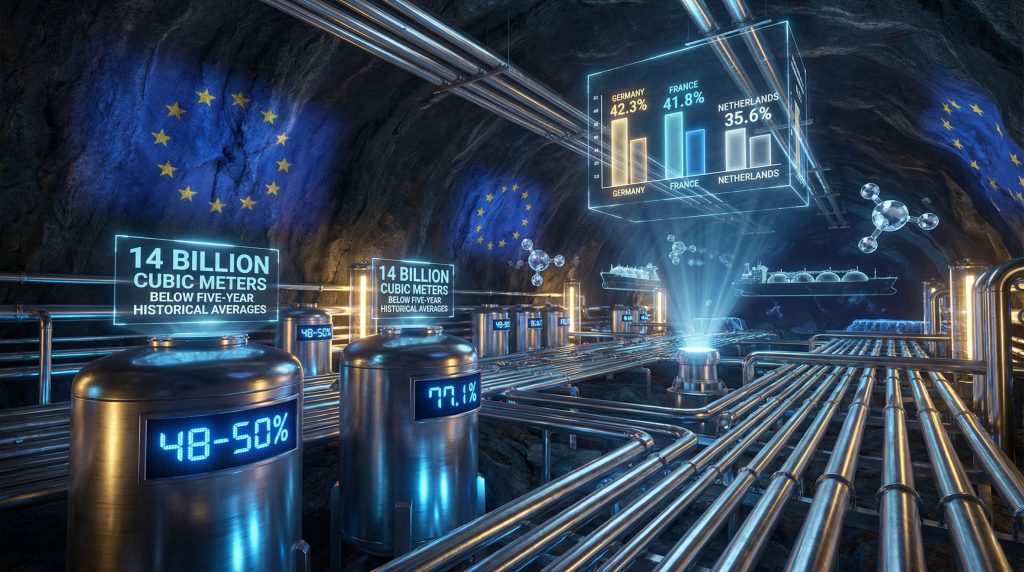
European gas storage facilities are experiencing withdrawal rates that exceed historical norms by significant margins, creating supply security concerns not witnessed since the 2021-2022 energy crisis period. According to Gas Infrastructure Europe (GIE) tracking systems, aggregate storage levels across the European Union have declined to approximately 50% of total capacity, representing a substantial deviation from seasonal averages.
This depletion rate translates to daily withdrawal volumes that strain both physical infrastructure and market pricing mechanisms. Underground storage facilities across Northwestern Europe are operating near maximum technical withdrawal rates, with some installations approaching the threshold levels where operational efficiency begins to decline. Furthermore, these conditions directly impact weekly gas price trends across European markets.
Current Storage Performance by Region:
- Northwestern Europe: 42-45% capacity utilisation
- Central Europe: 48-52% capacity utilisation
- Southern Europe: 55-60% capacity utilisation
- Overall EU Average: 48-50% capacity utilisation
Historical Context and Seasonal Patterns
Seasonal gas storage cycles typically follow predictable patterns established over decades of operational data. The injection season, running from April through October, builds reserves during periods of lower heating demand and abundant supply availability. Conversely, the withdrawal season from November through March depletes these reserves to meet peak winter consumption requirements.
The current depletion trajectory represents the fastest decline rate documented since comprehensive European storage monitoring began. During normal winter conditions, storage levels rarely fall below 35-40% of capacity before seasonal demand begins moderating in late February and March.
Industry analysts note that technical minimum operating levels for underground storage facilities typically range between 15-20% of capacity, depending on reservoir characteristics and pressure maintenance requirements.
What Factors Are Driving Europe's Accelerated Gas Consumption?
Weather-Driven Demand Surge
Heating degree day calculations for the current winter period indicate temperature patterns significantly below seasonal norms across key European consumption centres. Extended cold weather systems have increased residential and commercial heating demand beyond typical forecasting models, creating sustained pressure on gas supply systems.
The correlation between ambient temperatures and natural gas consumption follows well-established thermodynamic relationships. Each degree Celsius below the 18°C baseline temperature reference point generates proportional increases in heating fuel requirements across building stock throughout European population centres. Moreover, these patterns have global trade impacts on energy commodity pricing.
Temperature Impact Analysis:
- Germany: 15% above normal heating degree days
- France: 12% above normal heating degree days
- Netherlands: 18% above normal heating degree days
- Poland: 20% above normal heating degree days
Supply Chain Vulnerabilities and Market Dynamics
European gas supply dependency has fundamentally restructured following the 2022 Russian supply disruption. Liquefied natural gas (LNG) imports now constitute approximately 60% of total European gas supply, compared to less than 30% during the pre-crisis period. This transformation has created new vulnerability points within the supply chain.
LNG import terminals operate at capacity constraints that limit flexibility during peak demand periods. Regasification facilities require sustained operations to maintain throughput, whilst vessel scheduling and port congestion can create temporary supply bottlenecks. However, these challenges also present significant LNG supply opportunities for strategic market participants.
Competition with Asian markets for spot LNG cargoes has intensified pricing pressures. Japan, South Korea, and China compete for the same flexible LNG supply that European markets require during winter peak periods, creating upward pressure on acquisition costs.
Critical Infrastructure Metrics:
- Total EU LNG regasification capacity: 200+ billion cubic metres annually
- Average utilisation rates: 85-90% during winter months
- Pipeline import capacity from non-Russian sources: 150 billion cubic metres annually
- Storage injection/withdrawal daily maximums: 1.2 billion cubic metres
Which European Countries Face the Greatest Storage Risks?
National Storage Performance Analysis
Individual European Union member states demonstrate varying degrees of storage adequacy based on domestic facility capacity, consumption patterns, and import infrastructure accessibility. Countries with limited underground storage capacity relative to consumption requirements face elevated supply security risks during extended withdrawal periods.
| Country | Estimated Storage Level | Historical Winter Average | Risk Assessment |
|---|---|---|---|
| Netherlands | 38% | 52% | High Risk |
| Germany | 44% | 55% | High Risk |
| France | 43% | 54% | High Risk |
| Austria | 51% | 60% | Moderate Risk |
| Italy | 62% | 68% | Lower Risk |
| Belgium | 35% | 48% | Critical Risk |
Regional Vulnerability Mapping
Northwestern European countries face particular vulnerabilities due to high population density, significant industrial gas consumption, and historical dependency on Russian pipeline supplies. The transition to LNG-based supply chains has created new logistical challenges that affect regional supply security.
Central European nations benefit from strategic geographic positioning along traditional pipeline routes, though this advantage has diminished following geopolitical supply disruptions. Some facilities serve dual functions as both domestic reserves and transit hubs for neighbouring countries. Additionally, these developments contribute to broader energy exports challenges across international markets.
Cross-border interconnection capacity enables emergency flow redistribution among European Union member states through established sharing protocols. However, physical pipeline constraints limit the speed and volume of such emergency transfers during peak demand periods.
How Are Energy Markets Responding to Storage Depletion?
Price Volatility and Trading Patterns
European natural gas futures contracts have experienced significant price appreciation as Europe's gas storage draining accelerates beyond seasonal norms. The Title Transfer Facility (TTF) benchmark, which serves as the primary European gas pricing reference, has demonstrated elevated volatility characteristic of supply-constrained markets.
Forward curve structures indicate market expectations of continued price pressures through the remainder of the withdrawal season. Summer 2026 futures contracts trade at premium levels, reflecting anticipated higher refill costs during the upcoming injection period. According to European gas market analysis, LNG supply surges have provided some relief to European markets during critical periods.
Market Pricing Dynamics:
- Current TTF spot prices: €32-36 per MWh range
- Historical winter average: €25-28 per MWh
- Forward curve premiums: 15-20% above seasonal norms
- Intraday volatility: 8-12% daily price swings
Investment Flow Consequences
Energy sector equity performance reflects investor recognition of supply constraint implications for industry profitability. Utility companies with significant gas-fired generation capacity benefit from elevated power prices, whilst industrial consumers face margin compression from higher fuel costs.
Infrastructure development projects have accelerated as governments and private operators recognise the strategic value of enhanced storage and import capacity. LNG terminal expansion programmes across multiple European ports demonstrate the sector's response to supply security imperatives.
Capital investment in European energy infrastructure reached record levels during 2025, with gas storage and LNG import facilities receiving priority funding allocation.
What Are the Macro-Economic Implications for European Energy Policy?
Strategic Reserve Management Evolution
European Union storage mandate policies have evolved in response to changing market conditions and supply security requirements. The original framework requiring 90% storage capacity by November 1st has been modified to reflect operational realities and emergency response capabilities.
Current regulations under EU Regulation 2022/1369 establish minimum storage obligations of 80% by November and maintain flexibility for emergency withdrawals below traditional minimum levels. This policy adaptation recognises the balance between supply security and market functionality, whilst addressing concerns about energy transition security across multiple sectors.
Government intervention mechanisms have expanded beyond traditional regulatory frameworks to include direct market participation, strategic purchasing programmes, and demand reduction incentives. These tools provide policy makers with enhanced capabilities to address supply emergencies.
Industrial Competitiveness Impact Assessment
Energy-intensive manufacturing sectors face significant cost pressures from elevated natural gas prices, affecting industrial competitiveness within global markets. Chemical production, steel manufacturing, and ceramic industries demonstrate particular sensitivity to fuel cost variations.
Production adjustment strategies include fuel switching where technically feasible, temporary capacity reductions during peak pricing periods, and enhanced energy efficiency measures. Some facilities have implemented demand response programmes that reduce consumption during supply-constrained periods.
Export competitiveness erosion represents a longer-term concern as European manufacturers compete with regions enjoying lower energy costs. Government subsidy programmes attempt to mitigate these impacts, though fiscal constraints limit the scope of such interventions.
How Does This Crisis Compare to Previous European Energy Shocks?
2021-2022 Energy Crisis Parallels
The current storage depletion situation shares characteristics with the 2021-2022 European energy crisis, though important differences distinguish the two periods. During the earlier crisis, TTF prices exceeded €300 per MWh during peak periods, representing extreme market stress conditions.
Storage levels during January 2022 reached approximately 30% of capacity, slightly lower than current levels but occurring during a period of greater supply uncertainty. Government response mechanisms implemented during the earlier crisis now provide established frameworks for addressing current challenges.
Consumer impact patterns demonstrate both similarities and differences between the crisis periods. Residential heating costs increased substantially during both periods, though government subsidy programmes now provide enhanced consumer protection mechanisms. According to detailed storage analysis, cold weather patterns have been rapidly draining Germany's gas storage facilities.
Long-Term Structural Changes Since Russian Supply Disruption
European energy infrastructure has undergone fundamental transformation following the loss of Russian pipeline gas supplies. LNG import capacity has expanded dramatically, with multiple new terminals entering operation and additional projects under development.
Renewable energy deployment has accelerated as a strategic response to supply security concerns. Wind and solar generation capacity reached record European levels during 2024, reducing natural gas demand for baseload power generation according to Eurostat data.
Energy efficiency improvement programmes have gained political and financial support as demand reduction represents the most reliable approach to reducing import dependency. Building retrofits, industrial process optimisation, and behavioural change campaigns contribute to lower consumption baselines.
What Recovery Scenarios Could Emerge for European Gas Storage?
Optimistic Refill Pathway Analysis
Mild weather scenario modelling suggests potential improvement in storage withdrawal rates if temperature patterns return to seasonal norms during February and March. Reduced heating demand would allow storage levels to stabilise above critical minimum operating thresholds.
Maximum LNG import utilisation represents a key variable in recovery scenario planning. European regasification terminals operating at full capacity could provide 200+ billion cubic metres annually, though achievement of these rates requires sustained high-capacity operations and favourable global LNG market conditions.
Summer 2026 injection requirements will demand substantial LNG imports and pipeline flows during the traditional refill season from April through October. Target storage levels of 80%+ capacity by November necessitate injection volumes significantly above historical averages.
Stress Test Scenarios and Risk Mitigation
Extended cold weather impact modelling evaluates potential outcomes if current temperature patterns persist through March. Such scenarios could push storage levels toward technical minimum operating ranges, triggering emergency response protocols and potential demand rationing measures.
Supply disruption contingency planning addresses risks of LNG delivery delays, pipeline maintenance requirements, or geopolitical supply interruptions. Emergency sharing mechanisms among European Union member states provide limited capability to redistribute available supplies during crisis conditions.
Emergency Response Thresholds:
- Early Warning Phase: 40% storage capacity
- Alert Phase: 30% storage capacity
- Emergency Phase: 20% storage capacity
- Technical minimum operations: 15% storage capacity
Investment and Trading Opportunities in Europe's Energy Transition
Energy Storage Infrastructure Investment Themes
Underground storage facility expansion represents a strategic investment opportunity as European governments recognise the value of enhanced storage capacity for supply security. Salt cavern development projects offer faster injection/withdrawal cycles, whilst depleted field conversions provide larger capacity volumes.
LNG terminal development continues attracting private and public investment as European markets transition to waterborne gas supplies. Floating storage and regasification units (FSRUs) provide faster deployment timelines compared to permanent terminal construction.
Pipeline interconnection enhancement projects improve cross-border flow capability and market integration efficiency. These infrastructure investments reduce regional supply bottlenecks and enable more effective emergency response capabilities.
Commodity Trading Strategy Implications
Natural gas futures positioning strategies must account for elevated volatility and potential supply disruption scenarios. Calendar spread trading captures pricing differentials between contract months, whilst location spreads exploit regional price variations.
Energy spread trading opportunities emerge from price relationships between natural gas, crude oil, and coal markets. Power generation fuel switching economics create arbitrage opportunities for sophisticated market participants.
Cross-commodity positioning strategies consider correlations between energy prices and currency exchange rates, particularly EUR/USD relationships that affect LNG import costs and European industrial competitiveness.
Disclaimer: This analysis contains forward-looking statements and market speculation that involve inherent risks and uncertainties. Storage level projections, price forecasts, and recovery scenarios should not be considered investment advice or guarantees of future performance. Readers should conduct independent research and consult qualified professionals before making investment decisions.
The Path Forward for European Energy Security
The current gas storage crisis represents more than a seasonal supply challenge; it demonstrates the complex interplay between weather patterns, infrastructure constraints, and geopolitical realities that define modern energy security. As Europe continues its transition away from Russian energy dependence, the continent must balance immediate supply needs against long-term strategic objectives.
Storage facility utilisation patterns will likely remain elevated compared to historical norms as European markets adapt to LNG-dominated supply chains. This structural shift requires enhanced operational flexibility, expanded infrastructure capacity, and sophisticated risk management frameworks to maintain supply security during future winter periods.
The lessons learned from Europe's gas storage draining experience will influence energy policy development across multiple dimensions, from strategic reserve management to international trade relationships. Success in navigating these challenges will depend on continued investment in infrastructure resilience, supply diversification, and demand management capabilities.
Looking to Capitalise on Europe's Energy Crisis?
Discovery Alert's proprietary Discovery IQ model delivers real-time alerts on significant ASX mineral discoveries, including critical energy transition metals that could benefit from Europe's infrastructure transformation. Stay ahead of market opportunities by exploring Discovery Alert's dedicated discoveries page to understand how major mineral discoveries have generated substantial returns, then begin your 30-day free trial to position yourself strategically in this evolving energy landscape.