July 20, 2026
When the Countdown Clock Runs Out but the Planes Keep Flying
Every major energy disruption in modern history has produced a version of the same forecast: identify current inventory levels, subtract daily consumption, and project the date when physical supply runs out. These countdown-style analyses are not dishonest. They are, however, fundamentally incomplete. They treat the energy system as a static arithmetic problem when it is actually a dynamic, globally interconnected market that reprices, reorganises, and reroutes itself the moment scarcity becomes credible enough to generate profit opportunities.
The Strait of Hormuz disruption that began in late February 2026 provided the most extreme stress test of this dynamic in living memory. The predictions were alarming, the vulnerability was genuine, and the scale of disruption was historically unprecedented. Yet the Europe jet fuel shortage avoided outcome that emerged by mid-2026 tells a more nuanced story about how modern energy markets actually function under pressure.
When big ASX news breaks, our subscribers know first
The Scale of What Europe Was Actually Facing
A Supply Shock Without Precedent
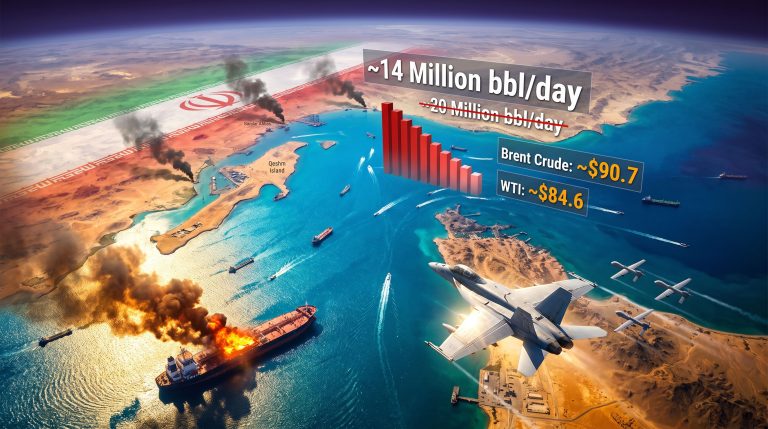
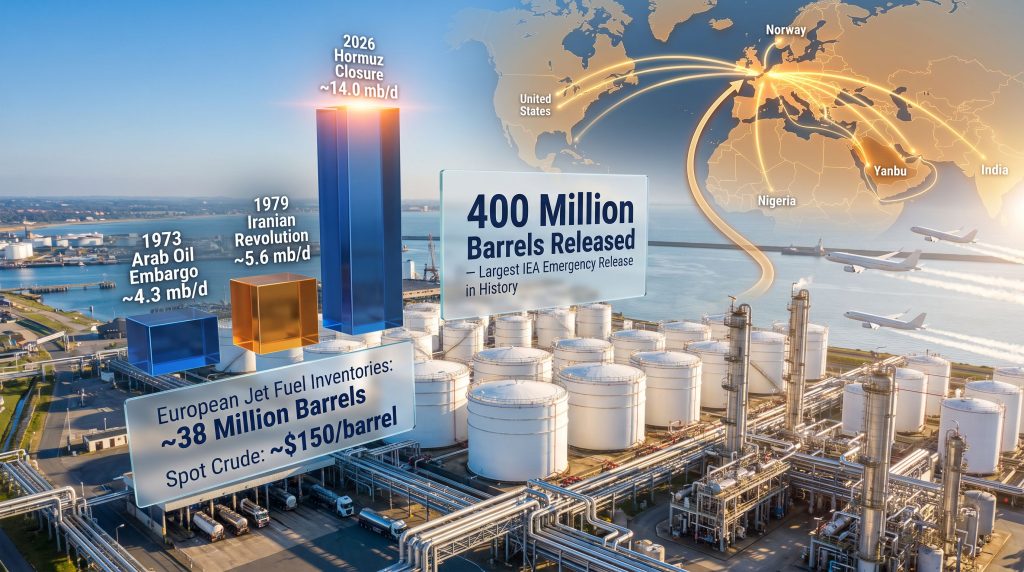
To understand why the shortage warnings were taken seriously, it helps to grasp the sheer magnitude of the Hormuz closure. At its peak, approximately 14 million barrels per day of global oil and refined product flows were disrupted, representing roughly 14% of total global demand. No previous supply crisis in recorded history removed this volume of supply from the market simultaneously. Furthermore, this level of crude oil price volatility had not been seen in any comparable historical episode.
| Disruption Event | Supply Removed (mb/d) | % of Global Demand | Approximate Duration |
|---|---|---|---|
| 1973 Arab Oil Embargo | ~4.3 | ~7% | ~5 months |
| 1979 Iranian Revolution | ~5.6 | ~8% | ~12 months |
| 1990 Gulf War | ~4.3 | ~6% | ~7 months |
| 2022 Russia-Ukraine (partial) | ~3.0 | ~3% | Ongoing |
| 2026 Hormuz Closure | ~14.0 | ~14% | Ongoing at time of writing |
Europe's structural position made it particularly exposed. The continent consumes approximately 1.6 million barrels per day of jet fuel and kerosene but produces only around 1.1 million barrels per day domestically, creating a persistent import requirement of roughly half a million barrels per day. Before the conflict, the Middle East supplied approximately 20% of Europe's total jet fuel import volume, a dependency that had been treated as economically efficient rather than strategically risky.
By early June 2026, European jet fuel inventories had fallen to an estimated 38 million barrels, representing less than one month of demand coverage. The IEA warned that if Europe managed to replace only half of its lost Gulf supply, physical shortages could emerge by June. Goldman Sachs scenario modelling indicated that inventories could breach the IEA's critical 23-day coverage threshold during that same period. Ryanair publicly estimated that a 10 to 20% supply reduction could force meaningful capacity cuts during peak summer travel.
These were not fabricated warnings. They were conditional risk projections built on plausible assumptions about how quickly replacement supply could arrive. The critical variable was always the speed of the global response, not the existence of the vulnerability itself.
The Four Mechanisms That Held the System Together
How Europe Replaced Supply It Was Never Supposed to Need
The reason the Europe jet fuel shortage avoided outcome materialised rather than the predicted crisis comes down to four simultaneous and mutually reinforcing responses. None of them alone was sufficient. Together, they transformed what looked like an arithmetic certainty into a price shock. In addition, European energy market trends leading into the crisis had already begun shifting procurement behaviour across the continent.
1. Emergency Strategic Reserve Mobilisation
The IEA coordinated the release of 400 million barrels of emergency strategic stocks across its 32 member nations, the largest coordinated release in the organisation's history. EU member states are required under existing rules to hold strategic reserves equivalent to approximately 90 days of consumption, providing a substantial buffer. Crucially, this release was not intended to replace all lost supply permanently. Its function was to buy commercial supply chains enough time to physically reorganise, which is exactly what it did.
2. Domestic Refinery Yield Reconfiguration
European refiners rapidly adjusted their crude processing operations to maximise jet fuel and kerosene output per barrel. Regional jet fuel yields reached record levels as refiners sacrificed production of other distillate products. Spain's Repsol reportedly increased jet fuel production by an estimated 15 to 20% above normal operating levels. Austria's OMV AG similarly skewed its refinery operations toward aviation fuel and kerosene categories. This was not a small adjustment; it represented a fundamental short-term restructuring of European refining economics.
3. Alternative Import Sourcing from Non-Gulf Suppliers
Perhaps the most operationally impressive component of the response was the speed with which alternative import corridors were established. According to reporting from the Financial Times, replacement supply arrived from multiple directions simultaneously. Specifically, cargoes were sourced from:
- The United States and Canada
- Nigeria and broader West Africa
- India and South Korea
- Norway
US jet fuel production exceeded 2 million barrels per day on a four-week rolling average for the first time on record. US exports to Europe reached historic highs as elevated European spot prices made Atlantic Basin cargoes economically compelling. Saudi Arabia simultaneously rerouted shipments through its Red Sea terminal at Yanbu, bypassing the disrupted strait entirely. By early June 2026, Saudi jet fuel flows to Europe via the Red Sea were reportedly running above pre-closure levels.
4. Demand Compression Through Price Signals
Higher fuel costs rendered certain marginal airline routes economically unviable, producing organic demand reduction without government rationing. Flights through and around the Middle East were cancelled or rerouted, lowering fuel consumption in precisely the most disrupted corridors. This demand-side adjustment was insufficient to close the supply gap independently but contributed meaningfully to the overall rebalancing equation.
The Price Mechanism That Made Adaptation Possible
Why Fear Functioned as Infrastructure
One of the most counterintuitive aspects of how the Europe jet fuel shortage avoided outcome came about involves the role of price panic itself. Energy commodity markets reprice the probability of future scarcity immediately, not after physical shortages emerge. This creates a dynamic where the price signal that alarms consumers is simultaneously the mechanism that mobilises the supply response. Consequently, the broader commodity market volatility seen throughout 2025 and into 2026 had already primed many market participants to react faster than in previous crises.
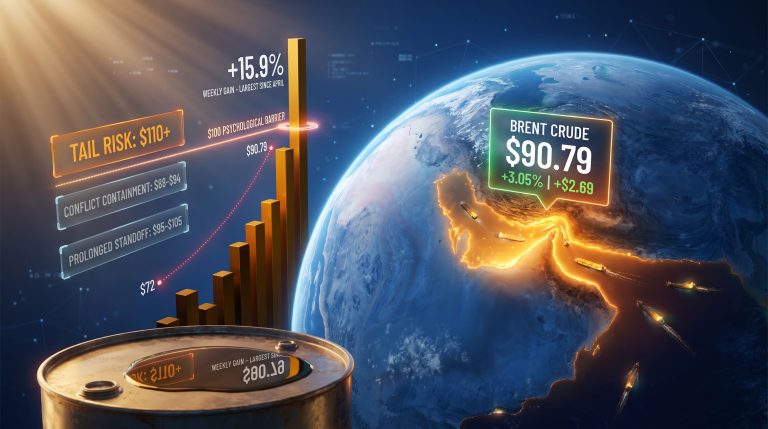
During the early weeks of the Hormuz crisis, physical crude grades for immediate delivery approached $150 per barrel, even as futures benchmarks for later delivery remained materially lower. This extreme backwardation is a market structure that signals acute near-term scarcity. It tells refiners, traders, and producers that someone will pay an enormous premium to secure barrels today.
Without that price spike, US refiners would not have reconfigured output toward jet fuel. Atlantic Basin cargoes would not have been redirected toward Europe. Saudi Yanbu shipments would not have been prioritised. The very panic that alarmed governments was the mechanism that funded the solution.
This creates what might be called a self-defeating scarcity dynamic. When a credible shortage forecast becomes widely known, the procurement behaviour it triggers partially pre-empts the physical shortage it predicts. Countdown projections that assume static production, trade, and consumption variables consistently underestimate this feedback effect because all three variables adjust simultaneously once prices move sharply enough.
What the Crisis Exposed That a Successful Outcome Can Obscure
Hidden Vulnerabilities That Remain Unresolved
The fact that widespread physical shortages did not materialise should not be interpreted as evidence that Europe's aviation fuel security infrastructure is robust. Several structural gaps became visible during the crisis that persist regardless of the successful outcome. Moreover, the oil market disruption caused by concurrent geopolitical pressures compounded the underlying fragility of existing supply arrangements.
Jet Fuel-Specific Reserve Gaps
European strategic stock rules mandate general petroleum reserves but do not require member states to hold dedicated aviation fuel reserves. During a jet fuel-specific disruption, strategic stocks must be converted or traded rather than directly deployed into aviation supply chains. For landlocked European nations with limited refinery flexibility, this created meaningful delays in accessing reserve protection.
Thinner Inventory Buffers Going Forward
European jet fuel stocks at approximately 38 million barrels in early June 2026 represent less than 30 days of demand coverage, a historically low buffer level. Diesel inventories across both Europe and the United States remain below historical seasonal averages. Russia's restriction of diesel exports following attacks on its refining infrastructure has further tightened European middle distillate markets, with European diesel margins reaching exceptional levels that signal structural tightness extending beyond aviation fuel alone.
Permanently Higher Supply Chain Costs
Replacement cargoes now travel materially longer distances than pre-crisis Middle Eastern supply routes. Higher freight costs, longer transit times, and greater logistical complexity are embedded in European aviation fuel pricing in ways that will not disappear when the immediate crisis resolves. The system remains functional, but it is operating with less redundancy and at greater cost per barrel delivered.
What Comes Next: Three Scenarios for European Aviation Fuel Security
Scenario Modelling for the Months Ahead
The trajectory of European jet fuel markets depends critically on how long the Hormuz disruption continues and whether secondary disruptions compound the primary supply gap. However, geopolitical trade disruption across multiple regions suggests that the risk of compounding shocks is meaningfully higher than in previous energy crises.
| Scenario | Key Condition | Inventory Outcome | Airline Impact |
|---|---|---|---|
| A: Hormuz reopens within 60 days | Middle Eastern supply restores gradually | Rebuilds over 3 to 6 months | Routes recover, costs normalise by Q4 2026 |
| B: Hormuz disruption extends through Q3 2026 | Continued alternative sourcing required | Approaches critical thresholds again by August | Sustained capacity constraints through winter 2026-27 |
| C: Secondary disruption compounds Hormuz | Red Sea or Black Sea escalation | Multiple alternative routes simultaneously threatened | Acute risk to European aviation fuel security |
Scenario C represents the tail risk that analysts are watching most carefully. Saudi Yanbu exports are currently one of the critical compensating flows replacing Hormuz throughput. Any escalation that threatens Red Sea shipping lanes would simultaneously remove one of the primary mechanisms that prevented the June shortage from materialising. EU energy ministers have been actively monitoring reserve levels in anticipation of exactly this scenario.
The next major ASX story will hit our subscribers first
What European Policy Should Take From the 2026 Experience
Structural Reforms That the Crisis Made Unavoidable
The Hormuz experience points toward several policy adjustments that the absence of widespread shortages should not delay:
- Introduce product-specific reserve mandates requiring member states to hold dedicated jet fuel and kerosene stocks, not just general petroleum equivalents
- Fund refinery flexibility upgrades that allow European plants to shift yield profiles more rapidly between distillate categories during supply stress events
- Formalise alternative supply corridor agreements with US, Norwegian, Nigerian, and West African producers as standing diversification rather than emergency improvisation
- Develop pre-agreed frameworks for redistributing jet fuel inventories between member states during supply stress, rather than negotiating these arrangements during a crisis
- Review whether the IEA's existing 23-day coverage threshold for emergency action is appropriate given the speed at which modern supply chains can reorganise
The Difference Between Winning and Being Secure
The Europe jet fuel shortage avoided outcome is a genuine achievement of global market coordination, emergency reserve architecture, and commercial adaptability. It is not, however, evidence that the underlying vulnerability has been resolved.
Europe has converted an immediate physical risk into a prolonged period of elevated costs, thinner buffers, and longer supply chains. The distinction between a price shock and a physical shortage matters enormously for aircraft operations and fuel allocation. An expensive market still moves fuel to where it is needed. An empty one cannot.
What the 2026 Hormuz crisis ultimately demonstrated is that modern energy systems protect themselves through economics rather than comfort. Scarcity becomes expensive enough to mobilise alternatives before it becomes severe enough to halt operations. That mechanism worked this time. Whether it would work again from a weaker inventory position, against a second simultaneous disruption, is the question European energy policymakers should be spending far more time answering than they currently are.
Disclaimer: This article contains forward-looking analysis, scenario projections, and conditional forecasts. All figures and timelines referenced are based on information available as of mid-2026 and should not be relied upon as investment advice. Energy market conditions are highly dynamic and subject to rapid change.
Want to Stay Ahead of the Next Major Commodity Disruption?
Discovery Alert's proprietary Discovery IQ model delivers real-time alerts on significant ASX mineral discoveries, cutting through market complexity to surface actionable opportunities the moment they are announced — explore historic examples of major discovery returns or start your 14-day free trial today to position yourself ahead of the broader market.