July 20, 2026
The World's Most Vulnerable Energy Corridor Is Now a War Zone
Global energy security has always rested on a set of uncomfortable assumptions. Chief among them: that the narrow maritime passages connecting the world's largest oil-producing regions to its largest consuming economies would remain open, regardless of geopolitical tension. The Strait of Hormuz, a 21-mile-wide chokepoint between Iran and Oman, was always the most fragile link in that chain. U.S. strikes on Iran in the Strait of Hormuz have, in 2026, shattered that assumption entirely.
What was once described in strategic studies as a theoretical vulnerability has become an active conflict zone, with cascading consequences for energy markets, regional stability, and the global economy. Understanding what is actually happening in the strait, and why it matters far beyond the Middle East, requires examining the geography, the military operations, and the economic data simultaneously. The broader geopolitical landscape of resource-critical regions has arguably never been more fraught.
When big ASX news breaks, our subscribers know first
Why the Strait of Hormuz Has No Substitute
The Mathematics of a Chokepoint
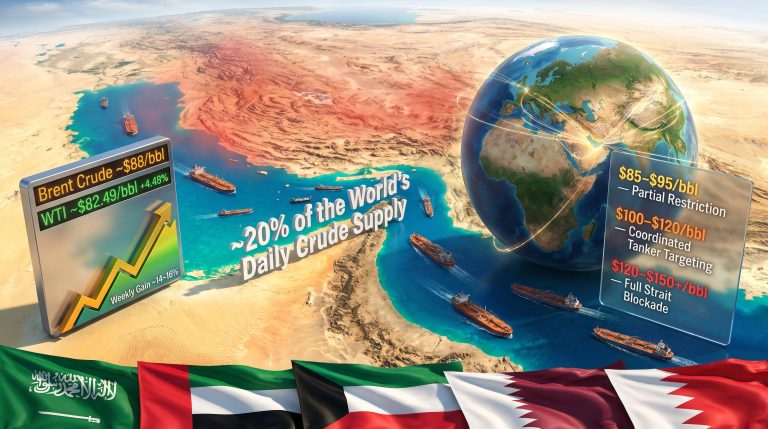
Before hostilities began, approximately 20 million barrels of crude oil and refined petroleum products moved through the Strait of Hormuz every single day. That figure represents roughly one-fifth of all oil traded globally, flowing through a navigable channel only a few miles wide at its narrowest point.
The strait's strategic weight is not simply about volume. It is about irreplaceability. While several pipeline projects have been developed over the decades to provide partial bypass capacity, including the Abu Dhabi Crude Oil Pipeline and Saudi Arabia's East-West Pipeline, none of these alternatives can absorb anywhere near the full throughput that the strait historically handled. The combined bypass capacity of all existing pipeline alternatives falls well short of the 20-million-barrel daily baseline.
This creates what energy security analysts call a single-point-of-failure risk at the heart of the global oil supply chain. Major Asian economies, including China, Japan, South Korea, and India, collectively import hundreds of millions of barrels annually through this corridor. For these nations, there is no quick pivot to alternative supply routes, and their strategic petroleum reserves offer only limited cushion against sustained disruption.
From Trade Route to Battleground: The 2026 Escalation Timeline
The current conflict traces its origins to February 28, 2026, when coordinated U.S. and Israeli strikes on Iran initiated what would become one of the most consequential military campaigns in recent decades. The Strait of Hormuz became the central operational theatre almost immediately, with Iran moving to restrict commercial shipping access as a retaliatory economic lever.
The U.S. military's response was the launch of a dedicated Hormuz campaign in March 2026, explicitly framed around restoring freedom of navigation for commercial vessels. What began as targeted interdiction operations gradually escalated into a sustained bombardment campaign. By mid-July 2026, the U.S. had entered its ninth consecutive night of continuous strikes against Iranian military infrastructure, with U.S. Central Command confirming the ninth wave commenced at 7:00 p.m. ET on Sunday, July 19, 2026.
The immediate trigger for this latest escalation was an Iranian attack on a commercial container ship transiting the strait, which left the vessel ablaze and crew members missing. That incident catalysed the most intense phase of U.S. military operations in the entire campaign.
What U.S. Forces Have Actually Targeted
Strike Categories and Operational Reach
The scale and scope of U.S. military operations against Iran since February 2026 far exceed what casual media coverage conveys. According to U.S. military statements, the campaign has struck more than 8,000 Iranian military targets, destroyed approximately 130 Iranian naval vessels, and deployed a combination of carrier-based fighter aircraft, naval surface ships, and one-way attack drones.
Target categories span multiple domains:
- Missile and drone launch sites positioned along Iran's coastline
- Radar installations and command-and-control infrastructure
- Ammunition storage facilities and logistics hubs
- Coastal defence emplacements and forward naval assets
- Over 60 small Iranian vessels destroyed across multiple discrete operations
- Command infrastructure in northern Iran, well beyond the strait's immediate geography
Geographic Expansion of the Strike Campaign
The targeting footprint has expanded significantly from its initial focus on strait-adjacent positions. The table below maps key strike locations against their strategic significance within the broader campaign:
| Strike Location | Primary Target Type | Strategic Role |
|---|---|---|
| Bandar Abbas | Coastal defence, naval assets | Iran's primary naval command hub |
| Abadan and Mahshahr | Military logistics, infrastructure | Southern industrial and military corridor |
| Qeshm and Kish Islands | Launch sites, radar systems | Forward operating positions controlling strait access |
| Sirik | Coastal defence installations | Eastern Hormuz approach zone |
| Bushehr perimeter | Nuclear facility boundary | First nuclear-adjacent strike of the campaign |
The strike on the perimeter of Iran's Bushehr nuclear power plant represents a threshold moment in the conflict. It marked the first time a nuclear facility has been targeted during the 2026 Hormuz campaign, resulting in at least 14 confirmed fatalities. The legal and geopolitical implications of nuclear-adjacent strikes under international humanitarian law remain deeply contested, and the precedent set here has no close modern parallel.
Iran's Retaliation and the Collapse of Diplomacy
Regional Counter-Strikes and Civilian Infrastructure Targeting
Iran's retaliatory posture has been deliberately designed to impose costs across the broader Gulf region rather than confining responses to direct military exchanges. Iranian strikes have targeted U.S. military installations and civilian infrastructure across Kuwait, Bahrain, Saudi Arabia, Jordan, Oman, and Qatar.
The targeting of civilian utilities has become a defining feature of the conflict's escalation trajectory. Kuwaiti officials confirmed that Iranian missile and drone strikes deliberately targeted water desalination plants within the country, cutting supplies to civilian populations. The U.S. Embassy in Bahrain's capital, Manama, issued warnings to American citizens following intelligence suggesting potential Iranian strikes on locations within the city.
Critically, U.S. operations have mirrored this approach. American strikes expanded to include the Bonji desalination plant, severing water access for approximately 10,000 civilians. When both sides begin targeting the infrastructure populations depend on for survival, the conflict has crossed a threshold that carries serious implications under international humanitarian law.
Why the June Framework Failed
A diplomatic memorandum of understanding reached in June 2026 was intended to create a de-escalation pathway. Its failure reveals a fundamental problem in conflict management: agreements that lack enforcement mechanisms and dispute resolution procedures are structurally fragile.
The memorandum contained no defined process for investigating disputed incidents or adjudicating claims that one party had breached its obligations. According to Michael Feller, Chief Strategist at Geopolitical Strategy, the agreement's structural ambiguity meant the first serious dispute rapidly transformed into a disagreement about whether the agreement itself remained valid. Washington and Tehran have both accused the other of violating the framework's terms, effectively rendering it defunct without either party formally withdrawing.
"The collapse of the June memorandum has removed the last functioning diplomatic guardrail from the conflict. With no ceasefire mechanism currently active and both sides escalating, the near-term trajectory remains deeply uncertain."
Energy Markets: Price, Volume, and the Data Divergence Problem
Oil Price Response and Market Sensitivity
Energy markets have responded to U.S. strikes on Iran in the Strait of Hormuz with significant upward price movement, though not yet at levels that reflect a complete supply shock scenario. Furthermore, the resulting oil price volatility has already begun rippling outward into broader commodity markets.
| Commodity | Price Movement | Current Level |
|---|---|---|
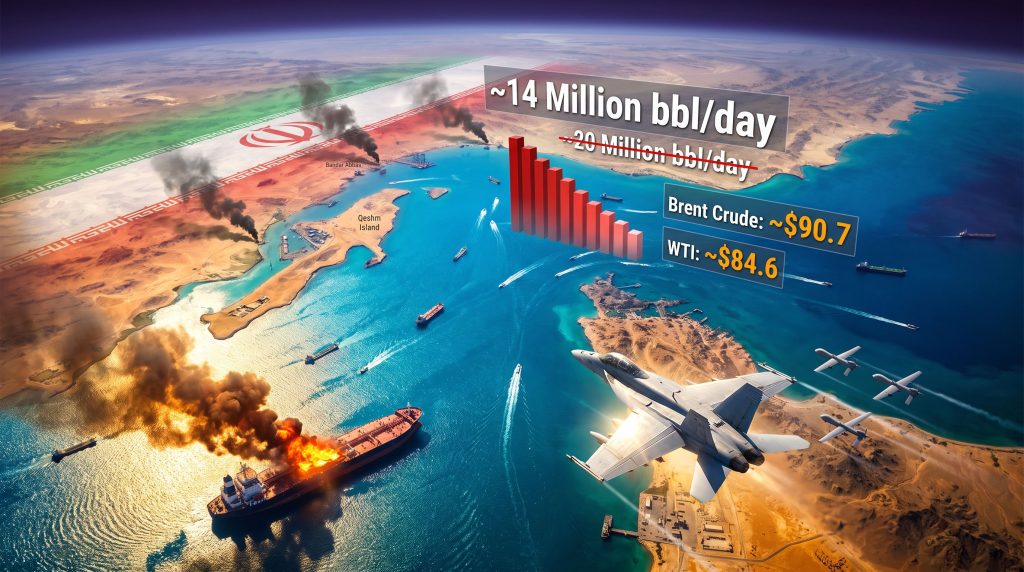
| Brent Crude Futures | +approximately 3% | approximately $90.7 per barrel |
| U.S. WTI Futures | +approximately 2.5% | approximately $84.6 per barrel |
Brent crude breaching $90 per barrel signals that markets are now pricing a meaningful supply risk premium into oil. The psychological importance of this threshold should not be underestimated. Energy traders and institutional investors use the $90 level as a reference point for assessing whether sustained conflict disruption is becoming structural rather than episodic.
Throughput Data and the Official-Market Divergence
The most consequential data point in the current conflict is the divergence between official U.S. government estimates of Hormuz throughput and real-time maritime intelligence tracking.
U.S. Energy Secretary Chris Wright stated on July 19, 2026, that approximately two-thirds of pre-conflict traffic was still moving through the strait, equating to roughly 14 million barrels per day. Maritime intelligence data from tracking firm Kpler told a more alarming story: vessel passings fell to just eight on a single Thursday, compared to 15 the previous day, representing a 47% single-day decline in transiting vessels.
Throughput Snapshot: Before vs. During Conflict
- Pre-conflict Hormuz throughput: approximately 20 million barrels per day
- Current U.S. government estimate: approximately 14 million barrels per day
- Volume gap: approximately 6 million barrels per day (a 30% reduction)
The methodological gap between vessel-count tracking and volumetric throughput estimates matters because it creates uncertainty that itself amplifies market volatility. If maritime intelligence trajectory data is more predictive of future throughput than official statements, markets may be significantly underpricing the supply risk embedded in continued escalation. This dynamic, moreover, contributes to the wider oil market disruption already reshaping global trade flows.
The 20% Transit Fee Proposal: An Unprecedented Monetisation of Military Power
President Trump's proposal to impose a 20% transit fee on vessels seeking U.S. military escort through the strait introduces a dimension to this conflict with no modern precedent. If implemented, the fee would effectively transform American naval power into a toll-collection mechanism in international waters.
The landed cost implications for importing nations would be substantial. A 20% transit surcharge on top of already-elevated crude prices would disproportionately affect Asian economies, which collectively represent the largest share of Gulf crude importation. Nations without deep strategic petroleum reserve capacity would face the most acute near-term exposure.
Human Cost and Strategic Pressure Points
Casualties on Both Sides
The human toll of the conflict is climbing with no deceleration visible. As of July 19, 2026, the following casualty figures had been confirmed:
- 17 U.S. military personnel killed since the conflict began in late February 2026
- A third American service member was confirmed killed over the weekend of July 19-20, 2026
- Unidentified remains were recovered in Jordan following a missing-in-action listing for one service member
- Iranian Health Ministry figures recorded at least 50 people killed and more than 500 wounded in U.S. strikes since July 6, 2026 alone
- At least 14 deaths resulted from the U.S. strike on the Bushehr nuclear facility perimeter
The mounting U.S. casualty count carries particular political weight domestically. Every American service member killed adds pressure on the administration to either demonstrate decisive military progress or develop an exit pathway.
The next major ASX story will hit our subscribers first
What a Continued Throughput Decline Could Mean for Global Energy
Scenario Analysis: If the 30% Reduction Deepens
The current estimated 30% reduction in Hormuz throughput has produced a 3% rise in Brent crude prices. The non-linear relationship between throughput loss and price response means that further declines could generate disproportionately larger price movements. Consequently, analysts tracking global market risks have begun revising their worst-case scenarios upward.
If maritime intelligence trajectory data reflects a path toward 50% throughput reduction, Brent crude could test price levels not seen since the post-COVID supply shock period. In that scenario:
- Asian importers without sufficient strategic reserve depth would face the most acute immediate exposure
- The International Energy Agency could be compelled to coordinate emergency reserve releases among member nations
- Shipping insurance costs for Gulf-origin cargo would escalate sharply, adding a secondary cost layer beyond crude prices themselves
- Nations with domestic refining capacity dependent on Gulf crude grades would face feedstock substitution challenges, as alternative crude grades carry different refining characteristics
The U.S. reinstatement of a blockade on Iranian shipping adds a secondary economic pressure layer on top of the strike campaign. This dual-track approach combines military degradation of Iran's capacity to threaten commercial vessels with economic degradation of Iran's export revenue. The combined effect on Iranian state finances could prove more consequential than either instrument applied in isolation.
Furthermore, in an environment of such acute physical supply risk, gold as a safe haven has once again attracted institutional attention as investors seek to hedge against escalating uncertainty.
Frequently Asked Questions
What triggered the ninth consecutive night of U.S. strikes on Iran?
The immediate trigger was an Iranian attack on a commercial container ship in the Strait of Hormuz, which set the vessel ablaze and left crew members missing. This followed the broader conflict that began February 28, 2026.
How much oil is still moving through the Strait of Hormuz?
U.S. Energy Secretary Chris Wright stated on July 19, 2026, that approximately 14 million barrels per day were still transiting the strait, representing roughly two-thirds of the pre-conflict baseline of 20 million barrels per day.
Which countries has Iran retaliated against?
Iranian retaliatory strikes have targeted military and civilian infrastructure in Kuwait, Bahrain, Saudi Arabia, Jordan, Oman, and Qatar, including water desalination facilities in Kuwait.
Has a nuclear facility been struck during the conflict?
Yes. U.S. strikes hit the perimeter of Iran's Bushehr nuclear power plant, marking the first nuclear-adjacent strike of the 2026 campaign and resulting in at least 14 confirmed fatalities.
What is the current oil price impact?
Brent crude futures rose approximately 3% to around $90.7 per barrel, while WTI futures climbed approximately 2.5% to $84.6 per barrel following the latest escalation involving U.S. strikes on Iran in the Strait of Hormuz.
Disclaimer: This article contains forward-looking analysis and scenario projections based on publicly available information as of July 19-20, 2026. Energy price forecasts and throughput scenarios are speculative and subject to rapid change. Nothing in this article constitutes financial or investment advice. Readers should consult qualified financial advisors before making investment decisions based on geopolitical developments.
Want to Track the Commodity Opportunities Emerging From Global Energy Disruption?
As Hormuz throughput declines and Brent crude tests $90 per barrel, commodity markets are repricing risk across the board — and Discovery Alert's proprietary Discovery IQ model delivers real-time alerts on significant ASX mineral discoveries the moment they hit the market, cutting through the noise to surface actionable opportunities in gold, energy-adjacent commodities, and beyond. Explore historic examples of how major mineral discoveries have generated extraordinary returns, then begin your 14-day free trial at Discovery Alert to position yourself ahead of the market during one of the most volatile commodity environments in recent memory.