July 19, 2026
When Geography Becomes Destiny: The Persian Gulf's Irreplaceable Role in Global Energy
Few geographic features carry as much economic consequence as a narrow strip of water measuring roughly 33 kilometres at its most constricted point. The Strait of Hormuz has functioned for decades as the circulatory system of global crude supply, and when military conflict threatens that corridor, the reverberations reach fuel pumps, factory floors, and financial markets across every continent. The current situation surrounding oil prices and U.S.-Iran strikes in the Middle East is not simply a regional security story. It is a stress test of the most concentrated vulnerability in the architecture of global energy supply.
When big ASX news breaks, our subscribers know first
Why the Strait of Hormuz Remains Irreplaceable in Global Crude Logistics
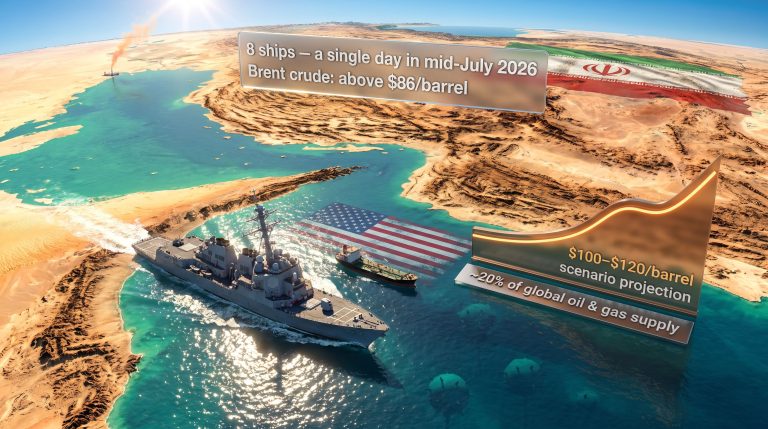
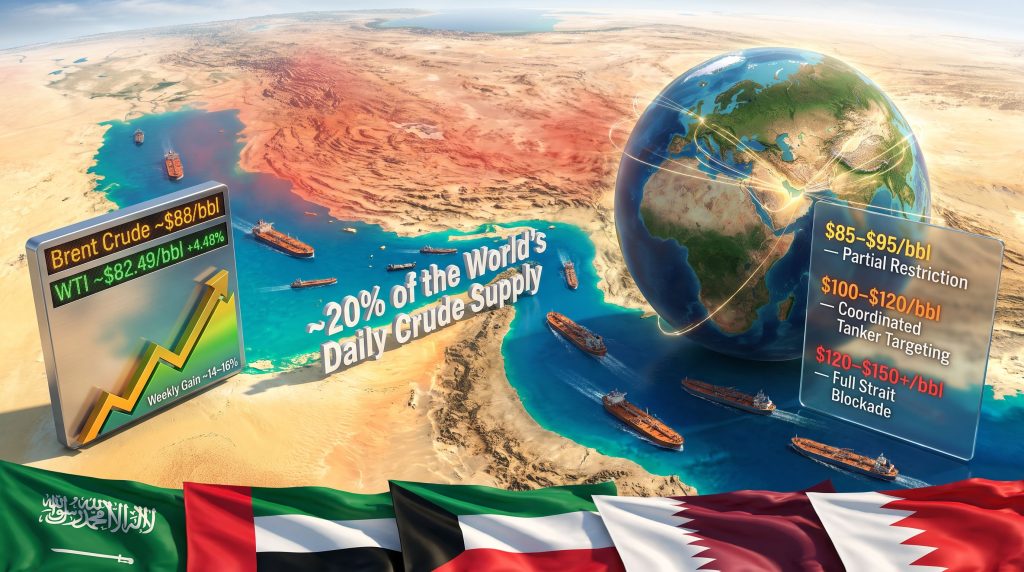
Understanding the price reaction playing out in crude markets requires a clear grasp of what the Strait of Hormuz actually represents in volumetric terms. Approximately 20% of the world's daily crude oil supply moves through this maritime passage, making it the single highest-throughput chokepoint in existence. No alternative routing can absorb that volume at comparable cost or speed.
The Gulf Cooperation Council nations sitting behind this chokepoint, including Saudi Arabia, the UAE, Kuwait, Qatar, and Bahrain, collectively represent a commanding share of OPEC market influence. Their export infrastructure, built over decades of capital-intensive development, includes not only oil terminals and refining complexes but also desalination plants and power generation systems that sustain both industrial output and civilian populations.
This layered infrastructure dependency is a critical point that many commodity market observers underweight. Disrupting a tanker transit route creates a logistics problem. Damaging a desalination facility or a power grid, however, creates a production problem — one that compounds over weeks rather than resolving within hours.
"When geopolitical risk concentrates around a single maritime corridor handling one-fifth of global oil supply, commodity markets reprice rapidly, often before any confirmed physical disruption has occurred. The probability of disruption alone is sufficient to move benchmarks."
The Mechanics of a Conflict-Driven Oil Price Rally
Commodity markets do not wait for confirmed supply losses before repricing risk. The current movement in crude benchmarks reflects a well-understood mechanism in energy economics: the geopolitical risk premium. When the probability distribution of supply outcomes shifts toward disruption, futures markets immediately embed that probability into spot and forward prices. Furthermore, the role of crude oil geopolitics in shaping these price dynamics cannot be overstated.
The numbers recorded in the most recent trading sessions are significant by any historical measure:
| Benchmark | Price Level | Movement |
|---|---|---|
| Brent Crude | ~$88/bbl | Largest weekly gain since April |
| WTI Crude | ~$82.49/bbl | +4.48% single-day increase |
| Weekly Price Gain | ~14-16% | Strongest advance since conflict onset |
A 14-16% weekly gain in crude prices is not routine volatility. It represents a structural repricing of supply risk, driven by the intersection of three simultaneous pressures: active military strikes on regional infrastructure, naval interference with Strait of Hormuz transit, and the collapse of a ceasefire framework that had temporarily anchored market expectations.
Three Mechanisms Driving the Current Price Surge
The price dynamic at work involves distinct but reinforcing forces:
-
Transit risk premium: Iran's Islamic Revolutionary Guard Corps Navy has actively stopped vessels attempting to transit the Strait of Hormuz without authorisation, reducing tanker throughput and pushing maritime insurance premiums sharply higher.
-
Infrastructure damage uncertainty: Attacks on Kuwaiti oil facilities, power infrastructure, and desalination plants over three consecutive days signal a deliberate strategy of targeting civilian energy systems, introducing production-side risk that extends well beyond transit disruption alone.
-
Ceasefire collapse repricing: Tehran's formal rejection of the interim ceasefire terms, which had provided a de-escalation anchor for markets, forces participants to price for a prolonged rather than near-term-resolved conflict.
UBS commodity analyst Giovanni Staunovo noted that "the oil market is tightening again, with repeated strikes on vessels transiting the Strait of Hormuz resulting in a measurable decline in tanker departures from the Gulf, and that energy infrastructure attacks are likely to sustain concern among market participants." (Source: World Oil, July 2026)
Conflict Timeline: How the Escalation Cycle Has Evolved
The current hostilities did not emerge without precedent. The formal conflict began on February 28, 2026, and had already produced significant displacement across regional energy and humanitarian systems before the most recent escalation wave. In addition, oil prices and trade war dynamics have compounded the existing pressure on global energy markets throughout this period.
The sequence of events driving the current price surge includes:
- An Iranian strike in Jordan killed two U.S. service members and wounded four others, triggering the most recent round of American military responses.
- U.S. forces have conducted strikes on more than 170 Iranian military targets across the conflict period, targeting air defence systems, drone and missile storage facilities, and naval assets.
- Specific U.S. strike locations have included Qeshm Island in the Persian Gulf and multiple sites across southern Iran.
- Iran has expanded its retaliatory posture to include attacks on Gulf allies, with Kuwait sustaining infrastructure damage, Bahrain intercepting aerial attack waves, and Jordan intercepting missiles near the Red Sea port city of Aqaba.
The geographic expansion of Iranian retaliatory strikes is arguably the most significant strategic development for energy markets. Attacks concentrated on Iranian territory create one risk profile. Attacks spreading across Kuwait, Bahrain, Jordan, and the approaches to Saudi and UAE energy hubs create an exponentially larger risk surface.
Regional Energy Security: How Gulf States Are Responding
The responses of individual Gulf states reveal differentiated exposure levels that matter for understanding which supply streams face the greatest near-term vulnerability.
Saudi Arabia and the UAE
Both nations issued precautionary security alerts around major energy export infrastructure before later confirming the immediate threat had passed. Saudi Arabia's position as the world's largest crude exporter makes its production and export systems the single most consequential potential target in any further escalation scenario. The UAE's dual role as a major crude and LNG export hub adds a second layer of strategic exposure.
Kuwait and Bahrain
Kuwait sustained confirmed infrastructure damage at an oil facility, prompting evacuations and raising questions about near-term production continuity. The deliberate targeting of Kuwaiti desalination and power infrastructure over three consecutive days represents a particularly acute operational threat, as water production and oil processing are deeply interdependent in Gulf industrial systems.
Qatar's LNG Dimension
Qatar's status as the world's largest LNG exporter introduces a secondary market risk that extends beyond crude oil benchmarks. Consequently, any escalation affecting Qatari export terminals would send significant shockwaves through European and Asian gas markets, which have increasingly relied on Qatari supply following the restructuring of global LNG trade patterns since 2022.
Strait of Hormuz Scenarios: Mapping the Price Pathways
Markets are not pricing a single outcome. They are probability-weighting a range of scenarios, each with materially different implications for crude benchmarks.
| Scenario | Description | Indicative Price Range |
|---|---|---|
| Partial Restriction (Current) | Selective vessel halting, rising insurance premiums, voluntary operator suspensions | $85-$95/bbl |
| Coordinated Tanker Targeting | Systematic attacks force major throughput reduction, triggering IEA strategic reserve releases | $100-$120/bbl |
| Full Strait Closure | Complete interruption of Hormuz transit removing ~20% of global daily supply | Severe dislocation; SPR buffer limited |
A critical piece of context often absent from mainstream coverage is the absence of viable large-volume alternative routing for Gulf crude. Rerouting around the Cape of Good Hope adds substantial transit time and cost but cannot physically absorb the full volume of Hormuz-dependent flows. This geographical constraint is what makes even a partial restriction so consequential for global price formation.
Historical precedent offers sobering reference points. The 1973 oil embargo demonstrated how supply concentration risk translates into economic damage far exceeding the direct volume loss. The 1980s Tanker War showed that sustained maritime conflict can dramatically alter insurance markets, shipping behaviour, and long-term infrastructure investment patterns, even when physical supply losses remain relatively contained. For further context, recent reporting from the New York Times outlines how the current situation compares to these historical episodes.
The next major ASX story will hit our subscribers first
Sanctions, Strategic Deterrence, and Iran's Hormuz Doctrine
One dimension of the current crisis that deserves closer analytical attention is Iran's long-standing strategic positioning of the Strait of Hormuz as its primary asymmetric leverage instrument. Tehran's declaration that oil, gas, and petrochemical exports would not transit the strait without Iranian coordination is not an improvised threat. It is the activation of a deterrence doctrine developed over decades.
This posture creates a dual-pressure dynamic on global supply. Tightened U.S. sanctions independently remove Iranian crude barrels from global supply, tightening the supply-demand balance. Simultaneously, Iran's Hormuz leverage threatens the transit of other nations' barrels. These are additive rather than substitutable pressures, and markets have only recently begun pricing both simultaneously.
Tehran's formal rejection of the interim ceasefire terms, following renewed U.S. strikes and the tightening of sanctions on Iranian oil exports, has materially narrowed the near-term diplomatic resolution pathway. Without a credible de-escalation mechanism, institutional energy market participants must model for a prolonged conflict duration rather than a near-term settlement.
Long-Term Structural Consequences for Global Energy Markets
Beyond the immediate price dynamics, a sustained conflict cycle involving oil prices and U.S.-Iran strikes in the Middle East carries structural implications that will reshape energy market architecture over multi-year timeframes.
Permanent repricing of Middle East risk premiums: Insurance markets, shipping operators, and energy traders are building higher baseline risk costs into operational models. This structural repricing persists even after active hostilities reduce in intensity, as the demonstrated vulnerability of Gulf infrastructure recalibrates long-term risk assessments.
Accelerated supply diversification investment: Prolonged Gulf instability strengthens the commercial case for developing non-Gulf crude supply streams, including North American shale, West African offshore, and Brazilian deepwater production. LNG import terminal investment is also likely to accelerate among Asian economies seeking to reduce dependence on Gulf-routed supply chains.
The OPEC production response variable: If Gulf disruptions reduce effective OPEC output, non-OPEC producers face significant commercial incentive to accelerate production. Revised OPEC demand forecasts will be closely watched as analysts attempt to gauge how the cartel balances spare capacity management against a volatile demand outlook. U.S. shale operators, with their relatively short well-to-production timelines, are positioned to respond more rapidly than conventional producers. However, if the conflict damages Saudi infrastructure directly, the world's largest producer's spare capacity buffer is removed entirely, creating a supply-demand imbalance that no short-term intervention can resolve.
Disclaimer: Price scenario ranges and conflict outcome projections discussed in this article represent analytical frameworks based on publicly available market data and historical precedents. They do not constitute financial advice. Commodity markets involve significant uncertainty, and actual price outcomes may differ materially from any scenario analysis.
Frequently Asked Questions
Why are oil prices rising due to U.S.-Iran military strikes?
Military exchanges between the U.S. and Iran create direct threat risk to the Strait of Hormuz, through which approximately 20% of global daily crude supply transits. Commodity markets price in the probability of supply disruption immediately upon escalation, driving benchmark prices higher even before confirmed physical supply losses occur. The oil price rally observed earlier this year demonstrated a similar mechanism, where anticipated supply constraints moved markets ahead of any confirmed disruption.
How significant has the oil price increase been?
Brent crude rose to approximately $88/bbl, while WTI traded near $82.49/bbl, representing a 4.48% single-day gain. The weekly price advance of approximately 14-16% ranks among the sharpest short-term rallies recorded since the conflict formally began in February 2026. CNBC's coverage of the WTI and Brent surge provides additional market context on these movements.
Which economies face the greatest exposure?
Import-dependent economies in Asia and Europe carry the heaviest near-term burden from elevated crude benchmarks, as higher input costs flow through to refined product prices, manufacturing margins, and transport costs. Gulf states including Kuwait, Bahrain, Saudi Arabia, and the UAE face direct infrastructure risk from the conflict itself.
Could prices reach $100/bbl or higher?
Under a scenario involving coordinated tanker targeting or a sustained naval blockade of the Strait of Hormuz, analytical price modelling suggests Brent crude could approach the $100-$120/bbl range, depending on disruption duration and severity. This remains a scenario projection, not a forecast. The dynamics surrounding oil prices and U.S.-Iran strikes in the Middle East will ultimately determine whether markets move toward or away from these elevated levels in the weeks ahead.
For ongoing coverage of upstream energy developments and Middle East market dynamics, World Oil (worldoil.com) provides industry reporting across global oil and gas markets.
Want to Stay Ahead of the Next Major Commodity Discovery?
While geopolitical shocks reshape global energy markets, Discovery Alert's proprietary Discovery IQ model delivers real-time alerts on significant ASX mineral discoveries — instantly translating complex commodity data into actionable investment insights for traders and long-term investors alike. Explore Discovery Alert's dedicated discoveries page to understand how historic mineral discoveries have generated exceptional returns, and begin your 14-day free trial to position yourself ahead of the market.