July 19, 2026
The Financialisation of a Base Metal: How LME Lead Stocks in Singapore Became a Warehouse Arbitrage Machine
Commodity markets have always had two faces: the physical world of smelters, shipments, and industrial consumption, and the financial world of contracts, spreads, and storage economics. For most of modern history, lead occupied an unglamorous corner of the base metals complex, its fortunes tied almost entirely to lead-acid battery production. Yet something structurally unusual has been unfolding in Singapore's warehousing network that cuts to the heart of how modern commodity markets actually function, and why visible inventory data can sometimes tell you very little about real-world supply and demand. The rise of LME lead stocks in Singapore is a case study in how financing mechanics can reshape a physical commodity market beyond recognition.
When big ASX news breaks, our subscribers know first
Understanding What LME Lead Stocks in Singapore Actually Represent
Before interpreting the staggering numbers now associated with LME lead stocks in Singapore, a foundational distinction is essential. LME "stocks" in this context refer exclusively to physical metric tons of refined lead metal held in exchange-approved warehouse facilities. They bear no relationship to equity instruments, company shares, or any financial security traded on the Singapore Exchange (SGX) or elsewhere.
Within that physical inventory framework, two categories exist:
- On-warrant stocks are metal formally registered on the LME system, visible to the market, and tradeable through LME contracts.
- Off-warrant stocks sit in LME-approved warehouses but are not formally registered, making them invisible to standard exchange reporting yet still part of the broader warehousing ecosystem.
Both categories matter for understanding price dynamics, because off-warrant metal represents a latent source of additional on-warrant supply that can materialise rapidly when the economics of warranting become attractive. Furthermore, the interplay between these two categories is central to understanding why base metal pricing disruptions have become increasingly difficult to interpret using traditional inventory signals.
Singapore currently holds approximately 98% of all on-warrant LME lead and around 95% of off-warrant LME lead globally. This concentration in a single city-state that manufactures virtually no lead-acid batteries is not a quirk of geography. It is the deliberate outcome of warehousing economics, logistical infrastructure, and a financing trade structure that has migrated away from the aluminium market and taken up residence in lead.
The 58% Inventory Surge: Mechanics of a Two-Day Warranting Event
| Metric | Value |
|---|---|
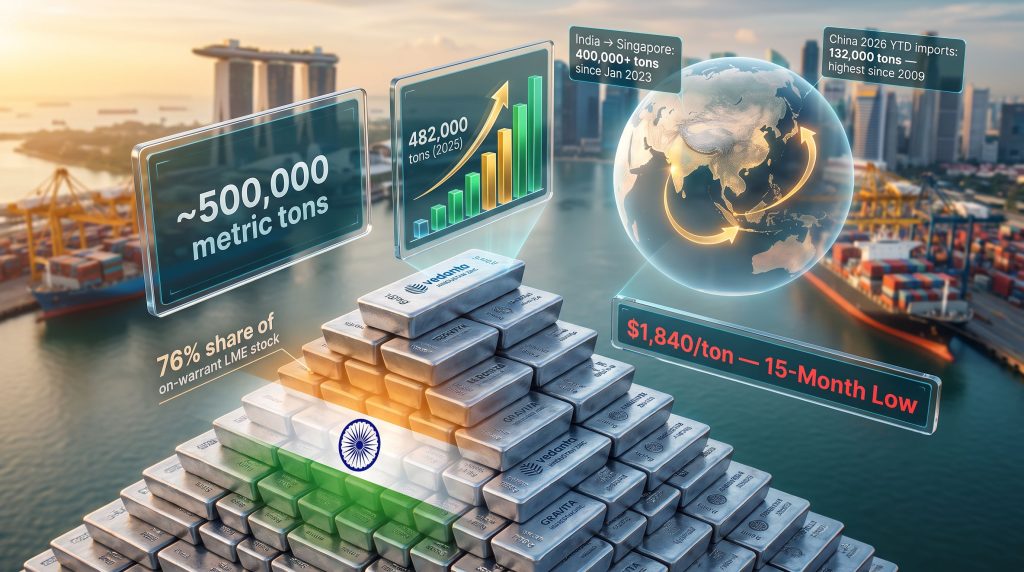
| Total LME Lead Stocks (mid-2026) | ~500,000 metric tons |
| Singapore's Share (on-warrant) | ~98% |
| Singapore's Share (off-warrant) | ~95% |
| Two-Day Inventory Jump | 171,175 tons (+58%) |
| Indian Brand Share of On-Warrant Stock | 76% |
| LME 3-Month Lead Price (post-surge) | $1,840/ton (15-month low) |
| Peak Monthly Indian Shipments to Singapore | ~31,000 tons (November 2025) |
| Total Indian Shipments to Singapore (since Jan 2023) | 400,000+ tons |
In mid-2026, LME lead stocks in Singapore jumped by 171,175 metric tons across just two trading days, representing a 58% single-event increase in visible inventory. Understanding how this is physically possible requires stepping through the warranting process.
Step-by-Step: How 171,175 Tons Appeared on LME Records Overnight
- Metal Placement: A major commodity trading firm delivers physical lead refined to LME specification into an approved Singapore warehouse and formally registers it on warrant, creating a new LME inventory record.
- Fee-Sharing Negotiation: The delivering trader negotiates a rental-split arrangement with the warehouse operator, effectively monetising the storage relationship by sharing future holding fees paid by whoever purchases the warranted metal.
- Ownership Transfer: The warranted metal is sold. The incoming owner, now responsible for paying storage fees under the existing arrangement, evaluates whether retaining the warrant makes commercial sense.
- Warrant Cancellation: The new owner cancels the warrant, removing the metal from on-warrant records and transferring it to off-warrant status, typically moving it to a competing warehouse offering more favourable terms.
- Off-Warrant-to-On-Warrant Transfer: In Monday's first tranche of 83,225 tons, approximately 34,256 tons represented metal shifting directly from existing off-warrant holdings in Singapore into on-warrant status, rather than arriving from external sources. This is a critical distinction.
- Cycle Repeats: The cycle restarts when the same metal is warranted again by a new participant seeking to replicate the fee-sharing economics.
After the first day's transfer, Singapore's off-warrant pool still held an estimated 142,598 tons of potentially warrantable metal, signalling that the episodic inventory surge was far from exhausted.
The critical insight here is that large warranting events do not necessarily indicate fresh physical supply entering the market. Much of what appears as a dramatic inventory spike can simply be metal rotating between accounting categories within the same warehousing complex.
From Aluminium to Lead: The Migration of the Financing Trade
Experienced LME market participants will recognise the warehousing arbitrage dynamic at play in Singapore's lead market. It is structurally identical to what once defined the LME aluminium complex, where inventory-churning between warehouses became a dominant market feature during periods of high aluminium stock accumulation. In addition, LME trading volumes across base metals have reflected this structural shift, with lead contracts attracting growing financial participation.
Aluminium's role as the preferred financing metal has diminished as its LME inventory base, including off-warrant stocks, has contracted to under 400,000 metric tons. That decline in available metal reduced the scale of the arbitrage opportunity, and trading capital migrated toward a metal where the conditions remained favourable.
Lead has filled that vacancy for several interconnected reasons:
- LME lead contracts have benefited from improved liquidity following the exchange's deliberate fee reduction initiative.
- Singapore's warehousing infrastructure, including facilities acquired by Trafigura from Grafton Logistics Services, provides direct operational control over the warranting cycle.
- The predictable cost structure of lead storage and LME contract mechanics creates reproducible arbitrage conditions.
- A rapidly expanding pool of Indian-origin lead, registered under LME good-delivery brands, has provided the raw material volume necessary to sustain the trade at scale.
What this means for price interpretation is significant. When metal accumulates in LME warehouses without a corresponding industrial offtake driver, the inventory signal reflects financing activity rather than a supply glut in any conventional sense. The metal is present, but it is functioning as a financial instrument generating returns through storage fee economics rather than responding to end-user demand shifts.
India's Transformation: From Zero to 76% of LME On-Warrant Lead
The raw material underpinning the Singapore warehousing trade has a clear geographic origin. India's refined lead export industry has undergone a transformation of exceptional speed.
| Year | Indian Refined Lead Exports |
|---|---|
| 2022 | 151,000 metric tons |
| 2025 | 482,000 metric tons |
| Growth | +219% in three years |
As recently as January 2023, there was no Indian-branded lead registered in LME on-warrant stocks. By June 2026, however, Indian brands represented 76% of all on-warrant LME lead inventory globally.
How Indian Producers Gained Access to the LME System
LME good-delivery brand registration is the gateway through which a producer's metal becomes tradeable on the exchange. The registration process requires meeting strict quality specifications and undergoing formal LME approval, a process that historically presented a barrier for smaller secondary smelters. You can find further detail on the LME's non-ferrous metals framework on the exchange's official website.
The progression of Indian brand registrations illustrates how the landscape has shifted:
- Pre-2025: Three registered Indian brands existed: two belonging to Hindustan Zinc, one of the world's largest integrated zinc-lead producers, and one from Jain Resource Recycling, a secondary smelter processing recycled material.
- 2025: Five additional Indian brands gained LME registration, representing combined annual production capacity of 195,000 metric tons. This expansion was directly linked to the LME's fee reduction programme targeting smaller producers.
- 2026: Gravita India became the ninth Indian lead brand to achieve LME good-delivery status, adding annual production capacity of 48,000 metric tons to the pool of LME-eligible Indian metal.
The distinction between primary and secondary production matters here. Hindustan Zinc operates as a conventional mining and refining business extracting ore and processing it into refined metal. The secondary producers gaining LME status process recycled lead-acid batteries and scrap metal, reflecting a structural shift in how India's metals refining industry is positioning itself within global commodity markets.
China's Sudden Appetite for Indian Lead: A Structural Disruptor
The assumption that Indian export volumes will continue flowing predominantly into Singapore LME warehouses faces a significant challenge from an unexpected direction. China's appetite for refined lead from India has shifted from negligible to substantial within a matter of months. Consequently, this redirection of flows is introducing new complexity into how commodity market volatility is assessed across the base metals complex.
| Period | Chinese Refined Lead Imports from India |
|---|---|
| Full Year 2024 | ~500 metric tons |
| January to May 2026 | 57,000 metric tons |
| Total 2026 Chinese refined lead imports | 132,000 metric tons (highest since 2009) |
| April 2026: India to Singapore | 1,555 metric tons (12-month low) |
| April 2026: India to China | 8,685 metric tons (34% of total Indian exports) |
The reasons behind China's accelerated lead import demand remain analytically uncertain. Several plausible scenarios exist:
| Scenario | Plausible Driver | Assessment |
|---|---|---|
| Domestic production shortfall | Environmental enforcement actions targeting Chinese secondary lead smelters | Medium probability |
| Battery sector demand growth | Expansion of energy storage and automotive lead-acid applications | Medium-High probability |
| Strategic stockpiling | State-directed accumulation ahead of anticipated price recovery | Low-Medium probability |
| Arbitrage opportunity | Traders exploiting price differentials between LME and domestic Chinese markets | Medium probability |
What is clear from the data is the directional consequence: every ton of Indian refined lead that flows to China is a ton that does not enter an LME warehouse in Singapore. If Chinese demand remains elevated, it acts as a structural drain on the metal available to sustain the Singapore warehousing financing trade.
The next major ASX story will hit our subscribers first
What the Inventory Surge Means for LME Lead Prices
The relationship between visible LME inventory and spot prices operates through well-established mechanisms. A large warranting event increases the market's perceived supply availability, typically widening the contango structure where near-term prices trade at a discount to forward prices, and applying downward pressure on spot values.
The July 2026 warranting event contributed directly to LME three-month lead prices falling to $1,840 per ton, a 15-month low. The scale of the move reflects not just the volume of metal warranted but also the market's inference that large additional quantities remained potentially warrantable from Singapore's off-warrant pool. Reuters analysis of the lead stockpile surge and price dynamics provides further context on how inventory churn has masked underlying market conditions.
However, warrant cancellations create a counterintuitive dynamic. When a new owner cancels warrants en masse to escape the fee-sharing arrangement, it removes metal from visible on-warrant statistics, which can appear to signal tightening conditions even when the physical metal has simply moved to off-warrant storage in the same city. This creates periodic false signals for traders relying on LME stock data as a fundamental demand indicator.
Variables Required for a Sustained Price Recovery
- China maintaining elevated demand for Indian refined lead, diverting metal away from Singapore warehouses and reducing the on-warrant pool.
- A rise in Singapore warehouse storage costs or a compression of rental-split economics that reduces the financial attractiveness of the warranting cycle.
- Acceleration in genuine industrial lead-acid battery demand, particularly from grid-scale energy storage deployment or automotive sectors, absorbing inventory organically.
- LME policy adjustments to warrant fees or storage parameters that alter the structural economics of the financing trade now that the April 2024 to December 2025 fee reduction initiative has concluded.
The Broader Lesson: When Inventory Data Misleads
The concentration of approximately 500,000 metric tons of lead in a single city-state with negligible domestic lead consumption is a striking illustration of how financialisation has reshaped base metals markets. Singapore does not need lead. Its warehouses hold lead because the economics of the warranting cycle, fee-sharing arrangements, and rental arbitrage make it commercially rational to accumulate metal there regardless of local industrial demand.
This creates a genuine analytical challenge for commodity trading giants and smaller participants alike. LME inventory data, long used by traders and analysts as a proxy for physical market tightness or surplus, carries a diminished signal value when the majority of registered inventory is driven by financing mechanics rather than industrial need. The same dynamic previously distorted aluminium price signals during periods of peak warehouse stock accumulation.
The LME's fee reduction initiative between April 2024 and December 2025 successfully attracted new Indian producers and stimulated contract liquidity as intended. Yet the policy outcome also contributed to a price-suppressive inventory overhang that pushed lead to multi-year lows. Understanding how commodity price impacts flow through to producer profitability requires precisely this kind of structural analysis rather than a surface reading of inventory statistics alone.
Investors and analysts monitoring LME lead stocks in Singapore should apply a dual-lens framework: assessing both the raw inventory numbers and the underlying mechanics driving them, recognising that rising stocks can reflect financial engineering as readily as genuine supply surplus.
This article contains analysis of market dynamics and forward-looking scenarios. Commodity prices, trade flows, and warehouse inventory levels are subject to rapid change. Nothing in this article constitutes financial or investment advice. Readers should conduct independent research before making any investment decisions.
Want To Know When The Next Major Mineral Discovery Hits The ASX?
Discovery Alert's proprietary Discovery IQ model scans ASX announcements in real time, instantly identifying high-potential mineral discoveries and translating complex data into clear, actionable opportunities — explore historic discoveries and their remarkable returns, then begin your 14-day free trial to position yourself ahead of the broader market.