June 15, 2026
Scenario Analysis: Disruption Pathways in European Energy Markets
Investor attention often focuses on headline oil futures and global energy trends, but the true test of system resilience emerges when geopolitical flashpoints threaten the underlying arteries of global energy trade. One of the most sensitive chokepoints—both physically and financially—is the Strait of Hormuz. Understanding its influence on the europe middle distillates rally as hormuz risks rise demands a holistic perspective, integrating import dependencies, logistical vulnerabilities, market psychology, and tactical response frameworks.
When big ASX news breaks, our subscribers know first
Europe's Middle Distillate Exposure: Anatomy of a Structural Weakness
Annual European Refined Product Import Flows:
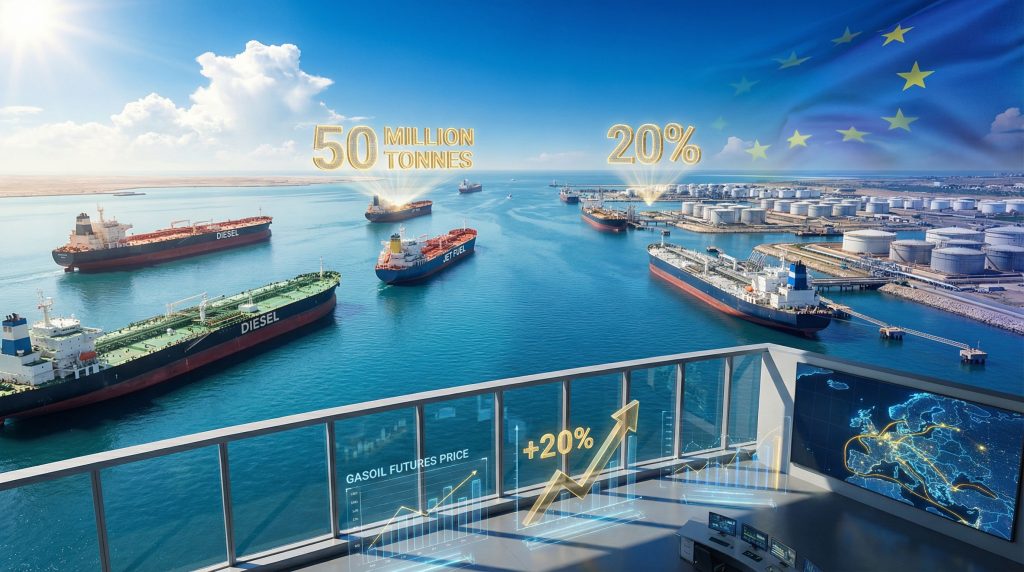
- Diesel and gasoil imports (EU & UK, 2025): Over 50 million tonnes
- Proportion transiting the Strait of Hormuz: ~20% (approx. 10 million tonnes)
- Jet fuel: 25+ million tonnes annually, with more than half sourced from Gulf producers via Hormuz
- Middle East Gulf jet/kerosine exports: 18.83 million tonnes (22.7% of global), with 54.3% delivered to EU/UK
- Middle East Gulf diesel/gasoil exports: 52.96 million tonnes (12.8% of global), with 20.9% to EU/UK
Chokepoint Scale:
The Strait of Hormuz accounts for 21% of global petroleum trade (U.S. EIA, 2024). Furthermore, about one-third of global seaborne crude and products pass through this corridor.
Structural Factors Underpinning Vulnerability:
- Refining Configurations: European plants are optimised for processing Gulf and North Sea light crudes; pivoting to heavy or alternative grades requires 3-6 months for technical reconfiguration.
- Product Specifications: Middle East Gulf diesel naturally meets stringent EU sulphur and cetane standards, making substitution during supply stress costly or infeasible.
- Storage Cycles: Most commercial and strategic storage covers only 30-45 days of demand, offering modest buffers during multi-week disruption scenarios.
Case in Point: March 2026 German Market Response
Despite no immediate interruption, wholesale suppliers raised middle distillate and petrol offers by up to €16 per 100 litres within a single morning. This illustrates the region's acute sensitivity to emerging risks and demonstrates how oil price movements amid trade wars can trigger rapid market reactions.
Market insight underscores that Europe's exposure is not just about imported volume—but about the nature and flexibility of its supply infrastructure. Most alternatives require time-consuming technical adjustments and carry elevated compliance or blending premiums.
Volatility Mechanisms: How Geopolitical Shocks Cascade Through Markets
When military tension or direct conflict emerges, the europe middle distillates rally as hormuz risks rise is swift—and often magnified by layered market mechanisms. However, these reactions must be understood within the broader context of trade war impact on oil markets which has already heightened market sensitivity.
Immediate Futures and Physical Market Ripples
| Category | March 2, 2026-Data | % Change / Comparison |
|---|---|---|
| ICE Gasoil Front Month | $922.50/t (Intraday) | +$169.75/t (+23%) |
| Gasoil to Brent Spread | $43.67/bbl | +$15.25/bbl |
| Jet to Gasoil Premium | $112.50/t (OTC) | >+50% |
| Jet to Brent Premium | $49.40/bbl (midday) | +$16.80/bbl |
| Gasoil Fund Longs | 13-week high | |
| Gasoil Net Longs | 14-week high |
Volatility Amplifiers:
- Physical settlement obligations tie ICE Gasoil futures directly to terminal delivery, entangling financial price spikes with physical market offers.
- Strategic inventory builds and just-in-time procurement practices push buyers to scramble for barrels, removing market slack.
- Speculative flows from hedge funds and non-commercial investors surge—net long fund positions often jump 15-20% in a single week of conflict escalation.
- Insurance withdrawal and increased war-risk cover premiums drive up freight rates by 10-20%, distorting delivered product costs well before any supply is physically halted.
Options Market Stress:
Implied volatility on energy options typically doubles—e.g., 30-day at-the-money implied vol on gasoil options may jump from 25% to 50%. Consequently, put-call ratios skew sharply towards calls, indicating fear of continued upside and frantic hedging.
Forward curve structures steepen as longer-dated contracts price persistent risk, reflecting broader uncertainty across months, not just days. Analysis from Kpler emphasises how Hormuz tensions create specific risks for middle distillate supplies.
Physical supply may remain steady initially, but price signals move rapidly—as seen in March 2026, when German wholesale prices spiked overnight purely on shifting risk perceptions.
Supply Chain Bottlenecks: When Vulnerabilities Compound
Key Refinery Maintenance Constraints (Q1 2026):
- Gunvor Ingolstadt (Bavaria): 100,000 b/d offline
- Bayernoil Vohburg-Neustadt (Bavaria): 207,000 b/d offline (Neustadt section since Feb 14)
- Combined capacity offline: 307,000 b/d—precisely as Hormuz security deteriorated
Major Infrastructure and Route Shocks:
Maersk suspended transit via Bab el-Mandeb, diverting ships around the Cape of Good Hope—a detour adding 10-14 days and 7,000+ nautical miles to European voyages. In addition, no LNG carriers passed through the Strait of Hormuz since February 28, signalling wider energy system repercussions.
Saudi Aramco's Ras Tanura refinery (550,000 b/d) closed after drone and missile debris strikes, with state media reporting only "limited damage." Furthermore, three commercial tankers (including the Skylight, Mkd Vyom, and Sea La Donna) were damaged by projectiles, prompting most shipowners to avoid the strait entirely.
Physical Logistics Table
| Supply Chain Event | Capacity/Impact | Duration/Timing |
|---|---|---|
| Bavarian refineries offline | 307,000 b/d | Early March 2026 |
| Ras Tanura outage | 550,000 b/d | March 2, damage limited |
| Cape of Good Hope reroute | +10-14 days per voyage | Indefinite, March onset |
| LNG movements | 0 through Hormuz | From Feb 28, 2026 onward |
Principles & Lessons:
- Maintenance schedules, designed for efficiency, can exacerbate system fragility when coinciding with exogenous shocks.
- Shipping bottlenecks reverberate not just within oil, but across LNG, petrochemicals, and even power generation, as alternative supplies struggle to meet sudden shifts.
- Market psychology shifts from just-in-time procurement to preemptive hoarding, further draining available spot volumes.
End-User Market Cascades: Price Transmission, Sectoral Impacts, and Inventory Surges
How Are End-Users Hit?
Diesel and heating oil wholesales in Germany experienced €10-20 per 100 litres price hikes within a single trading day. Spikes in heating oil demand reflect consumer panic-buying, whilst the agricultural sector faces surging diesel costs right as spring planting begins.
Commercial buyers escalate forward purchases, pushing storage utilisation above 85%, straining terminal capacity. For instance, forward contract premiums widen sharply, reflecting expectations of persistent supply tightness.
Visual Summary Table
| Sector | Typical Response | Magnitude |
|---|---|---|
| Road Transport | Immediate pump price increases | +10-20 €/100L |
| Agriculture | Early inventory build, demand shifts | (esp. Q1/Q2) |
| Commercial | Storage rates >85%, procurement rush | Spot premiums surge |
Research from Argus Media highlights how these patterns create cascading effects throughout the supply chain.
End-users experience the volatility in both direct costs and supply risk, making timely risk management and procurement strategy critical.
Financial Market Dynamics: Amplification from the Trading Desk
Pattern Recognition:
Investment funds amplify price trends via outsized net long positions—recently reaching 13- and 14-week highs for gasoil. However, the patterns observed mirror those seen during previous periods of oil price rally under tariffs, suggesting similar underlying market mechanisms.
Non-commercial traders with no physical exposure often react to headline risk, creating more exaggerated moves than would be justified by barrels-at-risk alone. Furthermore, options traders price in wild swings; call option premiums rise dramatically as hedgers and speculators jockey for protection.
Risk Premium Breakdown Table
| Risk Trigger | Probable Price Spike | Estimated Duration |
|---|---|---|
| Hormuz closure | 15-25% | 1-4 weeks |
| Refinery outages | 5-15% additional | 2-8 weeks |
| Insurance withdrawal | 10-20% freight cost jump | 4-12 weeks |
While physical supply may appear secure, most market volatility is ultimately driven by trading behaviours, fund allocations, and sentiment-driven flows.
The next major ASX story will hit our subscribers first
Scenario Modelling: Probabilities for Disruption
What Are the Most Likely Scenarios?
The OPEC meeting production impact discussions have already set the stage for heightened market sensitivity to supply disruptions.
Strategic Planning Table
| Scenario | Probability | Disruption Features | Typical Duration | Price Impact |
|---|---|---|---|---|
| Limited Disruption | 40% | Shipping delays (3-7 days); partial loss | 2-4 weeks | +10-15% |
| Stress Case | 35% | Strait closed (2-6 weeks); reroutes | 2-8 weeks | +25-40% |
| Extreme Case | 25% | Multiple chokepoint closures; SPR draw | 4-12 weeks+ | >+50% |
Disclaimer: These scenarios are illustrative and rely on current market data; actual outcomes may differ significantly if additional variables such as wildcat supply entries or policy interventions occur.
Resilience Tactics: Building Robustness in Volatile Times
Physical Hedging:
- Increase forward commercial inventories to 45-60 days during high-risk windows
- Diversify contracts to include North American, North Sea, and West African suppliers
- Pre-arrange alternative logistics via Cape of Good Hope, understanding scheduling and cost impacts
Financial Hedging:
- Deploy options collar strategies to cap exposure to upside shocks
- Use refining margin (crack) spread strategies to protect against disproportionate product premium moves
- Secure geopolitical risk insurance for supply contracts in exposed regions
Supply Chain and Storage:
- Invest in terminal upgrades for flexible, high-throughput storage
- Build relationships with alternative shipowners not reliant on Hormuz or Suez
- Develop rapid contingency plans for switching between supply routes
Structural Shifts: The Future of European Energy Security
Policy Implications:
- Expansion of strategic petroleum reserves
- Mandates for lower-risk renewables and alternative fuels
- Support for local refining capacity to prevent deindustrialisation of energy processing
Market Evolution:
- Permanent elevation of regional premiums
- Steeper forward curves as built-in risk compensation
- Higher structural costs for robust risk management, now embedded into long-term energy contracts
Infrastructure Investments:
- Major investments in interregional pipelines and storage terminals
- Broader moves toward alternative marine fuels supply chains
- Enhanced integration of refined product and LNG markets for multi-fuel resilience
Conclusion: Tactical Agility and Structural Transformation
The interplay of European import dependency, chokepoint logistics, and market psychology ensures that europe middle distillates rally as hormuz risks rise, not just in times of direct disruption, but anytime the risk calculus shifts. Market participants—from refiners and industrial end-users to traders and investors—must employ both tactical agility (spot procurement, futures hedging) and strategic foresight (infrastructure, diversification) to weather future disruptions.
Consequently, by monitoring scenario probabilities, investing in resilience, and staying ahead of market sentiment swings, the complex web of Europe's refined product markets can better adapt to the ongoing reality of geopolitical flux along vital energy corridors. The europe middle distillates rally as hormuz risks rise represents not just a temporary market phenomenon, but a structural shift requiring fundamental reassessment of energy security strategies.
Disclaimer: All scenario forecasts, price movements, and investment recommendations in this article rely on public data and market research as of March 2026. Future events may materially alter the impact and duration of supply chain disruptions and price volatility.
Looking to Capitalise on Energy Market Volatility?
Discovery Alert's proprietary Discovery IQ model delivers real-time alerts on significant ASX mineral discoveries, including critical energy transition materials and resources that benefit from global supply chain disruptions. Begin your 14-day free trial today to position yourself ahead of the market during these volatile energy periods.