June 15, 2026
The World's Most Vulnerable Energy Corridor and What Happens When It Reopens
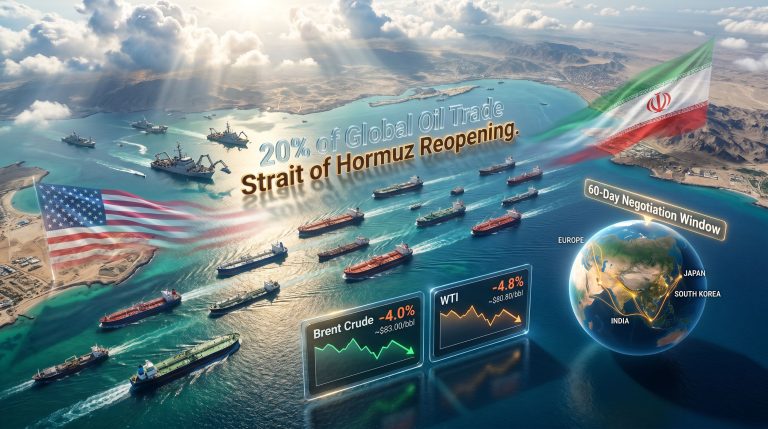
Few geographical features carry more economic weight than a narrow strip of water connecting the Persian Gulf to the Gulf of Oman. At its narrowest point, the Strait of Hormuz measures roughly 33 kilometres across, yet this slender passage functions as the circulatory system for a disproportionate share of the world's energy supply. Approximately 20% of all globally traded oil and a significant portion of liquefied natural gas exports transit this corridor every day under normal operating conditions, making it the single most consequential maritime chokepoint in existence.
When that corridor closes, the consequences radiate outward almost immediately, touching fuel import bills in New Delhi, spot gas prices on European trading hubs, and long-term contract delivery schedules in Tokyo and Seoul. Understanding what a Strait of Hormuz reopening deal actually means, and why the market reaction has been simultaneously enthusiastic and cautious, requires examining the mechanics of the closure itself, the fragility of the reported agreement, and the operational complexity of restoring normal traffic through a waterway that has been effectively shut for more than three months.
When big ASX news breaks, our subscribers know first
Why 33 Kilometres of Water Carries So Much Economic Weight
The Strait of Hormuz sits at the mouth of the Persian Gulf, bordered by Iran to the north and Oman and the United Arab Emirates to the south. Its strategic importance derives not from its size but from the absence of any comparable alternative. No pipeline network, no alternative shipping lane, and no combination of overland routes can absorb the full volume of crude oil, condensate, and LNG that normally flows through it at comparable cost or speed.
The numbers illustrate the dependency clearly:
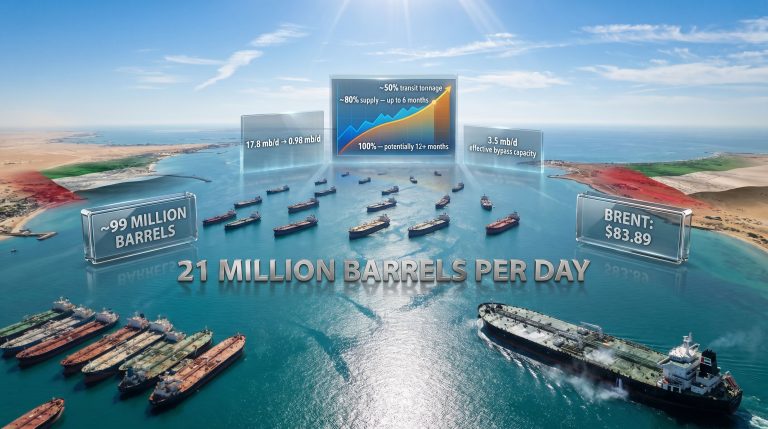
- Roughly 17 to 21 million barrels of oil per day transited the strait before the closure, representing approximately one-fifth of global petroleum consumption
- Qatar, the world's largest LNG exporter for much of the past decade, routes virtually all of its output through Hormuz from its Ras Laffan export terminal
- The UAE, Iraq, Kuwait, and Saudi Arabia all rely on Hormuz for the bulk of their seaborne export capacity
- Iran itself, despite its role in closing the corridor, is not immune to the economic consequences of a prolonged shutdown
What makes Hormuz uniquely irreplaceable is a combination of geography and infrastructure deficit. The East-West Pipeline across Saudi Arabia has a maximum capacity of around 5 million barrels per day, a fraction of normal Hormuz throughput. No equivalent bypass exists for LNG. When the corridor closes, the energy simply stops moving, reinforcing the broader energy security transition challenges that importing nations have long been warned about.
Three Months of Closure: The Accumulated Damage to Global Energy Trade
The current disruption began at the end of February, triggered by US and Israeli military strikes that prompted Iran to exercise its most powerful economic lever. Within days, commercial shipping operators began diverting, delaying, or anchoring vessels rather than risk transit. Insurance underwriters pulled coverage for the corridor, making passage commercially nonviable even for operators willing to accept physical risk.
The downstream effects compounded over weeks:
- European natural gas markets, which had been drawing down LNG from Qatari sources, lost a significant supply stream at precisely the point when seasonal demand remained elevated
- Asian importers, particularly India, Japan, and South Korea, faced delivery disruptions on both spot market cargoes and scheduled long-term contract volumes
- Crude oil supply chains tightened globally as Persian Gulf barrels became stranded, forcing buyers to source replacement volumes from more distant and more expensive origins
- Refinery run rates in some import-dependent economies were adjusted downward to manage reduced crude availability
The three-month closure created a backlog of commercial significance that will not clear overnight. Vessels that loaded cargoes in early March have been sitting at anchor for over 90 days, accumulating demurrage costs and tying up carrying capacity that would otherwise be active in global trade. The pent-up supply waiting to move represents a meaningful near-term market variable.
Breaking Down the Reported US-Iran Framework
What Does the Deal Actually Contain?
The Strait of Hormuz reopening deal that emerged in mid-June 2026 is best understood as a framework agreement rather than a completed diplomatic instrument. According to reporting from Reuters, multiple components have been identified, but formal ratification and leadership sign-off on several elements remain outstanding. Markets responded to the announcement, but experienced traders understand that the distance between a deal-in-principle and an enforceable agreement is often where the risk resides.
The reported structure contains three interdependent pillars:
| Component | Reported Status | Outstanding Issues |
|---|---|---|
| Strait of Hormuz Reopening | Announced in principle | Formal signing pending |
| 60-Day Ceasefire Extension | Reported as agreed | Full leadership ratification unclear |
| Highly Enriched Uranium Stockpile | Under negotiation | Disposal method not finalised |
| Sanctions Relief | Not publicly confirmed | Terms undisclosed |
| Nuclear Program Talks | Framework stage only | No timeline established |
The interdependence of these pillars is a critical structural feature. Because the Hormuz reopening, the ceasefire extension, and the nuclear enrichment discussions are linked, deterioration on any one front creates the conditions for unravelling the others. Iran has demonstrated both the willingness and the capability to use Hormuz as leverage, and that leverage does not evaporate the moment a document is signed.
In diplomatic terms, a deal-in-principle functions as a statement of intent rather than a binding commitment. Procedural ratification, domestic political approval within Iran, and verification mechanisms all need to be established before the agreement carries operational weight. Markets that price in a complete normalisation before these steps are confirmed are, in effect, running ahead of the available evidence. The broader geopolitical risk landscape surrounding this agreement remains deeply complex.
How Energy Markets Responded to Reopening Expectations
Crude and Gas Prices React Sharply
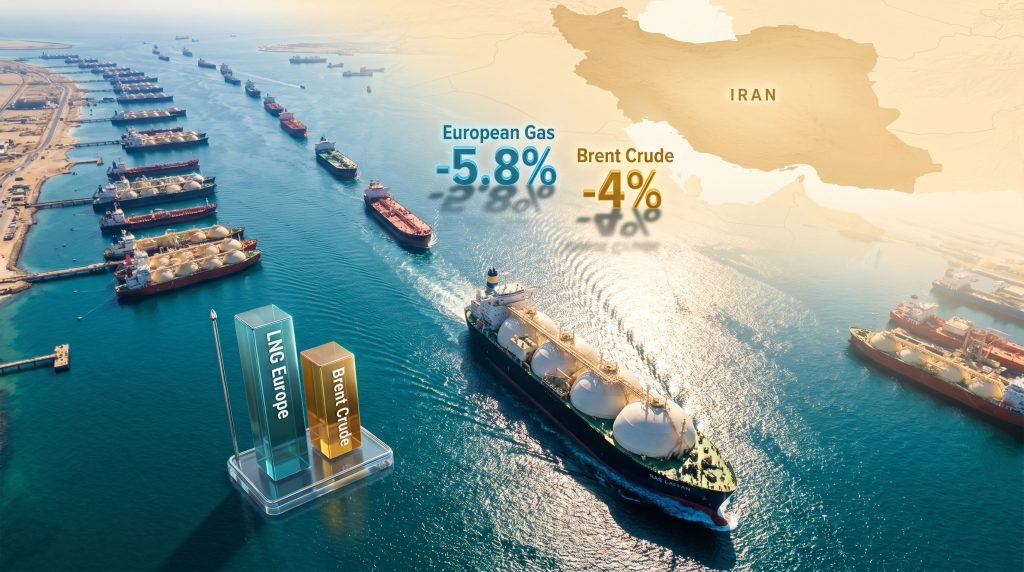
The immediate market reaction to the reopening announcement was sharp and broad-based. European natural gas prices fell as much as 5.8% in early Asian trading following the news, reflecting the direct exposure of European gas markets to Qatari LNG supply. Brent crude dropped more than 4% at the open, driven by expectations of restored Persian Gulf export volumes.
The scale of the price moves is instructive in both directions. A decline of this magnitude reflects how much of a risk premium had been embedded in energy prices during the closure period. It also signals that the market was not fully pricing in a resolution, meaning sentiment had remained genuinely uncertain rather than optimistic. Furthermore, these moves connect closely to the oil price pressures that have been building across multiple fronts throughout 2025 and into 2026.
However, the price response was notably measured compared to what full normalisation would theoretically imply. Several factors explain the restraint:
- Traders and shipowners are working through the details of an agreement that may not be fully available for days
- The history of Hormuz-related agreements includes instances where compliance proved selective or short-lived
- Operational realities, including vessel positioning, insurance market responses, and port logistics, mean that resumed traffic cannot begin instantaneously
- The nuclear enrichment question remains genuinely unresolved, creating a credible scenario in which the broader framework fractures
If the deal collapses before formal signing, or if post-signing compliance is contested, the price recovery could be violent. Energy markets that have partially unwound their risk premiums on the basis of a deal-in-principle are exposed to a rapid reversal if the diplomatic environment deteriorates. This asymmetric risk profile deserves attention from market participants managing energy price exposure.
The LNG Backlog: Vessels, Volumes, and the Coming Cargo Rush
One of the most concrete and immediate indicators of what a Strait of Hormuz reopening deal means in practice is the behaviour of individual vessels. The LNG carrier known as the Disha, operating under a long-term charter with an Indian state-owned energy importer, provides a case study in miniature. The vessel loaded a cargo from Qatar's Ras Laffan terminal around the beginning of March and has remained effectively stranded for more than three months.
As news of the reopening framework emerged, the Disha was observed moving northward past the UAE coast toward Oman, positioning itself near the strait entrance. This movement is significant for several reasons:
- It represents commercial operators beginning to test the diplomatic environment before formal confirmation
- It signals that at least some cargo owners are prepared to accept a degree of uncertainty in exchange for breaking a costly demurrage cycle
- It will provide real-world data on whether the corridor is genuinely passable before larger-scale traffic resumes
The broader backlog is substantial. Clusters of vessels have been sitting at anchor on both sides of the strait, with two distinct flotilla groupings reported: one positioned off Dubai in the Persian Gulf, and another in the Gulf of Oman to the south. The combination of tankers, LNG carriers, and product vessels waiting to move represents a significant surge of supply that will enter global markets once transit resumes, with front-month price implications that traders are already modelling. The LNG supply outlook beyond this disruption period will depend heavily on how quickly this backlog is absorbed.
Qatar's Ras Laffan facility, the origin point for a large proportion of the stranded LNG cargoes, is the world's largest LNG export complex. During the closure period, loading operations continued at the terminal even as vessels were unable to depart through Hormuz, creating a compound inventory problem that will require weeks of elevated throughput to resolve.
The next major ASX story will hit our subscribers first
Operational Challenges That Markets May Be Underpricing
GPS Spoofing and Location Falsification
A sharp increase in GPS spoofing activity around the strait has been documented during the closure period. Spoofing involves broadcasting false location data that causes vessel tracking systems to display incorrect ship positions. The practical effect is that real-time monitoring of traffic conditions is compromised, making it genuinely difficult for commercial operators, insurers, and regulators to assess whether the corridor is safe or congested at any given moment.
Transponder Deactivations
Separately from spoofing, many vessels transiting or approaching the strait have been operating with their Automatic Identification System transponders switched off. AIS transponder data is the primary tool used by shipping intelligence providers to track vessel movements, and widespread deactivation creates blind spots in the operational picture. Among the visible flotillas at anchor, multiple vessels have not broadcast their location for days or weeks.
Volume Surge Management
The sheer number of vessels queued on both sides of the strait creates a coordination challenge that has no recent precedent. A simultaneous surge of traffic through a narrow, technically demanding waterway creates collision risk, pilotage demand, and port congestion at receiving terminals. Normalisation of LNG traffic specifically is likely to take several weeks even under ideal conditions, given the loading and unloading time requirements of LNG vessels and the limited berth capacity at key receiving terminals.
Geopolitical Risks That Could Derail the Agreement
Iran's structural leverage over the Strait of Hormuz does not disappear upon the signing of a diplomatic document. Tehran's ability to restrict, threaten, or close the waterway is a function of geography and military positioning that persists regardless of the agreement's legal status. This creates an inherent verification and compliance challenge that previous Hormuz-related diplomatic episodes have illustrated repeatedly.
The uranium stockpile question is particularly significant. Iran's accumulation of highly enriched uranium represents a negotiating variable that both sides have incentives to keep deliberately ambiguous. The method of disposal, the timeline for reduction, and the verification framework are all described as unresolved. This ambiguity is not accidental; it preserves Iranian leverage in any post-agreement period while allowing both parties to claim progress in public-facing communications.
Regional actors beyond the immediate US-Iran bilateral relationship also carry influence over compliance. Proxy dynamics, non-state maritime actors, and the interests of Gulf states that have their own calculations regarding Iran's regional posture all introduce variables that a bilateral framework cannot fully account for. Reporting from NBC News suggests both sides expect formal signing within days, though considerable uncertainty persists around compliance mechanisms.
What the Closure Revealed About Global Energy Security Architecture
The three-month Hormuz closure has forced a candid assessment of the gaps in global energy security infrastructure. The absence of any viable alternative routing capable of absorbing displaced Persian Gulf volumes at comparable cost was not a new discovery, but the closure translated this theoretical vulnerability into a lived economic experience for importers across three continents.
Several structural implications are now in sharper focus:
- Long-term LNG contract structures are being scrutinised for the adequacy of force majeure provisions, with legal and commercial teams assessing whether existing clauses appropriately allocate the risk of prolonged chokepoint closures
- Strategic petroleum reserve drawdown capacity proved finite and insufficient to bridge a three-month supply disruption of this scale without meaningful price effects
- The case for supply diversification, including investment in non-Gulf source regions, has strengthened considerably among energy-importing governments, as reflected in the shifting crude oil price trends observed throughout this period
Regional Impact: Who Gains Most from the Strait of Hormuz Reopening Deal
The distribution of benefits from a successful reopening is uneven across importing regions, reflecting different dependency profiles and market structures.
| Region | Primary Exposure | Expected Benefit from Reopening |
|---|---|---|
| India | Crude oil and LNG imports | Immediate supply restoration and cost reduction |
| Europe | LNG spot market pricing | Near-term price relief estimated at 5-10% |
| Japan/South Korea | Long-term LNG contract delivery | Normalisation of cargo schedules |
| China | Crude oil import volumes | Volume and cost stabilisation |
India carries some of the most acute short-term exposure. As a major importer of both Persian Gulf crude and Qatari LNG, and with the Disha's position serving as a live illustration of the dependency, the restoration of Hormuz transit directly addresses supply gaps that have been accumulating since March. For European gas markets, the price relief from resumed Qatari LNG flows is expected to be meaningful but not transformative in isolation, given that European supply diversification has already partially redirected demand toward non-Gulf sources.
Frequently Asked Questions: Strait of Hormuz Reopening Deal
Has the Strait of Hormuz Officially Reopened?
As of the initial announcement, the Strait of Hormuz reopening deal remains a deal-in-principle. Formal signing has not yet been completed, and full ratification by relevant leadership on both sides is still pending. Commercial operators are beginning to position vessels in anticipation of reopening, but official confirmation of open passage has not been issued.
What Caused the Hormuz Closure?
US and Israeli military strikes at the end of February 2026 triggered Iran's decision to restrict transit through the strait, effectively closing the waterway to commercial shipping over the following days.
How Much Oil and Gas Passes Through Hormuz?
Under normal conditions, roughly 17 to 21 million barrels of oil equivalent per day transit the strait, representing approximately one-fifth of globally traded petroleum and a major share of seaborne LNG trade.
Why Did Oil and Gas Prices Fall on the Reopening News?
Markets moved to unwind the risk premium that had been embedded in energy prices during the closure period. The prospect of restored supply from stranded vessels and resumed Persian Gulf export operations drove both crude and natural gas benchmarks lower.
When Will LNG Traffic Return to Normal?
Full normalisation is unlikely to be rapid. The combination of vessel backlog, operational complications from spoofing and transponder blackouts, insurance market reassessment, and terminal logistics suggests a process measured in weeks rather than days.
What Happens to Energy Prices if the Deal Collapses?
A collapse of the reported framework before formal signing, or a credible breakdown in post-signing compliance, would likely trigger a significant reversal of the price declines observed at the announcement. Markets that have partially unwound closure-related risk premiums are structurally exposed to this scenario.
This article contains forward-looking analysis and market commentary that involves inherent uncertainty. Energy market outcomes depend on multiple variables including diplomatic developments, operational logistics, and geopolitical factors beyond current visibility. Nothing in this article constitutes financial or investment advice. Readers should consult qualified advisors before making decisions based on energy market forecasts or geopolitical scenario analysis.
Want to Stay Ahead of the Next Major Market-Moving Discovery?
Whilst geopolitical disruptions like the Hormuz closure reshape global energy and commodities markets, Discovery Alert's proprietary Discovery IQ model scans the ASX daily to deliver real-time alerts on significant mineral discoveries — turning complex data across 30+ commodities into clear, actionable insights before the broader market catches on. Explore historic discoveries and their exceptional returns, then start your 14-day free trial to ensure you're positioned ahead of the next major opportunity.