June 15, 2026
The World's Most Vulnerable Energy Corridor: Why Hormuz Disruptions Reshape Global Economics
Energy markets operate on the assumption that critical transit corridors remain open. When that assumption breaks down, the consequences extend far beyond fuel prices. The Strait of Hormuz represents one of those rare geographical features where physical geography and geopolitical risk converge with enough force to move central bank decisions, reshape trade balances, and determine whether import-dependent economies slide into recession. The U.S.-Iran peace deal and Strait of Hormuz reopening sits at the centre of this dynamic, and understanding it requires more than tracking crude benchmarks. It demands a structural view of why this particular waterway holds the global economy hostage whenever tensions escalate.
When big ASX news breaks, our subscribers know first
Why Hormuz Is Unlike Any Other Energy Chokepoint
The Strait of Hormuz is a narrow maritime passage separating Iran from Oman, connecting the Persian Gulf to the Gulf of Oman and ultimately the open ocean. What makes it categorically different from other maritime chokepoints is the sheer concentration of oil-producing nations that depend exclusively on it for export access.
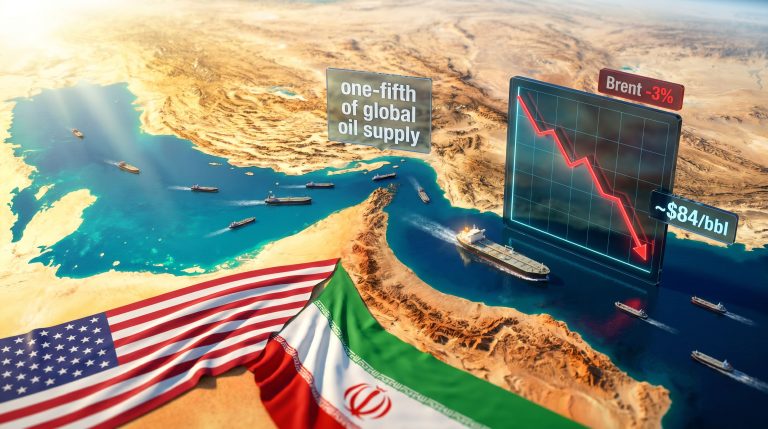
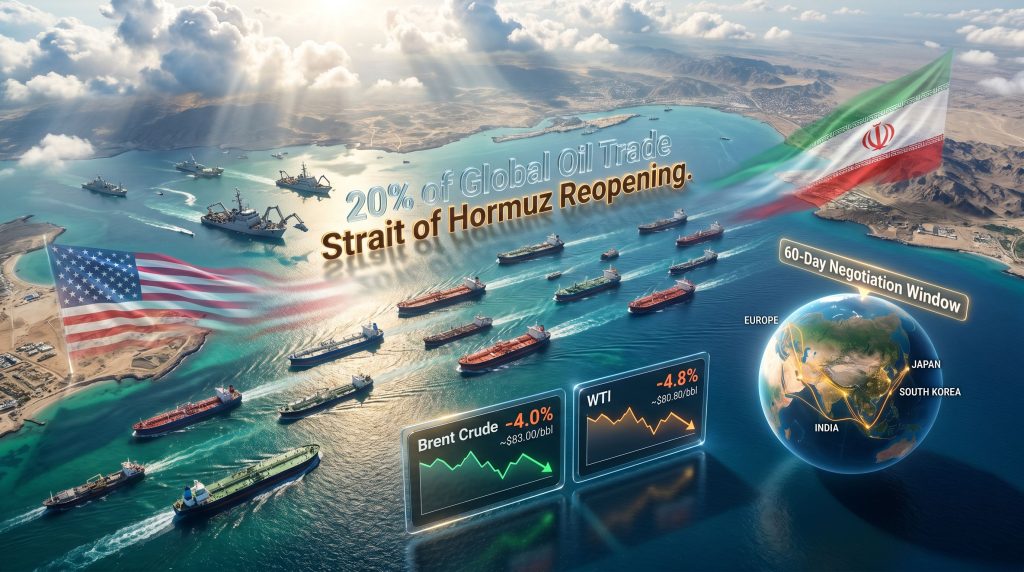
Every barrel exported by sea from Iran, Iraq, Kuwait, Saudi Arabia, the United Arab Emirates, and Qatar must transit this single passage. There is no alternative deepwater route. Approximately 20 to 21% of global oil trade moves through Hormuz under normal operating conditions, representing somewhere between 17 and 20 million barrels per day. Qatar, one of the world's top three liquefied natural gas exporters, routes all of its LNG shipments through the same waterway.
The systemic implications of closure go well beyond crude oil price trends, and the ripple effects touch virtually every sector:
- Petrochemical supply chains across Asia and Europe face feedstock shortages when Gulf crude is unavailable
- Fertiliser production dependent on Gulf-sourced natural gas liquids experiences cost spikes that translate into global food price inflation
- Industrial energy inputs across manufacturing-heavy economies become structurally more expensive, compressing corporate margins
- Shipping insurance markets reprice war-risk premiums across all Gulf-adjacent routes, raising costs for carriers operating nowhere near the direct conflict zone
"The Strait of Hormuz functions less like a shipping lane and more like a systemic node in global energy architecture. When it closes, the shock does not stay local. It propagates through every economy that depends on affordable energy inputs, which, in practice, means virtually every economy."
Historical precedent underscores this. During the Iran-Iraq War of 1980 to 1988, even partial disruptions to Gulf shipping created commodity price dislocations that lasted years, not weeks. During the 2018 to 2019 sanctions escalation, Iranian threats to close the strait drove Brent crude more than 4% higher in a single trading session. The 2026 closure, lasting more than three months, represents the longest sustained disruption to Hormuz transit in the waterway's modern commercial history. War-risk insurance premiums surged to levels not seen since the immediate aftermath of the September 11 attacks, compressing shipping margins globally and raising delivered energy costs for Asian importers by meaningful margins.
What Has Actually Been Agreed: Confirmed Terms and Unresolved Disputes
The announcement of a U.S.-Iran peace framework generated immediate market optimism. However, the gap between confirmed terms and contested claims is wide enough to warrant careful analysis before drawing conclusions about the deal's durability.
The Confirmed Framework
Pakistan's Prime Minister Shehbaz Sharif confirmed that the United States and Iran reached an agreement to bring an immediate and permanent end to hostilities. A formal signing ceremony is scheduled for Friday in Geneva, Switzerland. U.S. President Donald Trump announced authorisation of an immediate removal of the U.S. naval blockade. The agreement initiates a 60-day structured negotiation period focused primarily on Iran's nuclear programme, with the International Atomic Energy Agency expected to play a central verification role.
The diplomatic reception was broadly positive across major economies. The United Kingdom, France, Germany, and Italy issued a joint statement characterising the deal as a moment of opportunity to restore regional stability and stabilise oil's role in the global economy. Japan's Prime Minister Sanae Takaichi described the agreement as a major step toward resolving the situation and expressed strong hope for steady implementation and guaranteed freedom of navigation through Hormuz. Qatar's Ministry of Foreign Affairs, furthermore, welcomed the deal as an important step toward sustainable peace and regional economic growth.
The Disputed and Unresolved Elements
| Claim | Source | Verification Status |
|---|---|---|
| 60-day MOU framework with broader talks to follow | Axios reporting | Reported, not officially confirmed |
| Trump had not yet given final approval at time of initial reports | Axios reporting | Disputed by subsequent announcements |
| Hormuz transit classified as "restricted" in draft terms | Axios reporting | Contested |
| Iran required to clear mines before full reopening | Axios reporting | Unconfirmed by either party |
| Iranian official described Hormuz as open "with new conditions" | Separate Iranian official | Conflicts with U.S. position |
| Potential transit fees or tolls proposed by Iran | Iranian-Omani discussions | Directly contradicted by U.S. claims |
| 14-page draft memorandum includes oil sanctions waiver | Iranian state media | Reported, not officially released |
The most consequential ambiguity involves what precisely the Iranians mean by the phrase "new conditions" attached to Hormuz transit. If Iran intends to impose notification requirements, fee structures, or passage restrictions on vessels from certain nations, it fundamentally conflicts with the E4 position that freedom of navigation must be unconditional and unrestricted. This dispute alone has the potential to derail the 60-day follow-on negotiations before they produce binding outcomes. For further context on how geopolitical tensions and global trade interact in situations like this, the pattern of escalation and negotiation is well established.
"The arrangement as it stands is best characterised as a provisional ceasefire framework with a structured negotiation pathway. It is not a fully ratified peace treaty. The most consequential questions remain open, and markets that have priced in full resolution may be pricing in the optimistic scenario rather than the probable one."
According to NBC News, both sides have indicated the deal is expected to be signed within days, though key implementation details remain subject to further negotiation.
Oil Market Response: Reading the Price Signal Correctly
The immediate crude oil market reaction to the peace deal announcement was sharp and directionally clear.
| Benchmark | Pre-Deal Price (Approx.) | Post-Announcement | Change |
|---|---|---|---|
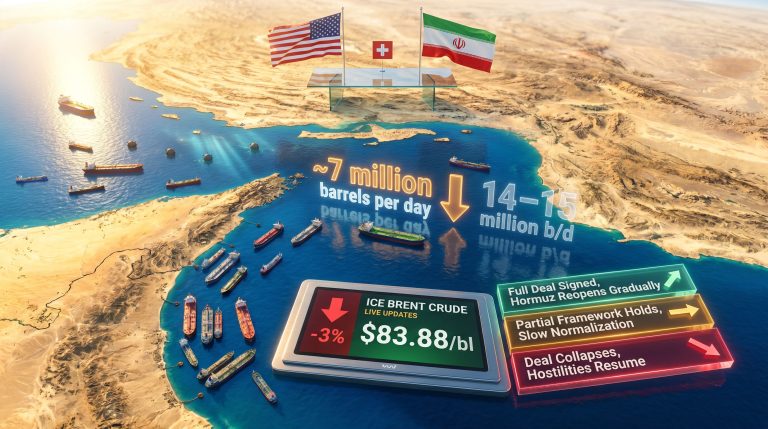
| Brent Crude | ~$86.50/barrel | ~$83.00/barrel | -4.0% |
| WTI Crude | ~$84.80/barrel | ~$80.80/barrel | -4.8% |
A 4 to 5% decline in a single session is significant, but energy market professionals interpret this move carefully. The price drop reflects a compression of the geopolitical risk premium that had been embedded in crude prices throughout the conflict period. It does not, however, reflect an actual increase in physical supply.
The distinction matters enormously for anyone trying to understand where oil prices go from here. Physical restoration of Iranian crude exports involves a sequenced process that cannot be compressed into days:
- Sanctions unwinding requires legislative and regulatory action across multiple jurisdictions, not just a presidential announcement
- Port infrastructure assessment in Iran must confirm that export terminals remain operationally intact after months of conflict
- Tanker repositioning requires vessels that had been rerouted away from Gulf waters to return, a logistical process measured in weeks
- Buyer contract renegotiation must occur as refiners in Asia and Europe that had secured alternative crude supplies work through existing commitments before absorbing Iranian barrels
Analysts have previously estimated that Iran holds suppressed export capacity in the range of 1 to 1.5 million barrels per day that could return to global markets as sanctions are progressively lifted. At a time when global oil balances are sensitive to supply shifts of even a few hundred thousand barrels per day, that volume matters considerably. The oil market trade war impact of the preceding period has already conditioned markets to expect volatility, making the interpretation of these signals all the more complex.
Christian Noyer, honorary governor of the Bank of France, stated that a fully implemented peace deal could ease inflationary pressures enormously, restore consumer confidence, and provide global central banks with significantly greater flexibility on monetary policy decisions, according to his remarks on CNBC's Squawk Box Asia. The macroeconomic logic is straightforward: sustained lower oil prices reduce input costs simultaneously across manufacturing, logistics, and agriculture, creating a broad disinflationary impulse that could support monetary easing decisions in major economies. Import-dependent nations in Asia, particularly Japan, South Korea, and India, stand to benefit disproportionately given their structural reliance on Gulf crude.
The Hormuz Reopening Timeline: Three Phases to Watch
Phase 1: Immediate Ceasefire and Naval Withdrawal (Days 1 to 30)
- U.S. naval blockade removal authorised immediately upon deal announcement
- Iranian mine-clearing obligations reportedly embedded in draft MOU terms, though unconfirmed by either party
- Commercial shipping insurers expected to begin reassessing war-risk premium classifications as risk environment changes
- Freedom of navigation declarations from E4 nations and Japan signal multilateral intent to resume normal transit
Phase 2: Conditional Resumption of Commercial Transit (Days 30 to 60)
- Iranian state media reporting indicates a 30-day window for full Hormuz reopening under draft terms
- Disputed transit conditions proposed by Iranian officials remain unresolved, representing the primary near-term implementation risk
- The U.S. position maintains that transit must be unconditional and free of tolls or fees
- IAEA preliminary engagement with Iranian nuclear facilities expected to begin during this phase
Phase 3: Sanctions Architecture Restructuring (Days 60 and Beyond)
- E4 nations have indicated readiness to begin lifting sanctions upon verified Iranian compliance with nuclear commitments
- Oil sanctions waiver reportedly included in the 14-page draft memorandum, though not officially released
- Full restoration of Iranian crude exports to pre-conflict volumes requires additional months of logistical and contractual preparation
- The G7 summit in France, beginning the Monday following the deal announcement, provides an immediate multilateral forum for aligning U.S. unilateral deal terms with broader international frameworks
How Major Economies Are Positioned
Europe: Sanctions Relief as Conditional Diplomatic Leverage
The E4 joint statement deliberately framed sanctions relief as conditional rather than automatic. The language calling for "rapid and comprehensive" implementation signals that European support is contingent on observable Iranian action, particularly on nuclear verification. European energy markets, which have navigated elevated gas and oil prices throughout the conflict period, stand to benefit materially from restored Gulf supply flows. Consequently, Europe's primary policy objective remains nuclear constraint, not merely an open shipping lane.
Japan's Structural Vulnerability
Japan imports approximately 90% of its crude oil from the Middle East, placing it among the most structurally exposed developed economies to any Hormuz disruption. Prime Minister Takaichi's public statement explicitly prioritised "free and safe navigation," language that directly reflects Japan's acute dependence on unobstructed Gulf transit. A sustained reopening reduces pressure on Japan's strategic petroleum reserve drawdowns and eases energy cost burdens on its manufacturing sector.
Qatar: Diplomat and Beneficiary
Qatar occupies a dual role in this situation. As a diplomatic actor with relationships across both Western and Gulf constituencies, it has positioned itself as a constructive voice for regional stability. As one of the world's largest LNG exporters, with all of its export volumes transiting Hormuz, it has enormous economic interest in a permanent reopening. Qatar's welcoming statement explicitly linked the deal to "economic growth," language that reflects both dimensions simultaneously. OPEC's market influence over the broader Gulf supply picture adds yet another layer of complexity to how restored Iranian exports would be absorbed by global markets.
The next major ASX story will hit our subscribers first
Three Scenarios for Oil Markets Over the Next 90 Days
Scenario A: Full Implementation
Hormuz reopens unconditionally within 30 days, Iranian oil sanctions are progressively lifted, and Brent crude stabilises in the $75 to $80 per barrel range as suppressed Iranian supply gradually returns. Global central banks gain room to ease monetary policy, supporting equity markets. Shipping and logistics costs normalise accordingly.
Scenario B: Partial Implementation
Hormuz reopens but with Iranian-imposed conditions or transit fee structures that remain disputed. Sanctions relief is delayed pending nuclear verification disagreements. Oil prices oscillate between $80 and $90 per barrel as markets price in ongoing uncertainty. Shipping insurers, furthermore, maintain elevated war-risk classifications.
Scenario C: Negotiation Breakdown
Follow-on talks collapse over nuclear red lines or Hormuz transit disputes. The U.S. re-imposes or maintains sanctions and naval posture in the Gulf remains elevated. Brent crude rebounds toward $90 to $95 per barrel as the risk premium is repriced. Global inflationary pressures re-intensify, constraining central bank flexibility and placing renewed pressure on emerging market economies. As The Guardian reports, the path to a durable ceasefire remains uncertain, with the U.S.-Iran peace deal and Strait of Hormuz reopening dependent on both sides holding to commitments that have not yet been fully formalised.
Disclaimer: The scenarios presented above are analytical frameworks for understanding potential outcomes, not financial forecasts. Energy market conditions can shift rapidly based on geopolitical developments. This article does not constitute financial or investment advice. Readers should conduct their own research and consult qualified financial advisors before making investment decisions.
Frequently Asked Questions
What is the Strait of Hormuz and why does it affect oil prices globally?
The Strait of Hormuz is a narrow maritime passage between Iran and Oman that serves as the sole maritime exit for crude oil exports from six major Gulf producers. Approximately 20% of global oil trade transits through it daily. When the strait is closed or restricted, global supply is effectively constrained regardless of production capacity elsewhere, causing prices to rise across all benchmarks.
Has the Strait of Hormuz officially reopened after the U.S.-Iran peace deal?
As of the deal announcement, the U.S. naval blockade removal has been authorised. However, the physical reopening of the strait to commercial traffic remains subject to mine-clearing operations, Iranian compliance with draft MOU terms, and resolution of disputed transit conditions. Full and unobstructed reopening has not been confirmed as complete.
What happens during the 60-day negotiation window?
The initial agreement establishes a ceasefire and triggers a 60-day structured negotiation process focused primarily on Iran's nuclear programme. The IAEA is expected to play a central verification role. Sanctions relief from E4 nations is explicitly conditioned on outcomes from this follow-on process rather than the ceasefire announcement itself.
Will Iran charge fees for Hormuz transit?
This remains one of the most contested elements of the current framework. An Iranian official described the strait as open under "new conditions," suggesting potential fee or notification requirements. The U.S. and E4 nations have both stated that transit must be unconditional and toll-free. Resolution of this specific dispute is expected during the 60-day follow-on talks.
What does the U.S.-Iran peace deal and Strait of Hormuz reopening mean for inflation and interest rates?
Lower sustained oil prices reduce input costs simultaneously across manufacturing, transport, and agriculture, creating a disinflationary impulse across the global economy. The Bank of France's honorary governor indicated that a fully implemented deal could ease inflationary pressures enormously and give central banks more room to manoeuvre on monetary policy. However, this outcome depends on the deal's full implementation, which remains subject to negotiation.
Want to Track the Investment Opportunities That Emerge From Global Energy Disruptions?
Discovery Alert's proprietary Discovery IQ model delivers real-time alerts on significant ASX mineral discoveries, instantly cutting through market noise to surface actionable opportunities — whether energy prices are stabilising or surging. Explore historic examples of major discovery returns and begin your 14-day free trial to ensure you're positioned ahead of the broader market.