June 15, 2026
The World's Most Vulnerable Energy Corridor and What Happens When It Closes
Few infrastructure realities concentrate geopolitical risk quite like a body of water measuring just 33 kilometres at its narrowest navigable point. The Strait of Hormuz has long occupied a unique position in global energy security thinking, not because of what flows through it on any given day, but because of what stops flowing when tensions escalate. Every barrel of crude oil, every cargo of liquefied natural gas leaving the Persian Gulf must pass through this single maritime passage, making it the most consequential chokepoint in the history of modern energy markets.
The June 2026 U.S.-Iran deal to reopen the Strait of Hormuz marks a pivotal moment in that history, but the full meaning of this agreement extends well beyond a simple diplomatic handshake. Understanding its implications requires a careful examination of what the deal actually contains, what it conspicuously leaves unresolved, and why energy market participants should resist the temptation to treat the current price correction as the final chapter.
When big ASX news breaks, our subscribers know first
Why the Strait of Hormuz Is Unlike Any Other Energy Chokepoint
The Strait of Hormuz sits between Iran to the north and Oman to the south, connecting the Persian Gulf to the Gulf of Oman and ultimately to the Arabian Sea. What makes it categorically different from other maritime chokepoints such as the Suez Canal or the Malacca Strait is the absence of a practical alternative for the bulk of Persian Gulf energy exporters.
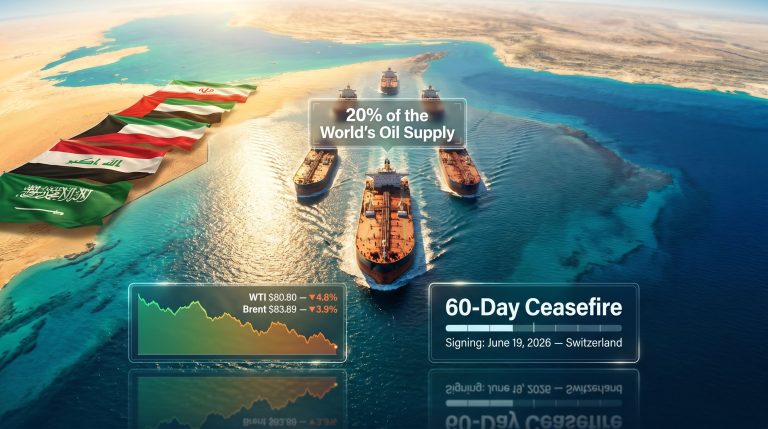
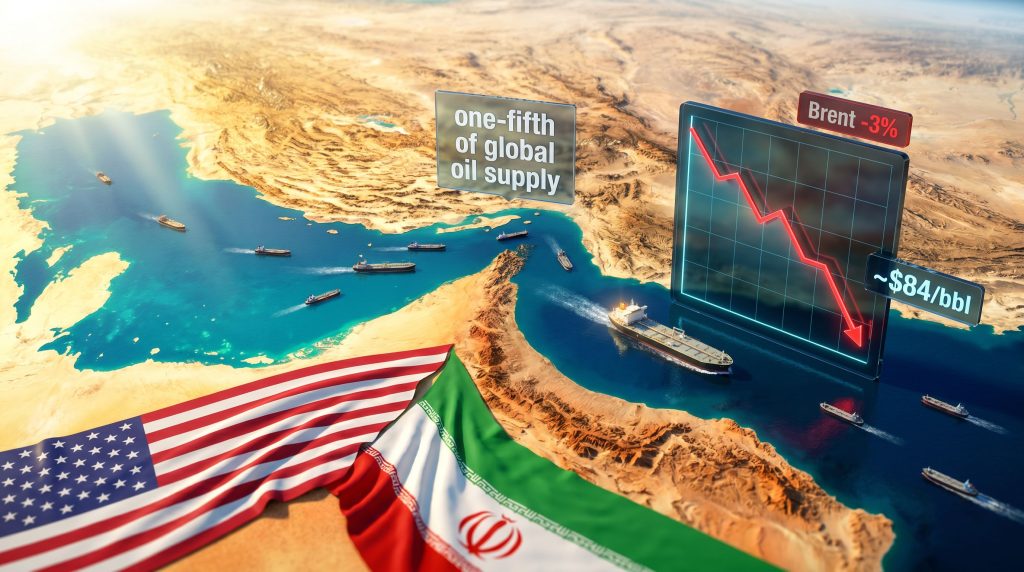
Before the conflict disrupted operations, the strait served as the transit route for approximately one-fifth of the world's daily oil supply, alongside a substantial share of global LNG volumes. Qatar, the world's largest LNG exporter, routes virtually all of its shipments through Hormuz. Saudi Arabia, the UAE, Kuwait, and Iraq all rely on the strait as their primary exit corridor to international markets.
"The Strait of Hormuz is not simply an oil transit route. It is the only viable exit for Persian Gulf LNG, meaning any sustained closure simultaneously tightens both crude oil and natural gas markets across the globe."
This dual-commodity exposure is what separates Hormuz from other geopolitical flashpoints. Previous instances of Hormuz tension, including the tanker wars of the 1980s and repeated Iranian threats to close the strait during nuclear negotiations in 2011 and 2012, each produced measurable spikes in energy pricing. The 2026 conflict, however, involved an actual cessation of commercial shipping rather than a threat, making it the most consequential Hormuz disruption in the modern era.
How the Conflict Disrupted Global Shipping and Energy Flows
The sequence of events leading to the strait's closure began with bombardments by U.S. and Israeli forces, which triggered Iran's decision to shut the waterway. The resulting disruption created a compounding supply shock, with crossings falling to a small fraction of pre-war levels during the blockade period. Furthermore, the broader geopolitical trade tensions surrounding the conflict amplified the market impact well beyond the immediate region.
What made the situation uniquely severe was the dual-blockade dynamic: the United States simultaneously maintained its own naval blockade, meaning vessels faced potential interdiction from both directions. War risk insurance premiums for ships attempting to transit Hormuz surged dramatically, making many voyages commercially unviable even when physical access might have been possible.
The downstream effects cascaded rapidly through interconnected markets:
- Asian LNG spot prices climbed sharply as Qatar's export capacity was effectively cut off from its primary buyers
- Gulf Cooperation Council producers including Saudi Arabia and the UAE lost access to their main export corridor, forcing costly rerouting considerations around the Cape of Good Hope
- European refiners dependent on Middle Eastern crude grades faced tightening supply and elevated freight costs
- Global shipping operators accumulated massive backlogs of uncommitted cargoes
What the U.S.-Iran Agreement Actually Contains
The formal announcement of the U.S.-Iran deal to reopen the Strait of Hormuz came first from Pakistani Prime Minister Shehbaz Sharif, followed by a social media post from U.S. President Donald Trump confirming that the agreement was complete and authorising the end of the U.S. naval blockade. Iranian state media subsequently confirmed the deal, framing it in domestic political terms as a concession by Washington.
Iran's Deputy Foreign Minister Kazem Gharibabadi confirmed that the full text of the memorandum of understanding would be published following the official signing ceremony scheduled for June 19, 2026.
The core elements of the agreement as publicly understood include:
- Mutual termination of competing naval blockades by both the U.S. and Iran
- A bilateral non-aggression commitment between Washington and Tehran
- Initiation of follow-on negotiations focused on Iran's nuclear program
- Sanctions relief targeting Iranian overseas oil exports, with specific terms still under negotiation
- A 60-day extension of the existing ceasefire, creating a defined diplomatic window
What Remains Unresolved: The Gaps That Matter Most
| Unresolved Element | Current Status | Market Implication |
|---|---|---|
| Sanctions relief on Iranian oil exports | Terms still under negotiation | Potential addition of 1-2 mb/d to global supply |
| Access to frozen overseas assets | Demanded by Iran, not confirmed | Affects Iranian fiscal capacity and compliance incentives |
| Nuclear program specifics | Deferred to follow-on talks | Geopolitical risk premium partially maintained |
| Israeli response to the framework | Uncertain; new Lebanon strikes reported | Signing timeline at risk |
| Full shipping resumption timeline | Not officially confirmed | Freight and insurance markets in transition |
A senior U.S. official described the framework as a performance-based incentive structure, where Iran receives economic rewards incrementally as it satisfies specific U.S. demands. This model differs fundamentally from lump-sum concession frameworks used in previous nuclear negotiations, and is designed to preserve American leverage throughout the process rather than front-loading benefits to Tehran.
Disclaimer: The deal as announced constitutes a memorandum of understanding, not a ratified treaty. Market participants should model a spectrum of outcomes ranging from full implementation to partial or total breakdown.
How Oil Markets Responded and What the Price Move Actually Signals
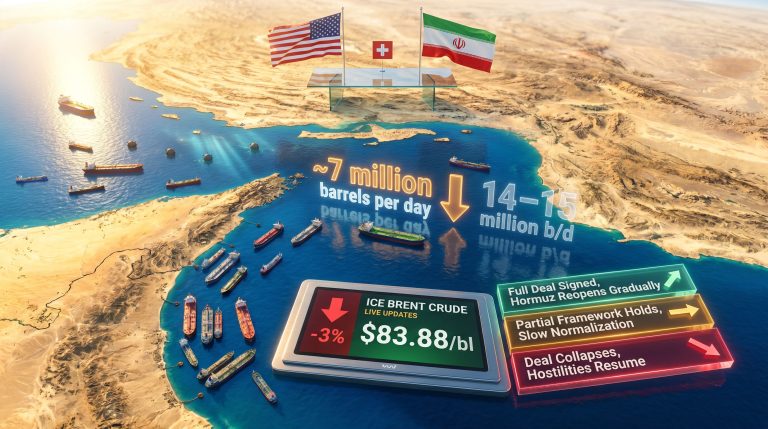
The market reaction to the U.S.-Iran deal to reopen the Strait of Hormuz was swift and significant. Brent crude fell more than 3% toward $84 per barrel following the announcement, having already closed the prior week at its lowest level in more than three months. West Texas Intermediate moved toward $81 per barrel. Consequently, Brent and WTI futures across multiple delivery months shifted sharply in response to the revised risk environment.
To interpret this move correctly, it is important to understand what the price decline represents and what it does not. The 3%+ single-session drop reflects the unwinding of a geopolitical risk premium that had been embedded in crude pricing during the conflict and blockade period. It does not reflect a fundamental shift in supply-demand balances, because Iranian oil has not yet actually returned to market.
| Scenario | Brent Price Range | Primary Driver |
|---|---|---|
| Pre-conflict baseline | Stable equilibrium | OPEC+ production management |
| Active blockade period | Elevated with risk premium | Supply disruption and shipping insurance surge |
| Deal announcement (current) | ~$84/bbl, declining | Risk premium unwinding |
| Full deal implementation | Further downside possible | Iranian supply re-entry and ceasefire stability |
| Deal breakdown or renewed conflict | Sharp rebound likely | Re-escalation of supply disruption risk |
The critical insight for energy market participants is that the current price level represents a transitional state. If Iranian crude exports genuinely return to the market under a sanctions relief framework, additional downward pressure on crude oil price trends becomes likely over a 6-to-12-month horizon. If the deal stalls or collapses, the risk premium would rebuild rapidly, potentially with greater force than during the initial conflict given reduced market confidence in diplomatic resolution.
The Diplomatic Architecture: Pakistan, Washington, and Tehran
Pakistan's emergence as the first nation to publicly announce the agreement is diplomatically significant. Islamabad's ability to maintain functional relationships with both Washington and Tehran reflects a careful neutrality that gave it credibility as a communication channel during indirect negotiations stretching across several weeks.
The announcement sequence itself — Sharif first, then Trump, then Iranian state media — suggests a carefully choreographed diplomatic rollout designed to allow each party to frame the outcome for its domestic audience. Iranian state media characterising the deal as a U.S. capitulation is a reflection of domestic political requirements in Tehran, not necessarily an accurate characterisation of the terms. For additional context, reporting from The Guardian on the ceasefire framework provides useful background on how both sides approached the negotiating dynamic.
The Israel Variable: The Most Significant Implementation Risk
Prime Minister Benjamin Netanyahu's government conducted new strikes on Lebanon in close proximity to the deal's signing deadline, introducing last-minute uncertainty into the diplomatic timeline. Israel's strategic calculus diverges sharply from an arrangement that could leave Iran's nuclear infrastructure intact while providing Tehran with economic relief and legitimacy.
Any Israeli escalation that provokes Iranian retaliation could collapse the ceasefire framework before formal signing. This remains the single most acute near-term risk to the deal's implementation, and market participants should monitor developments in Lebanon and the broader Levant region closely through the 60-day ceasefire extension window.
The next major ASX story will hit our subscribers first
Scenario Analysis: Three Pathways and Their Energy Market Consequences
Scenario 1: Full Implementation
The strait reopens to full commercial traffic, nuclear talks progress within the 60-day window, and sanctions relief begins flowing to Iran. Persian Gulf oil volumes recover toward pre-conflict levels over 6-to-12 months. Asian LNG spot markets normalise as Qatari cargoes resume regular delivery schedules. Brent crude faces sustained downward pressure as both the risk premium and incremental Iranian supply weigh on prices.
Scenario 2: Partial Implementation
Commercial shipping resumes but nuclear negotiations stall, preventing full sanctions relief from materialising. Oil markets stabilise without experiencing a full supply surge. A residual risk premium persists in energy pricing, reflecting unresolved nuclear tensions and uncertainty over deal durability. This scenario is arguably the most probable near-term outcome given the structural complexity of nuclear negotiations and the depth of mutual distrust between Washington and Tehran.
Scenario 3: Deal Collapse
Israeli military escalation or Iranian domestic political pressure derails the June 19 signing. The strait returns to a heavily impeded state and crude prices rebound sharply, potentially exceeding conflict-period highs as market confidence in diplomatic resolution deteriorates. Global inflation pressures re-emerge across oil-importing economies, with the most severe consequences concentrated in Asia.
Energy market participants should assign explicit probability weights across all three scenarios rather than treating the deal announcement as confirmation of the most optimistic outcome.
Downstream Consequences for LNG, GCC Producers, and Shipping Markets
LNG Markets and Asian Buyers
Qatar's status as the world's largest LNG exporter means that Hormuz closure directly translates into Asian supply tightness. Japan, South Korea, and China collectively represent the largest LNG import markets globally, and all three were forced into premium spot market purchases during the blockade period. The global LNG supply outlook had already been under scrutiny before the conflict, and a durable reopening gradually alleviates this structural tightness, though the repricing process takes time as term contracts, shipping logistics, and storage positions are adjusted.
European LNG import infrastructure expanded during the conflict period as buyers sought alternative supply sources. Some of this infrastructure may see reduced utilisation rates as Gulf supply normalises, creating secondary investment implications for European regasification capacity.
OPEC+ and GCC Production Strategy
The potential return of meaningful Iranian crude volumes to the market creates a strategic challenge for OPEC+ producers. Saudi Arabia and the UAE, which had been benefiting from tighter market conditions during the conflict, now face the prospect of managing group production discipline against a backdrop of recovering Iranian output. In addition, OPEC's market influence over pricing will be tested as the group navigates Iranian supply re-entry alongside its existing production management commitments. The pace and scale of Iranian supply re-entry will heavily influence OPEC+'s production strategy decisions through the remainder of 2026.
Marine Insurance and Shipping Cost Repricing
War risk insurance premiums for Hormuz-transiting vessels had reached extraordinary levels during the conflict, making many commercial voyages economically marginal. The deal announcement will trigger a gradual repricing of marine insurance as underwriters reassess the route's risk classification. This repricing process unfolds over weeks rather than days, as insurers require observable evidence of safe transits before materially adjusting premium structures.
The U.S. Domestic Political Dimension
The timing of the U.S.-Iran deal to reopen the Strait of Hormuz carries clear domestic political significance. Polling conducted during the conflict period indicated deep unpopularity among American voters, creating mounting pressure on the Trump administration as midterm elections approach in November 2026.
A ceasefire and diplomatic agreement achieved before the election cycle peaks represents a tangible foreign policy outcome. However, its political value is entirely contingent on whether implementation holds. A deal that collapses or produces visible Iranian non-compliance before November would carry significant political costs, creating an incentive for the administration to pursue robust verification mechanisms within the performance-based rewards framework.
Frequently Asked Questions
What is the Strait of Hormuz and why does it matter for oil prices?
The Strait of Hormuz is the narrow maritime passage connecting the Persian Gulf to the Gulf of Oman, serving as the primary export corridor for Gulf oil and LNG. Roughly one-fifth of the world's daily oil supply and a significant share of global LNG transits this route. Disruptions to shipping through the strait directly constrain global energy supply and drive crude prices higher.
What did the U.S. and Iran agree to in the June 2026 deal?
The two countries agreed to end their competing naval blockades, commit to mutual non-aggression, and initiate nuclear program negotiations. Sanctions relief on Iranian oil exports is part of the framework, though specific terms and timelines remain under negotiation.
Why did oil prices fall after the deal was announced?
Crude markets had embedded a significant geopolitical risk premium during the conflict period. The deal announcement triggered an unwinding of that premium, pushing Brent down more than 3% to approximately $84 per barrel. Further price movement depends on whether Iranian exports actually return to market and whether the agreement holds.
Could the deal collapse before implementation?
Yes. Israel's military actions near the signing deadline, unresolved questions about Iranian access to frozen overseas assets, and the complexity of nuclear negotiations all represent meaningful breakdown risks. The deal should be treated as a developing framework subject to revision rather than a finalised agreement.
Key Takeaways for Energy Market Participants
- The U.S.-Iran deal to reopen the Strait of Hormuz represents the most consequential Middle East energy security development in years, but its durability remains unconfirmed
- Brent crude's immediate decline to approximately $84 per barrel reflects risk premium unwinding, not a fundamental supply shift
- The performance-based sanctions relief structure preserves U.S. leverage but extends the period of negotiating uncertainty for energy markets
- Qatar's LNG exports, GCC crude producers, and Asian energy importers are the primary beneficiaries of a durable reopening
- The 60-day ceasefire extension window is the critical near-term monitoring period
- Israel's strategic posture and Iran's domestic political dynamics remain the two variables most capable of derailing implementation
This article contains forward-looking scenario analysis and market observations that involve uncertainty and assumption. Nothing in this article constitutes financial or investment advice. Energy market participants should conduct independent analysis before making trading or investment decisions.
Want to Stay Ahead of the Next Major Market-Moving Discovery?
While geopolitical events like the Strait of Hormuz crisis dominate energy headlines, the most transformative investment opportunities often emerge from significant mineral discoveries on the ASX — and timing is everything. Discovery Alert's proprietary Discovery IQ model delivers real-time alerts the moment high-potential discoveries are announced, turning complex data across more than 30 commodities into clear, actionable insights for investors at every experience level — start your 14-day free trial today and see why historic discoveries have generated extraordinary returns for those who moved first.