June 15, 2026
The World's Most Critical Energy Bottleneck and What Happens When It Reopens
Few geographic features carry more weight in global energy markets than a narrow strip of water roughly 33 kilometres wide at its most constrained point. The Strait of Hormuz has long functioned as the circulatory system of the world's oil supply, and when that system becomes blocked, the consequences ripple across every economy on the planet. The Strait of Hormuz reopening deal between U.S. and Iran, confirmed on June 14, 2026, therefore represents one of the most consequential geopolitical developments in recent energy market history. Understanding the mechanics of what happens when this chokepoint closes, and what it means when it reopens, requires stepping back from the headlines and examining the structural architecture of global energy dependency.
When big ASX news breaks, our subscribers know first
Why No Other Route Can Replace the Strait of Hormuz
The Irreplaceable Geography of Persian Gulf Oil Exports
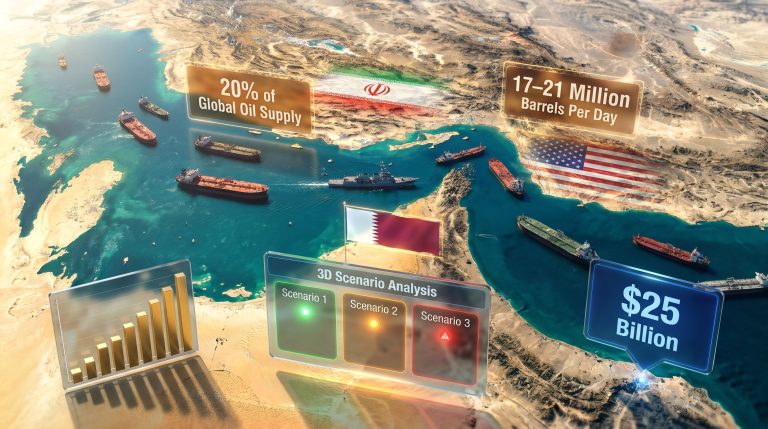
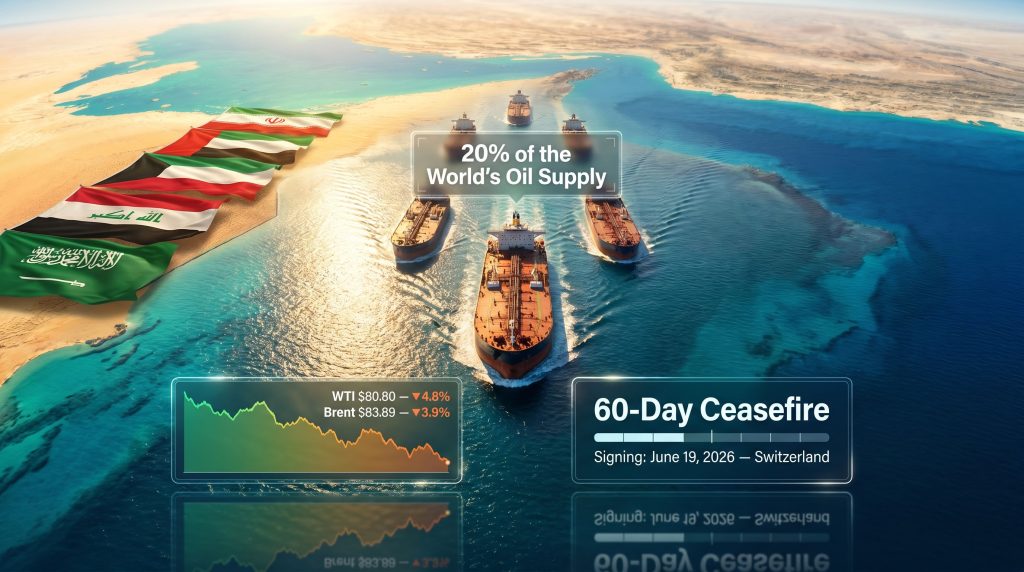
The strait connects the Persian Gulf to the Gulf of Oman, serving as the sole maritime exit point for crude oil produced by Saudi Arabia, Iraq, Kuwait, the UAE, and Iran. Before tanker traffic collapsed in early March 2026 following Iranian attacks on vessels transiting the waterway, approximately 20% of the world's total daily oil supply moved through this passage.
What makes Hormuz structurally irreplaceable is the absence of viable alternatives at comparable scale. While pipelines such as Saudi Arabia's East-West Pipeline and the UAE's Abu Dhabi Crude Oil Pipeline provide partial bypass capacity, their combined throughput represents only a fraction of Hormuz's normal daily flow. No infrastructure upgrade or emergency rerouting can substitute for the volume that ordinarily transits this 33-kilometre chokepoint. Furthermore, monitoring oil price trends during previous disruptions underscores just how rapidly markets respond to even partial restrictions on this corridor.
The 2026 disruption crossed a threshold that no prior Hormuz crisis had reached: a near-complete cessation of tanker traffic rather than targeted attacks on individual vessels. This distinction matters enormously. Previous incidents, including the Tanker War of the 1980s and the 2019 seizures, disrupted shipping at the margins. The 2026 closure disrupted it at the core, producing what analysts have characterised as the largest oil supply shock in recorded history, surpassing the 1973 Arab oil embargo and the 1990 Gulf War disruptions in both scale and immediacy.
"A physical maritime closure of this nature cannot be resolved through production increases or strategic reserve releases alone. Its resolution requires a geopolitical agreement, which is precisely what makes the June 2026 framework deal between Washington and Tehran so consequential."
What the U.S.-Iran Framework Agreement Actually Covers
Breaking Down the Deal's Architecture
On June 14, 2026, U.S. President Donald Trump confirmed via Truth Social that the deal with Iran was complete. The Strait of Hormuz would reopen without any toll or fee system imposed on transiting vessels, and the United States would immediately lift its naval blockade of Iran upon deal activation. Pakistani Prime Minister Shehbaz Sharif simultaneously confirmed a declared cessation of military operations across all active fronts, including Lebanon, with a formal signing ceremony scheduled for June 19, 2026, in Switzerland.
According to NBC News reporting on the expected deal, both sides indicated the agreement was days from being signed, reinforcing the compressed timeline that both governments were deliberately maintaining. The table below summarises the key components of the agreement and their current status:
| Deal Component | Reported Status |
|---|---|
| Strait of Hormuz reopening | Confirmed, no toll system to be imposed |
| U.S. naval blockade of Iran | To be lifted immediately upon deal activation |
| Ceasefire extension duration | 60 days |
| Military operations across all fronts | Declared permanently terminated |
| Formal peace deal signing | Scheduled June 19, 2026, in Switzerland |
| Iran nuclear program resolution | Unresolved, deferred to subsequent talks |
The Nuclear Dimension: Deliberately Deferred
The most significant gap in the current framework is the absence of any resolution on Iran's nuclear programme. Iran's enriched uranium stockpile and future enrichment thresholds remain openly contested, and multiple reports confirm these issues were not incorporated into the current agreement. Instead, the framework establishes a foundation for subsequent technical negotiations, a structure that reflects a deliberate sequencing strategy reportedly shaped by Iran's earlier position: reopen Hormuz first, address nuclear concerns in a separate, later process.
This architecture is not without historical precedent. The interim phases of the 2015 Joint Comprehensive Plan of Action (JCPOA) followed a similar logic, allowing both parties to claim diplomatic progress while deferring the most contentious technical disputes. The risk inherent in this approach is that unresolved enrichment disagreements could generate domestic political pressure on both sides during the 60-day ceasefire window, creating fragility in an agreement that otherwise appears structurally sound.
"The 60-day ceasefire structure means energy markets will face a binary repricing event in mid-August 2026, either confirming a durable peace settlement or signalling a return to crisis conditions. Traders and energy procurement teams should model both outcomes with equal rigour."
Oil Market Response: What the Price Drop Reveals
Immediate Reaction on June 14, 2026
Markets moved decisively on the announcement. U.S. crude oil futures (WTI) declined 4.8% to $80.80 per barrel by 6:01 p.m. ET on June 14, 2026. Brent crude, the international benchmark, fell 3.9% to $83.89 per barrel in the same session. The magnitude of the single-session decline reflects the degree to which supply scarcity had been priced into crude markets during the months of restricted Hormuz access.
The broader oil market impacts of prolonged chokepoint disruptions provide useful context here, particularly given how supply shock dynamics tend to overshoot in both directions. The sell-off is rational in directional terms, but its pace may not accurately reflect the operational timeline for supply restoration. Several logistical factors govern how quickly the market actually receives the additional barrels that the Hormuz reopening theoretically unlocks:
- Vessel repositioning: Tankers that rerouted away from the strait during the blockade require days to weeks to return to Hormuz transit patterns, depending on their current position.
- War-risk insurance repricing: During the disruption, war-risk premiums on Hormuz-transiting vessels spiked to levels that rendered many commercial voyages economically unviable. These premiums must be formally repriced by underwriters before operators commit to new transits.
- Port congestion management: A sudden resumption of high-volume traffic after months of suppression creates temporary bottleneck risk at loading terminals across the Gulf.
- Strategic reserve depletion depth: The extent to which consuming nations drew down strategic petroleum reserves during the crisis will influence how quickly restored supply translates into price stabilisation rather than inventory rebuilding.
Frontline CEO Lars Barstad indicated the week prior to the announcement that vessel transits through the strait would resume relatively quickly following any credible bilateral agreement, specifically noting that a mutual non-aggression signal toward shipping would be sufficient to unlock vessel movements without requiring a comprehensive peace deal.
Pakistan's Role as Diplomatic Intermediary
Why Islamabad Was Positioned to Broker This Agreement
Pakistan's selection as the primary diplomatic bridge between Washington and Tehran is not accidental. Islamabad maintains functional diplomatic channels with both governments, a rare combination given the deep structural hostility between the U.S. and Iran that has persisted since 1979. For both parties, using a neutral intermediary reduces the domestic political cost of direct negotiation, a consideration that carries significant weight in both American and Iranian political environments.
Prime Minister Sharif's public confirmation of the deal's terms, including the Switzerland signing date and the declared termination of military operations on all fronts, gave the announcement a multilateral credibility that a unilateral U.S. statement would not have achieved. The compressed timeline between the announcement on June 14 and the formal signing on June 19 suggests both governments are deliberately maintaining negotiating momentum, trading granular detail for forward movement.
Switzerland's role as the signing venue reinforces the agreement's neutrality framing. The country's established diplomatic infrastructure and long-standing neutrality status make it the conventional choice for high-stakes multilateral negotiations, a function it has served repeatedly throughout modern diplomatic history. The interplay of trade and geopolitics in shaping these negotiations is, however, equally difficult to separate from the purely diplomatic calculus at play.
The No-Toll Clause: More Than a Symbolic Concession
Why Iran's Toll Proposal Was a Red Line for Washington
Prior to the finalised agreement, Iran had reportedly explored the possibility of imposing transit fees on vessels passing through the strait, effectively converting a geographic bottleneck into a revenue-generating geopolitical instrument. The explicit inclusion of a no-toll commitment in the announced deal reflects a firm U.S. negotiating priority.
Under the United Nations Convention on the Law of the Sea (UNCLOS), coastal states bordering international straits are generally prohibited from imposing fees on transit passage. Iran's toll proposal would have challenged this legal principle while simultaneously establishing a precedent for monetising critical maritime chokepoints. The no-toll clause in the 2026 agreement reinforces both the legal framework and adds a direct political commitment layer that future Iranian administrations would face domestic and international costs for reversing.
The practical implications extend across multiple market participants:
- Tanker operators gain certainty over voyage economics, removing a cost variable that had been suppressing commercial willingness to resume Hormuz transits even before the formal ceasefire.
- Asian refiners in China, India, Japan, and South Korea, who collectively represent the largest consumers of Persian Gulf crude, benefit most directly from restored access to their primary supply source.
- Commodity traders can begin recalibrating Gulf-origin crude pricing differentials, which had widened substantially during the disruption as traders priced in both scarcity and logistics risk.
- LNG markets gain relief as well, given that Qatar's substantial LNG export operations also transit the strait and had faced similar access constraints during the closure.
The next major ASX story will hit our subscribers first
Three Scenarios for the 60-Day Window and Beyond
How Markets Should Think About Mid-August 2026
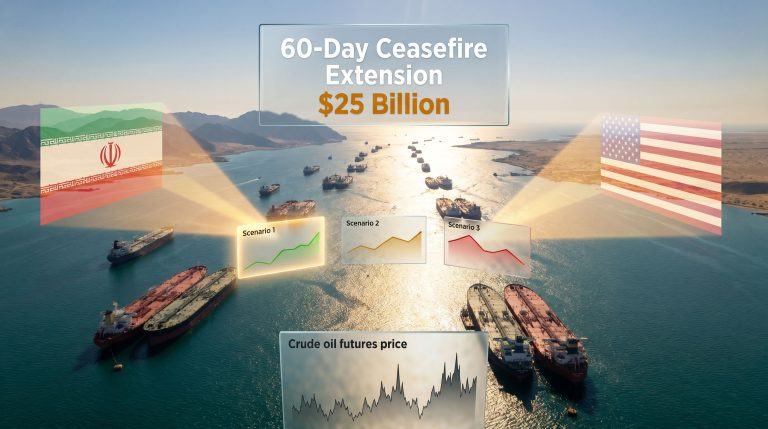
The 60-day ceasefire structure creates a hard analytical horizon. By mid-August 2026, markets will have a clearer picture of whether the framework is evolving into a durable settlement or fracturing under the pressure of unresolved nuclear disputes. Three scenarios bracket the likely range of outcomes:
Scenario 1: Stable Implementation (Base Case)
The ceasefire holds, technical nuclear talks advance without breakdown, and tanker traffic normalises within two to four weeks of the formal signing. Oil prices stabilise in the $75-$85 per barrel range as supply increases are absorbed into markets that had partially adjusted to reduced Gulf flows. Both parties have strong economic incentives to support this outcome: Iran requires sanctions relief and oil export revenue, while the U.S. requires a demonstrable diplomatic success.
Scenario 2: Partial Breakdown (Elevated Risk Case)
Nuclear talks stall during the 60-day window, generating domestic political pressure in both capitals. Isolated incidents involving non-state actors, such as IRGC-affiliated proxies or Houthi-linked groups, disrupt tanker traffic without triggering full military re-engagement. Oil prices oscillate between $80-$95 per barrel as markets price in re-escalation risk without fully reverting to crisis levels.
Scenario 3: Full Reversal (Tail Risk)
The June 19 signing collapses over enrichment disputes, Iran reimposes shipping restrictions, and the U.S. naval blockade is reinstated. With strategic petroleum reserves already depleted from months of drawdown, a second disruption would carry substantially greater price impact than the first. Oil prices spike above $100 per barrel, potentially significantly higher depending on the speed of re-escalation. Reuters reporting on Iran calling for actions rather than words underscores how cautious both sides remain about the durability of the framework.
How the 2026 Closure Compares to Prior Hormuz Crises
A Historical Perspective on Chokepoint Disruptions
| Event | Year | Duration | Supply Impact | Resolution Mechanism |
|---|---|---|---|---|
| Tanker War (Iran-Iraq conflict) | 1984-1988 | ~4 years | Partial, attacks on individual vessels | UN Resolution 598, ceasefire |
| Gulf War naval tensions | 1990-1991 | ~7 months | Moderate, threat-based deterrence | U.S.-led military coalition |
| Tanker seizures and incidents | 2019-2020 | Episodic | Limited, targeted incidents | Diplomatic pressure, naval escorts |
| 2026 Hormuz closure | 2026 | Months | Largest in recorded history | U.S.-Iran bilateral framework |
The 2026 event is structurally distinct from every prior Hormuz crisis in two critical respects. First, it achieved a near-complete cessation of tanker traffic rather than targeted disruption at the margins. Second, it is being resolved through a bilateral framework agreement rather than military defeat, UN mandate, or unilateral diplomatic pressure. This resolution mechanism is historically novel and introduces a different set of durability risks than prior crises, which were typically resolved by one party achieving a clear military or political upper hand.
In addition, the crude oil market overview heading into 2026 had already incorporated elevated geopolitical risk premiums, meaning that even a partial resolution carries disproportionate downward pricing force relative to prior disruption cycles. Consequently, the OPEC market influence on production decisions during this period will also play a critical role in determining how quickly global supply and demand dynamics rebalance.
Frequently Asked Questions: Strait of Hormuz Reopening Deal
What exactly was agreed between the U.S. and Iran?
The core commitments cover three areas: reopening the Strait of Hormuz to international shipping without any toll or fee mechanism, lifting the U.S. naval blockade of Iran immediately upon deal activation, and declaring a permanent cessation of military operations across all active conflict zones including Lebanon. The Strait of Hormuz reopening deal between U.S. and Iran includes a formal signing scheduled for June 19, 2026, in Switzerland. Iran's nuclear programme remains subject to separate subsequent negotiations.
When will tanker traffic actually resume through the strait?
Based on assessments from major tanker operators, vessel transits are expected to resume within days to weeks of the formal agreement signing, subject to war-risk insurance repricing, vessel repositioning from alternative routes, and port congestion management at Gulf loading terminals.
Why did oil prices fall so sharply on the announcement?
The 4.8% WTI and 3.9% Brent declines on June 14 reflect market pricing of anticipated supply normalisation. With roughly 20% of world oil previously transiting Hormuz, even a partial restoration of flows represents a material supply addition that exerts downward pressure on futures prices.
Is Iran's nuclear programme resolved?
No. Enrichment limits and stockpile disposition remain explicitly deferred to subsequent technical negotiations. The current agreement is a ceasefire and shipping access framework, not a comprehensive nuclear settlement.
What happens when the 60-day ceasefire expires?
Mid-August 2026 represents a structural decision point. If technical nuclear talks produce meaningful progress, the agreement is likely to be extended or formalised. If talks stall, re-escalation risk rises materially. Energy procurement teams and commodity traders should treat this date as a key scenario trigger.
This article contains forward-looking analysis and scenario projections based on publicly available information as of June 14, 2026. Market price scenarios and geopolitical outcome probabilities involve inherent uncertainty and should not be construed as investment advice. Readers should conduct independent research before making financial decisions based on any information contained herein.
Want to Capitalise on the Next Major Market-Moving Discovery Before the Broader Market Reacts?
While geopolitical events like the Strait of Hormuz reopening reshape commodity markets overnight, Discovery Alert's proprietary Discovery IQ model scans ASX announcements in real time — instantly identifying significant mineral discoveries and delivering actionable alerts to subscribers before the broader market catches on. Explore historic discoveries and their exceptional returns, then begin your 14-day free trial at Discovery Alert to position yourself ahead of the next major market opportunity.