June 15, 2026
The Slow Physics of Energy Recovery: Why Oil Markets Cannot Snap Back Overnight
There is a persistent misconception embedded in how financial markets interpret geopolitical resolutions. When a conflict ends, equity traders hit the buy button, bond spreads compress, and commodity prices reprice downward within hours. The assumption is that normalisation follows announcement with reasonable speed. In the physical world of crude oil, however, the mechanics of production, shipping, and refining operate on an entirely different clock, one measured not in trading sessions but in weeks and months of logistical sequencing.
The Strait of Hormuz oil supply recovery following the Iran war ceasefire announcement illustrates this gap between market reaction and physical reality with unusual clarity. Benchmark prices fell on the news, as expected. What the price move cannot capture is the scale of the operational reconstruction that must occur before a single additional barrel reaches a refinery on the other side of the planet.
When big ASX news breaks, our subscribers know first
Understanding the Chokepoint Before Assessing the Recovery
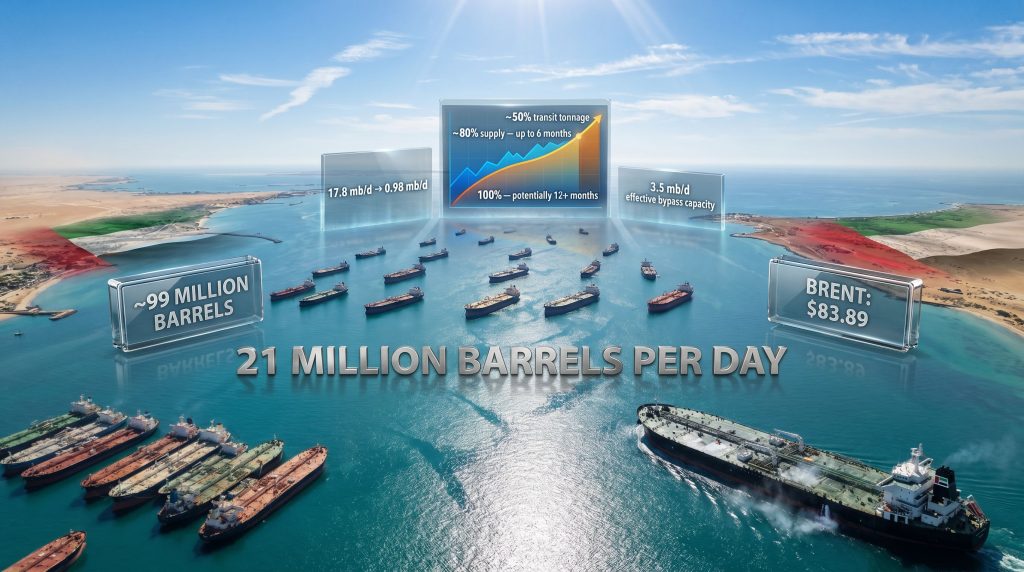
To appreciate the depth of the disruption, it helps to understand what the strait actually represents in structural terms. Under normal operating conditions, approximately 21 million barrels per day (mb/d) of oil and petroleum liquids flow through this narrow passage between the Persian Gulf and the Gulf of Oman. That volume equates to roughly 21% of total global petroleum liquids consumption and accounted for more than one-quarter of all seaborne oil trade in the 2022–2023 period.
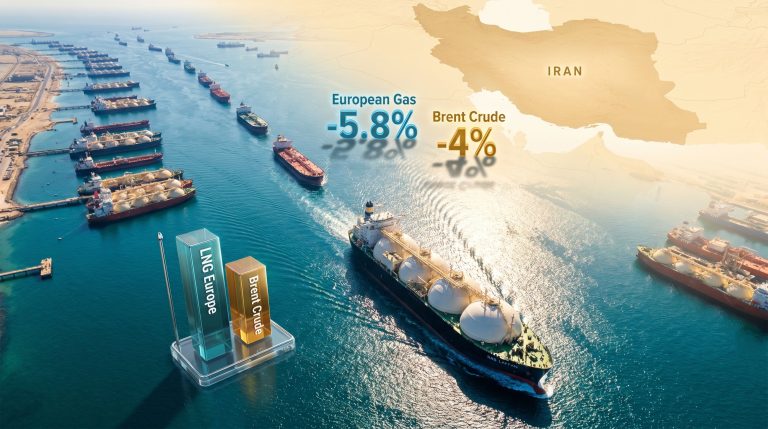
The strait is not a single-commodity corridor. Beyond crude oil, it serves as the primary export channel for liquefied natural gas (LNG) from Qatar, one of the world's dominant suppliers. Consequently, the energy security implications of any sustained disruption extend simultaneously into power generation, industrial feedstock supply, and heating markets across multiple continents. The scale of disruption to global LNG supply during this period has drawn particular attention from analysts tracking long-term energy security.
"The Strait of Hormuz is not merely a shipping lane. It is an artery through which a meaningful fraction of the global economy's energy requirements must pass. Blockage here does not reduce supply in a simple linear fashion; it fractures trade flows, reshapes pricing benchmarks, and creates feedstock shortfalls for refineries that took years to configure around specific crude grades."
The Magnitude of the Physical Backlog
When transit collapsed from its normal rate of approximately 17.8 mb/d to under 1 mb/d at the peak of the disruption, the consequences were not merely financial. Physical crude, refined products, and LPG accumulated aboard vessels that had nowhere to go.
| Commodity | Estimated Stranded Volume |
|---|---|
| Crude Oil | ~99 million barrels |
| Refined Oil Products | ~37 million barrels |
| LPG | ~279,000 metric tonnes |
| Pre-conflict crude throughput | ~17.8 mb/d |
| Throughput at peak disruption (May) | ~0.98 mb/d |
This backlog does not dissolve upon a ceasefire announcement. It must be physically sequenced out of the region, which itself consumes time, tanker capacity, and port infrastructure.
Why Political Resolution and Operational Resumption Are Separate Events
One of the most consequential distinctions in energy market analysis is the difference between a political agreement and an operational restart. These are not the same event occurring simultaneously; they are separated by a chain of prerequisite steps that each carry their own timeline.
S&P Global Energy has indicated that operators will require confidence in a stable, durable security window before committing vessels to transit. The phrase is precise and important. A ceasefire that lasts 30 or 60 days is insufficient grounds for a tanker operator to commit a vessel and its cargo to a multi-week voyage through a waterway that was, until recently, actively contested.
Daniel Sternoff, a senior fellow at the Center on Global Energy Policy at Columbia University, has noted that operators and producers alike need to understand what a reopening actually means operationally, including how quickly stranded material can be evacuated and whether the security environment is genuinely durable. Furthermore, the oil geopolitical risks associated with the region continue to weigh on operator decision-making well beyond any single political announcement.
The Insurance Market as a Hidden Gating Mechanism
A factor that receives far less attention than it deserves is the role of marine war-risk insurance in governing the pace of recovery. During periods of active conflict or elevated threat near major shipping lanes, underwriters withdraw coverage or reprice it to levels that make commercial voyages uneconomic. This is not a bureaucratic obstacle; it is a fundamental prerequisite for commercial shipping.
Before tanker operators can commit vessels to strait transit, war-risk coverage must be reinstated by underwriters who will make their own independent assessment of security conditions. This process unfolds on the insurers' timeline, not the politicians'. According to the IEA's warning on Hormuz oil export recovery, it will take time for operators and insurers to become comfortable and for coverage to be formally reinstated, particularly for on-the-ground personnel required to restart upstream assets.
Tanker Repositioning: The Logistics That Cannot Be Rushed
Oil tankers are among the most inertia-bound assets in global trade. They move slowly, operate under long-term contracts, and cannot be instantly redeployed from one trade lane to another. During the period of strait closure, tankers that would normally have transited the Hormuz route were redirected around the Cape of Good Hope, adding thousands of nautical miles and weeks to voyage times.
Reversing this diversion takes time. Vessels under contract on alternative routes cannot be immediately recalled. The inbound fleet must be repositioned, which itself takes weeks independent of any political development.
Estimated recovery phases, based on analytical frameworks from S&P Global and Wood Mackenzie, can be structured as follows:
| Recovery Phase | Milestone | Estimated Timeframe |
|---|---|---|
| Initial reopening | ~50% of pre-war transit tonnage | By end of June 2026 (optimistic case) |
| Partial normalisation | ~50% of regional production capacity online | Within days of formal reopening |
| Intermediate recovery | ~75% of regional capacity restored | Within weeks |
| Near-full operational recovery | ~80% of pre-shock supply levels | Up to 6 months |
| Full capacity restoration | 100% production and transit normalisation | 12+ months for hardest-hit producers |
Which Producers Face the Steepest Recovery Curve
Saudi Arabia and the UAE: Structurally Advantaged
Not all Persian Gulf producers face equivalent recovery challenges. Saudi Arabia and the UAE hold a significant structural advantage because both nations operate pipeline infrastructure capable of routing oil exports around the strait entirely.
- Saudi Arabia's East-West Pipeline connects Eastern Province oil fields to the Red Sea port of Yanbu
- The UAE's Abu Dhabi Crude Oil Pipeline (ADCOP) provides an alternative export route to the port of Fujairah on the Gulf of Oman
- The EIA estimates that combined effective bypass capacity across these pipelines totals approximately 3.5 mb/d, which is significant but represents only a fraction of the strait's normal 21 mb/d throughput
This means that even for the most advantaged producers, bypass infrastructure cannot substitute for full strait access. It can bridge the gap during a reopening transition but cannot carry the full volume of Gulf exports on its own.
Iraq: The Most Structurally Exposed Major Producer
Iraq presents the most challenging recovery profile among significant Persian Gulf oil exporters. The country possesses no meaningful pipeline bypass capacity, and its export infrastructure depends almost entirely on Gulf terminals that require strait access.
Alan Gelder, senior vice president of refining, chemicals and oil markets at Wood Mackenzie, has assessed that Iraq faces compounding challenges that go well beyond logistics. The country's fields experienced deep shut-in periods, its upstream infrastructure is complex, and the technical restart process is considerably more demanding than for producers with simpler field architectures. Wood Mackenzie's assessment points to a recovery timeline of approximately one year before Iraqi production approaches pre-conflict levels.
The Technical Reality of Restarting Shut-In Production
When onshore storage capacity reaches saturation, producers must implement shut-in procedures, meaning the deliberate halting of extraction at the wellhead level. This is not a reversible action that can be undone at the flick of a switch. The restart sequence involves multiple technical dependencies:
- Well integrity assessments must be completed before flow can safely resume
- Surface processing facilities require recommissioning after extended idle periods, including equipment checks and safety certifications
- Reservoir pressure management may require injection operations to restore sustainable production rates, a process that itself takes weeks
- Workforce and contractor re-mobilisation adds further lead time, particularly for fields where international service companies evacuated personnel during the conflict period
- Procurement of consumables and spare parts that were not stockpiled before the shut-in
"A sustained shut-in is not a pause button. Reservoir dynamics continue during the idle period, and production systems degrade without active maintenance. The longer the shut-in duration, the more complex and time-consuming the restart sequence becomes. Iraq's situation, characterised by longer shut-in periods and more complex field geology, places it at the far end of the recovery timeline spectrum."
How Oil Prices Are Processing the Recovery Narrative
The Price Gap Between Political Relief and Physical Reality
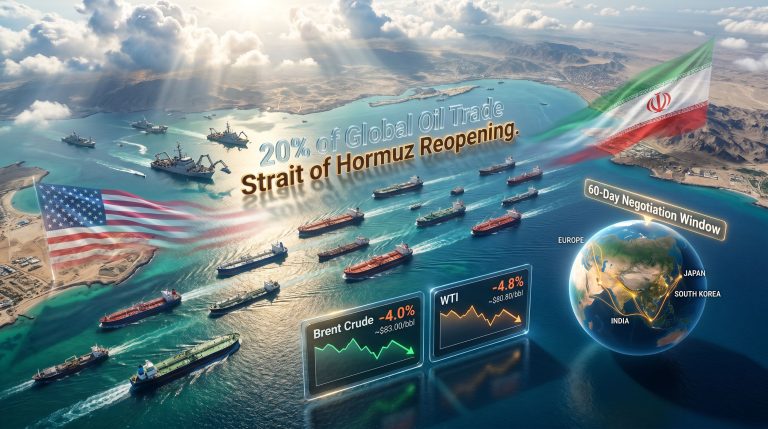
The immediate market response to the ceasefire announcement followed a predictable pattern. Brent crude fell approximately $3.45 to $83.89 per barrel, while the U.S. WTI benchmark dropped $4.03 to $80.85 per barrel. These are meaningful declines in percentage terms, reflecting genuine market relief.
However, both benchmarks remain well above the approximately $70 per barrel level at which oil was trading before the conflict began. Understanding these oil price movements in context is essential, as the persistent premium reflects the market's assessment that physical supply normalisation will lag political resolution by a considerable margin.
| Scenario | Market Assumption | Likely Brent Price Trajectory |
|---|---|---|
| Rapid normalisation (optimistic) | 75%+ capacity restored within weeks | Converges toward $70–$75/bbl |
| Gradual recovery (base case) | 80% capacity within 6 months | Stabilises in $78–$84/bbl range |
| Protracted disruption (pessimistic) | Iraq delays, insurance gaps persist | Remains above $85/bbl for 12+ months |
The Investment Freeze: A Compounding Medium-Term Problem
One of the least discussed but most consequential legacies of the strait's closure is the cessation of upstream capital investment during the conflict period. Energy infrastructure development operates on multi-year lead times. Drilling programmes, pipeline expansions, field development plans, and refinery upgrades that were deferred or cancelled during the conflict period will not deliver incremental supply capacity for years, regardless of when commercial operations resume.
Alan Gelder of Wood Mackenzie has highlighted this as a compounding structural headwind: the investment freeze does not end with the ceasefire. Capital must be recommitted, projects must be re-tendered, contractors must be reengaged, and the multi-year development cycle must restart from a point of significant delay. The practical implication is a structural undershoot in medium-term oil supply capacity that will be felt in global markets well beyond the immediate post-conflict period.
Downstream Consequences: Refineries, Fuel Markets, and Petrochemicals
Asian Refiners and the Crude Grade Substitution Problem
The disruption to Persian Gulf crude flows does not affect only upstream producers. Refineries in Asia, particularly in India, China, South Korea, and Japan, that are configured to process specific Middle Eastern crude grades have been forced to source alternative supplies from West Africa, the Americas, and the North Sea.
This substitution is not cost-free or frictionless. Alternative crude grades often carry different sulphur content, density characteristics, and yield profiles, meaning refineries must reconfigure their processing configurations or accept lower margins. In addition, current crude oil prices remain elevated enough to compress refinery margins further, even after operators absorb the additional costs of crude grade substitution.
Even after strait flows resume, refinery run rates will require additional weeks to normalise as operators rebuild feedstock inventories and recalibrate crude slates back to their preferred configurations.
The LPG and Petrochemical Blind Spot
The 279,000 metric tonnes of stranded LPG represents an often-overlooked dimension of the supply disruption. LPG is a primary feedstock for propylene and ethylene production in petrochemical complexes across Asia. Countries including India, Japan, and South Korea rank among the world's largest LPG importers, and the supply shortfalls created by the strait closure have cascaded into petrochemical production schedules in ways that are not immediately resolved by a political agreement.
The restart of LPG export flows follows the same sequencing constraints as crude oil, meaning petrochemical supply chains in Asia face weeks of continued tightness even after the waterway formally reopens.
The next major ASX story will hit our subscribers first
FAQ: Strait of Hormuz Oil Supply Recovery
How long will Strait of Hormuz oil supply recovery take to reach pre-war levels?
Based on assessments from S&P Global Energy and Wood Mackenzie, approximately 80% of pre-conflict supply levels could be restored within six months under a base-case scenario. Full normalisation, particularly for Iraq, may take 12 months or longer.
Why do oil prices remain elevated even after the ceasefire announcement?
Because physical supply normalisation lags political announcements significantly. The persistent premium above pre-war levels of approximately $70 per barrel reflects the market's rational assessment that tanker repositioning, insurance reinstatement, and upstream restarts will take months, not days.
Which Gulf producers will recover fastest?
Saudi Arabia and the UAE, due to their pipeline bypass infrastructure, are positioned to resume exports most quickly. Iraq, lacking bypass capacity and having undergone deeper shut-ins across more complex fields, faces the longest recovery timeline.
What is the effective bypass capacity if the strait remains partially restricted?
The EIA estimates approximately 3.5 mb/d of effective pipeline bypass capacity exists across Saudi Arabia's East-West Pipeline and the UAE's ADCOP. This represents a fraction of the strait's normal throughput of 21 mb/d and cannot substitute for full strait access.
How does the investment freeze affect the medium-term supply outlook?
Capital investment in upstream development effectively halted during the conflict. Given the multi-year lead times for energy infrastructure, this investment gap will constrain supply capacity growth for several years after commercial operations resume, creating a structural ceiling on how quickly the market can fully normalise. Consequently, the longer-term OPEC market influence over price stability becomes more pronounced as non-OPEC supply growth remains constrained.
Three Structural Constraints Governing the Recovery Pace
The Strait of Hormuz oil supply recovery is not a single event. It is a multi-phase process governed by three structural constraints that operate independently of each other and cannot be accelerated simply by political will:
-
Physical logistics: Tanker repositioning, stranded cargo clearance, and the inherent slow speed of maritime oil transport create irreducible delays measured in weeks to months, regardless of the political calendar
-
Insurance and risk markets: War-risk underwriters operate on their own assessment timeline. Coverage will be reinstated when they independently conclude conditions are safe, not when a government announces a ceasefire
-
Upstream restart complexity: Shut-in production, particularly in Iraq and smaller Gulf producers, faces well integrity, reservoir management, workforce, and capital constraints that extend recovery timelines to 12 months or more in the most affected cases
The reopening of the strait is a necessary condition for recovery. It is not a sufficient one. The gap between political announcement and physical supply normalisation will be measured in months, and the full restoration of pre-conflict production and trade flows remains a multi-year undertaking when the investment freeze is factored into the equation. As the WSJ has reported on deepening demand contraction, the road to full market recovery extends well beyond the initial headlines of any ceasefire agreement.
Want To Stay Ahead of Major Commodity Discoveries While Energy Markets Remain Volatile?
Whilst geopolitical disruptions continue reshaping global energy supply chains, Discovery Alert's proprietary Discovery IQ model delivers real-time alerts on significant ASX mineral discoveries, instantly identifying actionable opportunities across more than 30 commodities — explore historic discovery returns to see what's possible, and begin your 14-day free trial at Discovery Alert to position yourself ahead of the broader market.