August 7, 2026
The Hidden Architecture of Global Energy Risk: Why One Waterway Defines India's Economic Future
Every few years, financial markets are reminded that the global energy system rests on a surprisingly fragile physical foundation. Despite decades of diversification rhetoric, technological advancement, and supply chain sophistication, a single 33-kilometre-wide passage between the Iranian coastline and the Omani peninsula retains the ability to reshape oil prices, currency values, inflation trajectories, and government fiscal positions. The Strait of Hormuz reopening and its implications for India's oil imports is not merely a geopolitical news story. It is a stress test of how deeply integrated energy geography remains in modern economic planning.
When big ASX news breaks, our subscribers know first
Why the Strait of Hormuz Cannot Be Replaced
The Strait of Hormuz occupies a position in global energy infrastructure that has no genuine equivalent. At its narrowest navigable point, the shipping channel measures roughly three kilometres in each direction, yet approximately one-fifth of total global oil consumption transits this corridor every single day.
The Gulf producers whose exports depend entirely on this route include five of the world's most consequential crude suppliers:
- Saudi Arabia – the world's largest crude exporter and the anchor of OPEC+ production management
- Iraq – a high-volume producer whose export revenues fund virtually the entire national budget
- Kuwait – a compact but extraordinarily productive oil state with limited alternative export infrastructure
- The United Arab Emirates – a rapidly diversifying economy that still relies heavily on hydrocarbon export revenues
- Qatar – the dominant global exporter of liquefied natural gas, supplying critical volumes to Asian buyers including India
What makes Hormuz structurally irreplaceable is the absence of pipeline infrastructure capable of absorbing even a fraction of the displaced volume at comparable speed. While Saudi Arabia's East-West Pipeline (Petroline) offers some bypass capacity for crude, it cannot accommodate the full range of Gulf hydrocarbon exports, including LNG, LPG, and refined products, and operates well below the throughput volumes that pass through the strait daily.
"The Strait of Hormuz is not simply a shipping lane that nations would prefer to keep open. It is load-bearing infrastructure for the global economy, and any interruption, even a partial one, functions like removing a support column from a building that was designed around it."
How Does This Relate to Broader Oil Price Movements?
Understanding the crude oil market dynamics at play here requires appreciating how the strait's status influences everything from benchmark pricing to downstream fuel costs. Furthermore, oil price movements driven by geopolitical tension in this region have consistently demonstrated an outsized impact on global inflation and emerging market currencies.
From $70 to $119: Mapping the Price Shock Anatomy
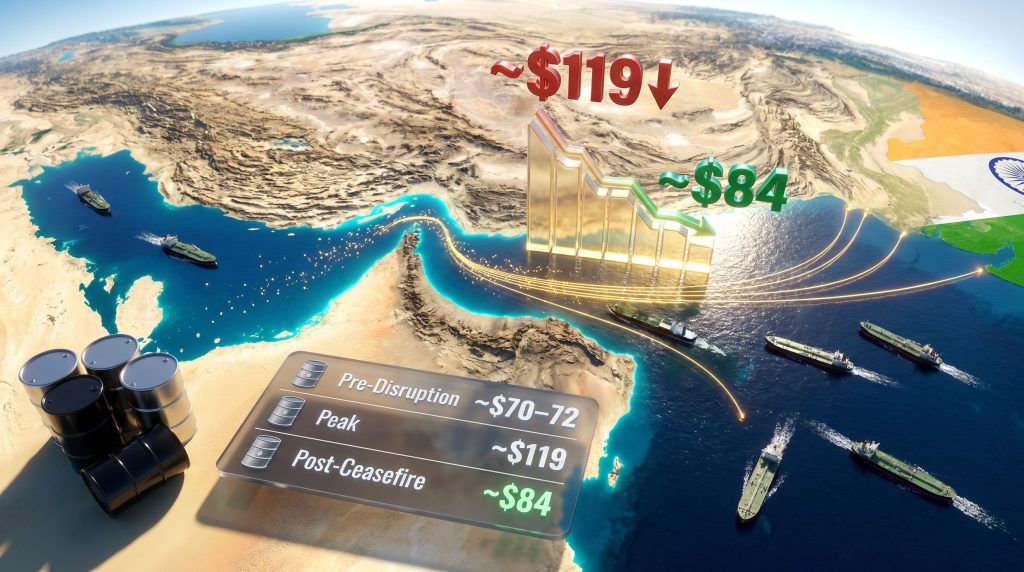
Understanding the scale of disruption caused by restricted Hormuz transit requires tracing the oil price trajectory across the disruption period. What unfolded was not a gradual adjustment but a sharp repricing of geopolitical risk embedded directly into the Brent crude benchmark.
| Price Milestone | Brent Crude (USD/barrel) |
|---|---|
| Pre-disruption baseline (February 2026) | ~$70-72 |
| Peak war-related disruption price | ~$119 |
| Post-ceasefire announcement price | ~$84 |
| Immediate decline on ceasefire news | approximately 4% |
The movement from roughly $70–72 per barrel in February to a peak of approximately $119 per barrel during the peak of disruption represents a near-70% price increase across a compressed timeframe. For a country of India's import scale, this magnitude of price movement translates into billions of additional dollars in monthly energy expenditure, compressing refinery margins, pressuring the current account, and forcing difficult trade-offs between fiscal support and retail price honesty.
The subsequent 4% decline to around $84 per barrel following the US-Iran ceasefire announcement illustrates how much of the elevated price reflected pure geopolitical risk premium rather than fundamental supply-demand imbalance. When traders concluded that physical supply disruption risk had materially reduced, the premium unwound rapidly — a pattern consistent with historical Hormuz tension episodes. Monitoring Brent and WTI futures during this period offered a real-time window into how traders were pricing the probability of sustained transit restrictions.
India's Structural Exposure: The Numbers Behind the Dependency
To appreciate why the Strait of Hormuz reopening carries such significance for India, the starting point must be understanding just how deeply India's energy system is anchored to Gulf supply chains.
Before the disruption period, India's energy import profile looked like this:
- Crude oil: More than 88% of total crude requirements sourced from abroad, with approximately half of that volume originating from Gulf producers whose exports transit Hormuz
- LPG: Approximately 60% import dependent overall, with around 90% of import volumes transiting through the strait
- Natural gas: Roughly half of national demand met via imports, with approximately 65% of those imports originating from Qatar and the UAE, both Hormuz-dependent exporters
These figures reveal a layered dependency structure that goes well beyond crude oil alone. India's vulnerability was not limited to petrol pump prices. It extended to cooking gas availability for hundreds of millions of households, fertiliser production economics (natural gas is the primary feedstock for urea manufacturing), power generation in gas-fired stations, and CNG supplies for urban transport fleets.
"The LPG dependency figure is particularly striking. With 90% of India's LPG import volumes transiting Hormuz, any sustained closure creates supply pressures that fall disproportionately on lower-income households, for whom subsidised LPG cylinders represent the primary cooking fuel. This is not merely an economic variable; it carries significant social and political weight."
What the Disruption Actually Cost: Retail Prices, Subsidies, and Fiscal Strain
The sequence of pricing decisions during the disruption period reveals the uncomfortable arithmetic facing any government managing politically sensitive fuel prices against a backdrop of surging import costs.
India's government chose to shield consumers initially, absorbing the cost differential at the fiscal level. On March 27, excise duty on both petrol and diesel was reduced by ₹10 per litre each, a measure explicitly timed to prevent retail price escalation during a period when five state assembly elections were scheduled, including the politically critical West Bengal contest.
Once the election cycle concluded, the adjustments came through:
- Petrol and diesel retail prices raised by approximately ₹7.50 per litre each
- CNG rates increased by ₹6 per kilogram
- LPG cylinder prices raised by ₹89 per 14.2-kg cylinder, implemented across two separate tranches
Despite these increases, state-owned fuel retailers continued operating at a loss estimated at approximately ₹50 crore per day, because retail prices still lagged the actual cost of procuring and refining imported crude at prevailing market rates. Industry sources noted that losses accumulated by state fuel retailers within a single quarter matched the full-year profit these companies had generated in prior periods — a striking illustration of the financial stress embedded in price management during supply disruption events.
India's Emergency Supply Response: Diversification Under Pressure
Perhaps the most consequential long-term outcome of the disruption may be what India's refining and procurement ecosystem was forced to build in response. Necessity accelerated changes that had been progressing slowly under normal market conditions.
Operational Framework: India's Emergency Supply Response
- Crude sourcing diversified across alternative geographic corridors including Russia, Africa, the United States, and Latin America
- India's active crude import supplier base expanded to approximately 40 source countries, substantially reducing single-corridor dependency
- Iranian crude reintroduced into the import mix after a seven-year hiatus, enabled by temporary US sanctions relief measures during the supply crisis
- LNG spot market procurement activated to compensate for reduced Qatar pipeline flows
- LPG commercial supply to hotels and restaurants initially suspended, then progressively restored to approximately 70% of prior volumes
- Retail fuel bulk purchase restrictions introduced to manage distribution integrity and prevent diversion to grey markets
- Full fuel supply chain inventory positions monitored and maintained at strategic depot and retail distribution points
The reintroduction of Iranian crude after seven years deserves particular attention. This was not a routine procurement decision; it represented a significant diplomatic and commercial shift made possible by the unusual circumstances of the crisis. Whether this supply relationship endures beyond the immediate disruption period will depend on the evolution of US sanctions policy and the durability of the broader US-Iran framework. For further context on India's Hormuz dilemma, the strategic calculus remains complex even after the ceasefire announcement.
The next major ASX story will hit our subscribers first
Sector-Level Benefits of Strait Reopening
The economic relief flowing from sustained Hormuz normalisation is not uniform across India's economy. It concentrates in sectors where energy costs represent a high proportion of total operating expenses.
| Sector | Energy Cost Sensitivity | Expected Benefit from Reopening |
|---|---|---|
| Aviation | Very High | Lower jet fuel acquisition costs, improved airline operating margins |
| Petrochemicals | High | Reduced naphtha and feedstock costs, improved output economics |
| Fertilisers | High | Lower natural gas input costs, eased agricultural input prices for farmers |
| Shipping and Logistics | High | Reduced freight rates, normalised insurance premiums |
| Food and Consumer Goods | Moderate | Lower transportation costs, moderated retail price inflation |
| Construction Materials | Moderate | Reduced energy-intensive production costs across cement and steel |
At the macroeconomic level, the transmission channels are equally significant. Lower crude import costs reduce the overall import bill, supporting the rupee against the US dollar and narrowing the current account deficit. Reduced energy input costs across manufacturing, agriculture, and services moderate the broader inflation environment, giving the Reserve Bank of India greater monetary policy flexibility.
How Does This Affect Industrial Sectors Beyond Energy?
The fiscal position also improves as the pressure to sustain fuel price subsidies or excise duty relief diminishes, restoring room for other government spending priorities. In addition, lower energy costs feed into broader industrial competitiveness, including steel production trends, where energy-intensive manufacturing benefits considerably from normalised input prices.
The Residual Risk That Persists After the Ceasefire
The Strait of Hormuz reopening should not be interpreted as the resolution of India's underlying energy security vulnerability. It represents a relief event within a structural condition that has not fundamentally changed.
Several residual risk factors merit attention from energy security planners and investors alike:
- Ceasefire durability: The agreement's long-term stability remains the central variable. Any deterioration in US-Iran relations or renewed regional escalation could rapidly reinstate transit restrictions and reimpose geopolitical risk premiums on crude pricing
- Selective access reports: During the disruption period, reports described the strait as being differentially accessible for vessels from certain nations, creating unpredictability for commercial shipping planners that standard insurance models struggled to price accurately
- Inventory drawdown: India's crude stockpiles declined by approximately 15% during the peak disruption period. While authorities maintained that reserves remained adequate, this drawdown highlights the limits of strategic buffer capacity under extended disruption scenarios
- Economics of diversification: Sourcing crude from Russia, West Africa, or Latin America at scale introduces higher freight costs, longer voyage times, and different crude quality characteristics that affect refinery yields
"The structural paradox India faces is that its most cost-efficient crude supply sources and its highest geopolitical risk corridors are the same geography. Diversification makes India more resilient but also more expensive to supply, a trade-off that becomes visible in refinery margins and ultimately in fuel retail economics."
Global Market Implications Beyond India
The Strait of Hormuz reopening carries implications that extend well beyond India's bilateral energy economics. The removal of geopolitical risk premium from Brent crude pricing affects every economy that imports oil, and several dynamics will unfold across global markets in the months ahead.
OPEC's market influence becomes particularly consequential at this juncture. With supply constraint pressure easing and prices moderating, the group's production management decisions will carry greater weight in determining whether crude markets find a new equilibrium or drift toward oversupply. Furthermore, other major Asian importers, including China, Japan, and South Korea, share similar Hormuz dependency profiles to India and will experience analogous relief across their energy import economics.
For global inflation dynamics, lower energy input costs represent a meaningful disinflationary impulse at precisely the point when many central banks have been managing persistent price pressures. The transmission from lower crude prices into consumer price indices typically takes two to four months across most economies, suggesting the macroeconomic benefits of sustained Hormuz normalisation will become measurable in headline inflation data through the latter part of 2026. The IEA's assessment of Hormuz oil security underscores just how central this corridor remains to global emergency response planning.
Frequently Asked Questions: Strait of Hormuz Reopening and India's Oil Imports
What Percentage of Global Oil Supply Passes Through the Strait of Hormuz?
Approximately one-fifth of global oil consumption transits the strait, making it the single most critical maritime chokepoint in the global energy system.
How Did the Disruption Affect Petrol and Diesel Prices in India?
The government initially absorbed rising crude costs through excise duty reductions of ₹10 per litre on both fuels. After state elections concluded, retail prices were raised by approximately ₹7.50 per litre each, with further increases applied to CNG and LPG.
Has India Resumed Iranian Crude Oil Imports?
Yes. After a seven-year gap, India reintroduced Iranian crude purchases under temporary US sanctions relief arrangements that were activated during the supply crisis.
What Happened to India's Crude Stockpiles During the Disruption?
National crude inventories declined by approximately 15% during the peak disruption period. Authorities stated that remaining reserves were sufficient to cover an extended consumption window.
Which Sectors Benefit Most From Lower Oil Prices Following Strait Reopening?
Aviation, petrochemicals, fertilisers, shipping and logistics, and food manufacturing carry the highest energy cost sensitivity and stand to benefit most directly from normalised crude and freight pricing.
Could the Strait Be Disrupted Again?
The ceasefire framework's durability is not guaranteed. A deterioration in US-Iran relations or renewed regional conflict could rapidly reinstate transit restrictions and reimpose price premiums across energy-importing economies globally.
Disclaimer: This article contains forward-looking analysis and scenario projections based on publicly available data and industry reporting. Crude oil prices, geopolitical conditions, and policy settings can change rapidly. Nothing in this article constitutes financial, investment, or energy procurement advice. Readers should consult qualified professional advisers before making decisions based on energy market or geopolitical assessments.
Want to Track the Next Major Commodity Shock Before It Moves Markets?
When geopolitical events like Hormuz disruptions reshape energy costs overnight, the investors best positioned are those with real-time intelligence on how commodity dynamics are shifting. Discovery Alert's proprietary Discovery IQ model instantly translates complex ASX mineral discovery announcements across more than 30 commodities into actionable insights — begin your 14-day free trial today and explore historic discovery outcomes that demonstrate why being early to a major find can define an investment portfolio.