August 10, 2026
The Supply Ceiling Nobody Is Talking About
Every major energy disruption Europe has faced in recent memory has been framed as a crisis with a beginning, a middle, and an eventual resolution. Wars end, sanctions regimes evolve, shipping lanes reopen, and markets stabilise. This framing has shaped every policy response the European Union has deployed across the past four years, defaulting toward market stabilisation over structural transformation.
However, embedded within that crisis-response cycle is a far more consequential threat, one that does not announce itself with a geopolitical shock and does not offer a diplomatic resolution. It is the slow, irreversible contraction of global oil export capacity as producing nations reach and surpass their production peaks.
The Europe peak oil crisis is not a hypothetical future event. It is a structural condition that is already developing across the continent's import supply chains, and the window for proactive adaptation may be considerably narrower than policymakers currently appreciate.
When big ASX news breaks, our subscribers know first
Why Geopolitical Shocks and Peak Oil Are Fundamentally Different Problems
Two Categories of Supply Disruption
To understand why Europe's current approach to energy security is insufficient, it helps to distinguish clearly between two categories of supply disruption that analysts and policymakers frequently conflate.
The first category is the geopolitical shock: a conflict, sanctions regime, or infrastructure closure that temporarily restricts supply. These events are acute, they generate immediate price responses, and they are ultimately reversible. When Russia invaded Ukraine in February 2022, Europe faced an acute dependency problem, with approximately 40% of EU natural gas supply flowing from Russian producers at the time.
That dependence was painful and politically damaging, but it was also a problem with addressable solutions: LNG terminals, alternative pipeline routes, accelerated renewable deployment, and supply source diversification. Furthermore, the trade war impact on oil markets during this period added another layer of complexity to Europe's already strained energy relationships.
The second category is categorically different. Terminal production decline is the permanent, irreversible reduction in a producing nation's capacity to generate and export crude oil. No amount of diplomacy resolves an exhausted reservoir. No alternative supplier relationship compensates for a systemic reduction in the total volume of oil available on global export markets.
The Insidious Nature of Gradual Decline
Critical distinction: A geopolitical supply shock creates an urgent, identifiable crisis. Terminal production decline creates a gradually tightening ceiling that may not generate political urgency until the constraint is already acute.
This is the core analytical challenge. Peak oil's gradual onset can be misread as a succession of manageable price cycles rather than a structural shift in available export volumes. Each upward price movement gets attributed to a specific trigger, masking the underlying long-term trend in supply capacity.
By the time the structural reality becomes undeniable, the lead time required to build genuine resilience through infrastructure investment, demand reduction, and supply chain restructuring has likely expired. Understanding crude oil price trends is therefore essential for European policymakers who must distinguish between cyclical volatility and permanent structural decline.
Europe's Import Exposure: The Numbers Behind the Vulnerability
Quantifying the Structural Dependency
The scale of Europe's import reliance provides essential context for understanding the severity of the peak oil risk. According to figures released by the European Council, the data tells a stark story:
| Metric | Figure |
|---|---|
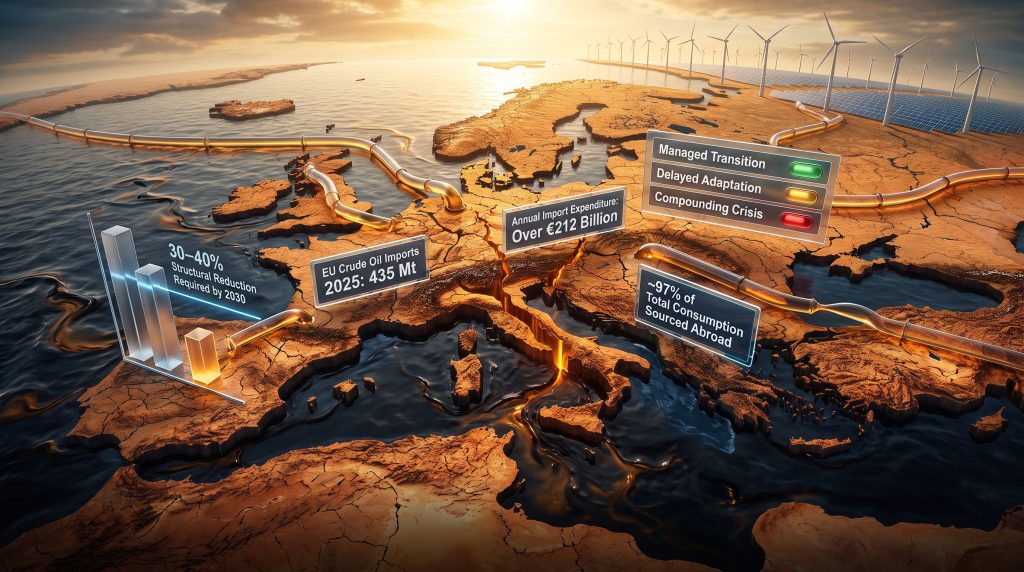
| EU crude oil imports (2025) | 435 million tonnes (Mt) |
| Annual import expenditure | Over €212 billion |
| Share of crude sourced externally | ~97% of total consumption |
| Pre-2022 Russian natural gas dependency | ~40% of EU natural gas supply |
| Global oil and gas trade through Strait of Hormuz | ~20% of daily flows (pre-crisis) |
These figures establish an uncomfortable baseline: the European Union is among the most import-dependent major economic blocs on earth for crude oil, with a structural reliance on external supply that dwarfs almost any equivalent economy of comparable size and sophistication.
Where Europe's Oil Now Comes From
Following the post-2022 restructuring of EU energy supply chains, import sources have been successfully diversified across a broader range of supplier nations, including Middle Eastern producers, West African exporters, Norwegian fields, and the United States. Analysts widely regard this diversification as a meaningful policy achievement.
However, diversification across multiple external suppliers does not eliminate structural exposure to a global supply ceiling. Critically, several of Europe's alternative suppliers are themselves approaching or have already passed their own long-term production peaks:
- North Sea production peaked in the late 1990s and has been in structural decline for more than two decades
- Multiple Middle Eastern producers face ageing legacy fields, rising domestic consumption that compresses their exportable surplus, and insufficient upstream reinvestment to sustain output growth
- West African production has seen uneven development, with operational and political risks constraining consistent export growth
- US shale output has delivered significant volumes but faces its own questions about long-term plateau dynamics as the most productive acreage is progressively depleted
Understanding Peak Export Capacity: The Metric That Matters Most for Europe
Why Total Production Is the Wrong Number to Watch
A common misconception in popular peak oil discussions is that the relevant metric is total global crude oil production. For energy-importing regions like the European Union, this framing is misleading. The genuinely critical figure is peak export capacity: the point at which key supplier nations can no longer sustain or increase the volume of crude available for international markets.
This distinction matters enormously because a producing nation can continue generating substantial oil output while its exportable surplus simultaneously shrinks. As domestic populations grow, economies industrialise, and internal consumption expands, the share of total production available for export contracts even if headline production remains stable. Several of Europe's current supplier nations are already experiencing this dynamic, where rising domestic demand is quietly eroding the export volumes available to European refineries.
What is peak export capacity? It refers to the point at which a producing nation's available surplus for international sale begins a structural decline, regardless of whether total production has peaked. For import-dependent economies, this is the more consequential threshold.
The Shift Project's 2030 Projection
Analysis from The Shift Project, a French research organisation specialising in energy transition modelling, projects that by 2030, aggregate production capacity among current EU crude oil supplier nations could contract sufficiently to generate severe structural supply constraints. The combination of ageing well stock, chronic underinvestment in upstream exploration across key producing regions, and the domestic consumption expansion phenomenon described above are all simultaneously compressing the export surplus available to European buyers.
Unlike the post-2022 Russian gas situation, where the EU was able to pivot toward alternative supply categories, a broad-based decline across multiple supplier nations simultaneously offers no equivalent pivot point. The pool of nations capable of meaningfully increasing their export volumes is shrinking.
Three Scenarios for Europe's Oil Supply Future
Mapping the Range of Possible Outcomes
Strategic scenario modelling across a range of plausible futures illustrates the divergence between proactive and reactive policy approaches:
| Scenario | Conditions | Likely EU Outcome |
|---|---|---|
| Managed Transition | Accelerated renewables buildout, demand reduction achieved, reserves expanded | Supply tightening absorbed without systemic crisis; energy costs elevated but stable |
| Delayed Adaptation | Incremental policy progress, continued import reliance, no structural demand reduction | Gradual supply squeeze through the 2030s; periodic price spikes; political instability pressure |
| Compounding Crisis | Peak oil decline coincides with geopolitical disruption; EU structurally unprepared | Severe supply shortfall, energy poverty escalation, heightened vulnerability to foreign leverage |
The Delayed Adaptation scenario most closely reflects the trajectory established by European policy behaviour across the 2022 to 2026 crisis cycle, where each disruption has been managed through emergency procurement and market intervention rather than structural reform.
The Compounding Crisis scenario is the outcome that energy security analysts flag as most dangerous and most systematically underappreciated. A moment where peak oil dynamics are already constraining available export volumes, and a simultaneous geopolitical disruption removes a key supplier, leaves Europe with no short-term remediation pathway. The broader context of geopolitical trade tensions makes this scenario increasingly plausible.
Europe's Crisis Response Pattern: Short-Term Management Over Structural Transformation
Three Crises, One Template
Across the 2022 Ukraine invasion, the 2023–2024 Red Sea shipping disruptions that affected supply routing through a critical chokepoint, and the 2026 Strait of Hormuz closure, European policy responses have followed a remarkably consistent template:
- Emergency procurement to replace disrupted supply volumes
- Diplomatic engagement to stabilise relationships with alternative suppliers
- Short-term market interventions to limit consumer price exposure
- Return to baseline once the immediate disruption resolves
What this template consistently omits is the structural dimension. Accelerating indigenous clean energy capacity, reducing the EU's fundamental oil demand, deepening strategic reserves, and investing in alternative energy vectors that reduce structural oil dependence have each been discussed at length, but consistently deprioritised when immediate stabilisation pressures dominate policy bandwidth.
A senior European official, quoted anonymously by the BBC in the context of the Hormuz closure, expressed profound frustration that European leaders continued to scramble for short-term solutions to energy price crises rather than advancing long-term structural plans to make the continent more competitive and resilient. The observation was pointed: different conflict, identical response pattern.
The Sovereignty Dimension
Energy insecurity is not solely an economic problem. It represents a sovereignty constraint with direct implications for geopolitical influence and national security. As the number of nations capable of increasing oil export volumes shrinks over time due to peak production dynamics, the geopolitical leverage of remaining exporters grows proportionally.
This dynamic played out with particular clarity during Europe's pre-2022 dependence on Russian natural gas, where a single supplier relationship created coercive vulnerability that affected the entire bloc's strategic posture.
Strategic warning: The fewer nations available to increase export volumes in a tight market, the more leverage each remaining exporter holds over import-dependent buyers, regardless of whether any active conflict or crisis is underway.
The next major ASX story will hit our subscribers first
What Genuine Structural Resilience Would Require
The Four Pillars of a Credible Response
Translating the structural risk into actionable policy requires moving beyond crisis-response frameworks toward a long-horizon resilience architecture. The most credible approach involves four interconnected pillars:
- Demand reduction at scale through mass electrification of transport and heating, reducing the fundamental volume of oil imports the EU requires rather than merely managing their cost
- Indigenous renewable capacity expansion at a pace sufficient to replace import volumes, not simply supplement them alongside continued fossil fuel dependence
- Strategic reserve depth expanded beyond IEA-mandated minimums, with better EU-level coordination to provide meaningful buffer time across disruption scenarios
- Diversification beyond oil through investment in hydrogen, synthetic fuels, and other non-crude energy vectors that reduce the structural role of petroleum in the European economy
In addition, the energy transition in mining offers instructive lessons for how heavy industrial sectors can systematically reduce petroleum dependency through structural investment rather than reactive procurement.
The Gap Between Policy Ambition and Structural Delivery
The EU has committed to tripling energy storage capacity by 2030, representing genuine progress on one critical pillar. However, a more comprehensive assessment reveals significant gaps:
| Policy Area | Current EU Status | Required Pace | Gap Assessment |
|---|---|---|---|
| Renewable electricity capacity | Expanding, broadly on 2030 targets | Needs acceleration beyond current trajectory | Moderate gap |
| Oil demand reduction | Incremental decline | Structural reduction of 30–40% by 2030 needed | Significant gap |
| Strategic oil reserves | Maintained at IEA minimums | Expansion and coordination required | Moderate gap |
| Transport electrification | Growing but uneven across member states | Mass-market EV penetration by mid-2030s required | Significant gap |
| Indigenous clean energy replacing imports | Scaling | Must replace rather than supplement import volumes | Critical gap |
Furthermore, securing adequate critical minerals demand will be central to delivering on renewable capacity commitments, as electrification infrastructure depends heavily on lithium, cobalt, and rare earth supply chains that carry their own geopolitical exposure.
Could Constrained Supply Actually Accelerate Europe's Transition?
The Scarcity Catalyst Paradox
There is a counterintuitive scenario worth examining: that the gradual tightening of global oil export capacity could, if recognised and framed correctly, function as the sustained economic pressure that motivates the structural energy transition Europe has repeatedly deferred. Historical precedent supports this possibility.
The acute gas crisis of 2022 accelerated EU renewable deployment timelines and LNG infrastructure investment considerably faster than years of climate policy mandates had managed to achieve.
A prolonged, structural tightening of oil export availability might similarly catalyse the industrial-scale electrification, storage buildout, and demand reduction that short-term market stability has consistently allowed policymakers to defer. Analysts at Bruegel have specifically warned that Europe must prepare for the possibility of a supply crunch that is structural rather than cyclical in nature.
The critical risk, however, is that peak oil's gradual onset continues to be misread as a series of cyclical price events rather than a structural ceiling. If European policymakers attribute each successive oil price spike to a specific geopolitical trigger and respond with the established emergency procurement template, the transition opportunity embedded in the supply constraint is wasted, and the Compounding Crisis scenario becomes progressively more probable.
Frequently Asked Questions: Europe's Peak Oil Crisis
What is the Europe peak oil crisis?
The Europe peak oil crisis refers to the growing structural risk that the continent's near-total dependence on imported crude oil leaves it exposed to a long-term tightening of global export capacity as key supplier nations approach or pass their production peaks. Unlike a geopolitical supply shock, this form of energy crisis develops gradually over years or decades without a clear triggering event, making it far harder to detect and politically mobilise against.
How much oil does the EU import each year?
In 2025, the European Union imported approximately 435 million tonnes of crude oil, representing expenditure of more than €212 billion. Approximately 97% of EU crude oil consumption is sourced from outside the bloc, making Europe among the most externally dependent major economies for petroleum.
What is the difference between a geopolitical oil shock and peak oil?
A geopolitical oil shock is a temporary, externally caused supply disruption that is, in principle, reversible through diplomacy, market adjustment, or infrastructure adaptation. Peak oil refers to the permanent, irreversible decline in a producing nation's output and export capacity — a trend driven by physical depletion that cannot be resolved through any negotiated outcome.
When could peak oil affect Europe's energy supply?
Research from The Shift Project projects that by 2030, production capacity among current EU crude oil supplier nations could begin contracting in ways that generate structural supply constraints. The precise timeline carries uncertainty, but the directional trend among ageing major producing nations is well-documented across the industry.
What is the most underappreciated aspect of peak export capacity?
Many analysts focus on global production totals, but the more consequential dynamic for European buyers is the compression of exportable surplus driven by rising domestic consumption in producing nations. A country can maintain total output while simultaneously reducing the volume available for international sale, creating a tightening supply environment that does not show up in headline production figures. The Robert Schuman Foundation has similarly highlighted how the 2026 oil crisis presents both danger and opportunity for European energy adaptation.
The Narrowing Window for Proactive Response
The lead time required to build genuine energy resilience is measured in decades, not budget cycles. Electricity infrastructure, transport electrification at scale, industrial demand reduction, and the development of alternative energy vectors all require sustained investment commitments that span multiple political terms. Europe's repeated reliance on the emergency stabilisation template has consumed time that cannot be recovered.
Framing the transition not as a climate obligation but as a strategic economic and security imperative may represent the most effective political lever for accelerating the pace of structural reform. Nations and economic blocs that achieve genuine energy autonomy earliest will hold meaningful competitive advantages in an era of structurally constrained global fossil fuel export capacity.
For Europe, the ability to sustain industrial output, maintain living standards, and project geopolitical credibility over the coming decades is directly and materially tied to whether it recognises the Europe peak oil crisis as a structural condition requiring structural solutions — before the tightening supply ceiling makes that recognition unavoidable.
Disclaimer: This article contains forward-looking analysis and projections based on publicly available research. Energy market trajectories involve significant uncertainty. Nothing in this article constitutes investment or financial advice. Readers are encouraged to consult independent sources and professional advisors before making decisions based on energy market forecasts.
Want To Stay Ahead of the Commodity Shifts Reshaping Energy Markets?
Discovery Alert's proprietary Discovery IQ model delivers real-time alerts on significant ASX mineral discoveries — including critical minerals central to Europe's energy transition — instantly transforming complex data into actionable investment insights for both short-term traders and long-term investors. Explore historic discoveries and their remarkable returns, then begin your 14-day free trial at Discovery Alert to position yourself ahead of the market.