July 1, 2026
Europe's critical mineral landscape stands at an inflection point. While global demand for rare earth elements accelerates alongside renewable energy deployment and electric vehicle adoption, European manufacturers remain almost entirely dependent on Chinese-controlled supply chains. This dependence creates strategic vulnerabilities that extend beyond simple procurement challenges into the realm of industrial competitiveness and technological sovereignty.
The dynamics reshaping this sector reflect broader shifts in global resource geopolitics, where mineral-rich nations are increasingly leveraging natural endowments for strategic advantage. Against this backdrop, Norway's expanding rare earth resource base represents more than geological discovery – it signals potential transformation of European supply chain architecture.
Continental Resource Security Through Norwegian Carbonatite Geology
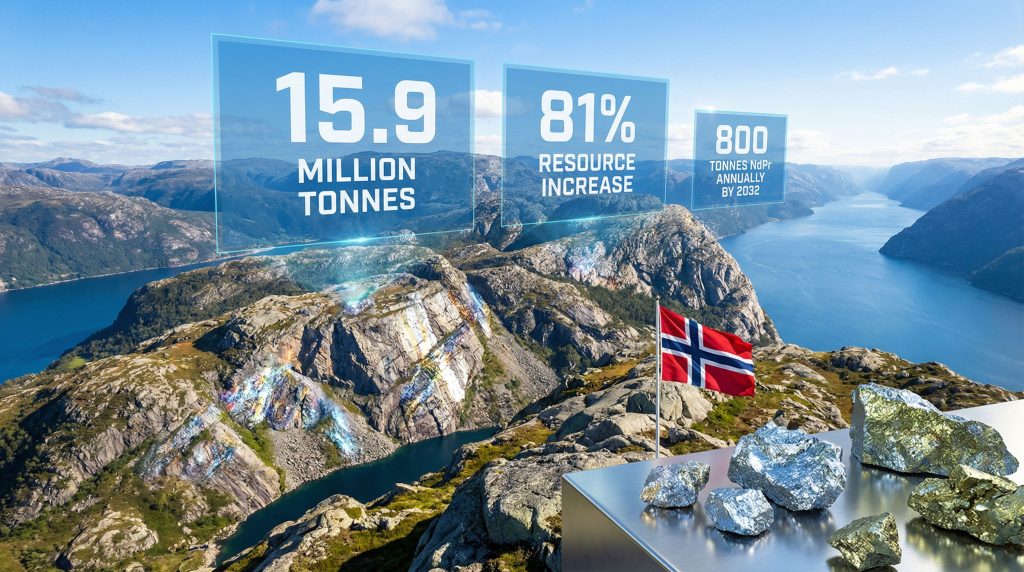
Norway's Fen Complex has emerged as Europe's most significant rare earth discovery, with recent resource evaluations revealing the deposit's exceptional scale and strategic importance. The complex hosts 15.9 million metric tons of total rare earth oxide (REO) content in indicated and inferred resources, representing an 81% increase from the 8.8 million tons calculated in 2024. This rare earths Norway deposit estimate has fundamentally altered Europe's strategic outlook on resource independence.
Carbonatite Formation Advantages in Mineral Extraction
The Fen deposit exemplifies carbonatite-hosted rare earth mineralisation, a geological formation type that offers distinct economic advantages over alternative rare earth sources. Carbonatite complexes – igneous rocks with high carbonate mineral content – concentrate rare earth elements through specialised geochemical processes that create naturally enriched ore bodies.
This geological characteristic provides several extraction benefits:
- Higher grade concentrations reducing processing volume requirements
- More predictable metallurgical behaviour compared to complex pegmatite systems
- Lower energy requirements for mineral liberation and processing
- Reduced environmental footprint through concentrated mineralisation
Global carbonatite deposits including Mountain Pass in California and Bayan Obo in China demonstrate the economic viability of this deposit type. The Fen Complex's carbonatite geology positions it favourably within this category of world-class rare earth resources.
Scale Analysis Within European Context
The magnitude of Norway's rare earths Norway deposit estimate becomes apparent when compared with other European prospects. Sweden's Per Geijer deposit, previously considered Europe's largest, contained 1.3 million tons of rare earth oxides in 2023 estimates, subsequently revised to 2.2 million tons. The Fen deposit's 15.9 million ton resource dwarfs these figures, establishing clear resource supremacy within the continent.
| European Rare Earth Deposits | REO Content (Million Tons) | Development Status |
|---|---|---|
| Norway Fen Complex | 15.9 | Pre-production |
| Sweden Per Geijer | 2.2 | Exploration |
| Greenland Kvanefjeld | 11.0+ | Suspended |
This resource scale provides Europe with meaningful domestic supply potential, though successful development requires overcoming substantial technical and economic challenges inherent in competing with established Chinese production. Furthermore, the strategic establishment of a European raw materials facility could complement Norway's production capabilities.
When big ASX news breaks, our subscribers know first
Strategic Implications for European Supply Chain Independence
China's dominance in rare earth markets stems primarily from processing infrastructure rather than raw material ownership. While controlling approximately 90% of global processed rare earths, China's influence extends throughout the value chain from mining through refined product manufacturing.
Understanding Chinese Market Control Mechanisms
The concentration of processing capacity creates critical vulnerabilities for European manufacturers regardless of raw material sources. Chinese facilities refine rare earth concentrates into the specialised oxides, metals, and alloys required for high-technology applications. This processing bottleneck enables market influence through:
- Export quota restrictions during geopolitical tensions
- Pricing manipulation through supply management
- Technology transfer requirements for market access
- Preferential allocation to domestic Chinese manufacturers
Historical precedents demonstrate this market power: during 2010-2011 geopolitical disputes, Chinese export restrictions created acute global shortages and price increases exceeding 1,000% for certain rare earth elements.
EU Critical Minerals Policy Framework
The European Raw Materials Act establishes domestic sourcing requirements aimed at reducing import dependence for strategic materials. The legislation targets:
- 10% domestic production of critical raw materials by 2030
- 40% processing capacity within EU borders
- 15% recycling rates for applicable materials
- Supply chain diversification beyond single-source dependencies
Norway's Fen development directly supports these objectives by creating European rare earth production capability. When operational in late 2031, the project's projected 800 tons of neodymium-praseodymium (NdPr) annual production would satisfy approximately 5% of EU demand for these critical permanent magnet materials. Additionally, the broader concept of a critical minerals reserve continues to gain momentum across developed nations.
Economic Fundamentals Driving Resource Expansion
The 81% resource increase reflects Rare Earths Norway's interpretation of additional drilling data collected during exploration expansion. This improvement – from 8.8 to 15.9 million tons – indicates initial resource estimates were conservative and the deposit possesses greater continuity than originally modelled.
Resource Classification and Confidence Levels
The JORC 2012 compliance standards governing the resource estimate ensure international comparability and institutional investor confidence. JORC classification distinguishes between:
- Indicated Resources: Higher confidence estimates based on detailed geological data
- Inferred Resources: Lower confidence estimates requiring additional drilling for confirmation
- Measured Resources: Highest confidence category supporting reserve calculations
WSP's consulting methodology incorporated expanded drilling programmes to upgrade resource confidence levels and extend known mineralisation boundaries. The depth extension potential to 1,000 metres below sea level suggests substantial exploration upside beyond current estimates.
NdPr Content Premium and Market Positioning
The deposit's 19% neodymium-praseodymium (NdPr) content represents significant economic advantage within rare earth markets. NdPr elements command premium pricing due to their essential role in permanent magnet manufacturing for:
- Electric vehicle motors requiring high-performance magnets
- Wind turbine generators demanding magnetic stability
- Industrial automation systems using servo motors
- Defence applications requiring specialised magnetic materials
This composition advantage enables superior project economics compared to deposits with lower NdPr percentages, as revenue concentrates in the highest-value rare earth elements rather than lower-priced constituents. These materials are fundamental energy transition minerals driving global decarbonisation efforts.
Production Timeline and Competitive Positioning
Rare Earths Norway projects production commencement in late 2031, with 800 tons of NdPr annual capacity by 2032. This timeline reflects the comprehensive development cycle required for greenfield rare earth projects, encompassing permitting, engineering, construction, and commissioning phases.
Regulatory Pathway and Permitting Requirements
The company currently holds an extraction permit but requires an operating permit before production begins. This two-stage Norwegian permitting structure ensures:
- Environmental impact assessment covering water quality, air emissions, and ecosystem protection
- Community consultation including indigenous Sámi populations where applicable
- Social licence validation through stakeholder engagement processes
- Technical compliance verification of mining and processing methods
Norwegian environmental frameworks establish stringent requirements that, while increasing compliance costs, enable premium market positioning as "conflict-free" and environmentally responsible rare earth production. For comprehensive guidance on this complex process, mining permitting insights provide essential understanding.
Cost Competitiveness Challenges
Despite resource advantages, the project faces significant cost competitiveness challenges relative to Chinese production. Norwegian operations encounter higher expenses across multiple categories:
- Labour costs exceeding Chinese wages by 3-5 times
- Environmental compliance requiring advanced waste management and emissions control
- Infrastructure development in regions lacking established mining support services
- Regulatory oversight imposing additional operational and reporting requirements
CEO Alf Reistad acknowledges the need for "derisking procedures" to achieve market viability, indicating recognition that supply security benefits alone may not overcome economic disadvantages without operational optimisation and strategic partnerships.
Market Dynamics and Competitive Intelligence
Global rare earth markets exhibit characteristics that favour established producers while creating opportunities for strategically positioned new entrants. Understanding these dynamics reveals both challenges and advantages facing Norwegian production.
Supply Chain Premium Opportunities
European manufacturers increasingly recognise supply chain security as a procurement priority, creating opportunities for premium pricing beyond commodity rates. Factors driving this shift include:
- Supply disruption experiences during geopolitical tensions
- Corporate sustainability mandates requiring responsible sourcing
- Risk management frameworks emphasising supply diversification
- Regulatory compliance with emerging due diligence requirements
Norwegian rare earth production can capture these premiums through:
- Long-term supply agreements with fixed pricing mechanisms
- Conflict-free certification meeting corporate responsibility standards
- Supply security guarantees reducing procurement risk for strategic customers
- Technical support services providing application development assistance
Technology Transfer and Processing Development
Successful Norwegian rare earth production requires complementary processing infrastructure development. Raw mineral concentrates require refinement into specialised oxides, metals, and alloys for industrial applications. This creates opportunities for:
- Strategic partnerships with existing rare earth processors
- Technology licensing agreements for proprietary separation processes
- Joint venture arrangements sharing development costs and market risks
- Vertical integration strategies capturing higher value-added processing margins
The development of European processing capabilities reduces dependence on Chinese refining while creating higher-value industrial activities and technical expertise within continental borders.
Investment Framework and Development Economics
The Fen project's investment attractiveness reflects multiple factors beyond simple resource scale, including geological risk, market positioning, and strategic value within European industrial policy.
Infrastructure and Capital Requirements
Successful development requires substantial capital investment across multiple categories:
- Mining infrastructure including extraction equipment, waste management systems, and site preparation
- Processing facilities for mineral concentration and initial refining
- Transportation systems connecting remote mining locations with processing facilities and export terminals
- Workforce development programmes creating specialised technical capabilities
The remote location of carbonatite deposits often requires greenfield infrastructure development, increasing capital requirements but creating long-term competitive advantages through optimised facility design. Understanding mineral deposit classifications becomes crucial for proper development planning.
Revenue Modelling and Market Scenarios
Financial projections must account for rare earth price volatility and market development scenarios. Key variables include:
- NdPr pricing trends driven by permanent magnet demand growth
- Supply-demand balancing as new global production capacity develops
- Chinese market policy affecting global pricing and availability
- Technology substitution potentially reducing specific element requirements
Conservative financial modelling typically incorporates multiple price scenarios reflecting both favourable market conditions and potential downturn periods to ensure project viability across market cycles.
The next major ASX story will hit our subscribers first
Geopolitical Implications and Strategic Positioning
Norway's rare earth development carries implications extending beyond European supply security into broader geopolitical and alliance considerations.
NATO Alliance Mineral Security
As NATO member nations prioritise defence industrial base resilience, access to critical minerals for military applications gains strategic importance. Rare earth elements are essential for:
- Advanced radar systems requiring specialised magnetic materials
- Precision-guided munitions using rare earth-based components
- Electronic warfare equipment dependent on rare earth phosphors and magnets
- Satellite communication systems incorporating rare earth-doped optical components
Norwegian production provides NATO alliance members with secure access to these strategically critical materials, reducing dependence on potentially adversarial suppliers.
Technology Transfer and Industrial Development
Successful rare earth production creates opportunities for broader industrial development through:
- Research and development initiatives advancing separation and processing technologies
- Technical expertise development in specialised metallurgical processes
- Supply chain integration with downstream manufacturing industries
- Innovation ecosystems supporting advanced materials applications
These developments position Europe for leadership in rare earth-dependent technologies while building technical capabilities that enhance long-term industrial competitiveness.
Risk Assessment and Mitigation Strategies
While the Fen deposit represents significant opportunity, comprehensive risk assessment reveals multiple challenges requiring careful management.
Technical and Operational Risks
Primary risk factors include:
- Geological uncertainty in unmined portions of the deposit requiring additional exploration
- Metallurgical complexity in optimising rare earth recovery and separation processes
- Environmental compliance costs potentially exceeding initial estimates
- Operational scaling challenges transitioning from pilot-scale to commercial production
Risk mitigation strategies focus on:
- Comprehensive geological modelling using advanced drilling and analytical techniques
- Pilot plant testing validating processing methods before full-scale investment
- Environmental monitoring establishing baseline conditions and compliance protocols
- Phased development approaches enabling operational optimisation and market validation
Market and Economic Risks
Commercial risks encompass:
- Price volatility affecting project economics during market downturns
- Competition intensification as other rare earth projects reach production
- Technology substitution potentially reducing demand for specific elements
- Chinese market response including potential pricing strategies to maintain market share
Mitigation approaches include:
- Long-term contracts providing revenue stability and customer commitment
- Product diversification across multiple rare earth elements and applications
- Cost optimisation programmes maintaining competitiveness across market cycles
- Strategic partnerships sharing market risks and providing technical expertise
Future Outlook and Development Scenarios
The trajectory of Norway's rare earth development depends on multiple interconnected factors, from technological advancement to market evolution and policy implementation.
Expansion Potential and Resource Growth
The deposit's depth extension potential to 1,000 metres below sea level suggests substantial opportunities for resource expansion beyond current estimates. Future exploration programmes may reveal:
- Additional mineralised zones extending known ore bodies
- Higher-grade areas improving overall project economics
- New geological targets within the broader carbonatite complex
- Byproduct opportunities including other critical minerals co-occurring with rare earths
This exploration upside provides long-term development optionality and potential for Norway to become a major global rare earth supplier rather than simply a European niche producer.
Integration with European Green Transition
The timing of Norwegian rare earth production aligns with European Union ambitions for renewable energy deployment and electric vehicle adoption. Key integration opportunities include:
- Wind energy expansion requiring substantial quantities of NdPr for turbine generators
- Electric vehicle manufacturing demanding secure rare earth supplies for motor magnets
- Energy storage systems incorporating rare earth-based components
- Industrial electrification using rare earth permanent magnets in efficient motor systems
This alignment creates natural market demand supporting project development while advancing European climate and industrial policy objectives. In addition, the success of this rare earths Norway deposit estimate could catalyse similar developments across the continent, as evidenced by Rare Earths Norway's official communications regarding their expansion plans.
Disclaimer: This analysis contains forward-looking statements and projections based on current information and industry trends. Actual results may differ materially from expectations due to geological, technical, market, regulatory, and other factors. Mineral resource estimates represent geological assessments and do not guarantee commercial viability or production outcomes. Investment decisions should consider comprehensive risk assessment and professional financial advice.
Ready to Capitalise on the Next Major Mineral Discovery?
Discovery Alert instantly alerts investors to significant ASX mineral discoveries using its proprietary Discovery IQ model, turning complex mineral data into actionable insights. Understand why historic discoveries can generate substantial returns by exploring Discovery Alert's dedicated discoveries page, showcasing exceptional outcomes from past breakthroughs.