August 14, 2026
The Race for Heavy Rare Earth Sovereignty: Why Europe's Window Is Narrowing Fast
The global transition to clean energy and advanced defence systems has created one of the most acute supply chain vulnerabilities in modern industrial history. At the centre of that vulnerability sits the Norra Karr heavy rare earth project mining lease, alongside a handful of obscure metallic oxides — dysprosium, terbium, and yttrium — whose combined output is dominated by a single nation to a degree that would be considered alarming in any other commodity category. For European manufacturers, automakers, and defence contractors, the question is no longer whether supply chain diversification is necessary. It is whether it can be achieved in time.
When big ASX news breaks, our subscribers know first
Why Heavy Rare Earths Have Become a Geopolitical Flashpoint
The Strategic Divide Between Chinese and Ex-China Rare Earth Markets
Heavy rare earth markets have undergone a structural transformation that now separates buyers into two fundamentally different pricing realities. Chinese domestic consumers access rare earth oxides at prices shaped by state-managed production quotas and internal policy. Buyers operating outside China, particularly in Europe and North America, face a separate pricing environment where scarcity premiums are increasingly embedded into long-term procurement costs.
This bifurcation is not a temporary market aberration. It reflects the cumulative effect of decades of Chinese industrial policy — a dominance built across mining, separation, alloying, and magnet manufacturing that no single competing nation has yet been able to replicate at scale. The practical consequence for European original equipment manufacturers is that securing dysprosium and terbium outside of rare earth supply chains commands a premium, and that premium is expected to persist and potentially widen.
Dysprosium, Terbium, and Yttrium: The Three Elements Driving Supply Chain Anxiety
Understanding why these specific elements generate such acute concern requires a basic grasp of permanent magnet technology. Neodymium-iron-boron magnets, which power EV motors and wind turbine generators, rely on dysprosium additions to maintain coercivity at elevated operating temperatures. Without dysprosium, magnet performance degrades in real-world conditions.
Terbium performs a similar function but with even greater efficiency at smaller addition volumes, making it arguably the most cost-sensitive of the three on a per-kilogram basis. Yttrium, meanwhile, has applications across phosphors, ceramics, and specialty alloys that keep it in persistent industrial demand.
Global production of separated heavy rare earth oxides remains heavily concentrated in China, which controls not just mining but the downstream separation and processing infrastructure that transforms raw ore into usable materials. According to the U.S. Geological Survey, China accounts for approximately 85 to 90 percent of global rare earth processing capacity, a figure that understates its dominance in the heavy rare earth segment specifically.
How Export Restrictions Have Accelerated the Push for Sovereign Supply
China's rare earth strategy of imposing export restrictions on rare earth-related technologies in April 2023, followed by a temporary suspension in late 2023, sent a clear signal to global buyers: supply access cannot be taken for granted. The pattern echoes the 2010 episode when China restricted rare earth exports following diplomatic tensions with Japan, triggering a price spike that briefly made rare earth development economics attractive across multiple jurisdictions before Chinese supply resumed at scale and prices collapsed.
The difference this time is that geopolitical fragmentation appears more durable. Global trade relationships are under structural pressure, defence procurement requirements are tightening around domestic and allied supply chains, and the electrification imperative is accelerating demand for precisely the elements most at risk of supply disruption.
What Is the Norra Kärr Heavy Rare Earth Project?
Location, Geology, and Deposit Composition
The Norra Kärr project is located in southern Sweden, positioned within a peralkaline igneous complex that hosts an unusual concentration of heavy rare earth elements relative to the light rare earth-dominated deposits that characterise most of the industry's current production base. The deposit's mineralogy is anchored by eudialyte-group minerals, which carry the heavy rare earth content and distinguish Norra Kärr from the bastnäsite or monazite-hosted deposits more commonly found in China, Australia, and parts of Africa.
This geological distinction matters commercially. Most operating rare earth mines produce predominantly light rare earth elements, with heavy rare earths representing a relatively small fraction of total output. Norra Kärr's composition inverts that ratio, making it one of a small number of deposits globally where dysprosium, terbium, and yttrium represent the primary economic drivers rather than byproduct streams.
A 15-Year Technical Foundation
Technical work on the deposit stretches back approximately 15 years, giving the project an unusually deep foundation of geological, metallurgical, and environmental data. A mining lease was previously held as early as 2013, and a pre-feasibility study was completed in 2015. The project operator, Leading Edge Materials, has been building on this accumulated knowledge base rather than starting from a greenfield technical position, which has significant implications for the speed at which subsequent study work can be advanced.
Why Norra Kärr Ranks Among Europe's Most Significant HREE Deposits
The projected production profile positions Norra Kärr as a genuinely continental-scale supply solution rather than a niche contributor. The following comparison illustrates the scale of the project's potential output relative to one of the world's most significant non-Chinese rare earth producers:
| Metric | Norra Kärr (Projected) | Lynas Malaysia Facility (Nameplate) |
|---|---|---|
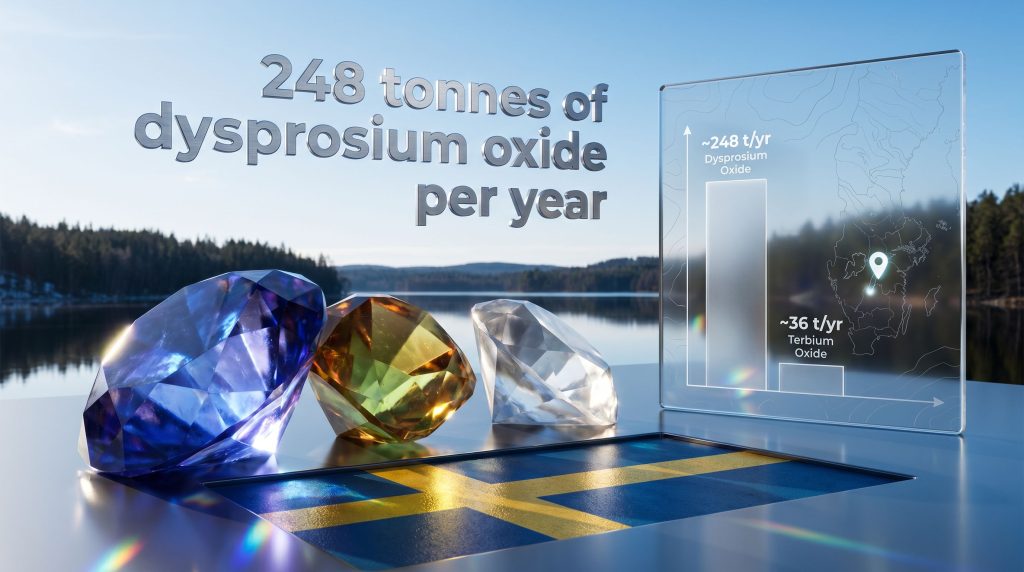
| Dysprosium Oxide Output | ~248 tonnes/year | ~250 tonnes/year |
| Terbium Oxide Output | ~36 tonnes/year | ~50 tonnes/year |
| Mixed Rare Earth Oxides | ~5,340 tonnes/year | Not disclosed |
| Operational Lifespan | 26 years | Ongoing |
| Geographic Classification | European Sovereign | Ex-China, Non-European |
Independent research conducted by the Edison Group estimated European annual dysprosium oxide demand at approximately 200 tonnes. At projected output of 248 tonnes of dysprosium oxide per year, Norra Kärr's production capacity would exceed total European demand, making it potentially the first European project capable of satisfying the continent's entire requirement for this critical magnet element.
What Does the 25-Year Mining Lease Actually Grant?
Understanding Sweden's Exploitation Concession Framework
Sweden's mineral permitting system distinguishes clearly between the exploration phase, during which companies hold investigation permits with no development rights, and the exploitation phase, which confers formal legal rights over a defined deposit for a specified term. The Norra Karr heavy rare earth project mining lease covers a 25-year term and was issued by Bergsstaten, the Swedish Mining Inspectorate, which functions as the regulatory authority responsible for assessing and approving concession applications under the Swedish Minerals Act.
Critically, prior to receiving this concession, the project operator held no legal rights over the deposit itself. The mineral could be studied, assessed, and modelled in extraordinary detail, but without the exploitation concession, none of that knowledge translated into a legally defensible development asset. The 25-year grant transforms the project's legal status entirely.
Before the exploitation concession was granted, conversations with potential investors and financing institutions were framed by uncertainty over whether development rights would ever be secured. Following the concession grant, those same conversations begin from a position of confirmed legal ownership of the deposit for a 26-year development window.
How a 25-Year Lease Term Changes the Risk Profile
For institutional investors, project financiers, and potential off-take partners, the presence or absence of a mining lease is a binary risk factor. Without it, capital deployment carries the risk of total loss if permitting fails. With a 25-year concession in place, the risk profile shifts toward execution risk, which is manageable through conventional project development tools including feasibility studies, environmental permitting, and engineering design.
This shift is particularly meaningful for the European Investment Bank and the Nordic Investment Bank, both of which require completed feasibility studies and de-risked development assets before engaging in formal due diligence processes. The mining lease is consequently a prerequisite for those conversations to begin in earnest.
How Did Norra Kärr Overcome Its Previous Permitting Setback?
The 2016 Concession Revocation: What Went Wrong
The original exploitation concession granted in 2013 was subsequently revoked in 2016, primarily on environmental grounds related to the project's proximity to Lake Vättern, one of Sweden's largest and most ecologically significant freshwater bodies. That revocation represented a significant setback and effectively reset the project's development timeline. The lesson drawn from that experience informed a fundamental redesign of the project's physical and operational structure.
The Strategic Redesign: Footprint Reduction and Process Separation
The redesigned project incorporates two major structural changes that directly address the environmental objections raised in the original assessment:
- The mine site footprint has been reduced by 65% compared to the original design, materially reducing the project's environmental interface with the surrounding landscape and Lake Vättern's catchment area.
- Chemical processing has been fully decoupled from the mine site, with downstream hydrometallurgical processing to be conducted at a separate industrial facility on pre-permitted industrial land where similar processes are already understood and regulated by existing authorities.
The practical operational sequence at the mine site now consists of:
- Rock extraction through quarrying operations
- Crushing and grinding of extracted material
- Magnetic separation to produce mineral concentrate
- Transport of mineral concentrate to the downstream processing facility
This separation of activities does not materially alter the project's overall economics, but it fundamentally simplifies the permitting pathway for the mine site itself by removing the most complex chemical processing activities from the ecologically sensitive location.
How Significant Is Norra Kärr to Europe's Rare Earth Supply Ambitions?
Benchmarking Against Non-Chinese HREE Projects Globally
Heavy rare earth projects outside China capable of delivering meaningful production volumes are extraordinarily rare. The global pipeline of advanced development-stage HREE projects can be counted on the fingers of one hand, and most face their own permitting, technical, or financing challenges. Lynas Rare Earths, the most significant non-Chinese producer, processes its ore in Malaysia rather than in its home country of Australia, which limits its applicability as a model for European supply chain sovereignty.
What makes the Norra Karr heavy rare earth project mining lease distinctive is the combination of:
- A geologically confirmed heavy rare earth-dominant deposit in a jurisdiction with established mining law
- A 25-year exploitation concession providing legally secured development rights
- 15 years of accumulated technical, metallurgical, and environmental study data
- A redesigned operational structure that has addressed the primary objections from the previous permitting process
- Location within the European Union, making it directly relevant to EU supply chain policy objectives
Why HREE Projects Outside China Remain Exceptionally Rare
The geological reality is that heavy rare earth-enriched deposits are genuinely uncommon. The ionic clay deposits of southern China that supply much of the world's heavy rare earth production are a geological feature specific to that region's weathering conditions. Eudialyte-hosted deposits like Norra Kärr represent one of the few alternative geological settings capable of hosting economically relevant heavy rare earth concentrations, but they come with their own rare earth processing challenges that have historically slowed processing development.
The next major ASX story will hit our subscribers first
Where Does Europe's Mine-to-Magnet Supply Chain Stand Today?
The Critical Raw Materials Act: Ambitions vs. Ground-Level Progress
The EU's Critical Raw Materials Act, introduced in 2024, established benchmarks requiring that by 2030 at least 10% of the EU's annual consumption of strategic raw materials be sourced from domestic extraction, at least 40% from domestic processing, and at least 15% from recycling. These targets represent a significant policy ambition, but the gap between legislative framework and operational reality remains substantial.
The strategic projects process established under the CRMA has been run twice, and critics within the industry have noted that the selection process has tended to favour projects with simpler permitting histories. This effectively disadvantages the very European deposits that sit closest to end-use demand but have faced the most complex regulatory pathways. Furthermore, the Norra Kärr project was not included in the initial strategic projects list, a situation that is expected to be revisited following the mining lease milestone. For a broader perspective, Europe's critical minerals supply chain faces considerable structural hurdles before these ambitions can be realised.
US Capital Is Moving Faster Than European Policy
While European institutions debate frameworks and application processes, US capital has been actively acquiring rare earth infrastructure across Europe and other jurisdictions. The following table illustrates the pace of strategic moves by non-European actors in the rare earth supply chain:
| Actor | Recent Strategic Move | Region |
|---|---|---|
| MP Materials | Public capital deployment, domestic processing expansion | USA |
| Energy Fuels | Acquisition of Vacuumschmelze, Europe's largest permanent magnet manufacturer | Europe |
| USA Rare Earths | Stake in French refiner/separator Carester; acquisition of Lescoma Metals (UK metallization) | Europe/UK |
| Lynas Rare Earths | Malaysian processing facility capacity expansion | Southeast Asia |
| Leading Edge Materials | 25-year mining lease secured for Norra Kärr | Sweden/Europe |
The pattern is instructive. The United States has replicated elements of China's industrial strategy by deploying public capital as a catalyst for private investment. That approach has mobilised significant private sector activity, whereas European critical raw materials supply policy has thus far generated frameworks without the capital deployment that translates frameworks into operational assets.
As Lynas Rare Earths CEO Amanda Lacaze cautioned at the Rare Earth Industry Association conference in Frankfurt in June 2024, China's lead in rare earth processing is measured in decades, and without a significant acceleration in investment and policy action, that lead will continue to extend rather than close (Lacaze, Rare Earth Industry Association Conference, Frankfurt, June 2024).
Two Non-Negotiable Policy Levers for Europe
- Streamline permitting frameworks by enabling regulatory authorities to process straightforward applications quickly, freeing capacity for complex assessments rather than allowing bureaucratic bottlenecks to apply uniformly regardless of project complexity.
- Deploy public capital strategically, using government-backed investment as the initial catalyst that unlocks private equity and debt markets, replicating the mechanism that has driven rare earth investment momentum in the United States.
What Are the Next Permitting Steps for Norra Kärr?
Environmental Permitting Under Sweden's Environmental Code
Following the exploitation concession, the next major regulatory milestone is the submission and approval of an environmental permit application under Sweden's Environmental Code. This process involves a comprehensive environmental impact assessment covering the mine site's interactions with surrounding ecosystems, water systems, and communities.
The project benefits from 15 years of environmental baseline data, which provides a substantially more robust foundation for the assessment process than would be available to a recently identified deposit. The redesigned project footprint, which is 65% smaller than the original design, also simplifies the scope of environmental assessment required.
Sweden's Single-Authority Permitting Reform
Sweden is in the process of implementing a single-authority framework for environmental permitting, consolidating what was previously a multi-agency process into a structure where a single competent body assesses the full application. This reform is expected to be operational at the point when the Norra Kärr environmental permit application is submitted, potentially reducing both the timeline and the procedural complexity of the assessment process.
Operational Precedent in the Lake Vättern Region
The Norra Kärr site is located adjacent to Lake Vättern, where comparable mineral processing operations — including a Sibelco facility on the opposite shore — already operate under existing environmental frameworks. This operational precedent is relevant to the environmental assessment process because it demonstrates that mineral extraction and processing activities have been regulated and managed in the same regional context, consequently reducing the novelty and associated uncertainty of the Norra Kärr application.
What Is the Realistic Production Timeline for Norra Kärr?
The company has stated a target of reaching production within four years, covering both mine-site operations and downstream processing. Achieving that timeline requires sequential completion of several interdependent milestones:
| Step | Status |
|---|---|
| Exploitation Concession Granted | Complete |
| Updated Pre-Feasibility Study | In Progress |
| Environmental Permit Application Preparation | Underway |
| Environmental Permit Granted | Pending |
| Off-Take Agreements Executed | Near-Term Target |
| Project Financing Secured | Dependent on PFS and off-takes |
| CRMA Strategic Project Reapplication | Future milestone |
| Construction Commencement | Post-financing |
| First Production | Target within 4 years |
The pre-feasibility study is the next critical financing milestone because it is the document that enables formal engagement with the European Investment Bank, the Nordic Investment Bank, and institutional debt providers. Until that study is complete, financing conversations remain preliminary rather than transactional.
How Does the Mining Lease Transform the Financing Outlook?
From Awaiting Decision to Rights Secured: The Investor Perception Shift
The psychological and practical impact of moving from a position of waiting for a regulatory decision to holding a confirmed 25-year development right cannot be overstated in the context of junior mining finance. Project risk is priced by investors based on the probability distribution of outcomes, and the exploitation concession effectively removes the scenario of total regulatory failure from that distribution.
Every subsequent investor conversation now begins from a confirmed foundation rather than a contingent one. The discussion moves directly to development timelines, capital requirements, production economics, and off-take structure — the commercially actionable questions that financing institutions and strategic partners are equipped to evaluate.
Financing Sources and Stage Relevance
| Financing Source | Stage Relevance | Key Requirement |
|---|---|---|
| European Investment Bank | Post-PFS | Completed feasibility study |
| Nordic Investment Bank | Post-PFS | Completed feasibility study |
| Strategic Off-Take Partners | Now Unlocked | Mining lease in place |
| Private Equity / Equity Markets | Ongoing | Progressive de-risking milestones |
| EU Strategic Project Grants | Future Application | CRMA reapplication required |
Why Binding Off-Take Agreements Are Now a Realistic Near-Term Catalyst
With the mining lease secured, the project operator can now enter into binding off-take discussions with European refiners, separators, and downstream manufacturers. Prior to the concession grant, any such agreement would have carried the residual risk of the concession not being awarded. That risk no longer exists.
European refiners and separators are actively seeking to secure dysprosium and terbium supply agreements — not as a forward-planning exercise but as an immediate operational necessity given current market conditions. According to project economics analyses for mine planners, a project combining a confirmed 25-year European mining lease, 15 years of technical data, and a redesigned operational structure represents a rare combination of attributes in a market with almost no credible alternatives.
What Does the Broader Leading Edge Materials Portfolio Look Like?
Woxna Graphite: Repositioning for Industrial Markets
The Woxna graphite project in Sweden has undergone recent test work focused on establishing the grade of concentrate achievable through updated crushing and flotation processes, alongside purification studies. The project is being repositioned away from battery-grade applications, where market conditions have been challenging for graphite developers, toward industrial market applications where existing demand channels provide a more accessible commercial pathway. A revised business case is being developed based on the test work results.
Bihor Sud, Romania: Attracting Direct Capital
The Bihor Sud project in Romania, where Leading Edge Materials has increased its joint venture ownership to 90% following accumulated investment, is being developed with a focus on attracting capital directly into the Romanian entity rather than through the listed company. A Competent Person's Report was completed earlier in the year, with preparation work ongoing. This structure separates the Romanian asset's capital requirements from the Norra Kärr financing pathway, allowing the flagship project to remain the primary focus of the listed entity's development capital.
Portfolio Prioritisation
Given the scale of the opportunity represented by the Norra Karr heavy rare earth project mining lease and its proximity to commercial development following the exploitation concession, the near-term value thesis for Leading Edge Materials is concentrated almost entirely on the Swedish project. The Woxna and Bihor Sud assets provide portfolio optionality but are not the primary drivers of the company's current investment case.
The Broader Significance: What Norra Kärr Represents for European Industrial Sovereignty
From Policy Ambition to Permitted Asset
Europe has produced an increasingly sophisticated framework of critical minerals policy over the past several years, from the European Critical Raw Materials Act to the Raw Materials Initiative and the Strategic Technologies for Europe Platform. What has been largely absent from that framework is a permitted, development-stage European heavy rare earth deposit capable of delivering material quantities of dysprosium and terbium within a realistic timeframe.
The Norra Kärr exploitation concession represents a transition from theoretical supply chain ambition to a concrete, legally secured development asset on European soil. That transition is genuinely rare in the history of European critical minerals development, and its significance extends well beyond the immediate commercial interests of the project operator.
The Race Against Processing Dominance
Building a mine-to-magnet supply chain in Europe requires not just mining assets but separation capacity, alloying capability, and magnet manufacturing infrastructure. The acquisition of Vacuumschmelze by Energy Fuels and the investments by USA Rare Earths in French and UK processing assets illustrate that non-European capital is already moving to establish positions across the midstream and downstream segments of the European rare earth supply chain.
A genuinely sovereign European supply chain would require European entities, backed by European capital and European policy, to occupy these same positions. The Norra Kärr project provides the upstream anchor for that chain. Whether European policy and capital can move quickly enough to build the remaining links before the window closes is consequently the defining question facing European industrial strategy in this decade.
This article is intended for informational purposes only and does not constitute financial advice or a recommendation to buy or sell any securities. Projections, production targets, and timelines referenced are based on company disclosures and independent research available at the time of writing and are subject to change. Mining projects involve material risks including permitting uncertainty, financing risk, and commodity price volatility. Readers should conduct their own due diligence and consult a licensed financial adviser before making any investment decisions.
Want to Stay Ahead of the Next Major Mineral Discovery Before the Market Moves?
Discovery Alert's proprietary Discovery IQ model delivers real-time alerts on significant ASX mineral discoveries — transforming complex data across more than 30 commodities into clear, actionable insights for both short-term traders and long-term investors. Explore how historic discoveries have generated extraordinary returns on Discovery Alert's dedicated discoveries page, and begin your 14-day free trial today to secure your market-leading advantage.