May 11, 2026
Understanding Europe's Strategic Material Dependencies
Manufacturing sectors across Europe face an unprecedented convergence of supply chain vulnerabilities, technological dependencies, and geopolitical risks that threaten the continent's industrial competitiveness. The clean technology transformation requires unprecedented volumes of specialized materials, yet European manufacturing relies heavily on import pathways controlled by single-source suppliers. These raw materials challenges for Europe create cascading economic risks that extend far beyond individual commodity markets.
Global market dynamics increasingly reflect the strategic importance of material processing capabilities rather than simple resource extraction. Processing infrastructure determines actual supply availability, creating bottleneck effects that traditional supply diversification strategies cannot address. European policymakers must navigate between immediate industrial needs and long-term strategic autonomy whilst competing against established processing centres with significant cost advantages.
The financial architecture supporting European raw materials security remains fragmented across multiple funding mechanisms, regulatory frameworks, and national priorities. Investment flows toward materials infrastructure require fundamentally different risk profiles and return timelines compared to conventional industrial development, creating structural misalignments between available capital and strategic requirements.
When big ASX news breaks, our subscribers know first
Europe's Critical Material Landscape
European economic security increasingly depends on access to materials classified as critical through systematic assessment frameworks. The European Commission maintains an official list of 34 materials deemed essential for economic stability, updated regularly based on supply risk calculations, economic importance metrics, and substitutability analysis.
Clean technology manufacturing represents the largest driver of critical material demand, with battery production requiring lithium, cobalt, and nickel in quantities that exceed historical mining output. Wind turbine manufacturing depends on rare earth elements for permanent magnet production, whilst semiconductor manufacturing requires germanium and gallium with no viable substitutes for specific applications.
The classification methodology distinguishes between materials that are merely scarce versus those that are strategically irreplaceable. Furthermore, lithium serves as the primary electrochemical medium in battery systems without large-scale alternatives currently available. Rare earth elements possess unique magnetic and luminescent properties that cannot be replicated through conventional materials science approaches.
European automotive manufacturers face direct exposure to material supply constraints through battery production requirements. Electric vehicle targets for 2030 require battery manufacturing capacity expansion that exceeds current lithium processing capabilities, creating potential production bottlenecks regardless of mining output levels.
Key Material Dependencies by Sector:
- Automotive: Lithium, cobalt, nickel for battery production
- Renewable Energy: Rare earth elements for permanent magnets
- Defence: Titanium, tungsten for specialised alloys
- Electronics: Germanium, gallium for semiconductor manufacturing
- Construction: Critical metals for specialised infrastructure
The interconnected nature of these dependencies creates systemic vulnerabilities where disruption in one material affects multiple downstream industries simultaneously. For instance, a lithium processing shortage impacts electric vehicle production, energy storage systems, and portable electronics manufacturing through shared supply chains.
Processing complexity varies dramatically across critical materials, with rare earth element separation representing perhaps the most technically demanding operation. The process requires sophisticated extraction chemistry, radioactive byproduct management, and specialised workforce expertise that cannot be rapidly replicated in new geographic locations.
Concentration Risks in Global Processing Infrastructure
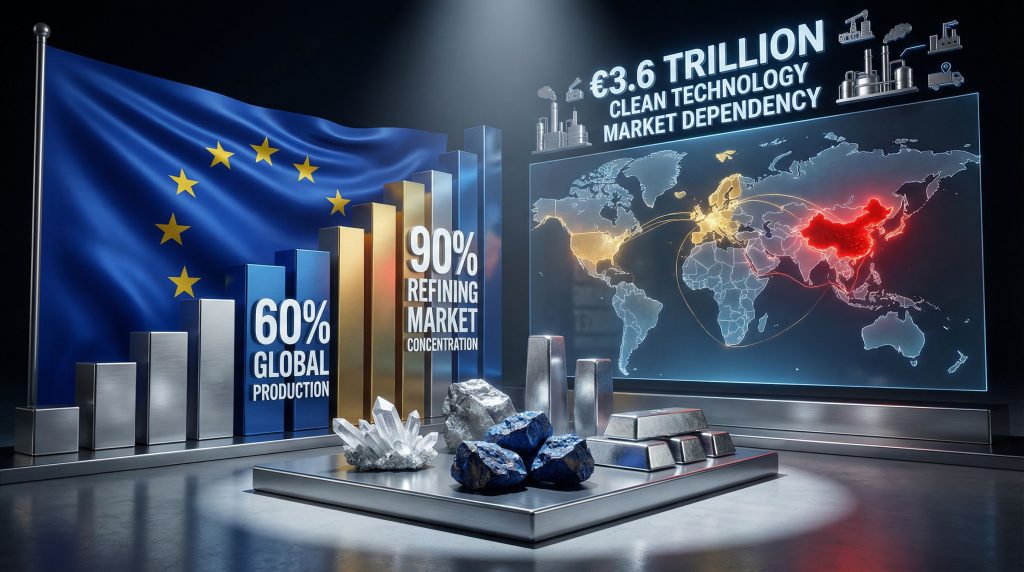
China controls approximately 70% of global rare earth mining production and over 90% of processing capacity, particularly for separation into individual rare earth oxides required for manufacturing applications. This processing dominance operates through accumulated operational experience, workforce expertise, and infrastructure optimisation rather than proprietary technology barriers.
Lithium processing presents different geographic patterns, with Australia leading mining output but China dominating conversion capacity. Chinese facilities control approximately 60% of global lithium processing capabilities, creating two-stage dependency risks for European manufacturers requiring processed lithium compounds rather than raw ore.
The 2023 gallium and germanium export restrictions imposed by China demonstrated how processing concentration translates into practical supply control mechanisms. These restrictions targeted materials essential for semiconductor manufacturing, creating immediate disruptions for European technology companies despite alternative mining sources being available globally.
Global Processing Concentration by Material:
| Material | China Processing Share | Alternative Capacity | Development Timeline |
|---|---|---|---|
| Rare Earth Elements | 90%+ | <5% (under development) | 7-10 years |
| Lithium Processing | 60% | 25% (expanding) | 3-5 years |
| Cobalt Refining | 70% | 15% (operational) | 4-6 years |
| Graphite Processing | 85% | 10% (limited) | 5-8 years |
Processing economics favour established facilities through scale advantages, energy infrastructure access, and operational learning curves. A new rare earth processing facility requires €150-300 million investment with 3-5 year construction timelines, during which operational inefficiencies exceed those of optimised Chinese competitors.
The technological barriers to competitive processing development involve accumulated operational knowledge rather than patent restrictions. Environmental compliance requirements, waste management systems, and workforce training represent significant obstacles for new processing centres attempting to achieve cost competitiveness.
European processing initiatives face structural cost disadvantages of 20-40% compared to Chinese facilities due to higher labour costs, stricter environmental regulations, and smaller scale economies. These differentials require either technological breakthroughs enabling superior efficiency or government subsidy mechanisms to achieve commercial viability.
"Industry analysts emphasise that processing dominance creates more strategic leverage than simple mining control, as processing capacity determines actual material availability for manufacturing applications regardless of mining output levels."
Economic Impact Assessment Across European Industries
European automotive manufacturers face direct revenue exposure through battery material costs, which represent approximately 25-30% of total electric vehicle battery pack expenses. Cost sensitivity analysis indicates that 50% increases in lithium, cobalt, and nickel prices translate to 10-15% increases in battery costs, affecting final vehicle pricing by 5-8% depending on market segment.
The €240 billion European automotive revenue faces varying degrees of material cost vulnerability across different vehicle categories. Premium electric vehicles demonstrate greater tolerance for material cost inflation compared to mass-market segments, creating asymmetric impacts across manufacturers depending on their product portfolios.
Wind turbine manufacturing economics depend directly on rare earth element availability for permanent magnet production, with dysprosium and terbium representing the most cost-sensitive components due to limited global supply. Consequently, a 100% increase in rare earth processing costs translates to approximately 15-20% increases in permanent magnet expenses, affecting large-capacity turbine economics significantly.
Sectoral Vulnerability Analysis:
- High Vulnerability (>20% cost exposure): Battery manufacturing, permanent magnet production
- Medium Vulnerability (10-20% cost exposure): Semiconductor assembly, specialised steel production
- Lower Vulnerability (<10% cost exposure): General electronics, construction materials
The 2021-2022 battery material cost surge provided concrete illustration of vulnerability pathways. Lithium carbonate prices increased from approximately €8,500 per tonne in early 2021 to over €51,000 per tonne by late 2022, creating estimated €2-4 billion in additional costs across European automotive manufacturers.
Defence sector material requirements remain partially classified but have increased substantially due to conflict-driven rearmament priorities. European defence manufacturing creates competing demand pressures with civilian industries for materials like titanium, tungsten, and specialised rare earth compounds.
Short-term supply disruptions create disproportionate economic impacts through inventory depletion and production scheduling disruption rather than absolute material unavailability. Economic modelling suggests that 20% supply reductions can generate 40-60% production delays when buffer inventories exhaust and manufacturing schedules require reorganisation.
Financial Investment Gaps and Funding Architecture
European investment intensity in critical materials infrastructure lags significantly behind global competitors, with current spending representing approximately 0.05% of GDP compared to higher percentages in the United States, Australia, and China. This investment differential reflects both budget constraints and structural challenges in private sector capital allocation toward materials projects.
Horizon Europe 2026-2027 allocates €2.4 billion specifically for materials research, representing increased prioritisation of critical materials within EU research funding frameworks. However, the transition from research funding to commercial-scale processing infrastructure requires different financial mechanisms and risk-sharing arrangements.
European Investment Landscape:
- Total Materials R&D: €2.4 billion (Horizon Europe allocation)
- Processing Infrastructure Needs: €50+ billion estimated requirement
- Current Private Investment: <€5 billion annually
- Funding Gap: €8-12 billion annually for strategic targets
The European Investment Bank has established dedicated financing instruments for green transition infrastructure, including critical materials processing facilities. Nevertheless, the capital requirements for competitive processing capacity exceed typical EIB project scales, requiring coordinated financing approaches across multiple institutions.
Member state co-financing mechanisms vary significantly across the EU, with Germany, France, and Poland demonstrating higher commitment levels than other countries. Germany's €1 billion commitment to lithium processing development represents the largest single national investment in European critical materials infrastructure.
Return-on-investment characteristics for materials processing differ fundamentally from technology ventures, requiring 5-10 year payback periods with commodity price volatility exposure. These project economics deter growth-focused investors whilst exceeding government budget capabilities for comprehensive strategic coverage.
Private sector investment faces structural misalignment between investor return expectations and actual project economics. Processing infrastructure requires patient capital with commodity market risk tolerance, characteristics that limit venture capital participation in strategic materials development.
The capital intensity for establishing competitive processing capacity varies by material but consistently exceeds private sector comfort levels absent government risk-sharing mechanisms. A lithium processing facility (30,000-50,000 tonnes annual capacity) requires €200-400 million investment with multi-year construction timelines.
Regulatory Framework Challenges and Implementation Barriers
European permitting processes for strategic materials projects currently require 7-15 years average timeline from initial application to operational approval, significantly exceeding the 27-month streamlined target established under the Critical Raw Materials Act. This timeline differential represents a critical constraint on European strategic autonomy objectives and requires comprehensive mining permitting insights to address effectively.
Regulatory fragmentation across 27 member states creates additional complexity for projects requiring cross-border coordination or regional supply chain integration. Environmental assessment requirements, whilst necessary for sustainable development, often conflict with urgency requirements for strategic materials infrastructure.
Regulatory Timeline Comparison:
| Project Stage | Current Average | CRMA Target | Reduction Required |
|---|---|---|---|
| Environmental Assessment | 36 months | 12 months | 67% reduction |
| Technical Permitting | 24 months | 9 months | 63% reduction |
| Final Approvals | 18 months | 6 months | 67% reduction |
| Total Timeline | 78 months | 27 months | 65% reduction |
Land use conflicts represent persistent challenges for domestic mining and processing projects, particularly in densely populated European regions. Community opposition factors, whilst legitimate stakeholder concerns, require sophisticated engagement strategies that extend project development timelines substantially.
State aid regulations within EU competition policy create additional complexity for government support of strategic materials projects. The balance between strategic necessity and market competition requires careful legal structuring to ensure compliance with European competition frameworks.
Environmental protection standards, whilst essential for sustainable development, require technological solutions that increase capital costs and operational complexity for materials processing facilities. Advanced waste management, emissions control, and environmental monitoring systems add 15-25% to total project costs compared to less regulated jurisdictions.
Cross-border coordination requirements affect projects spanning multiple member states or requiring regional supply chain integration. Legal harmonisation, regulatory alignment, and administrative coordination create additional layers of complexity for strategic materials infrastructure development.
The Critical Raw Materials Act attempts to address these challenges through fast-track permitting for designated strategic projects, but implementation requires significant changes to existing national regulatory frameworks and administrative procedures across member states.
The next major ASX story will hit our subscribers first
Market Dynamics and Competitive Positioning Strategies
European recycling economics present opportunities to reduce primary material dependency through circular economy approaches, though technological readiness levels vary significantly across different materials. Urban mining from electronic waste and end-of-life vehicle processing could potentially supply 15-25% of European demand for certain critical materials by 2030.
Recent developments in battery recycling breakthrough technologies demonstrate significant progress in material recovery rates. Furthermore, these innovations could revolutionise European raw materials challenges for Europe by reducing dependency on primary sources.
Recycling Potential by Material:
- Lithium: 30-40% recovery rates achievable from battery waste
- Rare Earth Elements: 85-95% recovery possible from permanent magnets
- Cobalt: 95%+ recovery rates from industrial applications
- Graphite: 60-70% recovery potential from battery applications
The economics of recycled materials require technological breakthroughs to achieve cost competitiveness with primary production. Current recycling processes for rare earth elements achieve high recovery rates but require energy-intensive separation procedures that exceed primary processing costs in many applications.
Strategic partnerships offer pathways to reduce supply vulnerabilities through diversification beyond Chinese sources. The Canada-EU Strategic Partnership on Raw Materials provides access to Canadian lithium and critical metals, whilst Australia-EU cooperation agreements target rare earth and lithium supply arrangements.
Africa-EU raw materials dialogue creates opportunities for development cooperation combined with resource access, though infrastructure development requirements and political stability considerations affect implementation timelines. The Democratic Republic of Congo controls approximately 70% of global cobalt reserves but requires substantial infrastructure investment for processing development.
Latin America engagement focuses on lithium triangle partnerships with Argentina, Chile, and Bolivia, countries controlling significant portions of global lithium reserves. However, resource nationalism policies and local processing requirements complicate direct supply agreements.
Technological innovation in material substitution research offers long-term solutions for reducing dependency on specific critical materials. Mining industry innovation continues to develop breakthrough technologies in battery chemistry, permanent magnet alternatives, and semiconductor materials that could fundamentally alter strategic material requirements over 10-15 year timeframes.
How Does Deep-Sea Mining Factor Into Europe's Strategy?
Deep-sea mining presents potential future supply sources for critical materials, though environmental considerations, technological challenges, and international regulatory frameworks remain undeveloped. The International Seabed Authority continues developing regulations for deep-sea extraction, with commercial viability timelines extending beyond 2035.
Risk Mitigation and Strategic Stockpiling Mechanisms
European strategic stockpiling mechanisms operate through both national and EU-level frameworks, though coordinated approaches remain limited compared to comprehensive Chinese strategic reserves. Current stockpiling focuses primarily on immediate supply security rather than long-term strategic leverage.
Cost-benefit analysis of stockpiling versus diversification strategies shows mixed results depending on material characteristics and market volatility patterns. Materials with high price volatility and limited substitutability benefit more from stockpiling approaches, whilst materials with multiple supply sources benefit from diversification strategies.
Strategic Reserve Considerations:
- Optimal Stock Levels: 90-180 day supply depending on material criticality
- Storage Costs: 2-5% annually of material value
- Release Mechanisms: Market price triggers and emergency protocols
- Coordination Requirements: Multi-national frameworks for effectiveness
The RESourceEU monitoring framework provides early warning capabilities for supply disruptions through market intelligence and price volatility tracking. However, the system requires enhanced data collection from private sector participants and improved integration with national monitoring systems.
Market intelligence systems track geopolitical risk factors, production capacity changes, and demand projections to provide advance warning of potential supply constraints. These systems require sophisticated modelling capabilities combining economic, political, and technical analysis.
Supply chain mapping initiatives identify vulnerability points and alternative pathway options for critical materials flows. Comprehensive mapping requires private sector cooperation and information sharing that may conflict with competitive considerations and commercial confidentiality requirements.
Release mechanisms for strategic reserves require predetermined criteria and coordination protocols to prevent market disruption whilst addressing supply constraints. Poorly timed releases can destabilise markets and discourage private sector investment in supply diversification.
Private sector inventory management coordination with government reserves offers opportunities for enhanced supply security without duplicating storage costs. However, such coordination requires information sharing and commitment mechanisms that may challenge commercial independence.
Technology Innovation and Future Supply Scenarios
Breakthrough recycling technologies offer potential pathways toward greater European materials independence through enhanced circular economy capabilities. Advanced separation techniques, automated disassembly systems, and improved material recovery processes could significantly increase recycling rates across critical materials.
Material substitution research targets alternatives for the most vulnerable supply dependencies, with particular focus on battery chemistry alternatives and permanent magnet substitutes. Sodium-ion batteries, iron-based permanent magnets, and alternative semiconductor materials represent active research areas with commercial potential within 5-10 years.
Technology Development Timelines:
| Innovation Area | Current Status | Commercial Viability | Impact Potential |
|---|---|---|---|
| Advanced Recycling | Pilot scale | 2027-2030 | 25-40% supply contribution |
| Battery Alternatives | R&D phase | 2030-2035 | 50%+ lithium reduction potential |
| Magnet Substitutes | Laboratory testing | 2028-2032 | 30%+ rare earth reduction |
| Processing Automation | Early deployment | 2025-2028 | 20-30% cost reduction |
European research initiatives through Horizon Europe and national programmes focus on technological solutions that could fundamentally alter critical materials requirements. These programmes emphasise breakthrough technologies rather than incremental improvements to existing processes.
Space-based resource extraction represents long-term potential for critical materials supply, though technological challenges, economic viability, and regulatory frameworks remain undeveloped. Commercial asteroid mining operations remain speculative with timelines extending well beyond 2040.
Artificial intelligence and automation technologies offer opportunities to improve processing efficiency and reduce operational costs for European materials facilities. Advanced process optimisation, predictive maintenance, and automated quality control could narrow cost gaps with established global competitors.
Investment Opportunities and Market Implications
European critical materials projects present strategic investment opportunities despite challenging risk-return profiles compared to conventional industrial development. Successful projects require patient capital, government risk-sharing, and long-term strategic perspective rather than traditional financial return optimisation.
Nordic lithium exploration in Finland and Sweden offers potentially significant resources within stable regulatory environments, though development timelines extend 7-10 years from discovery to production. These projects benefit from established mining infrastructure and skilled workforce availability.
Recycling infrastructure development presents opportunities for shorter development timelines and lower capital requirements compared to primary processing facilities. Urban mining operations and electronic waste processing facilities offer 3-5 year development timelines with government support mechanisms.
Investment Risk Assessment Framework:
- Technical Risk: Processing technology maturity and operational efficiency
- Regulatory Risk: Permitting timelines and environmental compliance
- Market Risk: Price volatility and demand sustainability
- Geopolitical Risk: Trade policy changes and strategic material restrictions
The broader global trade impact continues to influence investment decisions in European critical materials projects. Due diligence for European critical materials investments requires specialised expertise in processing economics, environmental compliance, and strategic material markets.
Traditional mining investment analysis approaches may not adequately address processing complexity and strategic value considerations. Environmental, social, and governance (ESG) factors play increasingly important roles in materials investment decisions, particularly for European projects requiring high environmental standards and community engagement.
ESG compliance requirements may increase costs but also provide competitive advantages in European markets. The regulatory compliance landscape for materials investments requires expertise in EU competition law, environmental regulations, and strategic materials policy.
Legal and regulatory due diligence represents significant components of total investment evaluation processes. Long-term market outlook suggests continued demand growth for critical materials driven by clean technology adoption and digital transformation.
However, supply response through recycling, substitution, and new processing capacity will affect individual material market dynamics significantly over 5-10 year timeframes. The ongoing European raw materials supply challenges require coordinated policy responses and sustained investment commitments to achieve strategic objectives.
Disclaimer: This analysis contains forward-looking statements and projections that involve inherent risks and uncertainties. Material market dynamics, technological developments, and policy changes may significantly affect actual outcomes. Investors should conduct independent due diligence and consider professional advice before making investment decisions related to critical materials or mining operations.
Interested in Capitalising on Critical Materials Opportunities?
Discovery Alert's proprietary Discovery IQ model delivers real-time alerts on significant ASX mineral discoveries, instantly empowering subscribers to identify actionable opportunities in critical materials mining ahead of the broader market. Understanding how major mineral discoveries can generate substantial returns becomes crucial as Europe's strategic material dependencies create unprecedented investment opportunities.