
June 27, 2026
Understanding Europe's Strategic Position in Global Supply Networks
The global manufacturing landscape operates on intricate webs of interdependence that extend far beyond raw material flows. While conventional analyses often focus on China's rare earth dominance or America's technological leadership, a fundamental shift in how we understand Europe supply chain leverage is emerging. Recent European Commission analysis reveals that Europe occupies critical upstream positions across multiple industrial sectors, challenging traditional assumptions about economic vulnerability and strategic leverage.
What Makes Europe a Critical Upstream Power in Modern Manufacturing?
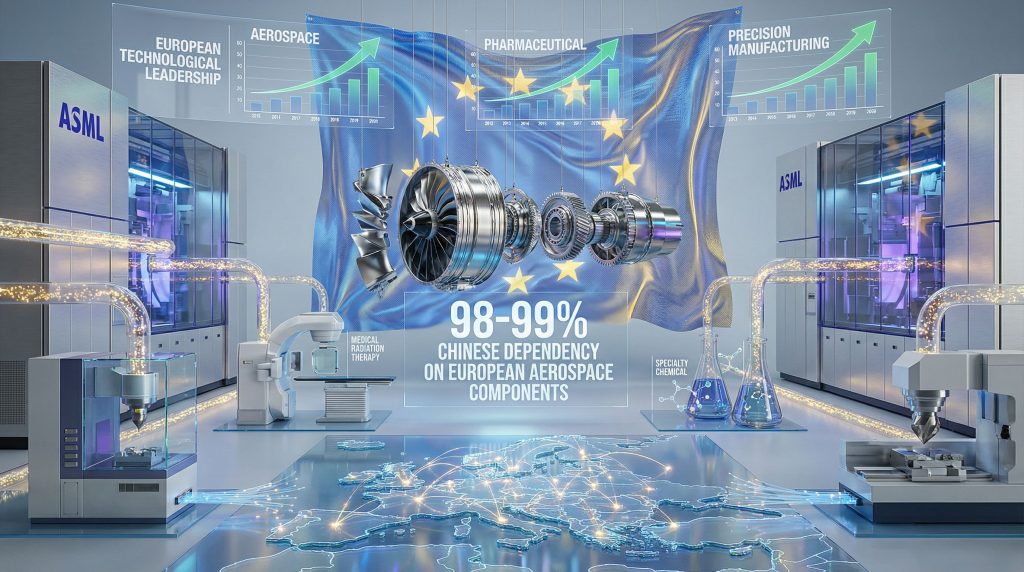
European industrial capabilities extend well beyond commonly recognised sectors, creating what industry analysts describe as technological monopolies in precision manufacturing. According to recent supply chain mapping, China demonstrates dependency rates of 98-99% on EU inputs in certain aerospace and pharmaceutical categories, with nearly 90% dependency in radiation therapy equipment production.
These dependencies centre on Europe's concentration of specialised industrial expertise across multiple member states. Unlike raw material dependencies that can often be substituted through alternative suppliers, Europe's technological exports require decades of accumulated knowledge, regulatory approval processes, and precision manufacturing capabilities that resist rapid replication.
The strategic value becomes apparent when examining the complexity differential between imports and exports. While Europe imports substantial volumes of raw materials and intermediate goods, its exports concentrate on high-complexity, low-volume components that serve as critical enablers for entire downstream industries.
Why Traditional Dependency Models Underestimate European Influence
Conventional supply chain analysis typically emphasises volume-based dependencies, creating an incomplete picture of actual strategic leverage. Europe supply chain leverage operates through what specialists term "technological choke points" where alternative suppliers either don't exist or would require years of development to achieve comparable capabilities.
This dynamic differs fundamentally from China's rare earth market position, which relies primarily on geological advantages and processing scale. European leverage stems from accumulated technological expertise, patent portfolios, and manufacturing precision that creates barriers to competitive entry rather than simple resource scarcity.
The aerospace sector exemplifies this pattern, where European precision sensor technology and advanced materials manufacturing enable global aviation production. These components, while representing relatively small volumes in traditional trade statistics, prove irreplaceable in the short to medium term due to safety certification requirements and technical specifications.
When big ASX news breaks, our subscribers know first
Quantifying Europe's Supply Chain Leverage Across Key Industries
The Aerospace and Defence Technology Stranglehold
European dominance in aerospace manufacturing creates dependencies that extend across both commercial and defence critical minerals applications. The 98-99% Chinese dependency on European aerospace components reflects not just current trade patterns but structural limitations in developing alternative suppliers for precision-engineered systems.
European precision sensor technology underpins modern aircraft navigation, engine management, and safety systems. These components require certification processes that span multiple years and regulatory jurisdictions, creating natural barriers to rapid supplier substitution even when geopolitical tensions escalate.
Defence implications multiply these dependencies, as military aircraft and missile systems often require even higher precision standards than commercial applications. European manufacturers have developed specialised alloys, guidance systems, and electronic components that integrate across NATO standardisation agreements, creating network effects that reinforce existing supplier relationships.
| Sector | Chinese Dependency on EU | Strategic Significance | Substitution Timeline |
|---|---|---|---|
| Aerospace Components | 98-99% | Critical for commercial aviation | 5-10 years |
| Radiation Therapy Equipment | ~90% | Healthcare infrastructure dependency | 7-12 years |
| Precision Sensors | High dependency | Defence and industrial applications | 3-7 years |
| Specialty Chemicals | Significant reliance | Manufacturing process enablers | 2-5 years |
Pharmaceutical and Medical Technology Dependencies
Europe's pharmaceutical influence extends beyond finished drug production into critical intermediate compounds and specialised medical equipment. The 90% dependency figure for radiation therapy equipment reflects European leadership in medical technology innovation and manufacturing precision.
Active pharmaceutical ingredient (API) production concentrates in European facilities due to regulatory expertise, quality control systems, and intellectual property protection frameworks. Furthermore, these dependencies create healthcare security implications that extend beyond traditional trade considerations, particularly for cancer treatment and specialised medical procedures.
Medical device manufacturing represents another layer of European leverage, where regulatory approval processes, quality certification requirements, and technical expertise create multi-year barriers to alternative supplier development. European manufacturers have established integrated supply chains that span from raw material processing to final device assembly, creating comprehensive dependencies rather than single-point vulnerabilities.
Industrial Manufacturing Choke Points
High-end machine tool production exemplifies European industrial leverage across multiple manufacturing sectors. German, Swiss, and Italian precision manufacturing equipment enables production capabilities in industries ranging from automotive to electronics, creating multiplicative effects where European supply chain disruptions could cascade across global manufacturing networks.
Specialty chemical production represents another critical leverage point, where European manufacturers control processes for advanced polymers, industrial catalysts, and specialised coatings. These chemicals often serve as enabling inputs for downstream manufacturing processes, where alternative suppliers may exist but require extensive testing and qualification periods.
Moreover, advanced materials manufacturing spans from armour-grade steel production to precision bearing systems. European metallurgical expertise and quality control systems have established standards that military and aerospace applications require, creating dependencies that extend beyond commercial considerations into national security implications.
The ASML Factor: Semiconductor Manufacturing as a Template for Leverage
How One Dutch Company Controls Global Chip Production
Advanced Semiconductor Materials Lithography (ASML) provides the clearest example of European technological leverage translated into global strategic influence. The company's extreme ultraviolet (EUV) lithography systems enable production of the most advanced semiconductor chips, creating dependencies that span the entire global technology sector.
ASML's position results from decades of specialised development in precision optics, laser technology, and mechanical engineering. The technical barriers preventing competitor emergence include requirements for sub-nanometer precision manufacturing, advanced laser systems, and integrated software that coordinates thousands of mechanical and optical components.
Consequently, the technological complexity creates natural monopoly conditions where even massive investment programmes by competing nations face multi-decade development timelines. This dynamic explains why ASML's position has persisted despite significant geopolitical incentives for alternative supplier development.
Scaling the ASML Model Across European Industries
ASML's strategic position provides a framework for understanding similar European advantages across other industrial sectors. The pattern involves accumulated technological expertise, patent protection, precision manufacturing requirements, and regulatory approval processes that collectively create barriers to competitive entry.
European companies in specialised industrial sectors often demonstrate similar characteristics: decades of research and development investment, integrated supply chains spanning multiple member states, and technological capabilities that require extensive tacit knowledge rather than simply capital investment for replication.
In addition, patent portfolios and technical expertise create self-reinforcing advantages where European companies maintain technological leadership through continuous innovation cycles rather than static competitive positions. This dynamic suggests that Europe supply chain leverage may strengthen over time rather than diminish through competitive pressure.
From Dependency Mapping to Strategic Implementation
The Political Will Challenge: 27 Member States, One Strategy?
European Union decision-making processes present fundamental challenges for rapid supply chain leverage deployment. Coordination across 27 member states requires consensus-building mechanisms that may prove incompatible with the speed requirements of economic coercion scenarios.
Historical precedents for unified European economic action demonstrate both potential capabilities and institutional limitations. Previous sanctions regimes have required months of negotiation and compromise, raising questions about whether European leverage can be activated rapidly enough to influence real-time geopolitical developments.
Furthermore, democratic processes versus rapid response requirements create inherent tensions in European strategic planning. While dependency mapping reveals potential power, the institutional framework for translating that potential into actionable leverage remains underdeveloped compared to more centralised decision-making systems.
Economic War-Gaming: Testing European Leverage Under Stress
Recent analysis of European supply chain leverage has sparked discussions about contingency planning and economic scenario modelling. Professional commentary suggests that without systematic stress-testing of leverage mechanisms, European advantages risk remaining theoretical rather than practically deployable.
The enforcement gap between having leverage and using leverage effectively represents a critical vulnerability in European strategic planning. Industry observers note that dependency relationships only translate into meaningful power when backed by credible enforcement mechanisms and political will for implementation.
However, Japan's strategic indispensability doctrine offers a potential model for European leverage deployment, combining technological dominance with disciplined execution frameworks. This approach emphasises building irreplaceable supplier relationships while maintaining institutional capabilities for rapid response coordination.
Supply chain dependencies create potential leverage, but institutional coordination and execution speed determine whether that potential becomes actionable power during crisis situations requiring immediate response capabilities.
Building Contingency Frameworks for Supply Chain Leverage
Effective leverage deployment requires pre-established frameworks for rapid decision-making and implementation coordination across European member states. Early warning systems could monitor supply chain vulnerabilities and potential pressure points before crises develop into acute confrontations.
Pre-authorised response mechanisms might enable faster European reaction times during supply chain disputes, reducing the coordination delays that currently limit European strategic options. These frameworks would require member state agreement on trigger conditions and response protocols before crisis situations develop.
Stockpiling strategies for critical European exports could provide additional leverage flexibility, enabling selective supply restrictions without completely disrupting global manufacturing networks. Strategic reserve policies could balance diplomatic pressure with economic stability considerations.
Investment Implications for Critical Materials Markets
How European Leverage Affects Rare Earth and Critical Mineral Strategies
European technological dominance intersects with global critical materials supply chains through advanced manufacturing processes that transform raw inputs into irreplaceable components. This intersection creates investment opportunities in European precision manufacturing companies that control strategic bottlenecks.
The relationship between European technology and critical minerals supply chains suggests that rare earth market dynamics must account for downstream manufacturing dependencies, not just upstream resource control. For instance, the proposed European CRM facility could leverage these technological advantages to enhance strategic autonomy.
Investment diversification benefits emerge from multi-polar supply chain control points, where Europe supply chain leverage balances against Chinese rare earth dominance and American financial market influence. Portfolio strategies incorporating European precision manufacturing exposure could provide hedging against supply chain concentration risks.
Regional Power Dynamics in a Multipolar Trade Environment
Moving beyond bilateral US-China trade frameworks reveals European leverage as a significant third pillar in global trade negotiations. Supply chain complexity creates multiple pressure points where different regional powers maintain strategic advantages across various industrial sectors.
European leverage capabilities suggest that future trade conflicts may involve triangular rather than bilateral dynamics, where multiple parties possess different types of strategic leverage across interconnected supply networks. This complexity could create both risks and opportunities for countries and companies operating across multiple regional markets.
The emergence of multipolar supply chain leverage may require new analytical frameworks for understanding strategic trade relationships and their implications for critical materials markets, technology development, and industrial policy coordination. These changes align with broader industry evolution trends that emphasise technological sophistication over resource abundance.
Future-Proofing Strategies for Investors and Policymakers
Identifying emerging European technological advantages requires monitoring research and development investments, patent filing patterns, and regulatory development across member states. Green technology transitions may create new categories of European supply chain leverage as environmental regulations drive demand for specialised manufacturing capabilities.
Building resilient investment portfolios across supply chain control points involves diversification strategies that account for regional technological specialisations rather than geographic proximity alone. European precision manufacturing, Chinese resource processing, and American technological innovation create complementary rather than competing investment themes.
Long-term investment strategies should consider how technological development cycles, regulatory changes, and geopolitical tensions may reshape the distribution of supply chain leverage across different regional powers and industrial sectors. The ongoing EU mining initiatives demonstrate this strategic thinking in practice.
The Enforcement Reality Check
When Dependency Becomes Actionable Power
Historical examples of successful supply chain leverage deployment demonstrate the importance of credibility and follow-through in translating dependencies into strategic influence. The reputation for implementing threatened restrictions affects the deterrent value of potential leverage activation.
Building credibility requires demonstrated willingness to accept economic costs associated with leverage deployment, including potential retaliation effects and relationship damage. European institutional frameworks must balance member state economic interests with collective strategic objectives during leverage implementation scenarios.
Measuring economic costs of leverage activation involves complex calculations that extend beyond direct trade volumes to include reputational effects, alternative supplier development, and long-term relationship stability across multiple trading partnerships.
Limitations and Risks of Supply Chain Weaponisation
Retaliation scenarios and escalation management present significant risks for European leverage deployment, particularly given the interconnected nature of global manufacturing networks. Supply chain disruptions often create cascade effects that impact multiple parties regardless of their involvement in initial disputes.
The innovation risk associated with trade conflicts includes accelerated competitor development programmes that may permanently erode European technological advantages. Leverage deployment creates incentives for alternative supplier development that could undermine long-term strategic positions.
Long-term relationship damage versus short-term strategic gains requires careful calculation of lasting effects from supply chain weaponisation. Trust relationships in industrial supply chains often require years to develop but can be permanently damaged through single leverage deployment episodes. These considerations echo broader trade war impacts on global economic stability.
The next major ASX story will hit our subscribers first
Strategic Recommendations for Stakeholders
For European Policymakers: Maximising Leverage Potential
Institutional frameworks for rapid supply chain response should prioritise decision-making speed while maintaining democratic legitimacy across member states. Pre-negotiated response protocols could reduce coordination delays during crisis situations requiring immediate action.
Investment priorities for maintaining technological leadership must balance current competitive advantages with emerging technology development that could create future leverage opportunities. Research and development coordination across member states could strengthen collective technological positions.
Coordination mechanisms across member state interests require balancing individual economic concerns with collective strategic objectives. Compensation frameworks might enable burden-sharing when leverage deployment imposes unequal costs across different European economies.
For Global Investors: Navigating Multipolar Supply Dependencies
Portfolio diversification strategies across supply chain control points should account for regional specialisations in technological capabilities, resource processing, and financial market influence. European precision manufacturing exposure provides potential hedging against supply chain concentration risks in other regions.
Identifying undervalued European technology companies requires analysis of strategic positioning within global supply networks rather than traditional financial metrics alone. Companies controlling irreplaceable manufacturing capabilities may possess strategic value that exceeds apparent market valuations.
Risk management for supply chain disruption scenarios should consider multiple pressure points across interconnected global networks. Scenario planning must account for triangular rather than bilateral leverage deployment affecting multiple trading relationships simultaneously.
For Corporate Strategy: Operating in a Leverage-Aware Environment
Supply chain mapping beyond tier-1 suppliers becomes critical for understanding exposure to European technological dependencies and potential disruption scenarios. Comprehensive supply network analysis should identify strategic bottlenecks across multiple supplier tiers.
Building relationships across multiple regional power centres provides hedging against bilateral trade conflicts while enabling access to specialised capabilities across different geographic markets. Diversified supplier strategies should account for technological specialisation rather than cost optimisation alone.
Contingency planning for economic coercion scenarios requires preparation for supply chain disruptions that may occur with limited warning during geopolitical tensions. Alternative supplier qualification and inventory management strategies should account for extended development timelines for precision manufacturing capabilities.
Disclaimer: This analysis is based on publicly available information and industry reporting. Supply chain dependencies and geopolitical leverage assessments may change rapidly due to technological developments, policy changes, or market conditions. Investment decisions should be made only after careful consideration of individual circumstances and professional consultation.
Ready to Invest in the Next Major Mineral Discovery?
Discovery Alert instantly alerts investors to significant ASX mineral discoveries using its proprietary Discovery IQ model, turning complex mineral data into actionable insights. Understand why historic discoveries can generate substantial returns by visiting Discovery Alert's dedicated discoveries page, showcasing historic examples of exceptional outcomes, and begin your 30-day free trial today to position yourself ahead of the market.