June 4, 2026
European aluminum markets face unprecedented transformation as carbon pricing mechanisms reshape decades-old trade patterns and competitive dynamics. The industrial metals sector, long characterised by location advantages based on energy costs and proximity to raw materials, now confronts a paradigm shift where carbon intensity becomes the primary determinant of long-term viability. This fundamental recalibration extends beyond simple cost adjustments, creating entirely new frameworks for investment allocation, supply chain design, and strategic positioning across regional markets.
European aluminum billet markets exemplify this broader transition, serving as a laboratory for understanding how carbon border adjustments, regulatory compliance costs, and sustainability requirements interact with traditional market forces. The complexity of these interactions extends far beyond headline price movements, encompassing sophisticated premium structures, delivery mechanisms, and risk management tools that collectively determine competitive positioning for producers, traders, and end-users throughout the value chain. Furthermore, understanding these decarbonisation benefits becomes crucial for market participants navigating this transition.
Premium Architecture and Market Structure Dynamics
European aluminum billet pricing operates through a sophisticated premium system that layers regional costs, processing margins, and regulatory compliance fees onto base London Metal Exchange (LME) pricing. Market participants navigate three primary assessment benchmarks that capture distinct geographic and logistical characteristics across the continent's aluminum supply network.
The structural foundation centres on 6063 extrusion grade specifications, which represent the dominant product category for European construction and automotive applications. These technical standards create natural quality-based segmentation, with metallurgical requirements influencing both production costs and market access for different supplier categories. Premium calculations must account for:
• Geographic delivery differentials reflecting transportation costs from production centres to consumption hubs
• Processing complexity margins covering secondary metallurgical operations and quality certification
• Inventory carrying costs including warehousing, insurance, and working capital requirements
• Regulatory compliance expenses encompassing environmental standards and documentation requirements
The distinction between Delivered Duty Paid (DDP) and in-warehouse pricing structures creates parallel market mechanisms serving different customer segments. DDP arrangements transfer logistics complexity and regulatory responsibility to suppliers, commanding premium levels that reflect this comprehensive service provision. In-warehouse pricing, conversely, places greater burden on purchasers while offering potential cost optimisation opportunities for buyers with sophisticated supply chain capabilities.
Regional variations between Brescia, Ruhr, and Rotterdam pricing points reflect not merely transportation economics but broader industrial ecosystem differences. Italy's concentrated extrusion industry creates distinct demand patterns compared to Germany's diversified industrial base, while Rotterdam's position as a continental logistics hub introduces unique inventory and financing dynamics.
Primary versus secondary producer interactions add another layer of complexity to premium formation. Primary producers operating with consistent feedstock quality and established customer relationships can maintain relatively stable margin structures. However, secondary producers, dependent on scrap availability and processing efficiency optimisation, face more volatile cost structures that directly impact their ability to compete on premium levels.
Market intelligence suggests that capacity utilisation rates across European secondary producers remain constrained at approximately 60-70% of nominal capacity, creating pressure on fixed cost absorption and premium sustainability. This utilisation challenge particularly affects smaller regional producers who lack the operational flexibility to adjust production volumes rapidly in response to demand fluctuations. Consequently, industry evolution trends indicate significant structural changes ahead.
When big ASX news breaks, our subscribers know first
Regulatory Transformation and Cost Integration
The European Union's Carbon Border Adjustment Mechanism (CBAM) represents the most significant regulatory intervention in aluminum markets since the establishment of modern trading frameworks. Implementation mechanics extend beyond simple carbon tax application, creating comprehensive documentation, verification, and compliance systems that fundamentally alter competitive dynamics across the supply chain.
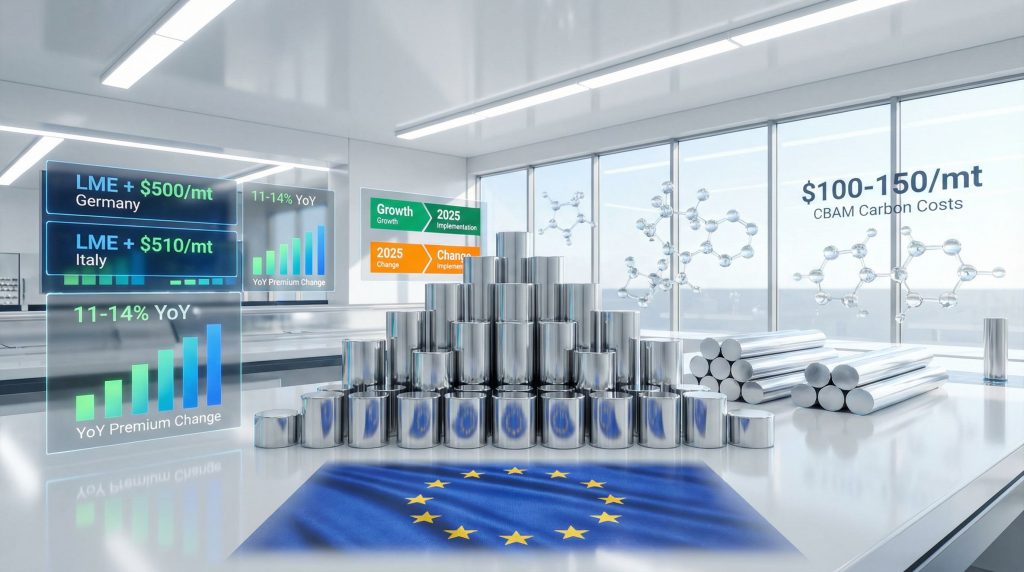
CBAM's transitional phase, which began October 1, 2023, required mandatory reporting without financial obligations. The compliance phase starting January 1, 2026 introduces actual carbon cost internalisation, with preliminary estimates suggesting EUR 90-100 per metric ton in direct carbon expenses. Currency conversion factors and aluminum's carbon intensity coefficients translate these regulatory costs into $100-150 per metric ton price additions for high-carbon intensity imports.
| Regulatory Component | Estimated Cost Impact | Implementation Timeline | Compliance Complexity |
|---|---|---|---|
| Import Duty Escalation | $20-30/mt | Post-quota expiration | Moderate |
| CBAM Carbon Costs | $100-150/mt | January 1, 2026 | High |
| Enhanced Documentation | $15-25/mt | Ongoing implementation | Moderate |
| Verification Requirements | $10-20/mt | Phased rollout | High |
The 573,000 metric ton quota threshold for tariff-free aluminum imports creates additional supply chain complexity. Historical import patterns suggest European markets typically exceed this threshold, triggering duty escalation from 4% to 6% on incremental volumes. This seemingly modest percentage increase compounds with CBAM costs to create substantial competitive shifts favouring low-carbon European production.
Regional competitive advantages emerge most clearly for Norwegian and Icelandic producers whose hydroelectric power sources deliver among the lowest carbon intensity profiles globally. These producers benefit not only from reduced CBAM exposure but also from enhanced market positioning as European customers increasingly prioritise supply chain carbon footprinting for their own sustainability reporting requirements. Additionally, tariff impact insights reveal broader implications for international competitiveness.
Front-loading inventory strategies became evident throughout 2025 as market participants anticipated regulatory implementation. This inventory build-up temporarily supported premium levels while creating potential overhang concerns for 2026 demand patterns. Supply chain managers report significant increases in advance purchasing commitments as companies seek to secure pre-CBAM pricing for strategic inventory positions.
Assessment methodology integration represents another technical challenge for market transparency. Pricing agencies must develop frameworks for incorporating carbon cost variables into traditional premium calculations while maintaining consistent, auditable methodologies that serve as reliable benchmarks for financial and physical settlement purposes.
Market Performance Analysis and Demand Dynamics
European aluminium billet premiums trajectories through late 2025 reflected the intersection of weakening industrial demand, regulatory uncertainty, and supply chain repositioning strategies. Market participants navigated an environment where traditional demand drivers faced headwinds while new regulatory frameworks created additional cost pressures and competitive realignments.
Automotive sector demand exemplifies these complex dynamics. European car production volumes declined throughout 2025 as economic uncertainty reduced consumer purchasing power and delayed replacement cycles. However, light-weighting initiatives within the automotive industry continued driving aluminum content per vehicle higher, partially offsetting volume declines with intensity improvements.
The construction sector weakness proved more straightforward in its negative impact. European construction activity contracted as higher interest rates constrained project financing and reduced residential investment. This contraction particularly affected extrusion demand, given aluminum's prominence in window systems, curtain walls, and structural applications where substitution possibilities remain limited.
Industrial extrusion capacity adjustments became necessary as demand patterns shifted. Norsk Hydro's announcement of operational restructuring, including facility consolidations across multiple European locations, signalled broader industry recognition that overcapacity relative to current demand required systematic capacity reduction. These adjustments, while painful for affected communities and workers, represent necessary rationalisation supporting premium sustainability for remaining operations.
Export market opportunities provided partial demand offset as European producers leveraged quality reputations and established customer relationships to access third-country markets. However, transportation costs and competitive pressure from regional suppliers limited the scale of export-driven demand support.
Premium volatility throughout this period reflected multiple uncertainty sources:
• Regulatory implementation timing creating front-loading and inventory management complexity
• Energy cost fluctuations affecting both production economics and competitive positioning
• Currency movements between EUR/USD influencing import competitiveness
• Raw material availability particularly for secondary producers dependent on scrap sourcing
Market psychology exhibited clear risk aversion characteristics as participants prioritised supply security over cost optimisation. This behaviour supported premium levels above what fundamental supply-demand balance might otherwise suggest, reflecting the value market participants placed on certainty amid regulatory transition.
What Factors Drive European Aluminium Billet Premiums Most Significantly?
The primary drivers include carbon compliance costs under CBAM, regional supply-demand imbalances, and energy price volatility affecting production economics. These factors interact to create complex premium structures that reflect both traditional market forces and emerging regulatory requirements. Furthermore, data-driven operations help companies better understand and respond to these market dynamics.
Operational Challenges and Strategic Adaptations
Secondary aluminum producers face the most acute operational challenges in the current market environment. These operations, typically smaller and more regionally focused than primary producers, confront simultaneous pressures from raw material costs, regulatory compliance requirements, and margin compression that threaten fundamental business model viability.
Scrap sourcing difficulties intensified throughout 2025 as competing demand from steel recycling and export markets reduced availability while increasing costs. Secondary producers operate with inherently variable feedstock quality and availability, making production planning and cost management significantly more complex than primary operations with consistent raw material inputs.
Spanish and Italian secondary producers report sustainability threshold concerns when spot market prices approach certain levels that make continued operations economically unviable. These threshold effects create potential supply disruption risks that could support premium levels if demand recovers while secondary capacity remains offline.
Production optimisation strategies focus on energy efficiency improvements and yield maximisation to offset raw material cost increases. However, these operational improvements typically require capital investment at a time when cash flow constraints limit available resources for facility upgrades and technology implementation.
Technology integration priorities emphasise digital tracking systems for carbon footprint documentation and automated quality control to reduce labour costs and improve consistency. These investments serve dual purposes of regulatory compliance and operational efficiency, though payback periods extend beyond typical industry norms given current margin pressures.
Supply chain adaptation strategies include:
• Supplier diversification to reduce dependence on single scrap sources or geographic regions
• Inventory optimisation balancing carrying costs against availability security
• Contract structure modification incorporating regulatory cost pass-through mechanisms
• Customer relationship deepening to maintain market access despite premium competition
Logistics optimisation efforts focus on transportation route efficiency and modal selection to minimise both costs and carbon intensity. Some producers report success with consolidated shipping arrangements that improve truck utilisation while reducing per-unit transportation costs and carbon footprints.
Regional clustering effects become more pronounced as producers seek to optimise supply chains within geographic proximity. This clustering supports local supplier networks while reducing transportation-related costs and carbon intensity, creating competitive advantages for well-positioned regional ecosystems. Consequently, aluminium premium assessments require increasingly sophisticated methodologies.
Strategic Investment Framework and Future Positioning
Investment strategies for European aluminum markets must balance immediate operational requirements with long-term positioning for a carbon-constrained competitive environment. Capital allocation decisions made during this transition period will largely determine competitive positioning throughout the next decade as regulatory frameworks solidify and market structures adapt.
CBAM compliance infrastructure represents a mandatory investment category rather than optional efficiency improvement. Companies require sophisticated monitoring, reporting, and verification systems to demonstrate carbon intensity levels and maintain market access. These systems demand both technology investment and organisational capability development, particularly for smaller producers lacking existing environmental reporting expertise.
Technology investment priorities should emphasise carbon intensity reduction and operational efficiency improvement simultaneously. The most effective investments deliver immediate cost benefits while positioning operations for enhanced competitiveness under carbon pricing regimes. Examples include:
• Energy efficiency upgrades reducing both operating costs and carbon intensity
• Process automation improving consistency while reducing labour and energy costs per unit
• Waste heat recovery systems capturing previously lost energy while reducing external energy requirements
• Digital optimisation platforms enabling real-time production optimisation and carbon tracking
Supply chain resilience investments focus on diversification and flexibility rather than single-source optimisation. The regulatory transition period demonstrates the importance of multiple sourcing options and operational flexibility to navigate disruptions and market changes.
Market timing considerations suggest that contract negotiation strategies should incorporate regulatory cost escalation assumptions and carbon pricing mechanisms. Fixed-price contracts without regulatory cost pass-through provisions create significant financial exposure as CBAM implementation progresses. In addition, diversification strategies become increasingly important for managing these complex exposures.
Risk management frameworks must address multiple uncertainty sources simultaneously. Traditional aluminum market risks around LME pricing and demand fluctuations now combine with regulatory implementation risks, carbon market development, and currency exposure related to EUR-denominated carbon costs applied to USD-denominated commodity pricing.
Investment decisions made during this transition period will determine competitive positioning for the next decade as carbon constraints become permanent features of aluminum market structure.
How Should Companies Prepare for CBAM Implementation?
Companies should prioritise establishing robust carbon monitoring systems, developing supplier carbon intensity databases, and implementing documentation workflows for regulatory compliance. Early preparation reduces implementation risks and provides competitive advantages through enhanced supply chain transparency.
The next major ASX story will hit our subscribers first
Risk Management and Financial Hedging Mechanisms
European aluminium billet premiums require sophisticated risk management approaches that address traditional commodity risks while incorporating new regulatory and environmental variables. The complexity of these overlapping risk factors demands comprehensive hedging strategies that extend beyond conventional commodity risk management.
Forward contract structures must incorporate regulatory cost variables and carbon pricing mechanisms to provide effective risk protection. Traditional commodity forwards based solely on LME pricing plus static premiums no longer capture the full range of price volatility sources affecting European aluminum markets.
Currency hedging becomes more complex given the interaction between EUR-denominated carbon costs and USD-denominated base aluminum pricing. This currency exposure creates correlation risks that traditional hedging approaches may not adequately address, particularly during periods of significant EUR/USD volatility.
Regulatory hedge instruments remain underdeveloped, creating challenges for market participants seeking protection against CBAM cost escalation or implementation delays. Insurance markets and structured product providers continue developing solutions, but liquidity and pricing remain limited relative to traditional commodity hedging markets.
Supply disruption contingency planning emphasises alternative sourcing arrangements and inventory management strategies. Companies report increasing use of option-based supply contracts that provide sourcing flexibility while limiting downside exposure to supply unavailability or price spikes.
Credit risk management requires enhanced scrutiny of counterparty financial health, particularly for secondary producers facing margin pressure and smaller traders with limited capital buffers. The industry transition creates higher probability of financial distress among weaker market participants, increasing counterparty risk for all market participants.
Portfolio diversification strategies extend beyond geographic and product diversification to include carbon intensity diversification across supply sources. This approach provides protection against regulatory changes while supporting sustainability reporting requirements that increasingly influence customer purchasing decisions.
Disclaimer: This analysis contains forward-looking statements and market projections that involve inherent uncertainties. Regulatory implementation timelines, carbon pricing mechanisms, and market responses may differ significantly from current expectations. Readers should conduct independent research and consultation with qualified professionals before making investment or operational decisions based on this analysis. All price figures and market data should be verified against current market sources, as commodity markets are subject to rapid changes that may not be reflected in this analysis.
Are You Positioning for the Next Major Metal Discovery?
Discovery Alert's proprietary Discovery IQ model provides real-time alerts on significant ASX mineral discoveries, including breakthrough aluminum and base metal finds that could reshape market dynamics. Don't miss potential opportunities in the evolving metals sector—explore historic discovery returns and begin your 14-day free trial today to stay ahead of market-moving announcements.