May 12, 2026
European Energy Resilience Through North Sea Asset Optimization
Continental energy security discussions increasingly focus on maximizing indigenous resource utilization while maintaining long-term sustainability commitments. European Union member states face complex balancing acts between immediate supply security requirements and climate policy obligations, creating strategic opportunities for countries with established hydrocarbon infrastructure.
Denmark emerges as a critical case study in this evolving landscape, where Denmark and North Sea production licences represent both immediate energy security assets and transition period bridges toward renewable energy independence.
When big ASX news breaks, our subscribers know first
Strategic Energy Positioning in European Context
European energy architecture underwent fundamental restructuring following 2022 geopolitical disruptions. Member states with significant domestic production capabilities gained renewed strategic importance as continental supply diversity became paramount. This shift elevated discussions around extending existing production infrastructure beyond originally planned decommissioning schedules.
Furthermore, Denmark's strategic positioning benefits from several convergent factors that distinguish its approach from purely commercial extension decisions. The country achieved renewable energy supply exceeding 50% of total consumption in 2024, according to International Energy Agency data, while maintaining significant North Sea production capacity through established operator partnerships.
Regulatory Framework Architecture
The 2020 North Sea Agreement established comprehensive parameters governing future hydrocarbon activities within Danish territorial waters. Moreover, this framework created specific operational boundaries including:
- Complete prohibition of new licensing rounds for oil and gas exploration
- Geographic limitations restricting new licences to areas west of 6°15' E longitude
- Mandatory state participation through Nordsøfonden's 20% ownership stake
- Definitive 2050 phase-out deadline for all fossil fuel extraction activities
These parameters ensure any extension considerations operate within established climate policy frameworks while maintaining operational flexibility for existing licensed areas. In addition, this regulatory approach demonstrates Denmark's commitment to balancing immediate energy security needs with long-term environmental goals.
Production Infrastructure Assessment
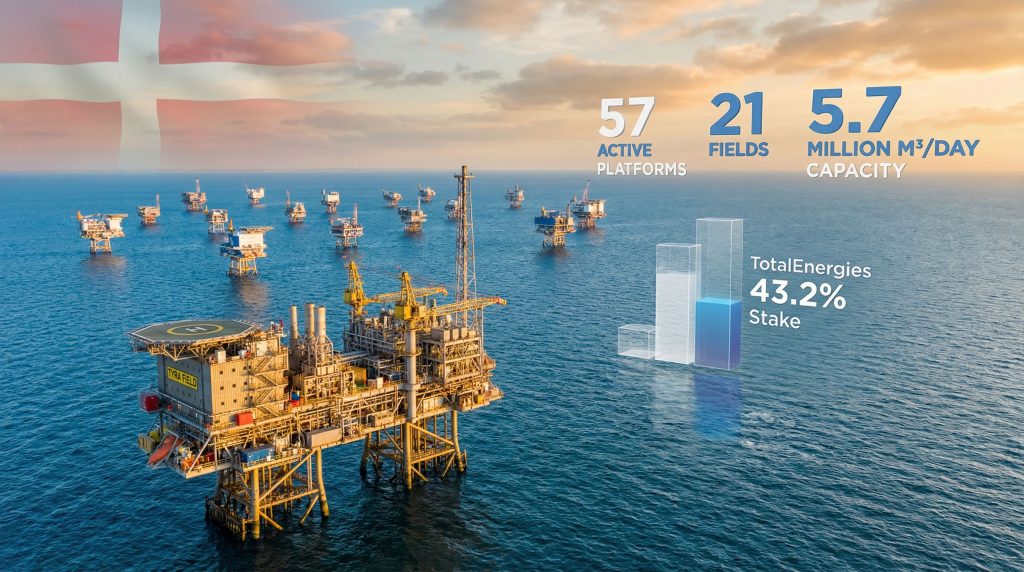
Current Denmark and North Sea production licences encompass 57 active platforms distributed across 21 operational fields. The operator distribution reflects established international partnerships:
| Primary Operator | Field Count | Strategic Significance |
|---|---|---|
| TotalEnergies | 15 fields | Lead operator partnership |
| INEOS | 5 fields | Secondary production presence |
| Wintershall Nordzee | 1 field | Specialized operational focus |
The Danish Underground Consortium (DUC) represents the most strategically significant asset, comprising TotalEnergies (43.2%), BlueNord (36.8%), and Nordsøfonden (20%). This consortium's current licence extends through 2042, positioning it as the primary candidate for potential extension evaluation.
Supply Security and European Energy Independence
Danish gas production projections indicate continued net export capacity through 2040, positioning the country as a sustained contributor to European energy security rather than a domestic consumption-focused producer. Consequently, this projection assumes particular significance given European import dependency challenges following Russian energy supply disruptions.
Continental Import Dependency Dynamics
European energy markets continue transitioning away from traditional supply sources while building renewable infrastructure capacity. Minister of Economic Affairs Stephanie Lose highlighted Europe's continued dependence on imported energy, including supplies from the United States, despite progress in diversifying away from Russian sources.
The Tyra field exemplifies Denmark's production capacity significance, operating as the country's largest gas facility with 5.7 million cubic meters per day gas production plus 22,000 barrels per day condensate output. This facility's continued operation directly contributes to European supply diversity objectives, particularly in the context of ongoing natural gas trends.
Geopolitical Risk Mitigation Strategy
Extension considerations address multiple strategic vulnerabilities simultaneously. Climate and Energy Minister Lars Aagaard articulated the strategic logic, emphasizing that Europe's transition toward green energy remains incomplete, making indigenous production preferable to imports from non-European sources.
This positioning offers several strategic advantages:
- Reduced exposure to supply chain disruptions from geopolitically unstable regions
- Enhanced negotiating leverage in international energy markets
- Strengthened energy sovereignty through indigenous resource optimization
- Transition period stability supporting renewable energy infrastructure development
Economic Optimisation and Green Transition Funding
Nordsøfonden's financial contribution demonstrates the economic significance of continued North Sea operations. The state energy company generated approximately 25 billion Danish kroner in taxes and dividends between 2012-2024, averaging roughly 2.08 billion kroner annually over this twelve-year period.
Revenue Allocation for Climate Objectives
The Danish government allocated 4 billion kroner annually beginning in 2034 for climate goal achievement, representing a substantial 60 billion kroner commitment over the fifteen-year implementation period. This allocation partially derives from hydrocarbon revenue streams, creating a direct link between continued production and green transition financing.
These revenues support broader European initiatives, including green hydrogen investments and renewable energy transformations across the region.
Industry Stakeholder Positioning
Industry organisations including BlueNord and Dansk Erhverv emphasise multiple economic benefits supporting extension considerations:
- Employment preservation in specialised energy sector roles
- Continued state revenue generation through production taxation
- Lower carbon footprint compared to imported energy alternatives
- Industrial expertise retention supporting future energy transition initiatives
TotalEnergies, as the primary DUC operator, expressed support for extension possibilities, characterising them as concrete contributions to supply security objectives.
Climate Policy Integration and Compliance Framework
Denmark maintains legally binding emissions reduction targets including 70% greenhouse gas cuts by 2030 from 1990 baseline levels, exceeding European Union requirements. The country committed to achieving net zero emissions by 2045 with negative emissions beyond that timeline.
Strategic Environmental Balance
Recent climate policy developments include ambitious 82% emission reduction commitments by 2030 from 1990 baselines, representing among the world's most stringent national targets. These commitments require careful integration with continued hydrocarbon production through the transition period.
The government frames extension evaluations within existing compliance frameworks, ensuring adherence to:
- International climate obligations including UN commitment frameworks
- 2050 extraction phase-out deadlines established through the North Sea Agreement
- Renewable energy scaling integration with renewable sources exceeding 50% of supply
- Green transition financing support through production revenue allocation
However, balancing these objectives with the broader OPEC production impact on global markets remains a complex challenge.
Renewable Energy Achievement Context
Denmark's renewable energy sector achieved significant milestones with over 50% of total energy supply from renewable sources in 2024. This achievement provides policy credibility for temporary fossil fuel production extensions, demonstrating genuine commitment to long-term energy transition objectives while addressing immediate European security requirements.
Implementation Framework and Decision Process
The announced government evaluation process indicates structured assessment methodology examining multiple dimensions simultaneously. Technical feasibility studies will evaluate specific licence extension possibilities while economic viability assessments consider various market scenarios.
For instance, the Danish Energy Agency provides comprehensive oversight of licensing frameworks for oil and gas operations, ensuring regulatory compliance throughout the process.
Stakeholder Consultation Structure
Environmental impact assessments operate within existing regulatory frameworks, ensuring compliance with Danish and European Union environmental regulations. Industry consultation processes involve established energy sector operators alongside environmental organisation input.
The government emphasised that any extension decisions must occur within North Sea Agreement parameters and align with Denmark and North Sea production licences policy objectives and international climate obligations.
Operator Response and Market Expectations
TotalEnergies welcomed extension possibilities as concrete contributions to supply security, indicating operational readiness for continued investment in Danish North Sea assets. Other consortium partners await formal evaluation outcomes while maintaining operational preparation for various scenarios.
Recent industry analysis suggests that Denmark is exploring significant extensions of its North Sea production capabilities. The evaluation timeline remains unspecified, though industry stakeholders anticipate structured decision-making processes reflecting the complexity of balancing energy security with climate policy compliance.
The next major ASX story will hit our subscribers first
Regional Energy Market Implications
Denmark's extension considerations reflect broader European energy strategy evolution where member states increasingly coordinate national resource decisions with collective security objectives. This approach may influence similar decisions across North Sea region countries facing comparable strategic choices.
Long-term Market Architecture
Extended Danish production supports European energy independence goals while providing transition period stability during renewable energy infrastructure scaling. This strategic positioning delivers:
- Bridge capacity supporting renewable energy deployment timelines
- Supply diversity reducing single-source dependency vulnerabilities
- Market stability through predictable indigenous production forecasts
- Strategic flexibility for responding to evolving geopolitical developments
Furthermore, these developments align with broader discussions about critical minerals and energy security in supporting Europe's energy transition.
European Coordination Precedent
Denmark's systematic approach to balancing immediate energy security with long-term climate commitments may establish precedents for other European Union member states managing similar strategic decisions. The integration of climate policy compliance with energy security objectives offers a framework other countries might adapt to their specific circumstances.
The emphasis on European collective benefit rather than purely national interest demonstrates evolving approaches to energy policy coordination within the European Union framework.
Further Analysis: Readers seeking deeper understanding of North Sea energy developments and European energy security trends can explore additional market intelligence through established energy industry analysis providers covering regional production trends and regulatory policy developments.
Disclaimer: This analysis contains forward-looking assessments regarding energy production, market conditions, and policy developments that involve inherent uncertainties. Production projections, economic forecasts, and policy implementation timelines may vary significantly from current estimates due to technological, market, or political factors beyond current prediction capabilities.
Want to Capitalise on Energy Market Opportunities?
Discovery Alert's proprietary Discovery IQ model delivers real-time alerts on significant mineral discoveries across the ASX, helping investors identify actionable opportunities in the rapidly evolving energy and resources sector. Explore historic examples of exceptional discovery outcomes and begin your 14-day free trial today to secure your market-leading advantage.