May 20, 2026
The Hidden Mechanics Behind European Ethanol Pricing — And Why Everything Is Changing
Commodity benchmarks rarely make headlines until they break. For decades, ethanol price formation in Europe operated in relative obscurity, relying on bilateral transactions, informal reference points, and a relatively stable cast of domestic suppliers. That era is ending. A convergence of compliance mandates, supply disruptions, antitrust enforcement, and new financial instruments has pushed European ethanol new benchmarks for a changing market to the top of the agenda for producers, blenders, traders, and regulators alike.
Understanding what is driving this transformation, and what it means in practice, requires looking beneath the surface of a market that most energy analysts have historically underweighted.
When big ASX news breaks, our subscribers know first
RED III and the Compliance Revolution Reshaping Ethanol Procurement
The Renewable Energy Directive III, commonly referred to as RED III, has fundamentally altered the commercial calculus for European ethanol. Earlier iterations of the directive treated biofuel volume as the primary compliance variable. RED III goes considerably further by embedding greenhouse gas intensity thresholds as a central compliance metric.
This shift is more consequential than it might appear. It means that not all ethanol is created equal in the eyes of European obligated parties. The GHG profile of a given ethanol shipment now determines its compliance value, creating commercially distinct categories within what was previously treated as a largely homogenous commodity.
The practical implications for procurement and benchmark design are significant. Furthermore, green transition policies are reshaping the entire supply and demand landscape across the sector:
- Crop-based ethanol with higher GHG intensity now occupies a defined compliance tier, subject to volume caps and ILUC restrictions under RED III
- Advanced and cellulosic ethanol, derived from non-food feedstocks, commands superior compliance value and in some national frameworks benefits from double-counting provisions
- Sustainability certification has become a procurement prerequisite rather than an optional premium, with schemes such as ISCC and RSB now functioning as gating criteria for compliance eligibility
- Bilateral pricing opacity, which previously characterised much of the higher-GHG crop-based ethanol trade, is increasingly inadequate as blenders face regulatory reporting obligations tied to specific GHG categories
The emergence of grade-specific ethanol benchmarks is not a refinement of existing market infrastructure. It reflects a structural segmentation of demand that did not exist under previous policy frameworks, and that existing price references were never designed to serve.
Feedstock origin adds another layer of complexity. Wheat, corn, and sugar beet ethanol all carry different default GHG values under RED III calculations, and production process variables, including whether renewable energy is used in distillation, further influence a shipment's certified intensity. This granularity has no precedent in European ethanol market history.
The E20 Question: Large Opportunity, Unresolved Barriers
One of the most consequential near-term demand variables in European ethanol is the potential introduction of E20 fuel blends. A gasoline blend containing 20% ethanol by volume, E20 would represent a significant step up from the E10 standard that now predominates across much of the EU.
The demand arithmetic is straightforward: a ten-percentage-point increase in the blending mandate across European gasoline consumption would require very substantial additional ethanol volumes. However, two structural barriers continue to delay any firm implementation pathway.
| Blend Level | Adoption Status | Primary Constraint | Near-Term Demand Relevance |
|---|---|---|---|
| E5 | Phased out in most markets | Superseded | Negligible |
| E10 | Dominant EU standard | Largely resolved | Already reflected in pricing |
| E20 | Under policy consideration | Engine compatibility, no binding timeline | High upside if mandated |
| E85 | Flex-fuel vehicles only | Limited fleet penetration | Marginal |
The engine compatibility issue is not trivial. A meaningful proportion of the existing European vehicle fleet was not designed or certified for sustained use of E20 fuel. Resolving this through fleet turnover or vehicle recertification programmes takes years rather than months. Until policy frameworks establish clear transition timelines, the demand uplift from E20 remains speculative rather than priced into forward curves.
This uncertainty has its own market consequence. Producers and blenders who might otherwise invest in expanded capacity are reluctant to commit capital to a demand scenario that lacks regulatory certainty. Consequently, the policy delay is not neutral — it actively suppresses investment in supply-side readiness.
Supply Under Pressure: Three Structural Shifts Tightening the Market
The European ethanol supply environment has grown considerably more complex over the past two to three years, with three distinct forces converging to tighten available volumes and introduce new sources of price volatility.
UK Production Capacity Losses
Capacity reductions at UK-based ethanol production facilities have removed a historically reliable and geographically proximate supply source from the continental balance. For northern European buyers in particular, the UK represented a low-freight, well-established origin. Its reduced contribution has opened arbitrage windows while also tightening spot availability for buyers who preferred domestic or near-regional supply.
Redirected US Ethanol Flows
The United States remains the world's largest ethanol producer, and American corn-based ethanol has historically found its way into European markets when domestic US economics or export incentives made transatlantic flows attractive. Changes in US blending policy, domestic demand variables, and freight economics have introduced greater variability in these flows. In addition, supply chain disruptions have further complicated the reliability of transatlantic ethanol trade. European buyers can no longer treat US import availability as a reliable swing supply source with predictable pricing.
Mercosur Trade Access Uncertainty
Ongoing EU-Mercosur trade negotiations carry substantial implications for European ethanol supply balances. Brazilian sugarcane ethanol has a considerably lower GHG intensity than European grain-based production and competes on cost. If preferential trade access is eventually granted to Brazilian volumes, it could materially compress margins for European producers and reshape the GHG-intensity premium structure that currently defines crop-based ethanol pricing.
The simultaneous occurrence of domestic production losses, variable import flows, and unresolved trade access negotiations creates a supply environment that is fundamentally more uncertain than anything European ethanol markets have historically had to price. This complexity demands price discovery tools of a different order than the bilateral reference mechanisms that previously sufficed.
New Pricing Architecture: How the Market Is Building Better Benchmarks
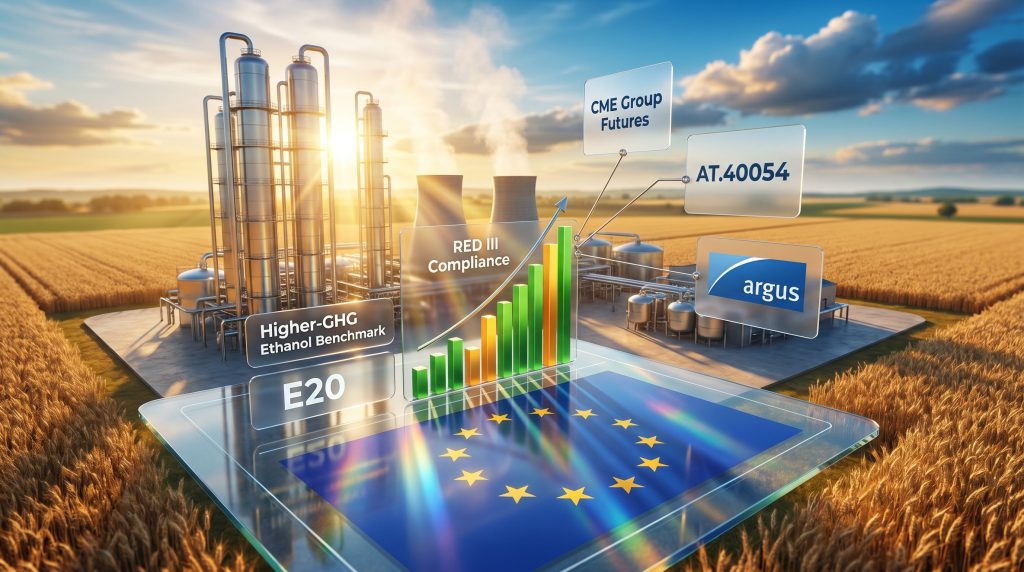
In response to this complexity, the European ethanol market has begun constructing a more sophisticated pricing infrastructure. The most significant development is the introduction of a dedicated Argus price assessment for higher-GHG crop-based ethanol, which provides a transparent daily reference for a category of ethanol that previously lacked any standardised public price signal.
This benchmark serves several functions that the market previously had to manage without:
- It establishes a credible, methodology-governed reference price that counterparties can use as a contract basis
- It makes the compliance cost of higher-GHG ethanol visible and comparable across transactions
- It creates the foundation for financial derivatives, enabling forward price exposure management
- It provides regulators and policymakers with observable market data on compliance-grade pricing
The broader direction of travel across price reporting agencies has been toward greater granularity in ethanol assessments. Fuel-grade, industrial-grade, beverage-grade, and certified sustainable variants each carry distinct commercial characteristics that a single aggregate benchmark cannot adequately represent.
CME Group Futures: Financial Infrastructure Meets Compliance Markets
The development of CME Group futures contracts referenced against the Argus higher-GHG ethanol benchmark represents a meaningful maturation of the market's risk management capabilities. For context, most agricultural and energy commodities of comparable scale have had exchange-traded derivatives available for decades. European ethanol has lagged significantly in this regard.
The availability of standardised futures contracts changes the risk management options available to each category of market participant. These instruments also align closely with broader commodities hedging strategies being adopted across global commodity markets:
- Producers can hedge forward price exposure against shifts in regulatory demand and supply-side competition without relying on bespoke bilateral arrangements
- Fuel blenders and obligated parties can lock in the cost of compliance-grade ethanol ahead of regulatory reporting periods, reducing earnings volatility
- Trading houses and intermediaries gain a liquid instrument for managing inventory risk and expressing directional views on supply-demand balances
- Financial market participants gain a biofuels-specific commodity exposure that sits within the broader decarbonisation investment theme
The linkage to a methodology-governed price reporting agency assessment rather than a physical delivery specification is itself noteworthy. It reflects the reality that compliance-grade ethanol is defined by its certification status and GHG profile rather than its physical characteristics alone.
Benchmark Integrity and the Antitrust Dimension
The credibility of any price benchmark depends entirely on the integrity of the price formation process that underlies it. European ethanol has attracted regulatory scrutiny on precisely this point, with the European Commission pursuing formal antitrust proceedings under case AT.40054 relating to alleged manipulation of ethanol price benchmarks.
Separately, Swedish agricultural cooperative Lantmännen received a fine from the European Commission in connection with participation in an ethanol benchmarks cartel, providing a concrete illustration of the legal consequences that benchmark manipulation now carries in this market.
| Regulatory Framework | Scope | Relevance to Ethanol Benchmarks |
|---|---|---|
| EU Benchmark Regulation (BMR) | Financial and commodity benchmarks | Applies to regulated ethanol price references |
| EU Competition Law (Article 101 TFEU) | Cartel and collusion prohibition | Legal basis for EC antitrust proceedings |
| RED III Sustainability Requirements | GHG intensity and feedstock certification | Defines compliance value by grade |
| IOSCO Principles for Price Reporting Agencies | PRA methodology standards | Governs assessment methodology and governance |
The implications extend beyond the firms directly implicated. Price reporting agencies face heightened expectations around methodology transparency, governance frameworks, and the robustness of their data collection processes. Market participants who contribute pricing data must ensure their reporting conduct is consistent with both benchmark regulation and competition law. The era of ethanol price-setting operating beneath the regulatory radar is definitively over.
The next major ASX story will hit our subscribers first
GHG Intensity as a Price Signal: Understanding the Premium Structure
One of the less widely understood dynamics emerging in European ethanol new benchmarks for a changing market is the price spread that has developed between different GHG intensity categories. This spread functions as a compliance signal, reflecting the market's collective assessment of regulatory scarcity and demand pressure within each tier.
Several factors determine the magnitude and direction of this premium at any given moment:
- The feedstock type and its default GHG value under RED III calculation methodologies
- Whether the production facility uses renewable energy in its distillation process, which can materially reduce certified intensity relative to the default value
- The credibility and market recognition of the certification scheme applied to a given shipment
- The proximity of total higher-GHG crop-based ethanol volumes to the national caps embedded in RED III implementation, since constraint near a cap inflates compliance value
This last factor is particularly important and often underappreciated. When national obligated parties approach the volumetric ceiling for crop-based ethanol, the compliance value of each additional tonne increases nonlinearly. Price benchmarks that capture this dynamic in real time provide substantially more decision-relevant information than historical contract references.
The Food-Versus-Fuel Constraint and Its Long-Run Supply Ceiling
No analysis of European ethanol supply is complete without accounting for the ILUC problem. Indirect land use change — the process by which bioenergy crop expansion displaces food production onto previously uncultivated land — has been a structurally contested issue in European biofuels policy for over fifteen years.
RED III's treatment of ILUC is more explicit than its predecessors, embedding volume restrictions on high-ILUC risk feedstocks and establishing a trajectory toward phase-down of crop-based contributions to blending mandates. This creates a long-run ceiling on domestic European ethanol supply that market participants must account for in their strategic planning.
Agricultural commodity price linkages compound this constraint. Periods of food price inflation, whether driven by weather events, geopolitical disruption, or input cost shocks, consistently generate political pressure to redirect cereal and sugar feedstocks away from fuel production. The ethanol market has no reliable mechanism for insulating itself from these external shocks, which is precisely why robust forward pricing and hedging infrastructure matters. Furthermore, the trade and pricing impacts of geopolitical disruptions continue to reverberate throughout the biofuels supply chain.
The combination of ILUC restrictions and food-versus-fuel political dynamics creates a durable structural incentive for European policy to accelerate the transition toward advanced, waste-based, and non-food feedstock ethanol. However, the commercial scaling of these pathways remains a medium-to-long-term story. In the near term, crop-based ethanol remains the dominant supply source, operating under increasingly complex constraints.
Scenario Analysis: Four Pathways for European Ethanol Benchmarks Through 2030
The trajectory of European ethanol markets over the next three to five years will be shaped by the interaction of policy, supply, and financial market development. Four scenarios capture the plausible range of outcomes.
Scenario A: E20 Mandate Accelerated
A clear EU-level timeline for E20 implementation, combined with a managed vehicle fleet transition, would generate a demand surge that tightens supply balances and amplifies the commercial significance of the higher-GHG benchmark. Futures liquidity would likely increase as both producers and blenders seek to manage new forward exposure.
Scenario B: Mercosur Agreement Finalised
Brazilian sugarcane ethanol gaining preferential EU market access at scale would introduce a large, lower-GHG, cost-competitive supply source. This scenario would compress margins for European grain-based producers and potentially reduce the GHG-intensity premium as lower-carbon volumes expand their market share.
Scenario C: Strengthened Benchmark Regulation Post-Antitrust
If the Commission's antitrust proceedings result in formal regulatory requirements governing ethanol benchmark methodologies, price reporting agencies would operate under heightened oversight. This scenario would likely increase benchmark credibility and market adoption while raising the compliance cost for PRA governance.
Scenario D: Advanced Ethanol Scales Faster Than Expected
Accelerated commercialisation of cellulosic and waste-based production could erode the volume share of crop-based grades more rapidly than current projections suggest. This would reduce the long-term market for higher-GHG benchmarks while creating new pricing infrastructure requirements for advanced feedstock categories.
Each scenario carries distinct implications for producers, blenders, traders, and the financial participants building exposure to European biofuels. However, the critical insight is that no single scenario dominates — the actual outcome will reflect combinations of these forces playing out at different speeds across different member states.
What Market Participants Need to Prioritise Now
For those operating across the European ethanol value chain, the structural shifts underway point to several concrete priorities. Notably, commodity price performance across adjacent markets offers useful parallels for understanding how benchmark evolution shapes commercial strategy.
- Compliance segmentation is permanent. RED III has created distinct commercial categories that require distinct price references. Procurement strategies built around undifferentiated ethanol pricing will generate increasing basis risk over time.
- Risk management infrastructure has arrived. CME Group futures linked to the Argus higher-GHG ethanol benchmark provide hedging tools that did not previously exist. The question for producers and blenders is no longer whether to hedge, but how to integrate these instruments into treasury and procurement frameworks.
- Supply uncertainty is structurally elevated. UK production losses, variable US flows, and unresolved Mercosur dynamics create a more volatile supply environment than historical norms suggest. Inventory management and contract structures need to reflect this new baseline.
- Benchmark governance is a competitive differentiator. In a market where antitrust proceedings have already produced fines, the methodology transparency and governance quality of the price references that market participants rely upon carries legal as well as commercial significance.
- Policy remains the dominant variable. E20 timing, RED III national implementation, and ILUC restrictions will collectively set the demand ceiling and supply floor for crop-based ethanol. For instance, European renewable ethanol has already demonstrated record-level GHG reductions, underlining how rapidly regulatory conditions are evolving. Monitoring these variables with the same rigour applied to supply-demand fundamentals is no longer optional for sophisticated participants.
This article is intended for informational purposes only and does not constitute financial, legal, or investment advice. Forecasts, scenario analyses, and market projections involve inherent uncertainty and should not be relied upon as predictions of future market outcomes. Readers should conduct their own due diligence and consult qualified advisers before making any commercial or investment decisions based on the information presented here.
Want to Stay Ahead of the Next Major Commodity Discovery?
While European ethanol markets undergo structural transformation, Discovery Alert's proprietary Discovery IQ model scans the ASX daily to deliver real-time alerts on significant mineral discoveries — turning complex commodity data into actionable investment insights for both short-term traders and long-term investors. Explore how historic discoveries have generated substantial returns and begin your 14-day free trial today to position yourself ahead of the broader market.