May 20, 2026
India's Fuel Price Crisis: When a Distant Chokepoint Hits Every Petrol Station
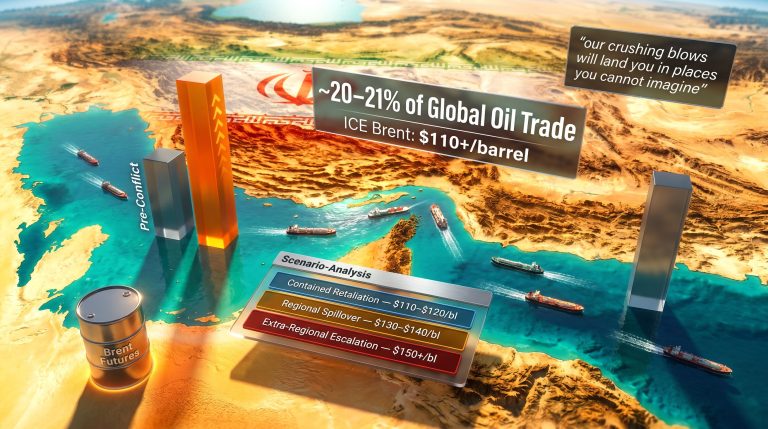
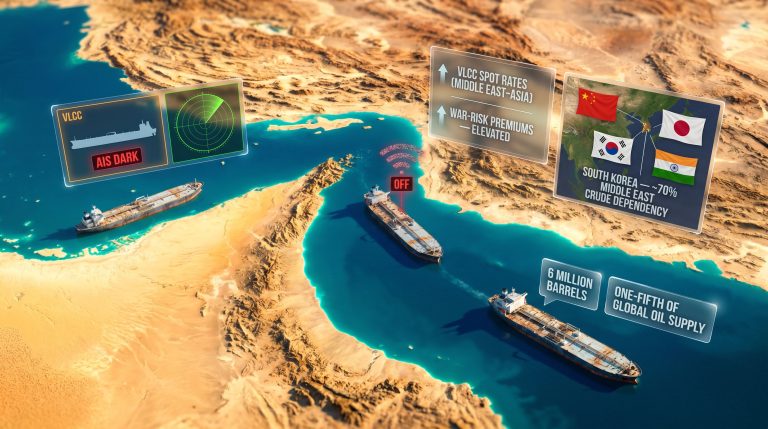
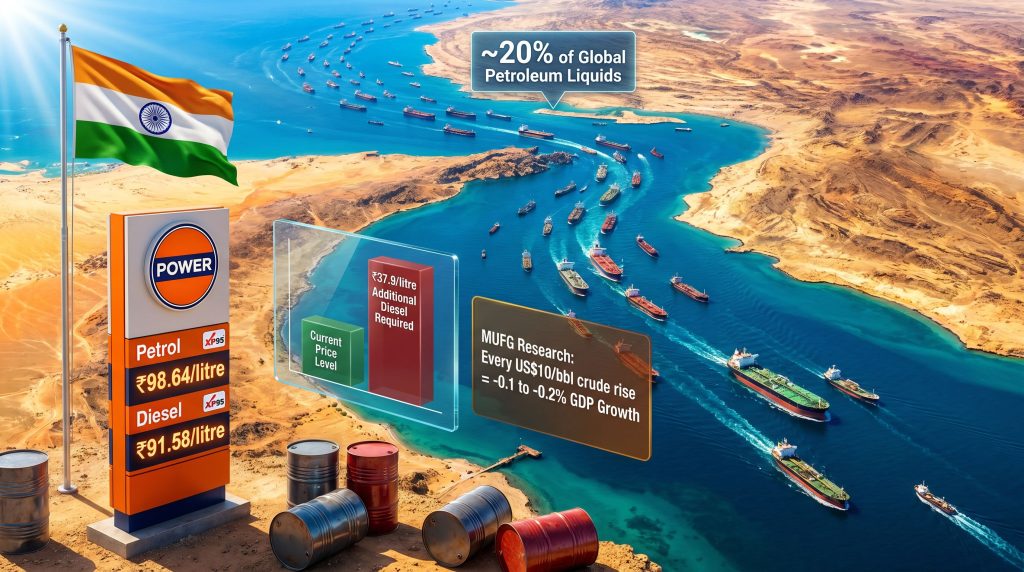
Global energy markets have long operated under an uncomfortable truth: the most strategically sensitive infrastructure on Earth is not a pipeline, a refinery, or a power grid. It is a 54-kilometre-wide stretch of water between Iran and Oman. The Strait of Hormuz carries roughly 20 to 21 million barrels of oil per day, representing approximately 20% of all petroleum liquids consumed globally. When tension escalates in that corridor, the price signal travels almost instantaneously to commodity exchanges, insurance markets, and eventually to the fuel pumps where Indian consumers fill their vehicles.
Understanding why the India fuel price hike due to Strait of Hormuz crisis is not simply a domestic policy story requires stepping back from the headline figures and examining the structural architecture that connects Gulf crude production to South Asian retail prices. Furthermore, oil price movements in global markets compound these pressures in ways that extend well beyond any single geopolitical flashpoint.
When big ASX news breaks, our subscribers know first
Why India Cannot Escape the Hormuz Equation
India's crude oil import dependency is not a temporary condition awaiting a technological fix. It is a structural feature of the country's energy economy. The nation imports approximately 85% of its crude oil requirements, and a significant portion of that volume originates from Gulf producers including Iraq, Saudi Arabia, and the UAE, all of whom route exports through the Strait of Hormuz.
Unlike oil-exporting nations, India has no production windfall to offset rising import costs. Every dollar added to the per-barrel price of crude translates directly into a wider import bill, a larger current account deficit, and downward pressure on the Indian rupee. Because crude oil is priced in US dollars internationally, a weakening rupee compounds the damage further: the domestic cost of the same barrel of oil rises even if the dollar price holds steady.
Research from MUFG highlights the quantified version of this vulnerability:
A US$10 per barrel increase in crude oil prices is estimated to reduce India's GDP growth by 0.1 to 0.2 percentage points while pushing headline inflation higher by approximately 0.2 percentage points, creating a compounding macroeconomic headwind during any sustained period of Hormuz-linked supply disruption.
This means that geopolitical risk in a region thousands of kilometres away registers as a measurable drag on Indian household incomes, corporate earnings, and government fiscal arithmetic simultaneously. Consequently, the trade war impact on oil adds yet another layer of uncertainty to an already volatile pricing environment.
A Four-Year Price Freeze and Its Inevitable End
India's state-run oil marketing companies (OMCs) maintained retail fuel prices without revision from April 2022 through to May 2026, a freeze spanning more than four years. This was a politically motivated decision: retail fuel prices are deeply sensitive in a country where diesel powers both agricultural operations and the logistics networks that underpin food distribution.
The freeze held even as global crude markets moved through multiple cycles. However, when Hormuz-related supply disruptions pushed Brent crude to elevated levels and domestic under-recoveries became fiscally unsustainable, the adjustment arrived in two steps:
- An initial increase of approximately ₹3 per litre on both petrol and diesel, effective 15 May 2026
- A follow-up adjustment of approximately ₹0.9 per litre implemented within days of the first revision
- Post-revision petrol prices in major markets reached approximately ₹98.64 per litre
- Diesel settled at approximately ₹91.58 per litre in comparable markets
Despite these back-to-back revisions, the adjustments remain insufficient relative to the cost environment that India's refiners are operating within. Analysis from Kotak Institutional Equities indicates that under-recoveries — the gap between what OMCs charge consumers and the actual cost of supply — are running at an estimated ₹8 to 9 billion per day.
| Metric | Estimated Value |
|---|---|
| Initial retail hike (May 15, 2026) | ₹3.00 per litre |
| Follow-up retail adjustment | ~₹0.9 per litre |
| Petrol price, major markets | ~₹98.64 per litre |
| Diesel price, major markets | ~₹91.58 per litre |
| Daily under-recovery estimate | ₹8 to 9 billion per day |
| Monthly refiner burden at US$120/bbl crude | ₹250 to 260 billion |
At a delivered crude price of approximately US$120 per barrel, Kotak Institutional Equities estimates the aggregate monthly burden on India's refining sector at ₹250 to 260 billion, a figure that describes an unsustainable operating environment for state-owned enterprises whose remit includes social pricing obligations.
How India's Retail Fuel Pricing Mechanism Actually Works
The mechanics of how petrol and diesel reach their final pump price in India are not widely understood outside the sector. The process involves multiple layered cost components, each of which expands when crude prices rise.
- Crude oil benchmarking: India prices its import basket against a weighted average of the grades it actually purchases, known as the Indian crude basket.
- Delivered cost calculation: Freight, insurance, and port handling charges are added to the benchmark crude price.
- Refining margin application: The cost of converting crude into refined products including petrol, diesel, and aviation turbine fuel (ATF) is applied.
- Tax layering: Central government excise duty and state-level value-added tax (VAT) are added on top of the refinery gate price, making India's effective fuel tax burden among the highest in Asia.
- OMC marketing margin: State-owned refiners add their distribution and marketing cost margin.
- Under-recovery absorption: When the resulting retail price falls below the cost-recovery level due to a political price freeze, OMCs absorb the difference, effectively subsidising consumers at the expense of their own balance sheets.
This architecture creates a delayed but eventually unavoidable reckoning. The longer a price freeze persists against a rising crude cost environment, the steeper the eventual correction must be to restore financial sustainability to the refining sector. In addition, India's energy import taxes further complicate the pricing calculus for state-owned refiners navigating these structural pressures.
The Four Scenarios That Reveal How Far Prices May Still Rise
Kotak Institutional Equities modelled four distinct pricing frameworks to estimate the additional per-litre adjustments required for Delhi retail prices to reach full cost recovery, assuming crude remains near US$120 per barrel. The range of outcomes is striking:
| Pricing Scenario | Additional Diesel Hike Required | Additional Petrol Hike Required |
|---|---|---|
| Trade Parity (windfall tax on exports only) | ₹37.9 per litre | ₹28.9 per litre |
| Export Parity with Windfall Tax | ₹13.4 per litre | ₹17.1 per litre |
| Fixed Normative Refining Margins | ₹24.7 per litre | ₹20.5 per litre |
| Low-Margin Refining Assumption | ₹21.1 per litre | ₹19.0 per litre |
Even under the most conservative scenario, diesel prices in India may need to rise by more than ₹21 per litre above their current post-hike level to achieve full cost recovery, provided crude oil remains near US$120 per barrel.
The spread between these scenarios is not merely academic. Each scenario corresponds to a different policy choice the government might make regarding how refining margins are calculated and how windfall taxes are applied to export revenues. The choice of framework therefore becomes a political decision as much as a technical one.
Understanding the Windfall Tax: A Policy Tool Under Active Revision
India's windfall tax architecture was introduced in 2022 as a mechanism to capture excess profits generated by domestic refiners when global crude prices surge and export margins widen disproportionately. The levy applies to diesel exports, ATF exports, and more recently, petrol exports.
The most recent government revision to windfall tax rates reflects a recalibration of the balance between revenue extraction and refiner viability:
- Diesel export levy: reduced from ₹23 per litre to ₹16.5 per litre
- ATF export levy: cut substantially from ₹33 per litre to ₹16 per litre
- Petrol: previously exempt, now subject to a new ₹3 per litre export levy
Kotak Institutional Equities described the direction of this revision as more commercially rational than previous iterations, noting that post-tax refining spreads of approximately US$20 to 30 per barrel represent commercially viable economics under current market conditions.
One aspect of India's windfall tax design that is less commonly understood is the asymmetric treatment of different fuel products. ATF saw the largest absolute reduction in export levy, which reflects the aviation sector's sensitivity to fuel cost escalation and the government's interest in maintaining the competitiveness of Indian carriers and airports during a period of elevated crude costs.
The next major ASX story will hit our subscribers first
The Broader Economic Transmission: Inflation, Growth, and Currency
The consequences of an India fuel price hike due to Strait of Hormuz crisis extend well beyond household petrol expenditure. Diesel is the backbone of India's freight and logistics ecosystem, meaning any revision to diesel prices initiates a cost cascade across multiple sectors simultaneously. For a comprehensive view of underlying market forces, the latest crude oil market update provides essential context.
Key transmission channels include:
- Diesel-powered road freight increases the delivered cost of food, consumer goods, and industrial inputs across India's logistics network
- Agricultural operations reliant on diesel-powered irrigation and mechanised farming face margin compression that flows through to food prices
- Urban households experience dual pressure from rising commuting costs and higher prices for essential goods in retail markets
- Manufacturing sector input costs rise as energy and freight costs climb
- Aviation faces higher ATF costs, which are typically passed through to ticket prices
The macroeconomic sensitivity data from MUFG crystallises the scale of exposure:
| Economic Impact Channel | Estimated Effect |
|---|---|
| GDP growth reduction per US$10/bbl rise | 0.1 to 0.2 percentage points |
| Inflation increase per US$10/bbl rise | ~0.2 percentage points |
| Currency direction | INR weakening vs. USD |
| Most exposed sectors | Logistics, aviation, agriculture, manufacturing |
A sustained Hormuz disruption maintaining crude above US$100 to 120 per barrel through FY2026-27 could therefore represent a compounding triple pressure on India's economy: higher inflation constraining consumer spending, slower GDP growth reducing tax revenues, and a weaker rupee raising the cost of all dollar-denominated imports simultaneously.
South Asia's Shared Vulnerability
India's exposure to Hormuz-linked crude price volatility is not unique within its immediate geographic neighbourhood. The same supply disruption dynamics are transmitting across South Asian economies that share the same structural characteristic: heavy import dependence on Gulf crude with limited domestic production buffers. Furthermore, Asian energy import pressure from US tariff policy has added a further dimension of complexity to regional energy pricing.
Nepal and Sri Lanka have both faced fuel pricing pressures driven by the same upstream crude cost dynamics. Sri Lanka, navigating a post-crisis economic recovery with constrained foreign exchange reserves, faces particular vulnerability to renewed energy cost inflation. Unlike Gulf Cooperation Council nations that generate oil export revenues to offset price movements, South Asian economies experience crude price increases as a pure cost shock with no corresponding income offset.
The absence of strategic petroleum reserve depth comparable to OECD member states means South Asian governments face a narrower window for absorbing shocks through subsidies or price controls before fiscal constraints force retail price adjustments.
What a Prolonged Disruption Would Mean
Scenario analysis across different disruption durations reveals meaningfully different policy and economic implications:
Short-term disruption (days to weeks):
- Immediate Brent crude spot price spike
- Tanker rerouting around the Cape of Good Hope raises freight and insurance costs
- OMC under-recoveries widen ahead of policy response
- Retail price revision pressure intensifies
Sustained disruption (months):
- Structural repricing of India's entire import cost base
- Significant inflationary pass-through into food, transport, and manufactured goods
- Possible government intervention through excise duty reductions to partially offset retail price increases
- Accelerating rupee depreciation raising the cost of all dollar-denominated imports
Long-term strategic implications:
- Renewed urgency around domestic renewable energy expansion as a fuel substitution strategy
- Potential inclusion of Hormuz disruption clauses in long-term crude supply contracts
- Greater policy focus on strategic petroleum reserve development to extend the buffer period during future supply shocks
- Engagement with alternative crude suppliers in Africa, the Americas, and non-Gulf Asian producers
India's medium-term energy security calculus is increasingly shaped by the recognition that Hormuz vulnerability is not a tail risk to be modelled occasionally. It is a recurring structural exposure embedded in the country's import-dependent petroleum economy, demanding both pricing flexibility in the short term and genuine supply diversification over the longer horizon.
Frequently Asked Questions
Why did India raise fuel prices in May 2026?
State-owned oil marketing companies raised retail fuel prices for the first time in over four years in May 2026, responding to a significant escalation in global crude costs driven by supply disruptions linked to Strait of Hormuz tensions. The India fuel price hike due to Strait of Hormuz crisis involved a total combined adjustment across two revisions reaching approximately ₹3.9 per litre. According to reporting on India's fuel price rise, refiners had been absorbing losses for an extended period before the revision became unavoidable.
What is an under-recovery and why does it matter?
An under-recovery occurs when the price charged to consumers falls below the actual cost of supplying the fuel. With OMCs absorbing an estimated ₹8 to 9 billion per day in under-recoveries, the financial burden on state-owned refiners is both substantial and unsustainable at current crude price levels.
How much further could prices rise?
Kotak Institutional Equities modelling suggests further increases of between ₹13 and ₹38 per litre for diesel and ₹17 to ₹29 per litre for petrol may be required to reach full cost recovery, depending on which pricing methodology the government adopts and whether crude prices remain near US$120 per barrel.
What is the windfall tax on petroleum exports?
India's windfall tax captures excess profits when domestic refiners benefit disproportionately from elevated global export margins. The levy applies to diesel, ATF, and petrol exports, with rates recently revised to reduce the diesel levy from ₹23 to ₹16.5 per litre, ATF from ₹33 to ₹16 per litre, and a new ₹3 per litre levy introduced on petrol exports.
Disclaimer: This article contains forecasts, scenario modelling, and institutional research estimates. These figures represent analytical projections rather than confirmed outcomes. Crude oil prices, government policy responses, and macroeconomic conditions are subject to rapid change. Nothing in this article should be construed as financial or investment advice.
Want To Stay Ahead Of The Commodity Price Movements Shaping Global Markets?
When geopolitical flashpoints like the Strait of Hormuz send shockwaves through energy and commodity markets, Discovery Alert's proprietary Discovery IQ model delivers real-time alerts on significant ASX mineral discoveries, helping investors identify actionable opportunities before the broader market reacts — explore historic discoveries and their returns or start your 14-day free trial today to position yourself ahead of the next major market move.