June 11, 2026
European Industrial Transformation Through Deep Mining Elimination
The systematic dismantling of deep coal extraction operations across Europe reflects broader industry evolution trends that extend beyond environmental policy. When examining the structural forces driving these closures, geological constraints emerge as equally significant as regulatory pressures in determining operational viability. The last Czech deep coal mine closure represents a convergence of economic, technical, and policy factors that offers insights into managed industrial transitions.
The Moravian-Silesian basin's transformation from producing 25 million metric tons annually in the 1980s with over 100,000 miners to complete operational cessation by January 2026 demonstrates the scale of industrial reorganization possible within a single generation. This contraction occurred through multiple phases, with the most severe workforce reductions happening during the 1990s post-communist transition when tens of thousands lost employment as operations closed sequentially.
Strategic Timeline Implementation
The last Czech deep coal mine closure followed a structured timeline that began with gradual workforce reduction from approximately 3,850 employees to 2,300 by October 2025. OKD's production collapsed from 1.1 million metric tons in 2025 to zero by January 2026, marking the end of over 250 years of continuous deep mining operations in the region.
Key Closure Metrics:
• Workforce reduction: 40% in final phase (2,300 to 0 employees)
• Production decline: Complete cessation from 1.1 million tons annually
• Operational depth: Multiple kilometer-deep shafts requiring extensive infrastructure
• Regional unemployment: 6.6% (above national average but substantially improved from 1990s levels)
The closure occurred despite the mine remaining operationally functional, illustrating how geological challenges can override market viability. Mining costs escalated significantly due to operational depths exceeding one kilometer, requiring sophisticated ventilation systems, underground railway networks, and complex extraction machinery including shearer cutting systems that slice coal from seams under challenging conditions.
When big ASX news breaks, our subscribers know first
EU Just Transition Fund Implementation Strategy
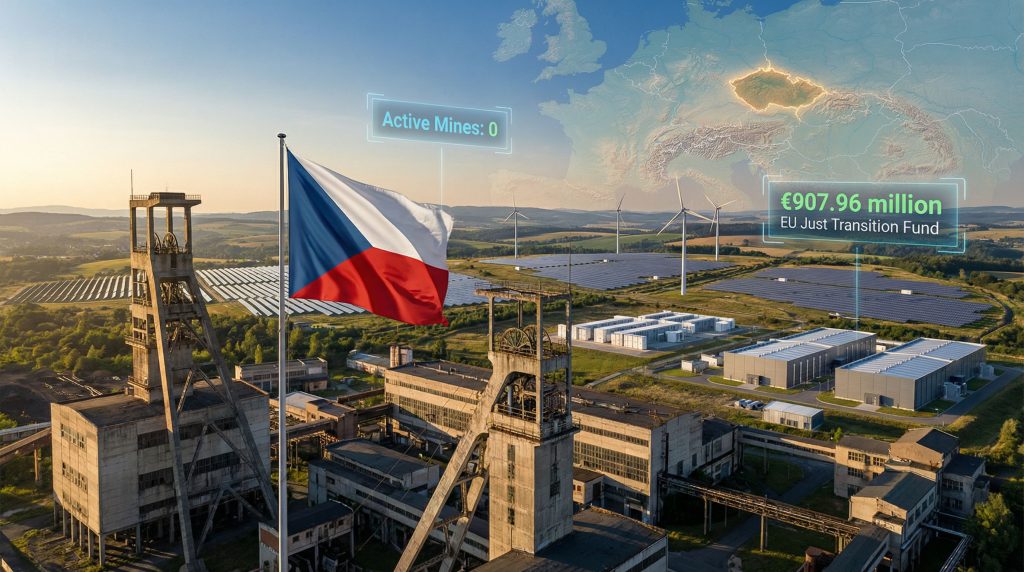
The European Union allocated €907.96 million specifically for the Moravian-Silesian region through the Just Transition Fund, representing one of the largest regional transformation investments in European industrial policy. This funding targets four primary areas: infrastructure development, workforce retraining, environmental remediation, and innovation hub establishment.
Fund Distribution Framework:
| Priority Area | Allocation Percentage | Projected Investment |
|---|---|---|
| Infrastructure Development | 40% | €363.2 million |
| Workforce Retraining | 25% | €227.0 million |
| Environmental Remediation | 20% | €181.6 million |
| Innovation Hubs | 15% | €136.2 million |
The workforce retraining component specifically targets 3,850 affected workers, providing skills transition programs designed to facilitate movement into emerging industries. Furthermore, this represents a comprehensive approach to managing large-scale employment displacement through proactive intervention rather than reactive support.
Cross-Border Labor Market Dynamics
The closure reveals complex regional employment patterns, with significant Polish worker participation in Czech mining operations. Polish miners, including those who travelled daily across the border for employment, now face decisions about relocating to Polish mines where operations continue until 2049, or transitioning to entirely different industries within the Czech economic transformation.
The cross-border labour dependency highlights how European coal transitions create ripple effects across national boundaries. Poland maintains 70,000 workers in black coal mining with union guarantees extending operations until 2049, demonstrating that Central European coal transitions occur unevenly across neighbouring countries.
Foreign Investment Attraction Mechanisms
The region's EU membership since 2004 catalysed foreign direct investment that provided alternative employment opportunities. South Korea's Hyundai established operations in the region, exemplifying how automotive manufacturing can replace heavy industry employment. The geographic position bordering Poland and Slovakia creates logistics advantages for international manufacturers seeking Central European production bases.
Economic analysis indicates that the 1990s and early 2000s represented the most challenging transition period, with current workforce adjustments benefiting from established retraining mechanisms and diversified economic base that developed over three decades of gradual change.
Economic Models for Profitable Mine Closures
Unlike many global mining closures driven by bankruptcy or market collapse, the Czech approach demonstrates state-managed closure of financially stressed but operationally viable assets. OKD's business model shifted from active extraction to alternative revenue streams while maintaining core competencies in coal trading and energy generation. In addition, this approach offers valuable industry consolidation strategies for other regions facing similar challenges.
Cost Structure Analysis
Operational costs escalated 45% due to kilometre-deep mining requirements, while global coal prices declined 30% from 2022 peaks. Environmental and safety compliance costs increased 25% annually, creating compound pressure on profit margins. Equipment replacement requirements exceeded €200 million, indicating substantial capital intensity even during wind-down phases.
Depth-Related Operational Challenges:
• Ventilation system complexity increases exponentially with depth
• Underground transportation infrastructure requires constant maintenance
• Safety protocols demand sophisticated monitoring and emergency systems
• Equipment durability decreases under extreme operational conditions
The structural cost disadvantages created by geological factors ultimately rendered operations economically unsustainable despite continued market demand for coal products. This demonstrates how technical constraints can override commodity price cycles in determining long-term operational viability.
Alternative Revenue Development
OKD's post-mining business strategy leverages existing infrastructure for new applications:
Methane Capture Operations: Utilising gas seepage from abandoned shafts for small-scale power generation
Battery Storage Facilities: Converting electrical grid connections for renewable energy storage
Data Centre Development: Exploiting underground cooling potential and electrical infrastructure
Coal Trading Expertise: Maintaining market knowledge for commodity trading operations
These alternative revenue streams demonstrate how mining companies can transition core competencies rather than completely abandoning industry knowledge and infrastructure investments. This approach aligns with broader sustainability transformation initiatives across the mining sector.
Regional Coal Policy Comparative Analysis
The Czech Republic's complete hard coal elimination by 2026 establishes the earliest cessation timeline among Central European countries, creating a natural policy experiment within the region. This approach contrasts significantly with neighbouring countries' extended transition timelines and highlights different strategic approaches to fossil fuel dependency.
Central European Coal Phase-Out Comparison:
| Country | Hard Coal Cessation | Lignite Timeline | Workforce Impact | Strategic Approach |
|---|---|---|---|---|
| Czech Republic | 2026 | 2030 | 15,000 jobs | Complete elimination |
| Poland | 2049 | 2050+ | 70,000 jobs | Extended transition |
| Slovakia | 2030 | 2035 | 8,000 jobs | Gradual reduction |
| Germany | 2018 | 2038 | 40,000 jobs | Renewable substitution |
Energy Security Considerations
The closure timing coincides with European energy security reassessment following geopolitical disruptions. Russia's 2022 Ukraine invasion temporarily extended mining operations as energy markets surged, but long-term strategic planning ultimately prioritised complete fossil fuel elimination over short-term energy security concerns.
Projected Czech Energy Mix Transformation (2026-2033):
• Nuclear capacity expansion: 35% to 45% of total generation
• Renewable infrastructure: 20% to 30% through €15 billion investment
• Natural gas dependence: Maintained at 20-25% for grid stability
• Import dependency: Reduced to 5% through domestic capacity expansion
The strategy emphasises nuclear capacity expansion with two new reactors planned by 2035, combined with aggressive renewable deployment and grid modernisation for renewable integration. This approach prioritises energy independence through diversified domestic generation rather than continued fossil fuel extraction. The mining decarbonisation benefits associated with this transition extend beyond environmental considerations to include economic resilience.
Environmental Legacy Management Requirements
The cessation of deep mining operations creates complex environmental liabilities extending decades beyond active extraction. These challenges require sustained policy attention and dedicated funding commitments that continue long after economic activity ceases.
Long-Term Remediation Framework
Environmental Management Categories:
• Groundwater Systems: Ongoing pumping and treatment to prevent contamination spread
• Surface Subsidence: Continuous monitoring and infrastructure protection measures
• Methane Emissions: Capture and treatment systems for abandoned shaft networks
• Contaminated Site Cleanup: Soil and water treatment across former operational areas
Environmental management costs project at €50 million annually for the next 25 years, totalling €1.25 billion in long-term liability. This represents approximately 138% of the original EU Just Transition Fund allocation, indicating the substantial ongoing costs associated with heavy industry cleanup.
The funding structure combines state resources with EU environmental programmes, but long-term cost sustainability remains dependent on continued political commitment across multiple electoral cycles. Consequently, this highlights the importance of establishing dedicated funding mechanisms rather than relying on annual budget allocations for environmental liability management.
Infrastructure Repurposing Opportunities
Existing electrical grid connections, transportation networks, and industrial facilities provide foundation for alternative economic development. The underground infrastructure offers unique opportunities for innovative applications including geothermal energy systems, underground storage facilities, and specialised manufacturing operations requiring controlled environmental conditions. For instance, these mine reclamation insights demonstrate how former mining sites can be transformed into productive assets.
Historical Context and Industrial Evolution
Coal mining in the Ostrava region commenced in the late 18th century, transforming a rural Habsburg territory into Central Europe's industrial heartland. Major investors including the Rothschild family financed railways, steelworks, and supporting infrastructure that attracted tens of thousands of labourers and established the foundation for heavy industry concentration.
Communist Era Expansion and Post-1989 Transition
Communist nationalisation in 1948 accelerated production, reaching peak output of 25 million metric tons annually in the 1980s with over 100,000 miners. The 1989 communist collapse triggered massive industrial restructuring as privatisation eliminated economically unviable operations and tens of thousands of workers lost employment as mines closed sequentially.
When privatised OKD declared bankruptcy a decade ago, state intervention prevented market-driven liquidation and enabled managed wind-down operations. This approach contrasts with rapid market closures that typically accompany mining bankruptcies, allowing gradual workforce adjustment and systematic infrastructure decommissioning.
The three-decade adjustment period from 1989 to 2026 provided time for alternative industries to establish operations and workers to transition gradually rather than experiencing sudden mass unemployment. This extended timeline enabled social adaptation that reduces the shock of final closures compared to rapid industrial collapse scenarios.
The next major ASX story will hit our subscribers first
How Will This Impact European Industrial Policy?
The completion of Czech hard coal mining demonstrates the feasibility of comprehensive fossil fuel elimination in industrialised regions through coordinated policy intervention and sustained financial support. The €907.96 million EU investment combined with systematic closure management provides a replicable framework for similar transitions across Europe.
What Are the Transferable Policy Elements?
Graduated Closure Scheduling: Beginning transitions while industries remain profitable rather than waiting for market collapse
Cross-Border Coordination: Managing regional labour market impacts across national boundaries
Infrastructure Leverage: Utilising existing industrial assets for alternative economic development
Environmental Integration: Addressing environmental liabilities during active operations rather than post-closure
Comprehensive Social Support: Providing retraining, relocation assistance, and extended transition periods
The success metrics extend beyond environmental compliance to include economic diversification, employment stability, and regional prosperity maintenance through industrial transformation. However, early indicators suggest manageable unemployment levels and emerging alternative industries, though long-term outcomes require sustained monitoring across multiple economic cycles.
The Czech model offers particular relevance for smaller EU member states managing resource sector transitions, demonstrating how coordinated European funding can enable comprehensive industrial transformation while maintaining regional economic stability and social cohesion. The comprehensive transition strategies implemented in Moravia-Silesia provide valuable lessons for other regions facing similar challenges.
Furthermore, the last Czech deep coal mine closure represents not just an end, but a beginning of innovative approaches to industrial transformation that prioritise worker welfare, environmental responsibility, and long-term economic sustainability.
Ready to Discover the Next Major Mining Investment Opportunity?
Discovery Alert's proprietary Discovery IQ model delivers instant notifications on significant ASX mineral discoveries, helping investors identify emerging opportunities before they become widely known. Whether you're interested in coal transitions creating new investment landscapes or seeking the next breakthrough discovery, begin your 30-day free trial today to gain the market-leading advantage you need for informed investment decisions.