June 6, 2026
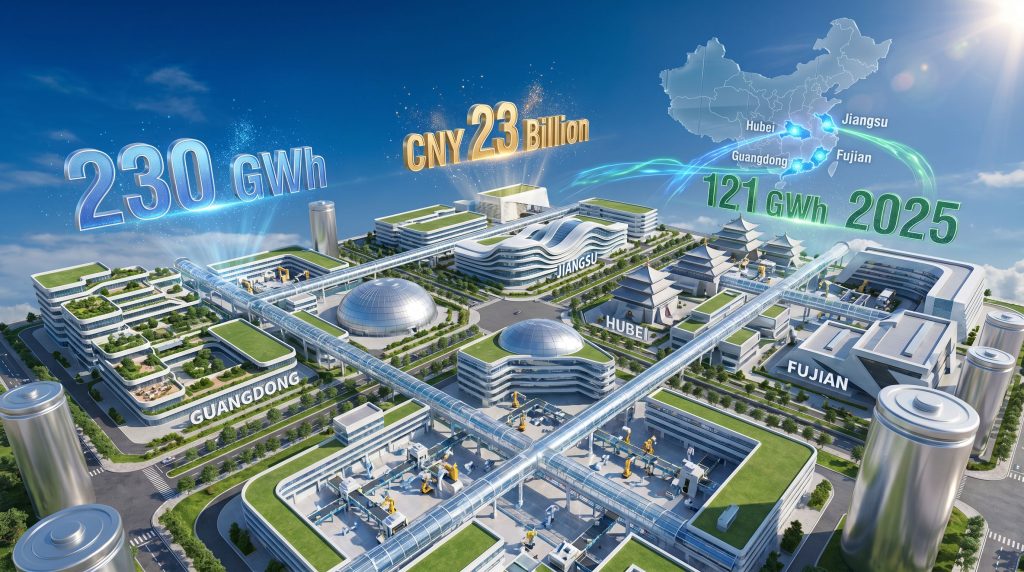
EVE Energy's ambitious expansion plans represent a pivotal moment in global battery manufacturing, where EVE Energy manufacturing capacity expansion decisions will reshape competitive dynamics across the energy storage sector. The company's CNY 23 billion investment targeting 230 GWh additional capacity demonstrates unprecedented confidence in sustained demand growth for large-format lithium iron phosphate batteries.
Understanding EVE Energy's Strategic Manufacturing Roadmap
Battery manufacturers operate within complex market dynamics where production capacity must anticipate demand patterns years in advance. EVE Energy's current manufacturing trajectory demonstrates how energy storage segment focus is reshaping traditional battery production strategies across the industry.
Current Production Baseline and Market Position
EVE Energy's projected 121 GWh total lithium battery output for 2025 positions the company as a significant player in global battery manufacturing, with energy storage applications comprising 71 GWh of this capacity. This represents approximately 58.7% allocation toward energy storage versus automotive applications, indicating strategic business segment prioritisation.
According to Benchmark Mineral Intelligence data, EVE Energy maintains fifth-place global ranking among battery cell manufacturers as of 2025. The competitive landscape ahead includes established leaders CATL, BYD, LG Energy Solution, and CALB, each maintaining distinct technological and market positioning advantages.
Global battery deployment volumes exceeded 1.6 TWh in 2025, providing market context for EVE Energy's expansion plans. This total installed base demonstrates the scale of demand that manufacturers must serve while managing production capacity growth rates.
Geographic Distribution Strategy Across Four Key Provinces
EVE Energy manufacturing capacity expansion spans four strategically selected provinces:
- Jingmen, Hubei Province – Central China positioning for supply chain access
- Huizhou, Guangdong Province – Southern China manufacturing hub proximity
- Qidong, Jiangsu Province – Eastern seaboard export logistics advantages
- Shanghang, Fujian Province – Southeast coastal manufacturing corridor
This geographic distribution strategy reflects sophisticated logistics planning for raw material sourcing, component supply chains, and finished product distribution networks. Each province offers distinct advantages in terms of transportation infrastructure, skilled workforce availability, and regional economic development incentives.
The multi-provincial approach also provides risk distribution benefits, reducing vulnerability to localised disruptions while optimising transportation costs to various end markets across China and international destinations. Moreover, this expansion strategy aligns with broader lithium industry innovations that are transforming manufacturing approaches across the sector.
When big ASX news breaks, our subscribers know first
What Does CNY 23 Billion Investment Signal for Battery Industry Competition?
Capital allocation patterns in battery manufacturing reveal strategic confidence levels and competitive positioning assumptions that extend beyond simple capacity expansion metrics.
Capital Allocation Efficiency in Gigawatt-Scale Manufacturing
EVE Energy's CNY 23 billion ($3.2 billion) investment for 230 GWh combined capacity yields an investment-to-capacity ratio of $13.9 million per GWh. This capital intensity metric provides insight into manufacturing technology sophistication and automation levels planned for the expanded facilities.
The announcement timeline compressed into "rapid succession in late March and early April" 2026 suggests coordinated board-level decision making rather than incremental, cautious capacity additions. This compressed timeline indicates management confidence in sustained demand conditions justifying large-scale capital commitments.
Investment financing structures typically blend debt, equity, and potentially regional development incentives, though specific allocation details remain undisclosed. The scale of commitment suggests access to substantial capital markets or internal cash flow generation capabilities.
Manufacturing Technology Integration and Automation Levels
Large-format lithium iron phosphate (LFP) production requires specialised manufacturing equipment distinct from traditional cylindrical or pouch cell production lines. EVE Energy manufacturing capacity expansion focuses specifically on energy storage applications, necessitating technology platforms optimised for:
- Cycle life optimisation – 10,000+ cycle requirements versus 2,000-3,000 for automotive
- Temperature stability – Broader operating range specifications
- Cost sensitivity – Grid-scale applications demand aggressive cost structures
- Safety standards – Stationary storage fire safety requirements
Manufacturing automation systems for gigawatt-scale facilities typically incorporate advanced process control, quality management, and production scheduling technologies. These systems enable consistent output quality while managing complex supply chain coordination across multiple raw material inputs.
How Do Market Dynamics Drive Rapid Capacity Expansion Decisions?
Energy storage market conditions shifted fundamentally throughout 2025, creating price signals that triggered widespread capacity expansion announcements across the battery manufacturing sector.
Energy Storage Market Transformation from Oversupply to Shortage
Market dynamics demonstrated clear inflection point characteristics during the second half of 2025. Energy storage battery pricing increased more than 20% over six months for 314 Ah storage cells, indicating transition from oversupply to relative shortage conditions.
This price trajectory reversal occurred alongside "sustained rise in activity and robust demand" documented across multiple market segments. When battery prices increase 20% over six months without corresponding raw material cost increases, this typically indicates demand-driven pricing power rather than cost-push inflation.
Historical context from InfoLink analysis shows global energy storage installations reached 175.4 GWh in 2024, with projections for 222 GWh additional capacity in 2025. This growth trajectory supports demand assumptions underlying capacity expansion decisions. Furthermore, developments in battery-grade lithium refining continue to shape supply chain dynamics across the industry.
Competitive Response Patterns Among Leading Manufacturers
Industry-wide capacity expansion announcements reflect synchronised competitive responses to shared market intelligence. Multiple manufacturers announcing major expansions within weeks suggests industry-wide recognition of fundamental market shift rather than isolated strategic decisions.
The competitive dynamics create pressure for rapid decision making, as delays in capacity additions could result in market share losses to faster-moving competitors. This creates potential for industry-wide overcapacity if demand projections prove overly optimistic.
Policy concerns emerged regarding potential repetition of destructive competition cycles "previously seen in the solar PV sector," where rapid capacity expansion preceded price collapse and industry consolidation.
What Regulatory Framework Challenges Could Impact Expansion Plans?
Government regulatory response to rapid capacity expansion reflects policy concerns about maintaining industry stability while supporting technological advancement and economic development objectives.
Government Policy Intervention in Battery Manufacturing
The April 9, 2026 symposium convened by Ministry of Industry and Information Technology (MIIT), National Development and Reform Commission (NDRC), and four additional government bodies demonstrates high-level policy attention to battery sector competitive dynamics.
Government focus areas include:
- "Involution" prevention – Curbing destructive competition practices
- Capacity planning oversight – Coordinated industry development
- Price competition regulation – Market stability maintenance
- Overseas market spillover prevention – Trade relationship management
The symposium structure included "power and energy storage battery companies" as participants, indicating government intent to engage directly with industry stakeholders rather than imposing unilateral regulatory constraints.
Compliance Requirements for Multi-Provincial Operations
Multi-provincial manufacturing operations create complex regulatory compliance requirements across different jurisdictions. Environmental impact assessments, safety certifications, and local content requirements may vary significantly between provinces.
Quality certification standards for large-format energy storage cells include:
- GB/T 36276-2018 Chinese lithium-ion battery safety standards
- IEC 61427-1 international energy storage system standards
- Fire safety testing requirements for stationary installations
- Thermal runaway prevention validation protocols
Regional development incentives and workforce requirements may influence facility design and operational planning across different provincial locations.
How Does EVE's Technology Portfolio Support Gigawatt-Scale Manufacturing?
Technical capabilities in large-format cell manufacturing determine production feasibility and product differentiation potential across energy storage market segments.
Next-Generation Battery Energy Storage System Specifications
EVE Energy's 6.9 MWh "Mr. Big" product family demonstrates large-format system integration capabilities essential for utility-scale applications. The system architecture incorporates:
- 430 Wh/L volumetric energy density – Competitive with industry benchmarks
- 10,000 cycle life rating at 70% state of health – Meeting energy storage durability requirements
- Standard 20-foot container configuration – Transportation and installation efficiency
- 10% energy density improvement versus previous generations
These specifications align with grid-scale storage requirements where space efficiency, long-term durability, and installation simplicity create operational advantages for end users.
Large-Format Cell Manufacturing Capabilities
628 Ah cell certification following large-scale fire safety testing demonstrates EVE Energy's technical capability in large-format cell production. This cell capacity represents significant scale advantages compared to traditional energy storage applications using smaller format cells.
Technical achievements include:
- Temperature differential control within 5°C precision – Critical for large-format cell safety
- Active balancing and thermal management – Advanced system integration capabilities
- Fire safety validation – Regulatory compliance for stationary applications
Large-format cell manufacturing requires specialised production equipment and quality control systems distinct from automotive battery production lines. Additionally, innovations in battery recycling breakthrough technologies are increasingly important for sustainable large-scale production.
What Strategic Partnerships Enable Rapid Market Penetration?
Partnership strategies provide market access and demand validation essential for justifying large-scale capacity expansion investments.
Domestic Collaboration Framework Analysis
EVE Energy announced strategic cooperation agreements totalling more than 50 GWh with five domestic partners, including specific collaboration with Jinko Storage. These partnership structures provide:
- Demand visibility – Forward contracting reduces market risk
- Technology validation – Customer feedback on product development
- Supply chain integration – Coordinated logistics and inventory management
- Market access – Partner distribution networks and customer relationships
The 50+ GWh partnership volume represents substantial portion of planned expansion capacity, providing demand foundation for investment justification.
International Expansion Coordination with Domestic Growth
EVE Energy manufacturing capacity expansion occurs alongside international facility development in Malaysia, Hungary, United States, and Indonesia. This global production network strategy provides:
- Trade policy risk distribution – Reduced dependence on export markets
- Regional market access – Proximity to end users and supply chains
- Currency exposure management – Natural hedging through geographic diversification
- Regulatory compliance – Meeting local content and manufacturing requirements
Coordinating domestic expansion with international facility development requires sophisticated supply chain management and technology transfer capabilities. However, rapid growth has led to significant profit surges, demonstrating the financial strength supporting these ambitious expansion plans.
The next major ASX story will hit our subscribers first
Which Investment Scenarios Present Highest Risk-Reward Profiles?
Investment analysis for gigawatt-scale manufacturing expansion requires scenario modelling across demand growth, competitive dynamics, and technology transition variables.
Capacity Utilisation Rate Projections
Demand forecasting for 2026-2030 energy storage deployments must account for:
- Grid modernisation requirements – Renewable energy integration driving storage demand
- Industrial energy management – Behind-the-meter applications expanding
- Electric vehicle infrastructure – Charging networks requiring grid support
- Data centre expansion – AI and cloud computing driving power quality requirements
Market absorption capacity for additional 230 GWh supply depends on deployment rate acceleration beyond current growth trajectories. If global installations continue at 200+ GWh annually, EVE Energy's expansion represents substantial market share capture requirements.
Technology Transition Risk Assessment
Sodium-ion battery development presents potential disruption risk to LFP demand growth, particularly in cost-sensitive stationary storage applications. Technology transition timelines affect investment payback periods for LFP-focused manufacturing capacity.
Solid-state battery commercialisation remains largely automotive-focused in near term, with limited impact on stationary energy storage applications through 2030. Manufacturing flexibility for next-generation chemistries requires facility design considerations during construction phases.
The broader context of critical minerals & energy transition developments will significantly influence long-term technology pathways and investment returns.
How Will Global Supply Chain Dynamics Affect Manufacturing Success?
Raw material sourcing and supply chain security become increasingly critical as manufacturing capacity scales to gigawatt levels across multiple facilities.
Raw Material Sourcing Strategy for Expanded Production
Lithium, iron, phosphate supply chain security requirements for 230 GWh additional capacity include:
- Lithium carbonate/hydroxide – Approximately 46,000-50,000 tons annually
- Iron phosphate – Substantial tonnage requirements for LFP cathode production
- Graphite anode materials – Natural and synthetic graphite sourcing
- Electrolyte components – LiPF6 and organic solvents
Vertical integration opportunities versus third-party sourcing decisions affect capital allocation and operational risk profiles. Geographic diversification of material inputs reduces supply disruption vulnerability.
Understanding lithium brine market insights becomes crucial for securing long-term raw material supplies at competitive pricing levels.
Export Market Access and Trade Policy Implications
International market penetration strategies for expanded capacity must navigate evolving trade policy landscapes. Government symposium focus on preventing "spillover of excessive competition into overseas markets" suggests potential export restrictions or controls.
Regional manufacturing versus export-based market access strategies affect facility utilisation planning and customer relationship development across different geographic markets.
What Quality Control Systems Enable Gigawatt-Scale Consistency?
Manufacturing process standardisation across multiple facilities requires sophisticated quality management systems to ensure consistent product performance at unprecedented production scales.
Manufacturing Process Standardisation Across Multiple Sites
Quality management systems for multi-facility operations must address:
- Batch-to-batch consistency – Critical for energy storage applications requiring predictable performance
- Inter-facility standardisation – Identical processes across geographic locations
- Supply chain quality control – Raw material specification enforcement
- Performance validation protocols – Consistent testing across all production lines
Gigawatt-scale production introduces statistical quality challenges where small percentage defect rates can affect thousands of cells, requiring advanced process control and monitoring systems.
Performance Validation and Warranty Framework
Long-term performance testing methodologies for energy storage applications require:
- Accelerated aging protocols – Predicting 20+ year performance in compressed timeframes
- Thermal cycling validation – Temperature variation impact assessment
- Calendar aging studies – Time-dependent degradation characterisation
- Safety margin verification – Conservative rating versus actual capability
Warranty structures for 10,000+ cycle applications create long-term financial obligations requiring careful performance prediction and risk assessment methodologies.
Strategic Implications for Energy Storage Market Evolution
EVE Energy's expansion represents broader industry transformation toward utility-scale energy storage as a fundamental grid infrastructure component rather than niche technology application.
Market Consolidation Acceleration Through Scale Advantages
Competitive positioning impact of 230 GWh additional capacity creates pressure on smaller manufacturers lacking scale economies for cost competitiveness. Manufacturing efficiency at gigawatt scale typically provides 15-25% cost advantages versus smaller facilities through:
- Procurement leverage – Volume discounts on raw materials and equipment
- Automation benefits – Fixed costs distributed across higher production volumes
- Learning curve effects – Process optimisation through higher production experience
- Logistics efficiency – Dedicated transportation and distribution networks
Technology leadership requirements for sustained competitiveness extend beyond manufacturing scale to include product innovation, system integration capabilities, and customer service networks.
Infrastructure Investment Requirements for Market Success
Grid integration capabilities for large-scale storage deployments require coordination between manufacturers, system integrators, and utility customers. Successful market penetration depends on:
- Technical support networks – Local engineering and commissioning capabilities
- Service infrastructure – Maintenance and replacement part availability
- Customer relationship management – Long-term partnership development at utility scale
- Financial solutions – Leasing, power purchase agreements, and project financing
The transition from product sales to comprehensive energy storage solutions requires capabilities beyond manufacturing excellence, including system design, project development, and long-term service delivery.
This analysis is based on publicly available information and industry data. Investment decisions should consider additional factors and professional consultation. Battery manufacturing involves significant technical, market, and regulatory risks that may affect project outcomes and financial returns.
Ready to Capitalise on Battery Manufacturing Opportunities?
Discovery Alert's proprietary Discovery IQ model delivers instant notifications on significant ASX mineral discoveries, helping you identify companies positioned to benefit from the battery supply chain boom and energy storage growth. Explore Discovery Alert's historic discovery examples to understand how major mineral finds can generate substantial market returns, then begin your 14-day free trial to position yourself ahead of the market.