June 23, 2026
The complex interplay between executive emergency powers and constitutional limitations has reached a pivotal moment in American trade policy. Presidential authority to impose tariffs through emergency declarations faces unprecedented judicial scrutiny, fundamentally altering how the United States approaches international commerce regulation. This constitutional framework, established through centuries of legal precedent, now constrains executive branch flexibility in ways that reshape global trade relationships and create significant US economy tariffs impact.
The separation of powers doctrine establishes clear boundaries between legislative and executive responsibilities in trade regulation. Article I, Section 8 of the Constitution explicitly grants Congress the power to regulate commerce with foreign nations and to lay and collect duties, imposts, and excises. This foundational principle creates inherent tension when presidents attempt to bypass congressional oversight through emergency authorities.
Understanding the International Emergency Economic Powers Act Framework
The International Emergency Economic Powers Act (IEEPA), enacted in 1977, originally provided presidents with authority to regulate international commerce during national emergencies. However, the law's application has evolved significantly from its initial legislative intent, which focused on genuine threats to national security rather than routine trade disputes.
Historical precedents for IEEPA utilization reveal a pattern of increasingly broad interpretations across different administrations. The Trump administration's invocation of IEEPA to address trade deficits and bilateral disputes represented a substantial expansion beyond traditional emergency justifications. Furthermore, previous applications typically involved sanctions against hostile nations or responses to immediate security threats.
Legal thresholds for invoking emergency trade measures require presidential determination that unusual and extraordinary circumstances threaten national security, foreign policy, or the economy. The distinction between legitimate emergency powers and routine trade policy implementation has become increasingly blurred, prompting judicial intervention to clarify constitutional boundaries.
Recent tariff implementations under IEEPA authority included measures exceeding 10% on nearly all US trading partners, imposed since April 5, 2025. These actions cited persistent trade deficits and foreign inaction on fentanyl trafficking as emergency justifications, representing an unprecedented interpretation of IEEPA's scope.
When big ASX news breaks, our subscribers know first
Supreme Court's Constitutional Interpretation and Market Impact
The US Supreme Court strikes down Trump's tariffs in a landmark 6-3 decision in February 2026, fundamentally reshaping executive trade authority. Chief Justice John Roberts authored the majority opinion, establishing that the Constitution did not vest taxing power in the executive branch, reinforcing congressional primacy in trade regulation.
This landmark ruling applied strict constitutional scrutiny to executive emergency determinations, requiring substantially higher evidentiary standards for future IEEPA invocations. Moreover, the Court's narrow interpretation of emergency authority prevents presidents from using trade policy as a general foreign policy tool without explicit congressional authorization.
| Constitutional Element | Court's Position | Legal Foundation |
|---|---|---|
| Executive Taxing Authority | Explicitly Rejected | Article I, Section 8 |
| Emergency Power Scope | Narrowly Construed | Due Process Requirements |
| Congressional Oversight | Mandatory Consultation | Commerce Clause Authority |
| Judicial Review Standard | Strict Scrutiny Applied | Separation of Powers Doctrine |
The decision preserved certain tariff categories under well-established legal authorities. Steel and aluminum tariffs imposed under Section 232 national security provisions remain valid, as do automotive sector measures utilising tested trade authorities. These surviving tariffs demonstrate the distinction between constitutionally sound emergency powers and overreaching executive actions.
Economic Transformation Across Affected Industries
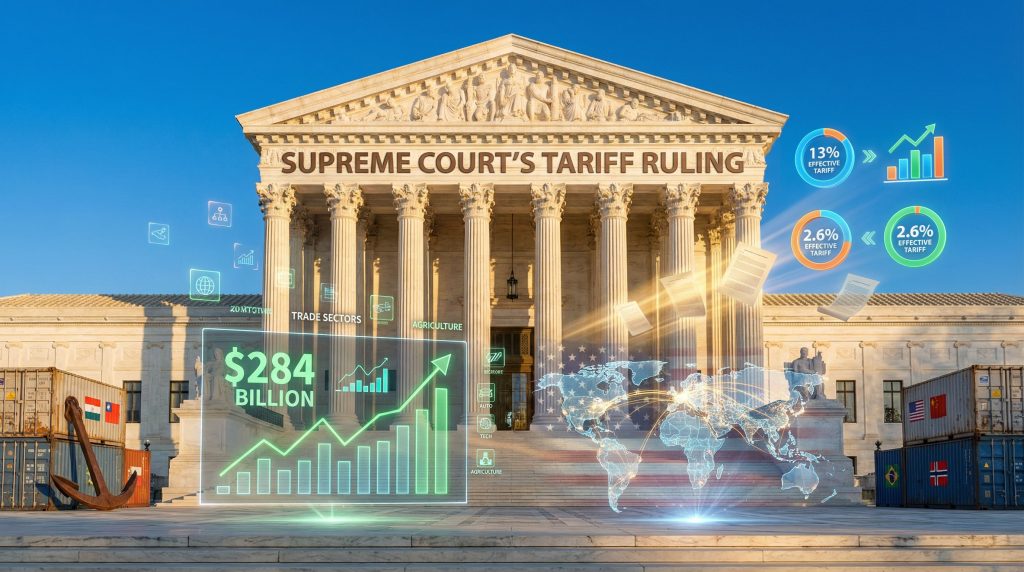
Federal revenue implications reveal the scale of economic disruption caused by the Supreme Court's ruling. The Treasury collected approximately $284 billion in customs duties during the affected period, representing a $204 billion increase from the previous year-equivalent timeframe. Consequently, this massive revenue stream now faces elimination, requiring significant federal budget adjustments.
"The effective US tariff rate reached approximately 13% as of late 2025, compared to a 2.6% baseline from the previous year" – Federal Reserve Bank of New York research published in February 2026.
The tariff burden distribution analysis reveals that 90% of costs fell on US companies and consumers rather than foreign producers, contradicting administration arguments about international cost-sharing. Only a fraction of tariff expenses were absorbed by foreign suppliers, demonstrating the domestic economic impact of broad-based trade restrictions and their effects on tariffs impact investment markets.
Industry-specific adjustments vary significantly across affected sectors:
- Energy importers managing crude oil and refined product cost recalibrations
- Agricultural commodity traders addressing soybean and wheat price volatility
- Metals processors adjusting to base metals and rare earth input pricing changes
- Chemical manufacturers recalibrating petrochemical feedstock cost structures
Regional economic impacts depend heavily on import dependency levels and existing trade relationships. Areas with significant manufacturing presence face complex supply chain reorganisation, while agricultural regions experience commodity price adjustments affecting farmer profitability and export competitiveness.
Alternative Legal Pathways and Congressional Dynamics
Section 122 of the 1974 Trade Act emerges as the administration's primary alternative for implementing trade restrictions following the Supreme Court's decision. This authority allows tariff implementation up to 15% maximum rates but includes significant constraints absent from IEEPA applications.
The 150-day time limitation under Section 122 requires congressional reauthorisation for extensions, fundamentally altering executive flexibility in trade policy implementation. This procedural requirement forces greater inter-branch coordination and prevents indefinite unilateral trade actions.
Balance-of-payments justifications under Section 122 require detailed economic analysis demonstrating genuine fiscal emergencies. However, historical precedents for Section 122 utilisation remain limited, creating uncertainty about procedural requirements and judicial review standards for future applications.
Congressional authorisation processes face complex political dynamics despite Republican control of both chambers. Lawmakers increasingly voice concerns about tariff impacts on consumer prices, creating potential resistance to broad trade restrictions even within the president's own party.
Recent legislative activity includes separate House and Senate resolutions challenging specific tariff implementations on Canada and Brazil. In addition, tariffs affecting Canadian industries remain under congressional scrutiny, though comprehensive tariff legislation remains stalled. These procedural votes indicate growing congressional assertiveness in trade policy oversight.
International Trade Agreement Recalibration
Bilateral relationship adjustments require comprehensive renegotiation across multiple trading partnerships. The US Trade Representative's office completed trade agreements with India, Indonesia, Taiwan, and Vietnam during the past month, calling for increased energy and commodity imports from American suppliers.
Indonesia Trade Agreement Specifics:
- $15 billion in energy product purchases, including $7 billion in refined gasoline
- $4.5 billion in crude oil imports
- $3.5 billion in LPG purchases
- $4.5 billion in agricultural product commitments
The Indonesia agreement maintains a 19% tariff rate on most imports while removing barriers on over 99% of US products. Agricultural components include minimum annual purchases of 3.5 million tons of soybeans, 3.8 million tons of soybean meal, and 2 million tons of wheat for five-year periods.
Critical minerals cooperation represents a strategic component of these renegotiated agreements. Indonesia committed to partnering with US mining firms to improve bilateral supply chains covering mining, processing, and downstream production of rare earths and other essential materials.
| Trading Partner | Agreement Status | Key Components |
|---|---|---|
| Mexico & Canada | Tariff Removal Required | Energy Integration, Fentanyl Cooperation |
| China | Comprehensive Restructuring | Trade Balance, Security Concerns |
| Brazil | Free Speech Justifications Invalid | Agricultural Trade Flows |
| Indonesia | Recently Completed | Energy Imports, Critical Minerals |
Supply chain diversification strategies emerge as companies adjust to reduced tariff protection for domestic industries. Furthermore, rare earth processing facility geographic redistribution becomes essential as Chinese-dominated supply chains face ongoing scrutiny despite court rulings on tariff authority.
Corporate Financial Recovery and Legal Proceedings
Tariff refund processes create unprecedented administrative challenges for both government agencies and private companies. The Court of International Trade assumes jurisdiction over recovery claims, with major refining companies including Valero and Marathon Petroleum leading litigation efforts to recover paid duties.
Estimated refund exposure potentially exceeds $200 billion based on duty collections during the affected period. Processing these claims requires significant administrative resources and legal framework development for handling mass refund applications across multiple industries and time periods.
Compliance costs during the transition period include:
- Legal fees for tariff recovery proceedings and supply chain contract renegotiation
- Inventory valuation adjustments reflecting duty reversals
- Accounting system modifications for retroactive duty calculations
- Administrative expenses for processing refund documentation
Timeline expectations for refund processing depend on Court of International Trade capacity and Treasury Department administrative procedures. Complex cases involving multiple tariff categories and extended time periods may require years for complete resolution.
Companies face strategic decisions about immediate legal action versus awaiting administrative guidance on refund procedures. Early litigation efforts may establish favourable precedents but require significant upfront legal investment without guaranteed outcomes.
The next major ASX story will hit our subscribers first
Long-Term Strategic Implications for Trade Architecture
Presidential trade strategy evolution reflects enhanced constitutional constraints on executive authority. Future administrations must incorporate congressional consultation requirements and stricter emergency justification standards into trade policy development processes, considering both tariffs and currency effects and broader US–China trade war impact.
Enhanced judicial scrutiny of executive trade actions creates additional procedural requirements for emergency determinations. Courts apply strict constitutional analysis to emergency declarations, preventing routine use of extraordinary powers for standard trade disputes.
International precedent effects influence global trade dispute resolution mechanisms. The Supreme Court's emphasis on separation of powers principles may encourage other nations to challenge executive trade actions through judicial rather than diplomatic channels.
Structural changes in trade policy governance include:
- Strengthened legislative oversight mechanisms requiring congressional notification and consultation
- Modified executive branch procedures for emergency trade determination
- Enhanced transparency requirements for justifying emergency actions
- Improved inter-branch coordination protocols preventing constitutional conflicts
Trade authority consolidation under congressional oversight may slow policy implementation but increases democratic legitimacy and constitutional compliance. However, long-term trade relationships benefit from greater predictability and reduced susceptibility to sudden executive policy reversals.
Market Response and Economic Forecasting
Financial market adjustments reflect significant policy uncertainty following the Supreme Court's decision. Commodity futures experience increased volatility as traders reassess long-term price projections without broad-based tariff protection for domestic industries.
Currency exchange rate fluctuations indicate international confidence in reduced US trade protectionism. The dollar's relative strength reflects expectations of lower consumer prices and improved international trade relationships following tariff elimination.
Sector-specific equity performance varies based on import dependency and competitive positioning. Industries heavily reliant on tariff protection face valuation adjustments, while consumer-oriented sectors benefit from anticipated cost reductions.
Economic modelling scenarios consider multiple tariff policy trajectories:
- Baseline scenario assumes gradual tariff reduction to pre-2025 levels
- Congressional authorisation scenario maintains selective protection through legislative processes
- Section 122 implementation provides limited, time-constrained tariff authority
- Free trade acceleration eliminates remaining protective measures
GDP growth projections indicate modest positive effects from tariff elimination, primarily through reduced consumer costs and improved business investment. Nevertheless, transition costs and industry adjustments may temporarily offset these benefits during the initial adjustment period.
Employment effects vary significantly across trade-dependent industries. Manufacturing sectors previously protected by tariffs face competitive pressure, while service industries and consumers benefit from lower input costs and increased purchasing power.
What Does This Mean for Future Trade Policy?
The ruling establishes that the US Supreme Court strikes down Trump's tariffs represents a constitutional watershed moment limiting executive trade authority. For instance, future trade policy must navigate enhanced separation of powers requirements while addressing legitimate emergency threats to national security.
Congressional involvement in trade policy increases significantly under the new constitutional framework. Lawmakers must balance constituent economic interests with broader strategic trade objectives, creating more complex but potentially more sustainable policy outcomes.
How Will International Partners Respond?
International trading partners adjust expectations for US policy stability following enhanced judicial oversight of executive actions. Trade agreements benefit from reduced uncertainty about sudden policy reversals, encouraging longer-term commercial relationships.
The Supreme Court ruling reinforces constitutional limitations on presidential power while maintaining essential emergency authorities for genuine national security threats. Additionally, NPR's analysis highlights the broader implications of this decision for executive authority in trade policy.
US Supreme Court strikes down Trump's tariffs ultimately strengthens democratic oversight of trade policy while preserving necessary tools for addressing legitimate emergency situations. The decision creates a more predictable framework for international commerce while ensuring constitutional compliance in executive branch actions.
This analysis reflects current legal and economic developments as of February 2026. Trade policy remains subject to legislative action and further judicial interpretation. Stakeholders should consult qualified legal and financial advisors for specific guidance on tariff obligations and recovery procedures.
Looking to Capitalise on Trade Policy Shifts and Market Volatility?
Discovery Alert's proprietary Discovery IQ model delivers real-time alerts on significant ASX mineral discoveries, helping investors navigate market uncertainties and identify actionable opportunities when trade policies create commodity price volatility. Begin your 14-day free trial today at Discovery Alert and position yourself ahead of market movements driven by global economic changes.