
June 22, 2026
The Economics of Staying Whole: Why Africa's Resource Giants Are Refusing to Choose Between Coal and Clean Energy
The global energy debate has long been framed as a binary: fossil fuels or renewables, extraction or transition, legacy or future. However, this framing has always been too simplistic for the complex realities facing large, diversified resource companies operating in emerging markets. The more instructive question is not which energy source wins, but how established mining conglomerates can generate the capital needed to fund transformation without destroying the very engine that makes transformation possible.
This tension sits at the heart of how South Africa's largest coal producer is repositioning itself for the next decade and beyond, making the Exxaro renewable energy and coal strategy one of the more analytically rich case studies in the global resources sector right now.
When big ASX news breaks, our subscribers know first
What the Dual-Track Model Actually Means in Practice
At its core, Exxaro's strategic architecture separates the business into two concurrent missions running in parallel rather than in sequence. The first is the disciplined optimisation of existing coal infrastructure to maximise cash generation. The second is the construction of a renewable energy and transition metals platform designed to become the dominant earnings contributor by the end of the decade.
This is not managed decline. It is a deliberate capital rotation strategy, and the distinction matters enormously for how investors should read the company's forward trajectory. Furthermore, understanding the Exxaro renewable strategy reveals just how carefully this architecture has been designed to serve multiple stakeholder groups simultaneously.
The critical insight here is that coal's share of group earnings is expected to shrink not because coal volumes will fall, but because the renewable energy and metals businesses will grow faster. This is an additive model, not a substitutive one. Coal operational capacity is being preserved and optimised, while entirely new earnings streams are constructed alongside it.
For income-focused shareholders, this preserves dividend capacity. For ESG-focused institutional investors, it provides a credible decarbonisation trajectory. The dual-track model is, at its most sophisticated level, a simultaneous communication strategy as much as it is a capital allocation framework.
Why the Coal Foundation Cannot Be Removed Without Collapsing the Structure
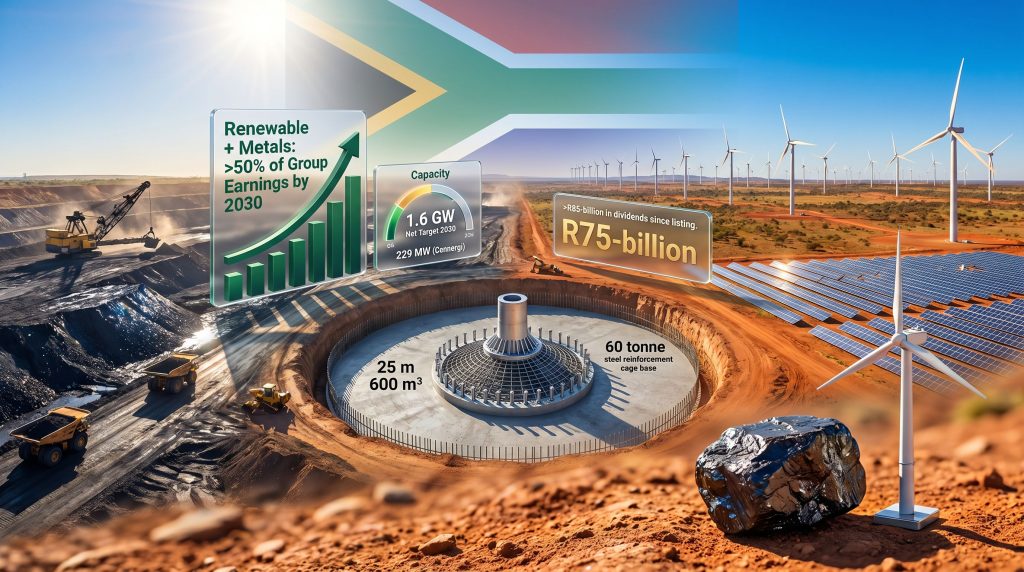
Understanding Exxaro's position requires appreciating a structural dependency that rarely gets sufficient analytical attention: the renewable energy growth ambition is financially underwritten by coal cash flows. Without the free cash flow generated by long-life coal assets, the capital required to reach a 1.6 GW net energy solutions target by 2030 simply would not be available.
This creates an important strategic constraint. Any premature acceleration of coal wind-down, whether driven by external ESG pressure or internal strategic miscalculation, would paradoxically undermine the funding of the very clean energy expansion that makes the company's long-term positioning credible.
Exxaro's coal assets also serve a domestic energy security function that cannot be easily substituted in the near term. South Africa's electricity supply challenges have made coal-fired generation an unavoidable part of the national energy mix for the foreseeable future. Long-life coal operations that supply both domestic consumption and export markets retain commercial relevance that extends well beyond the timelines that many Western analysts typically assign to thermal coal.
The company's own forward planning assumes that the global runway for thermal coal likely extends beyond 2050, particularly given rising energy demand in developing economies and increasing geopolitical fragmentation reshaping trade flows and energy security priorities.
Building the Renewable Energy Platform: Engineering Reality at Scale
Exxaro's clean energy ambitions are anchored by Cennergi, its primary renewable energy vehicle, which currently contributes 229 MW to South Africa's national grid across wind and solar generation technologies. Within a single year leading up to its June 2026 Capital Day, the company doubled the scale of its renewable energy business — a rate of growth that signals genuine capital deployment rather than strategic signalling.
The Engineering Demands of Utility-Scale Wind
The Kareebosch wind development offers a useful window into the capital intensity of utility-scale renewable infrastructure. Each turbine anchor structure at this project requires:
- 600 m³ of concrete poured into a 25-metre excavation
- A 15-tonne steel centre mounted on a 60-tonne steel base
- A total of 76 tonnes of steel per turbine foundation
These figures illustrate why utility-scale wind is not a short-cycle investment. The permanence of the infrastructure, the civil engineering complexity, and the lead times involved mean that today's capital commitments translate into decades of operational cash flows. Consequently, the inflation-linked earnings profile of renewable energy contracts serves as a particularly attractive counterbalance to the commodity price volatility inherent in coal. The broader energy transition in mining is driving similar capital intensity considerations across the global sector.
Solar at the Coal Hub: A Symbolically Significant Deployment
The deployment of 68 MW of solar capacity at Exxaro's Lephalale coal hub represents one of the more strategically interesting renewable investments in the African mining sector. Lephalale is home to Grootegeluk, one of South Africa's most significant coal operations. The integration of large-scale solar generation directly into the operational footprint of a major coal asset carries both practical and narrative weight.
From a practical standpoint, distributed generation at this scale reduces dependency on Eskom's constrained national grid, lowers scope 1 and 2 emissions at the asset level, and reduces operational energy costs. From a strategic communication standpoint, it demonstrates that renewable energy is not being positioned as a replacement for coal operations but as a complementary layer within the same operational ecosystem.
Exxaro's Renewable Energy Growth Snapshot
| Metric | Current Status | 2030 Target |
|---|---|---|
| Cennergi grid-connected capacity | 229 MW | Scaling actively |
| Lephalale solar deployment | 68 MW | Integrated operational asset |
| Total energy solutions capacity (net) | Growing | 1.6 GW |
| Renewable and metals share of group earnings | Increasing | >50% |
Transition Metals: Manganese, Iron Ore, and Zinc as Diversification Pillars
Renewable energy alone does not fully explain Exxaro's post-2030 earnings architecture. The recently concluded manganese transaction adds direct exposure to a metal with growing industrial and battery technology relevance, complementing existing equity-accounted investments in iron ore and zinc.
Manganese is a material often underappreciated in mainstream transition minerals discussions, which tend to focus on lithium, cobalt, and nickel. However, manganese is a critical input in high-manganese lithium-ion battery chemistries that are gaining commercial traction as manufacturers seek to reduce dependence on higher-cost cobalt and nickel. The surging critical minerals demand globally reinforces why manganese exposure adds meaningful strategic value to Exxaro's portfolio.
The combination of manganese, iron ore, and zinc creates a multi-commodity diversification buffer that operates across different demand cycles. This reduces the correlation of earnings across the portfolio and provides a more resilient total return profile than a pure coal or pure renewable play could achieve independently.
Decarbonisation as a Financial Metric, Not Just an Environmental One
Exxaro's decarbonisation commitment involves a target of carbon neutrality by 2050, with scope 1 and 2 emissions reductions as central pillars. However, the more analytically interesting dimension of its approach is the stated objective of reducing the carbon intensity of earnings, not just operational emissions.
This framing shifts the conversation from process metrics to financial metrics in a way that has significant implications for institutional capital allocation. Traditional mining ESG frameworks evaluate how a company produces its revenues, whereas the carbon intensity of earnings framework evaluates where those revenues come from. The measurable mining decarbonisation benefits of this approach are increasingly attracting institutional capital that would otherwise screen out resource companies entirely.
As renewable energy and transition metals grow as a proportion of total earnings, the carbon footprint embedded in each rand of group profit structurally declines, even if absolute coal volumes remain stable. This is a more sophisticated and investor-relevant framing than most comparable resource companies currently employ.
A Twenty-Year Track Record That Contextualises the Forward Ambition
November 2026 marks the 20th anniversary of Exxaro's JSE listing in November 2006. The financial track record across that period provides important context for assessing the credibility of the company's forward strategy.
| Milestone | Figure |
|---|---|
| Market capitalisation at JSE listing (Nov 2006) | ~R20-billion |
| Market capitalisation at start of 2025 | ~R51-billion |
| Market capitalisation in 2026 | R75-billion |
| Total stakeholder value created since listing | >R200-billion |
| Cumulative dividend distributions since listing | >R85-billion |
| Total employees and contractors supported | >20,500 |
The near 4x growth in market capitalisation over 20 years, combined with more than R85-billion in dividend distributions, reflects a capital allocation track record that few comparable African resource companies can match. This history is not merely retrospective data; it is the credibility foundation upon which the 1.6 GW renewable energy target and the 50%-plus earnings rebalancing goal should be evaluated.
The next major ASX story will hit our subscribers first
What Investors Should Watch in Exxaro's Strategic Evolution
For investors assessing the Exxaro renewable energy and coal strategy through a forward-looking lens, several dynamics merit close attention:
- Earnings mix progression: The pace at which renewable energy and transition metals move toward the 50%-plus earnings contribution target will be the primary indicator of strategic execution success
- Cennergi capacity additions: Each incremental MW added toward the 1.6 GW target represents contracted, inflation-linked cash flow with lower commodity price risk than coal
- Manganese ramp-up: The speed at which the recently concluded manganese transaction begins contributing materially to earnings will signal the effectiveness of the transition metals diversification
- Coal cash flow sustainability: Any deterioration in coal price realisations or operational performance would put pressure on the capital available to fund the growth segments
- Carbon intensity of earnings trajectory: This metric, while not yet standard across the sector, may become an increasingly important indicator for ESG-focused capital allocation decisions
"The dual-track model works precisely because it does not force a choice between financial sustainability and strategic transformation. The companies most likely to navigate the energy transition successfully are those that use legacy cash flows as transition fuel rather than treating legacy assets as liabilities to be divested at depressed valuations."
Comparing Strategic Approaches Across the Sector
| Strategic Approach | Core Logic | Primary Risk |
|---|---|---|
| Pure coal exit | Divest coal, redeploy capital into renewables | Capital destruction on distressed coal sales |
| Coal preservation only | Maximise coal returns, defer energy transition | Regulatory and ESG risk post-2035 |
| Dual-track (Exxaro model) | Sustain coal cash flows while growing clean energy and metals | Execution risk across concurrent capital programmes |
| Renewables-only pivot | Exit mining, become a pure-play energy company | Loss of geological and operational competitive advantage |
The dual-track approach carries its own execution risks, primarily the challenge of managing capital allocation discipline across two simultaneously growing business segments with different risk profiles. However, relative to the alternatives, it presents the most coherent framework for a company with Exxaro's asset base, workforce scale, and stakeholder obligations. In addition, the implications for green steel pricing and downstream industrial markets add further complexity to how capital is being allocated across the sector more broadly.
Furthermore, Exxaro's integrated sustainable growth strategy outlines how these concurrent priorities are formally embedded within the company's governance framework, providing institutional investors with a structured basis for long-term position building.
Key Takeaways for Understanding Exxaro's Strategic Position
- Coal is not being wound down; it remains the cash-generating foundation that funds all growth elsewhere
- Renewable energy capacity doubled within a single year, with a 1.6 GW net target set for 2030
- The Kareebosch wind and Lephalale solar projects represent genuine utility-scale infrastructure with long operational lives
- Manganese adds a transition-critical metal dimension alongside existing iron ore and zinc exposure
- Reducing the carbon intensity of earnings, not just operational emissions, is the defining metric of Exxaro's decarbonisation approach within the broader Exxaro renewable energy and coal strategy
- A R75-billion market capitalisation and more than R85-billion in cumulative dividends provide the credibility context for ambitious forward targets
- Geopolitical fragmentation and energy security concerns are extending the commercial viability of coal assets in ways that 2021-era models did not anticipate
Disclaimer: This article is intended for informational purposes only and does not constitute financial advice. Forward-looking statements, targets, and projections referenced in this article are subject to material risks and uncertainties. Past financial performance is not a reliable indicator of future results. Investors should conduct independent research and seek professional financial advice before making investment decisions.
Want to Identify the Next Major ASX Mineral Discovery Before the Broader Market?
Discovery Alert's proprietary Discovery IQ model delivers real-time alerts on significant ASX mineral discoveries — transforming complex mineral data into clear, actionable insights for investors at every experience level. Explore historic examples of major discoveries and their returns, then begin your 14-day free trial at Discovery Alert to position yourself ahead of the market.