June 19, 2026
The Hidden Architecture of Polymetallic Value: Why Multi-Metal Projects Redefine Mining Economics
Most investors approaching the mining sector through a single-commodity lens miss a structural advantage that experienced project financiers have understood for decades. When a deposit produces four distinct metals simultaneously, each governed by independent supply-demand cycles, the resulting cash flow profile behaves less like a mining operation and more like a diversified commodity fund with a fixed cost base. That architecture is precisely what makes the Falco Horne 5 feasibility study in Quebec so analytically compelling in 2026.
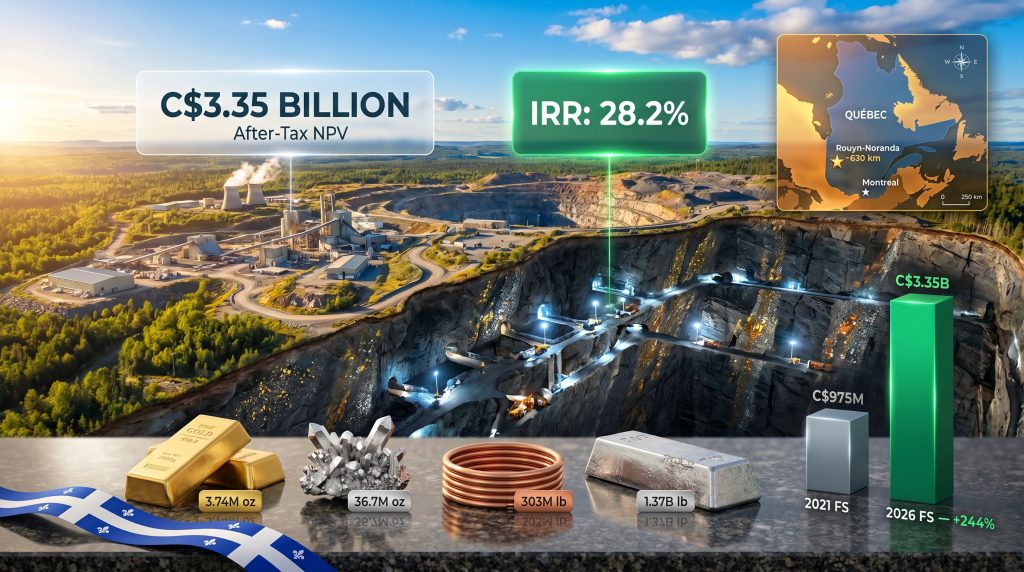
Falco Resources (TSXV: FPC) released an updated feasibility study for its Horne 5 underground project in June 2026, delivering one of the most dramatic project revaluations in recent Canadian junior mining history. The after-tax net present value, discounted at 5%, came in at C$3.35 billion, representing a 244% increase from the equivalent figure in the 2021 study. Understanding what drove that number, what risks surround it, and what milestones remain is essential for anyone tracking advanced development projects in Quebec's polymetallic corridor.
When big ASX news breaks, our subscribers know first
Quebec's Rouyn-Noranda District: A Geological Foundation That Few Regions Can Match
The Rouyn-Noranda region in western Quebec sits atop one of North America's most enduring mining corridors. The district's productivity traces back to Archean volcanogenic massive sulphide deposits, a geological setting characterised by metal-rich hydrothermal fluids deposited along ancient seafloor volcanic arcs. VMS systems are prized in economic geology not only for their metal grades but for their predictable structural geometry, which supports reliable resource modelling and mine planning.
Horne 5 lies approximately 630 kilometres northwest of Montreal, positioned within this storied district in an operational environment that greenfield developers can rarely replicate. The region offers:
- An established underground mining workforce with generational expertise
- Grid-connected hydroelectric power, reducing capital expenditure on energy infrastructure
- Road and rail access already built to industrial standards
- Proximity to Glencore's Horne smelter, which processes copper-gold concentrates
Industry Context: Brownfield-adjacent projects in established mining districts typically carry 15 to 25% lower effective capital intensity than true greenfield developments of equivalent throughput scale, owing to shared infrastructure and reduced logistics complexity.
This infrastructure premium is not theoretical for Horne 5. It is embedded in the project's capital cost estimate and processing design, and it materially influences the risk profile that project lenders and streamers assign when evaluating financing proposals.
Economic Transformation: Reading the 2026 Feasibility Study Properly
The Numbers That Moved Markets
Falco's shares rose 17% on the day following the feasibility release, a day after reaching an eight-year intra-day high of C$0.65. That market response reflects more than enthusiasm for a single data release. It signals a re-rating of the probability-weighted pathway toward production.
The table below captures the core economic evolution between the two studies:
| Economic Metric | 2021 Feasibility Study | 2026 Updated Feasibility Study | Change |
|---|---|---|---|
| After-Tax NPV (5% discount) | ~C$975M (implied) | C$3.35 billion | +244% |
| Internal Rate of Return | ~18.9% | 28.2% | ~+9-10 percentage points |
| Initial Capital Cost | ~C$1.08 billion | C$1.75 billion | +62% |
| Base-Case Gold Price | Lower historical assumption | US$3,600/oz | Significant upward revision |
| Base-Case Silver Price | Lower historical assumption | US$50/oz | Upward revision |
| Base-Case Copper Price | Lower historical assumption | US$4.80/lb | Upward revision |
| Base-Case Zinc Price | Lower historical assumption | US$1.35/lb | Upward revision |
A critical observation here is that production volumes are largely unchanged between the two studies. The mine plan processes approximately 15,500 tonnes per day across a 15-year operating life in both versions. What changed dramatically was the commodity price deck applied to those tonnes. This is not a re-engineered mine plan. It is a repriced revenue model applied to a stable production base, which means the NPV increase is almost entirely attributable to higher assumed metal prices rather than geological upside or processing improvements.
What a 28.2% IRR Actually Means in Practice
Junior mining projects rarely clear institutional hurdle rates. Most project finance lenders and infrastructure funds apply hurdle rates in the 15 to 20% IRR range before committing capital to construction financing. Horne 5's 28.2% IRR sits well above that threshold, which expands the potential financing universe beyond specialist mining lenders to broader infrastructure capital pools.
That said, IRR figures at feasibility stage carry inherent uncertainty. Capital cost overruns, metal price corrections, and schedule delays all compress returns. Furthermore, the gap between a feasibility-stage IRR and the realised economics of a completed mine is well-documented across the industry, making the financing structure and execution capability of the project team as consequential as the headline numbers. A thorough definitive feasibility study process is what separates credible project economics from theoretical projections.
The Reserve Base: Scale, Grade, and What the Numbers Actually Contain
80.9 Million Tonnes Under NI 43-101
The updated feasibility establishes proven and probable mineral reserves of 80.9 million tonnes under Canada's NI 43-101 reporting standard. These classifications carry legal weight in Canadian securities law. Proven reserves reflect the highest confidence tier, requiring detailed sampling and continuity data. Probable reserves require demonstrated geological and grade continuity but with somewhat less density of sampling.
The grade profile across those 80.9 million tonnes is as follows:
- Gold: 1.44 grams per tonne
- Silver: 14.1 grams per tonne
- Copper: 0.17%
- Zinc: 0.77%
Translating those grades into contained metal inventory:
| Metal | Contained Reserve Quantity |
|---|---|
| Gold | ~3.74 million oz |
| Silver | ~36.7 million oz |
| Copper | ~303 million lb |
| Zinc | ~1.37 billion lb |
The zinc grade of 0.77% deserves particular attention. In the context of a VMS deposit, zinc is often the dominant base metal, and at the throughput rates planned for Horne 5, it generates a significant and sustained revenue stream. Over the 15-year mine life, the operation is projected to deliver 1.1 billion pounds of zinc and 247.3 million pounds of copper, alongside 3.3 million ounces of gold and 27.2 million ounces of silver.
Lesser-Known Insight: VMS deposits like Horne 5 frequently contain vertical metal zonation, where zinc-lead mineralisation dominates shallower levels while copper-gold enrichment increases at depth. This spatial distribution influences mine sequencing decisions and can create grade variability across the mine life that differs from the reserve average, a nuance rarely captured in headline feasibility figures.
Validating the 15-Year Mine Life
At a processing rate of approximately 15,500 tonnes per day, annualised throughput equates to roughly 5.66 million tonnes per year. Dividing the 80.9 million tonne reserve base by that annual rate produces a theoretical mine life of approximately 14.3 years, broadly consistent with the stated 15-year operating life when accounting for ramp-up and draw-down phases. This arithmetic check is important for investors evaluating whether the reserve base genuinely supports the production profile. In addition, understanding cut-off grade economics helps contextualise why certain portions of the deposit are included or excluded from the reserve estimate.
Permitting: Nine Years Into One of Canada's Most Rigorous Environmental Review Processes
The BAPE Framework and Where Horne 5 Stands
Falco first submitted the environmental impact assessment for Horne 5 in December 2017. The project has since navigated Quebec's Bureau d'audiences publiques sur l'environnement (BAPE) process, which is widely regarded as one of the most procedurally thorough subnational environmental review frameworks in Canada. The BAPE model incorporates independent panel assessment, structured public participation, and technical scrutiny phases that run sequentially rather than concurrently.
The key permitting milestones, in sequence, are:
- Initial environmental impact assessment submission (December 2017)
- Provincial information request phases and technical review
- Public hearings under the BAPE process
- EIA admissibility determination
- Acceptability analysis by Quebec's Environment Ministry (expected completion: Fall 2026)
- Ministerial decree issuing formal provincial authorisation
Quebec's Environment Ministry indicated it expects to complete the acceptability analysis in Fall 2026. This is the final substantive analytical step before a ministerial decree can be issued. The mining permitting process at this scale is rarely linear, however, and investors should account for procedural variability in their timelines.
Why the Ministerial Decree Is the True Inflection Point
A ministerial decree is not merely an administrative formality. It is the formal provincial authorisation that transitions a project from a regulated development proposal to a construction-authorised asset. For project finance purposes, lenders and royalty streamers view decree issuance as a prerequisite for committing capital at scale. Without it, construction financing negotiations remain conditional.
The strategic significance of releasing the updated feasibility study simultaneously with news of the environmental review's near-completion is not accidental. These two developments together constitute a coordinated de-risking narrative, addressing the two largest categories of project risk simultaneously: economic viability and regulatory clearance.
Glencore's Role: More Than an Offtake Partner
A Three-Dimensional Strategic Relationship
Glencore's involvement with Horne 5 operates across three distinct dimensions that compound in value:
- Development rights: Glencore holds development rights over the project, providing institutional credibility and a potential co-development pathway that smaller project proponents rarely secure with a counterparty of Glencore's scale.
- Offtake agreement: A pre-committed purchase arrangement for copper and zinc concentrates eliminates marketing risk for two of the four primary revenue streams, a meaningful credit enhancement in any financing structure.
- Smelter proximity: Glencore operates smelting infrastructure in the Rouyn-Noranda region, reducing concentrate haulage costs and logistics complexity. For a project producing both copper-gold and zinc concentrates, co-location with a compatible smelter is a structural advantage that translates directly into net smelter return calculations.
Project Finance Mechanism: Offtake agreements from investment-grade counterparties function as implicit partial revenue guarantees in project finance structures. Lenders frequently apply a haircut to uncommitted revenues while treating contracted offtake volumes at near-full value, which directly improves debt service coverage ratios and reduces the equity contribution required from the project developer.
Glencore's strategic interest in zinc and copper also aligns with the long-term demand narrative surrounding energy transition infrastructure, where both metals feature prominently in grid buildout and electrification supply chains.
The next major ASX story will hit our subscribers first
Risk Framework: What Could Undermine the C$3.35 Billion Valuation
Metal Price Sensitivity and the Gold Price Assumption
The 2026 NPV is anchored to a gold price assumption of US$3,600 per ounce. While gold has reached historically elevated levels in recent years, applying a US$3,600/oz base case to a 15-year mine life projection introduces meaningful sensitivity. The following table illustrates how gold price movements could affect project economics:
| Gold Price Assumption | Approximate NPV Impact |
|---|---|
| US$3,600/oz (base case) | C$3.35 billion |
| US$3,000/oz (-17%) | Estimated 30-40% NPV reduction |
| US$2,500/oz (-31%) | Project economics under pressure; IRR approaches hurdle rate |
| US$4,000/oz (+11%) | Upside scenario; IRR expansion above 30% |
Note: Sensitivity figures above are illustrative analytical estimates. Readers should consult the full NI 43-101 technical report for precise sensitivity analysis.
The polymetallic revenue structure provides partial insulation against gold price corrections. Zinc and copper revenues continue independently of gold market movements, which is precisely the structural resilience that single-commodity gold developers cannot offer.
Capital Cost Execution in a Post-Inflation Environment
The 62% increase in capital costs from the 2021 to 2026 study, rising from approximately C$1.08 billion to C$1.75 billion, reflects the broad inflationary pressures on construction materials, skilled labour, and equipment that characterised the 2021 to 2026 period globally. The critical question is whether those inflationary pressures have stabilised or whether the construction phase will encounter further escalation.
Underground mine development carries inherently higher execution complexity than open-pit equivalents. Ground conditions, ventilation design, shaft sinking timelines, and ore handling systems all introduce variability that surface operations avoid. Feasibility-level capital estimates typically carry contingency provisions of 10 to 15%, but historical data across the industry suggests that large underground projects frequently experience cost growth beyond those provisions.
The Financing Gap: The Most Consequential Near-Term Challenge
The arithmetic of Falco's financing challenge is stark. A C$1.75 billion capital requirement against a market capitalisation of approximately C$205 million produces a leverage ratio that makes conventional equity financing impractical as a standalone approach. The realistic toolkit includes:
- Gold or silver streaming: Pre-selling a portion of future metal production to royalty companies such as Wheaton Precious Metals, Franco-Nevada, or Royal Gold in exchange for upfront capital. Streaming is a well-established mechanism for large polymetallic projects with committed offtake.
- Senior secured project debt: Infrastructure-focused lenders and export credit agencies have financed comparable Canadian underground projects, provided permitting is in place and offtake is committed.
- Strategic equity participation: Glencore's existing involvement makes it a logical candidate for equity co-investment, though this would require bilateral negotiation and potentially dilute Falco's existing shareholders.
- Quebec and federal critical minerals financing programs: Various provincial and federal funding frameworks exist for qualifying projects, though these typically function as supplementary rather than primary capital sources.
BMO Capital Markets analyst Andrew Mikitchook noted that market participants are expected to closely monitor Falco's financing roadmap, with visibility on a full construction financing plan identified as a key revaluation trigger beyond the feasibility update itself.
Catalyst Roadmap: What Comes Next for Horne 5
Sequential De-Risking Events and Their Market Implications
Each forthcoming milestone for Horne 5 unlocks a different category of investor. Junior mining specialists tend to hold positions through permitting. Infrastructure capital and institutional debt providers engage only after construction-ready status is achieved. This sequential widening of the investor base is what drives re-rating events beyond what feasibility economics alone justify. Consequently, the resource drilling programs conducted over the deposit's history have been instrumental in building the confidence levels required to attract that broader institutional interest.
| Milestone | Expected Timing | Significance |
|---|---|---|
| Quebec Environment Ministry acceptability analysis | Fall 2026 | Final substantive permitting hurdle |
| Ministerial decree issuance | Post-Fall 2026 | Construction-ready status confirmed |
| Near-term financing plan announcement | H2 2026 (market expectation) | Capital structure clarity; potential re-rating |
| Full construction financing close | TBD | Execution phase commences |
| Construction start | TBD post-financing | Asset transitions from development to production-stage |
The 17% single-day share price gain following the feasibility release is best understood as a forward-looking probability adjustment. Markets were not simply pricing the feasibility numbers. They were recalibrating the likelihood of each subsequent milestone occurring within a compressed timeframe.
Frequently Asked Questions: Falco Horne 5 Feasibility Study
What is the Horne 5 project?
Horne 5 is a large-scale underground polymetallic project located in Rouyn-Noranda, Quebec, owned by Falco Resources (TSXV: FPC). It targets gold, silver, copper, and zinc from an 80.9-million-tonne proven and probable reserve base across a planned 15-year mine life. Further detail is available directly on the Falco Horne 5 project page.
What did the 2026 feasibility study update reveal?
The study produced an after-tax NPV of C$3.35 billion at a 5% discount rate, an IRR of 28.2%, and an initial capital cost of C$1.75 billion, using base-case metal prices of US$3,600/oz gold, US$50/oz silver, US$4.80/lb copper, and US$1.35/lb zinc.
How significant is the NPV increase from 2021 to 2026?
The NPV increased by 244%, driven almost entirely by upward revisions to the metal price assumptions. Production volumes and mine plan parameters remained broadly consistent between the two studies, isolating the price revision as the primary driver.
What is Glencore's role in the project?
Glencore holds development rights over Horne 5, has a pre-committed offtake agreement covering copper and zinc concentrates, and operates a smelter in the Rouyn-Noranda region. This combination of rights, offtake, and infrastructure proximity represents a structural competitive advantage relative to most undeveloped projects of comparable scale.
When could Horne 5 receive its environmental approval?
Quebec's Environment Ministry indicated it expects to complete the acceptability analysis in Fall 2026. A ministerial decree would follow as the final step toward formal construction authorisation.
What are the primary risk factors?
Key risks include gold price sensitivity given the US$3,600/oz base case assumption, capital cost execution risk in an environment that has already produced a 62% cost increase since 2021, and the structural challenge of financing C$1.75 billion in capital relative to Falco's current market capitalisation.
Strategic Takeaways for Investors Tracking Quebec's Advanced Mining Pipeline
The Falco Horne 5 feasibility study update delivers five strategic signals that extend beyond the headline NPV figure:
- Reserve scale is validated: 80.9 million tonnes of proven and probable reserves positions Horne 5 among Canada's largest undeveloped polymetallic deposits under NI 43-101 classification.
- Economics exceed institutional thresholds: A 28.2% IRR at the base-case price deck clears the hurdle rates typically applied by infrastructure lenders and project finance institutions.
- Permitting is approaching its final stage: Nine years of environmental review investment is nearing completion, with the ministerial decree as the remaining formal authorisation step.
- The financing plan is now the critical catalyst: With feasibility economics confirmed and permitting near completion, the announcement of a credible construction financing structure is the single most consequential near-term revaluation event.
- The Glencore relationship is a structural differentiator: Few undeveloped projects in Canada combine tier-one major development rights, committed offtake, and co-located smelter capacity in a single counterparty relationship.
Disclaimer: This article is intended for informational purposes only and does not constitute financial advice or a recommendation to buy or sell any security. All forecasts, NPV figures, and sensitivity analyses involve significant uncertainty. Metal price assumptions used in feasibility studies may differ materially from actual future prices. Investors should conduct their own due diligence and consult a qualified financial adviser before making investment decisions. All figures sourced from publicly available company disclosures and analyst commentary as cited within the article.
Want to Track the Next Major Polymetallic Discovery Before the Market Does?
Discovery Alert's proprietary Discovery IQ model scans ASX announcements in real time, instantly identifying significant mineral discoveries across gold, copper, zinc, and silver — transforming complex data into actionable insights for investors at every level. Explore how historic discoveries have generated extraordinary returns on Discovery Alert's dedicated discoveries page, and begin your 14-day free trial today to position yourself ahead of the market.